



Value and quotation of works, paintings by François Reynaud

Key takeaways
- Works by François Reynaud (1825–1909) sell for between €50 and €12,900, with an oil-on-canvas painting of fishermen fetching €12,900 in 2024.
- The Marseille-based artist primarily works in oil on canvas (98.1% of auction lots), and 96.4% of his sales take place in France.
- Watercolor drawings are valued between €50 and €300, while oil-on-canvas paintings range from €140 to €12,900 depending on the composition and scale of the work.
If you own a work by or after François Reynaud, and would like to know its value, our state-approved experts and auctioneers will offer you their appraisal services.
Our specialists will carry out a free appraisal of your work, and provide you with an accurate estimate of its value on the current market.
Then, should you wish to sell your work, we will direct you to the best possible arrangement to obtain the optimum price.
Rating and value of the artist François Reynaud
The artist François Reynaud leaves behind a very singular body of work, in the current of academic figuration. He studied art in Marseille. Now, the prices of his works are rising under the auctioneers' gavel.
The price at which they sell on the art market ranges from €50 to €12,900, a significant gap but one that says a lot about the value that can be attributed to François Reynaud's works.
An oil on canvas depicting fishermen on a beach sold for €12,900, whereas it was estimated at between €2,600 and €3,800.
96.4% of sales of his works take place in France, and his oils on canvas account for 98.1% of auctions.
In the 1990s, the value of his works was at its highest. Yet they are not rare in auction rooms, and collectors still seek them out.
Order of value from a simple work to the most prestigious
Technique | Estimation |
|---|---|
Drawing - watercolor | From 50 to 300€ |
Oil on canvas | From 140 to 12 900€ |
Estimate in less than 24h
Style and technique by artist François Reynaud
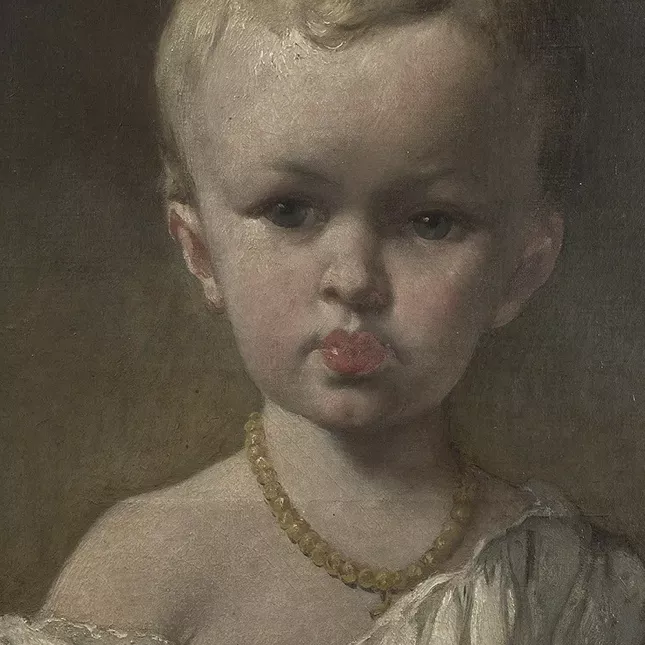
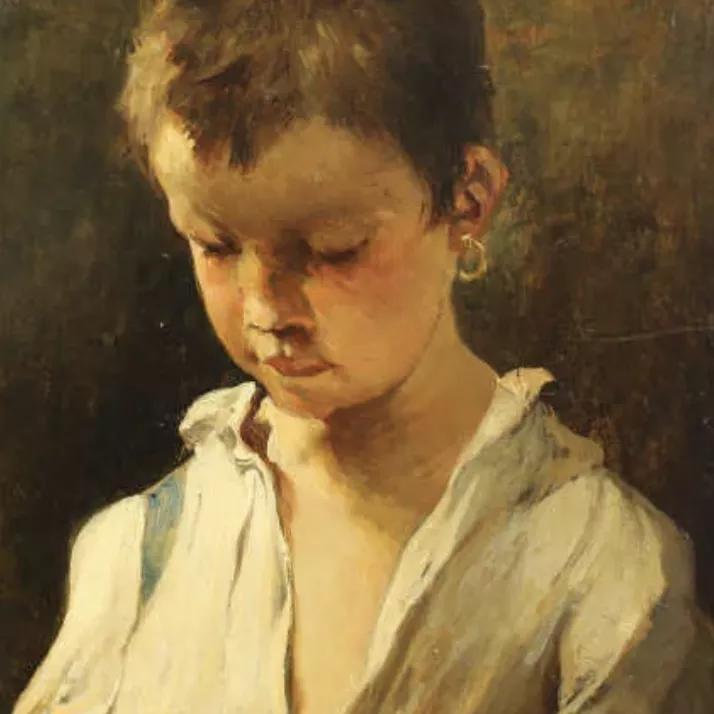
François Reynaud focuses on a rigorous construction of the image, where the precision of the drawing dictates the organization of forms and the distribution of masses.
His approach is based on a methodical study of volumes, which light comes to sculpt with carefully measured gradation. The linear structure, with its controlled exactitude, defines clear contours while preserving a supple modelling.
The chromatic palette, dominated by measured tonalities, favours subtle transitions between values, avoiding excessively abrupt contrasts that would break the balance of the composition. Each brushstroke is part of a logic of harmonization, translating an analytical vision of pictorial matter.
Reynaud does not give in to expressionism of gesture but opts for a calculated technique, where the layering of paint layers contributes to a controlled visual depth.
His work on textures testifies to a particular attention to surface effects, which he modulates with an almost tactile precision.
This technical refinement, combined with a constant formal demand, gives his works a visual density where the rigor of the line combines with a diffuse sensitivity.
Through this methodical approach, he inscribes his approach in a continuity where the structural analysis of the image takes precedence over any desire for approximation, thus affirming a conception of painting based on the mastery of plastic relationships and the intelligibility of forms.
François Reynaud, forgotten figure of the 20th century
François Reynaud (1825-1909), an artist from Marseilles, was part of the academic tradition of the 19th century, but his name today remains largely unknown to the general public.
Born in Marseille, he showed an early inclination for drawing and painting, which naturally led him to enter the École des Beaux-Arts in his native city.
Under the guidance of Augustin Aubert and Émile Loubon, he acquired a rigorous training, in which the study of the nude, mastery of chiaroscuro and perspectivist construction held a central place.
Faithful to the principles of classicism, he never gave in to the seductions of exalted romanticism or the nascent audacities of naturalism, preferring an approach in which anatomical precision and compositional balance take precedence.
His work follows in the footsteps of the great academic masters, but he nevertheless developed his own sensibility, particularly in his treatment of materials and light.
Experts can identify an original work by François Reynaud by referring to his Autoportrait, which condenses the characteristics of his style: meticulous drawing, softened chromatic transitions and particular attention to textures.
His preferred medium remained oil on canvas, but he also mastered oil on panel, a technique still common at the time, particularly prized for decorating churches and religious buildings.
Although deeply attached to Marseille, where he spent most of his career, Reynaud multiplied his travels to Italy and the Alps, in search of motifs and atmospheres conducive to his inspiration.
His stay in Italy marked a decisive stage in his artistic development: there, he refined his treatment of volumes, studied the play of light and shadow inspired by Renaissance painting, and perfected his rendering of skin tones.
From these travels, he brought back a science of contrasts and a subtlety in the modulation of tones, which enriched his compositions.
While his work has not stood the test of time with the same notoriety as that of his more famous contemporaries, it nonetheless remains representative of an academicism where formal rigor is combined with a thoughtful approach to light and pictorial matter.
Focus on Jeune Femme au Voile, François Reynaud
Jeune femme au voile embodies François Reynaud's technical mastery and academic rigor. The portrait is distinguished by its extremely fine modeling, achieved by superimposed glazes that give the skin a remarkable transparency and softness.
The skilfully directed light sculpts the facial features with an almost sculptural precision, accentuating relief while maintaining subtlety in the treatment of shadows.
The veil, the central element of the composition, is an exercise in virtuosity: through a play of transparencies and finely nuanced textures, Reynaud manages to suggest the lightness of the fabric without compromising the legibility of the underlying features.
The Italian influence, particularly perceptible in the treatment of volumes and contrasts, recalls the legacy of the Quattrocento masters, yet is fully in line with the academic demands of the 19th century.
The sparse background, treated in halftones, refocuses the eye on the model's face and accentuates the intensity of her expression.
Reynaud here plays on a subtle balance between realism and idealization, giving the figure a presence that is both tangible and timeless.
With its rigorous craftsmanship and mastery of chiaroscuro, this work testifies to the painter's expertise in the art of portraiture. Every detail, from the satin-finish rendering of the skin to the minute reflections of light on the veil, is part of a quest for visual harmony and technical perfection.
Through this representation, François Reynaud goes beyond the simple capture of a face to turn it into an exercise in style, where pictorial matter is placed at the service of expression and formal refinement.
François Reynaud's imprint on twentieth-century art
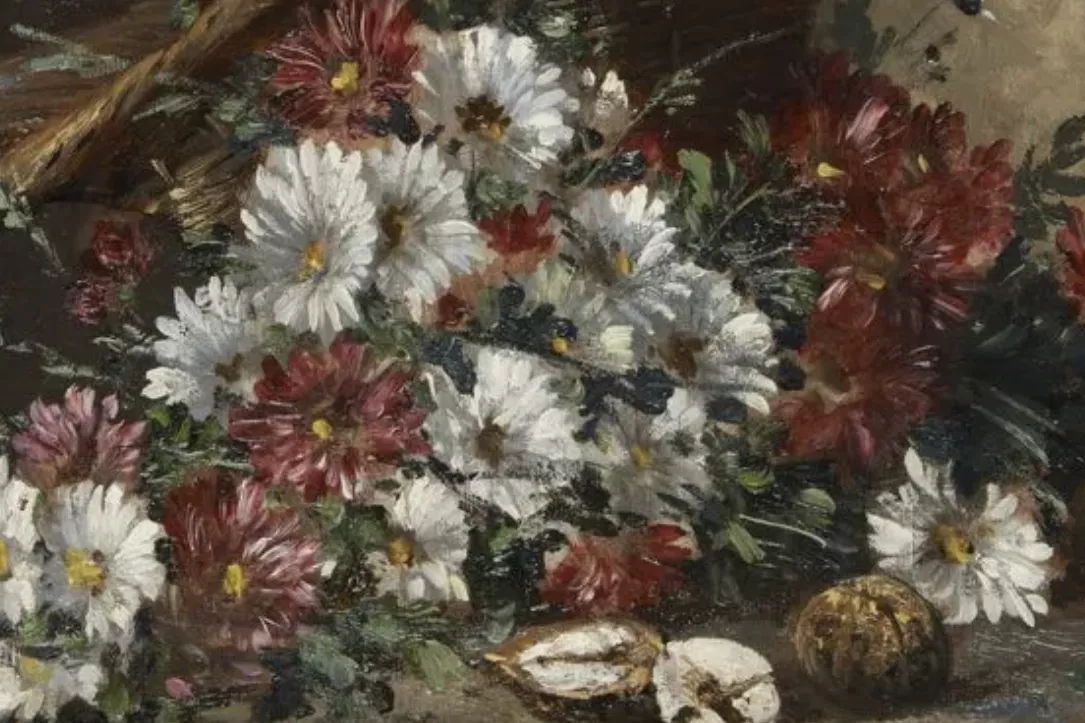
A discreet but technically accomplished academic artist, François Reynaud is part of a pictorial tradition in which rigorous drawing and mastery of lighting effects take precedence over any form of modern experimentation.
His work, faithful to the academic teachings of the 19th century, bears witness to a perfect assimilation of classical codes, while revealing his own sensibility in the treatment of figures and atmospheres.
While his name remains little known to the general public today, his influence can be measured in the transmission of precise know-how, particularly among regional artists who, through contact with him, perpetuated a certain taste for balanced composition and meticulous rendering of materials.
In a century when academic art was progressively challenged by the avant-garde, Reynaud embodied a resistance to the evolution of pictorial forms, anchoring his production in a classical ideal that, despite the aesthetic upheavals of his time, continued to appeal to a fringe of amateurs and commissioners.
His commitment to religious and decorative painting, in particular, helped preserve a demanding craft tradition, where oil on panel and chiaroscuro effects maintained their place in the artistic landscape.
Through his portraits and compositions, he leaves the imprint of a meticulous painter, attached to the permanence of forms and the transmission of ancestral techniques.
He thus marks the history of 19th-century art alongside artists such as Henri Fantin-Latour, Guillaume Fouace or Jules Laurens.
Recognizing the artist's signature
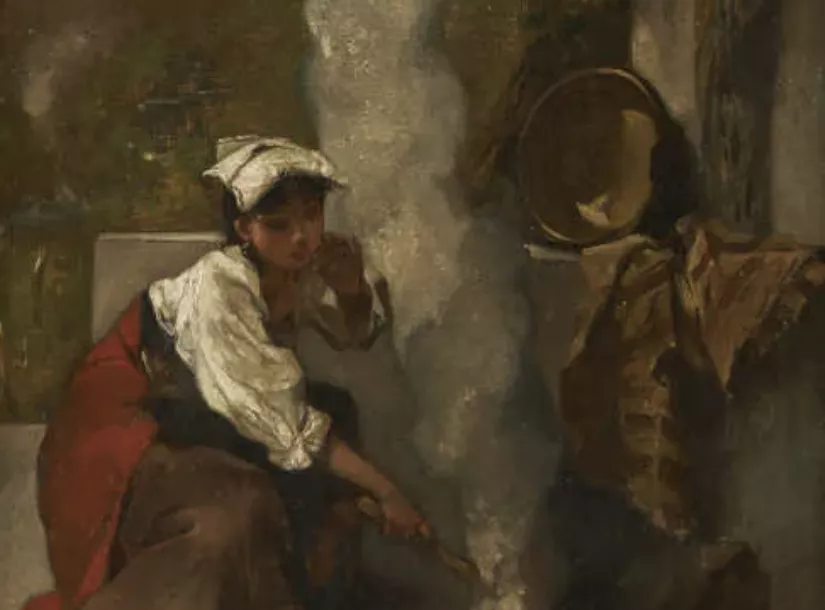
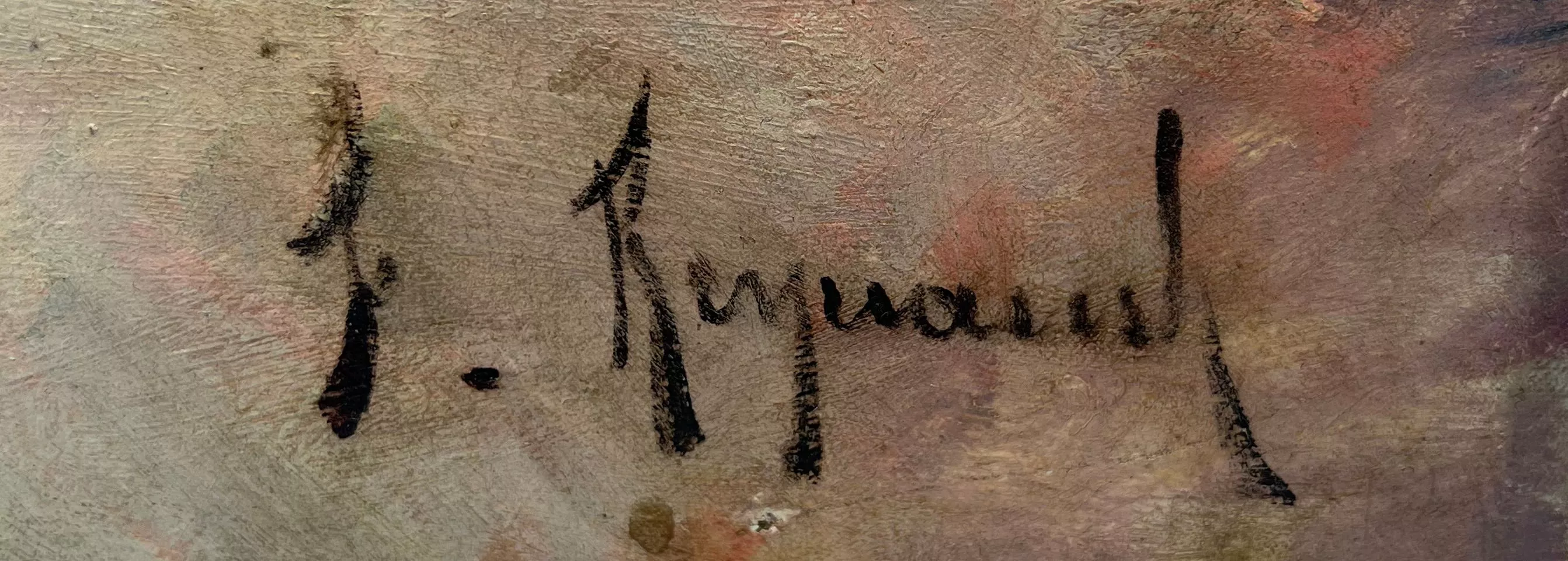
François Reynaud's works are usually signed in the lower right-hand corner of the painting, in a color that contrasts with the background. However, it's best to have your work appraised even if the painting bears a signature.
He signs " F. Reynaud ".
Knowing the value of a work
If you happen to own a work by or after François Reynaud, don't hesitate to request a free valuation using our form on our website.
A member of our team of experts and licensed auctioneers will contact you promptly to provide you with an estimate of the market value of your work, not forgetting to send you ad hoc information about it.
If you wish to sell your work, you will also be accompanied by our specialists in order to benefit from alternatives to sell it at the best possible price, taking into account market inclinations.
Estimate in less than 24h
Discover in the same theme

Value and quotation of works, paintings by Delphin Enjorlas
Delphin Enjorlas, an academic painter of the 20th century, produced work that is little-known but valuable and stable. Estimated in 24h.
Learn more >

Rating and value of paintings by Victor Léon Dupré
Victor Léon Dupré was a landscape painter of the Fontainebleau School who produced works that are highly regarded and valued at auction.
Learn more >

Rating and value of paintings by Marius Borgeaud
Marius Borgeaud is a 19th-century luminist painter who produced paintings that are increasingly popular and valuable at auction.
Learn more >
Other works from the same period sold at auction

Estimated 600 - 800 €
Alexandre Gabriel DECAMPS (1803-1860) Two children reading.

Estimated 9 000 - 12 000 €
Guillaume FOUACE (1837-1895) Pheasant and hare.

Estimated 600 € - 800 €
Henri ZUBER (1844-1909), Bridge at Artemare. Oil on canvas.

Estimated 500 - 800 €
Louis BUISSERET (1888-1956) - Water carrier, Portugal, circa 1943, Oil on canvas

Estimated 10.000 - 15.000 €
Ebridge Ayer BURBANK(1858-1949), Young African-American boy, Oil on panel.

Estimated 3.000 - 5.000 €
Henri EPSTEIN (1892-1944), Place du sud de la France, Oil on canvas.

Secure site, anonymity preserved

Auctioneer approved by the State

Free and certified estimates
Frequently asked questions
-
Who is François Reynaud, and what is his artistic background?François Reynaud (1825–1909) was a painter from Marseille who worked within the 19th-century academic tradition. Trained at the École des Beaux-Arts in Marseille under Augustin Aubert and Émile Loubon, he distinguished himself through his formal rigor, his mastery of chiaroscuro, and his rejection of the avant-garde movements of his time. Although little known to the general public today, his work demonstrates great technical finesse and a unique sensibility in his treatment of light and materials.
-
What are the price ranges and market valuations for François Reynaud's works?The prices of François Reynaud’s works range from €50 to €12,900, depending on the medium and quality. Drawings and watercolors range from 50 to 300 €, while oil paintings on canvas—which account for 98.1% of his auction sales—range from 140 to 12,900 €. For example, an oil on canvas depicting fishermen sold for 12,900 €, far exceeding its initial estimate of 2,600 to 3,800 €.
-
How can you authenticate a work by François Reynaud?François Reynaud’s works are generally signed “F. Reynaud” in the lower right corner of the painting, in a contrasting color. However, we strongly recommend having your works appraised by our state-certified experts and auctioneers. Auctie's offers a free, no-obligation appraisal: fill out our online form, and an expert will contact you within 48 hours to authenticate and appraise your painting.
-
When is the best time to sell a work by François Reynaud?Now is an excellent time to sell a work by François Reynaud: his market value has been rising steadily, with prices increasing with each auction. Although his paintings reached their peak in the 1990s, they remain highly sought after by collectors, particularly in France, where 96.4% of his sales take place. Fans of academic art and figurative painting continue to hold him in high regard.
-
How does the appraisal and sale of a work of art take place at Auctie's?Appraisals at Auctie's are free and non-binding: submit your request via our online form, and our experts will respond within 48 hours with an accurate appraisal. If you’d like to sell your artwork, we’ll guide you every step of the way, offering you the best options to achieve the highest possible price based on current trends in the art market.
