



Rating and value of works, paintings by Gustave Courbet

Key takeaways
- Works by Gustave Courbet, a leading figure of Realism, sell for between €50 and €12.7 million, depending on the medium and provenance.
- Oil-on-canvas paintings, the artist’s preferred medium, fetch the highest prices, ranging from €170 to €12.5 million at auction.
- In 2022, the painting “The Poor Village Woman” (1866) sold for €1.4 million, exceeding its initial estimate of €700,000 to €1 million.
If you own a work by or after Gustave Courbet, and would like to know its value, our state-approved experts and auctioneers will offer you their appraisal services.
Our specialists will carry out a free appraisal of your work, and provide you with a precise estimate of its value on the current market.
Then, if you wish to sell your work, we will direct you to the best possible arrangement to obtain the optimum price.
Rating and value of the artist Gustave Courbet
The artist Gustave Courbet leaves behind a classic body of work, composed mainly of realistic scenes. He was the leader of the realist movement in his day. Now, prices for his works are exploding at auctioneers' gavels.
His paintings are highly prized, especially by American and English buyers. The price at which they sell on the art market ranges between €50 and €12,753,900, a very substantial range but one that speaks volumes about the value that can be attributed to Courbet's works.
In 2022, the tableu La Pauvresse de village dating from 1866 sold for €1,400,000 while it was estimated at between €700,000 and €1,000,000.
Order of value from a simple work to the most prestigious
Technique used | Result |
|---|---|
Estamp | From €50 to €2,590 |
Drawing - watercolor | From €220 to €120,000 |
Oil on canvas | From €170 to 12 573 900€ |
Estimate in less than 24h
Style and technique of the artist Gustave Courbet
Gustave Courbet, an emblematic figure of realism, is distinguished not only by his desire to faithfully represent reality, but also by his social commitment.
A leader of this movement, he is recognized for his concern to give a voice to the most deprived and to women, often relegated to the margins of society.
Courbet sought to capture the essence of everyday life, from rural scenes to portraits of workers, rejecting the academic idealizations of the time.
His preferred medium was oil on canvas, a technique that enabled him to play with textures and shades of color to make matter and emotions palpable.
The painter distinguishes himself by his vigorous, thick brushstrokes, bringing an almost tactile dimension to his compositions, in keeping with his favorite trend: realism. He mastered the art of contrasts between light and shadow, lending his canvases a dramatic depth.
In addition to painting, Courbet also explored other forms of expression, producing a series of drawings and prints, in which his stylistic identity is readily apparent.
His works reflect an uncompromising vision of the world around him, making him a committed and profoundly modern artist.
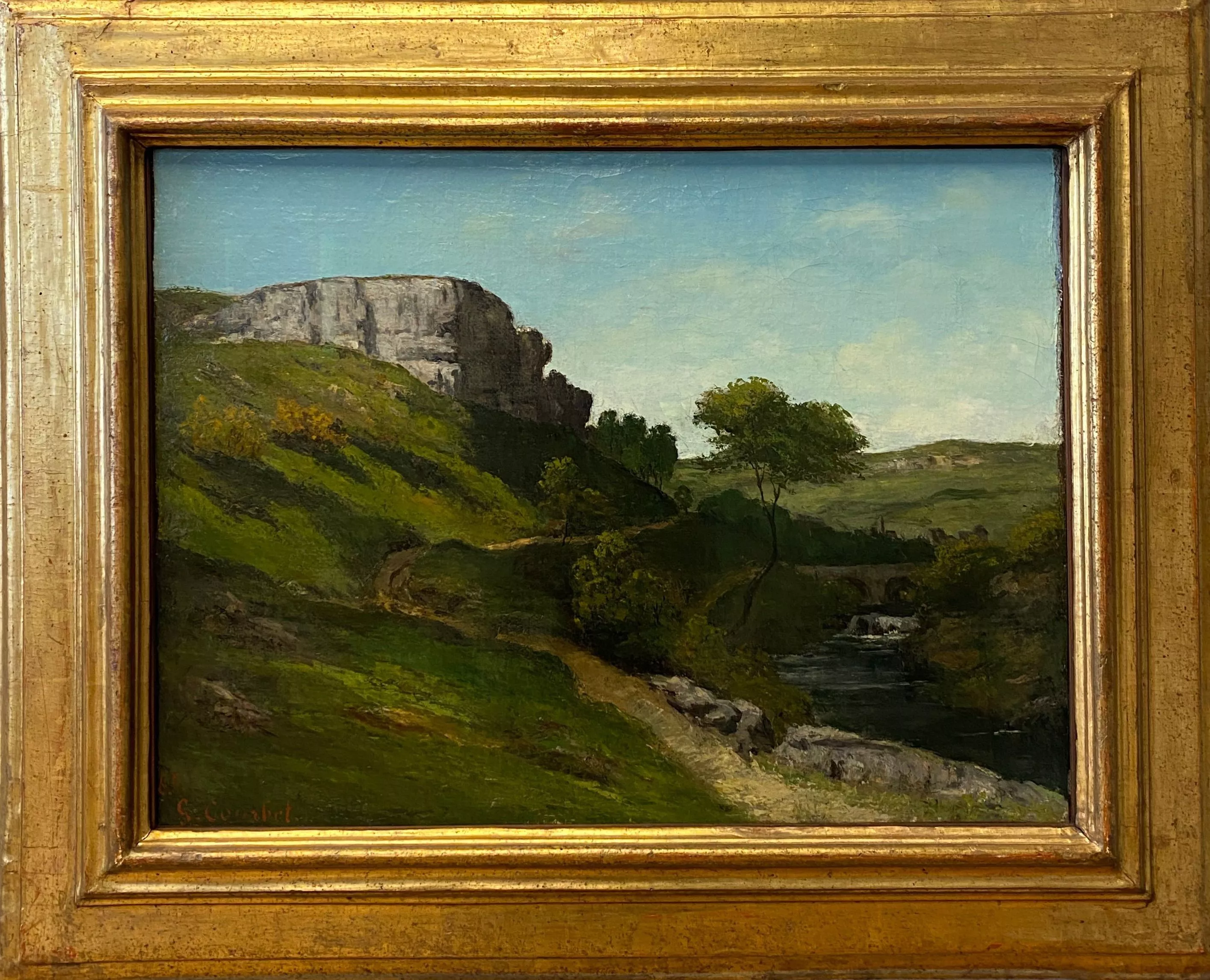
Gustave Courbet, leader of realism
Gustave Courbet (1819 - 1877) was born in the Doubs region of France. He produced over a thousand works and is one of the most controversial artists of the 19th century. His family was well-to-do, owning a great deal of land.
His father was wealthy enough to be an elector on the criteria of censal suffrage. He enters the Ornans seminary, where he receives drawing lessons from a pupil of baron Gros. He neglects the rest of his studies and takes lessons from one of David's pupils.
He attends the local fine arts school and decides to move to Paris, far from the aspirations of his father, who wants to enroll him in the polytechnic. He begins studying law, which is a pretext for being able to move to Paris.
He copies masters from all over Europe, including Géricault. His first paintings are influenced by Romanticism. He submits works to the Salon that are rejected. After several attempts, the Salon accepts Loth and his daughters in 1844, because he has conformed to the acedemic canons.
This is one of the only works that respects the Académie's guidelines; for most of his career, he will refuse the Académie's techniques, as well as the hierarchy of genres.
In the 1840s, he met Virginie Binet, who was to be his first love and his greatest inspiration: he painted les Amants. In the same years, he painted a portrait of Charles Baudelaire, who was to become his friend and a positive critic of his work.
He returned to Ornans, and drew inspiration from everyday scenes from the lives of the poor, as Isabey did with sailors. It was at this time that social realism was born, Courbet's intellectual contribution to art.
His painting Un enterrement à Ornans was rejected from the Salon, intellectuals disputed the merits and idignity of the painting : Courbet launched the battle of realism.
He went into exile in Switzerland at the end of his life, following several setbacks with French justice. The painters of his time showed solidarity with his cause. Some visited him and exhibited with him, including Ferdinand Holder. He died in Switzerland in 1877.
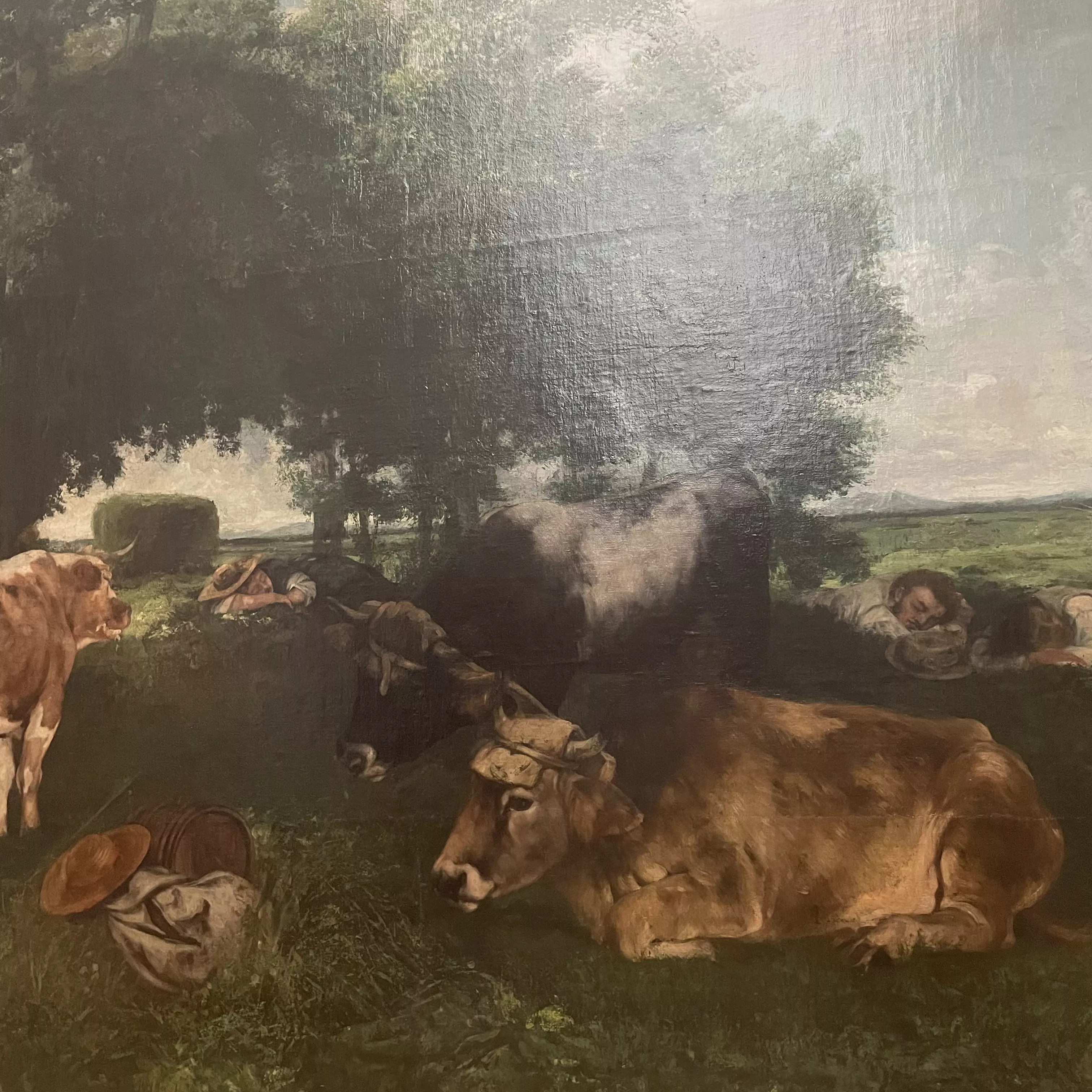
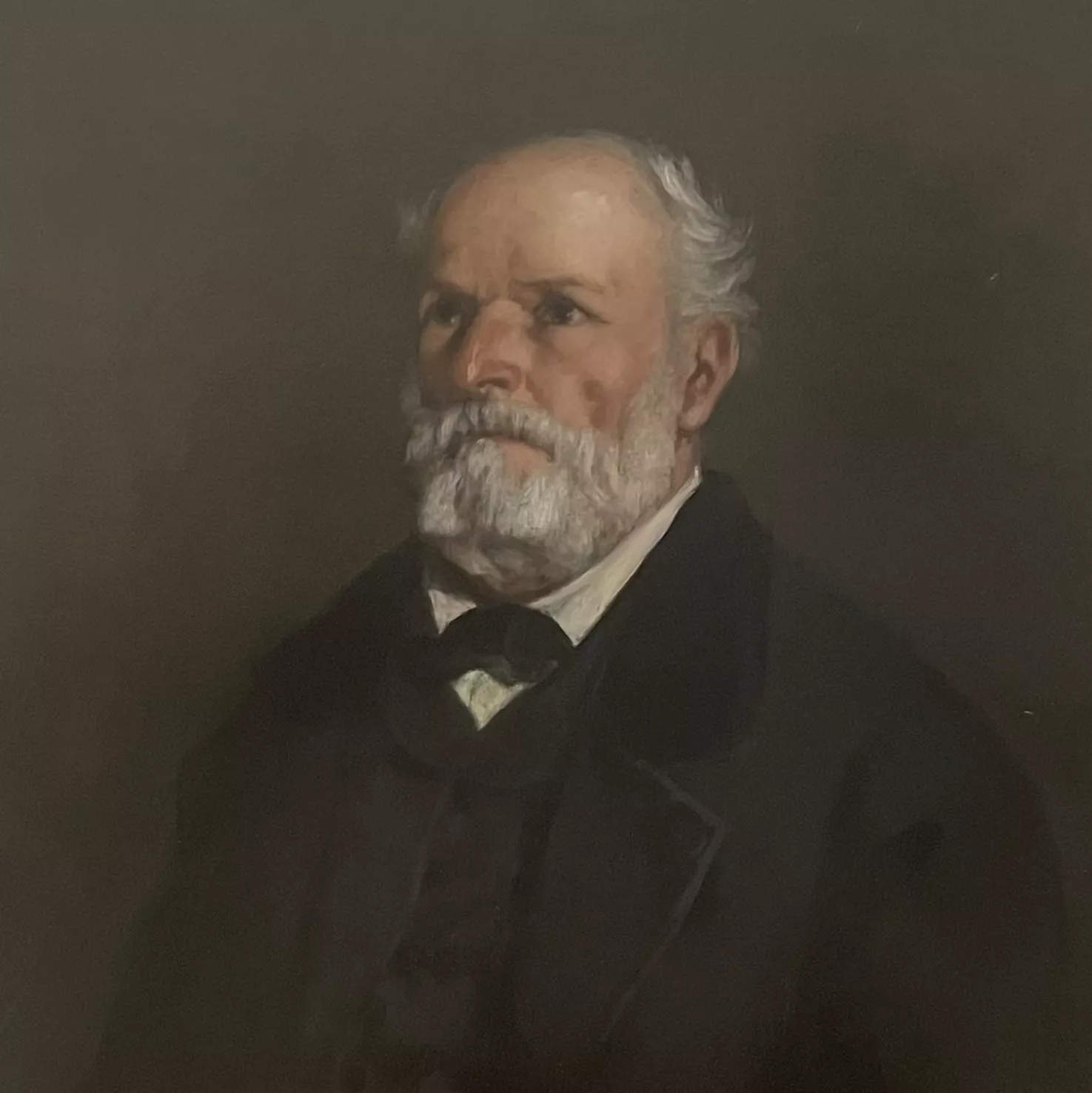
The historiographical context of realism in art history
The 19th century, and Gustave Courbet in particular, marks a historiogrpahic turning point in art history. The period is still imbued with academic standards, but also with a complex socio-political context.
At the end of the 18th century, the industrial revolution profoundly transformed the working classes and social habits. It also transformed the iconographic programs chosen by certain painters.
Some were keen to increase the visibility of the most vunerable, whose work was just as difficult as that in the fields. Courbet, in this context, seized on the difficulty and simplicity of working-class life to create a new genre.
The technique, already employed by a few before him - including Théodore Géricault, who borrowed the codes of history painting to illustrate an anecdotal scene, Le radeau de la Méduse, would once again serve Courbet well.
All the codes of the greatest academic genre are reused : dimensions of the canvas, deliberately large, pyramidal composition, fleshed-out representation of the scene depicted, noble colors... Courbet reuses many of these elements to create Un enterrement à Ornans.
This painting, which shows a modest funeral ceremony in a village, shocks the era with its audacity. Courbet defies convention by treating a simple subject with the same importance as the great classical works.
Realism doesn't just represent reality faithfully; it also becomes a means of highlighting social injustices.
By giving a place to the working classes and denouncing, through their works, the inequalities of their time, artists such as Courbet, Jean-François Millet and Honoré Daumier contributed to making art a mirror of society, closer to human concerns.
The refusal of a funeral in Ornans
Focus on Courbet's cover portrait
Gustave Courbet's cover painting perfectly embodies the essence of his realist approach, while revealing a remarkable technical mastery and eye for detail.
At first glance, the portrait depicts a woman elegantly reclining on a richly decorated sofa. The figure's relaxed pose and direct, confident gaze testify to a certain intimacy between artist and sitter, while capturing a moment of calm voluptuousness.
Courbet, true to his desire to paint reality without embellishment, pays particular attention to textures and materials. The shimmering satin of the white dress, which catches and reflects the light in subtle ways, contrasts with the heavier, shimmering fabrics of the cushions.
The floral motifs and bright red hues of the accessories add a touch of dynamism to the whole, while underlining the luxurious, sophisticated character of the scene.
What's also striking about this painting is the woman's attitude. Her expression, half longing, half proclaiming, reinforces the idea of a modernity in female representation.
Courbet does not seek to idealize his model but to reveal a certain authenticity, both in the pose and in the emotion captured. There is an assumed sensuality here, far from the classical canons, where the woman becomes both object of contemplation and central subject of the composition.
Courbet's palette, rich in shades of gray, white and red, lends the work an atmosphere that is both intimate and noble.
The artist manages to capture a scene of luxury and relaxation while maintaining a realistic approach, true to his style, blending technical rigor and psychological exploration of the character.
Gustave Courbet's imprint on his period
His works are part of the permanent collections of many prestigious museums around the world, and Gustave Courbet is today considered one of the major artists of the realist movement and a precursor in terms of artistic choices. Today, his work is highly prized at auction, and given the magnitude of his output, collectors play a major role in preserving his work.
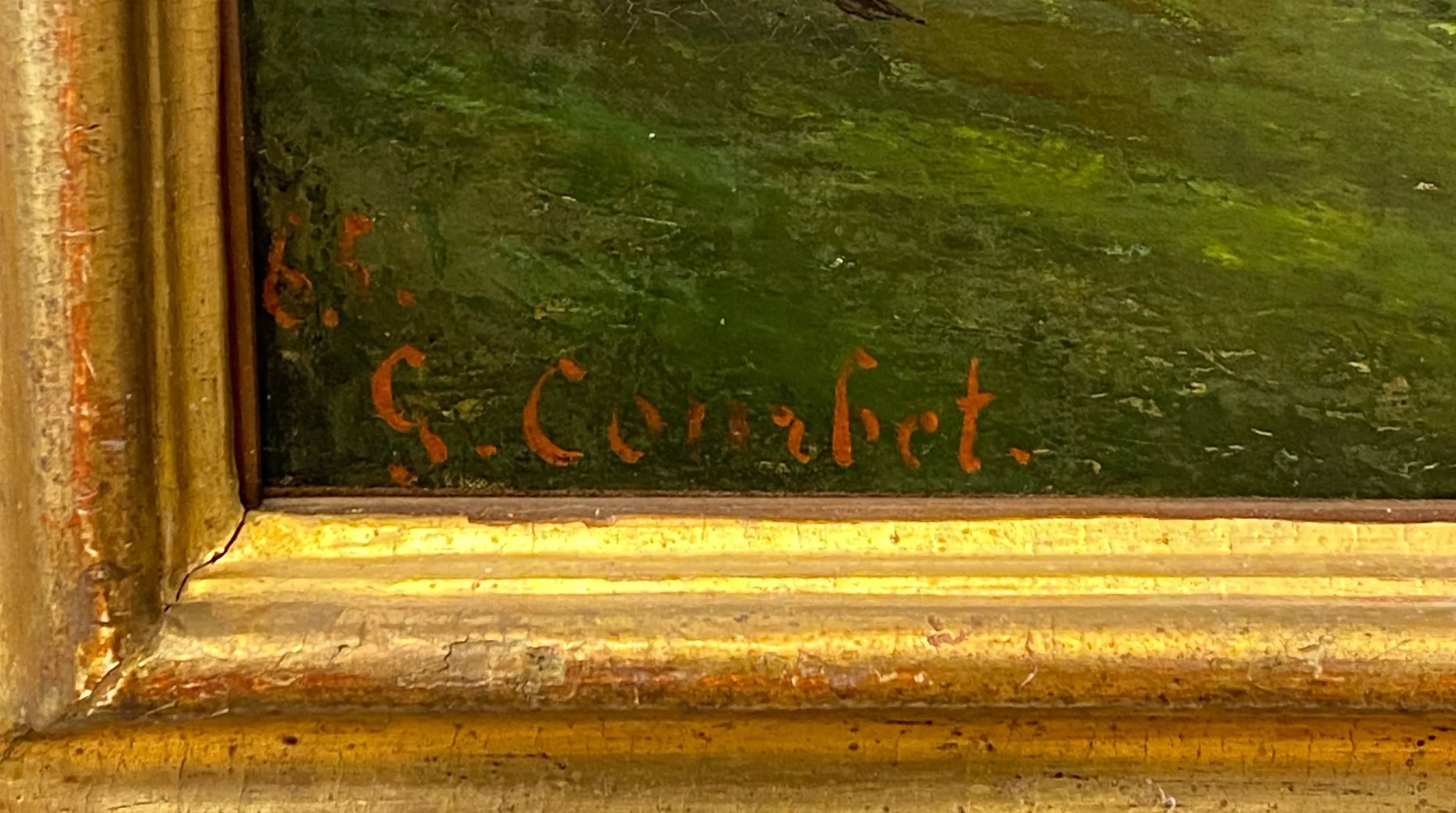
Recognizing the artist's signature
Not all Courbet's works are signed. They may be at the bottom of the painting, but if you think you own one, it's best to have it appraised to be sure of its originality.
Knowing the value of a work
If you happen to own a work by or after Gustave Courbet, don't hesitate to request a free appraisal using our form on our website. A member of our team of experts and certified auctioneers will contact you promptly to provide you with an estimate of the market value of your work, as well as any relevant information about it. If you wish to sell your work, you will also be accompanied by our specialists in order to benefit from alternatives to sell it at the best possible price, taking into account the inclinations of the market.
Estimate in less than 24h
Works from the same period sold at auction

Estimated 2 000 € - 3 000 €
Delphin ENJOLRAS (1857-1945) "A Midsummer Night's Dream", Oil on canvas

Estimated 500 - 800 €
Louis BUISSERET (1888-1956) - Water carrier, Portugal, circa 1943, Oil on canvas

Estimated 10.000 - 15.000 €
Ebridge Ayer BURBANK(1858-1949), Young African-American boy, Oil on panel.

Estimated 8000 - 12000 €
Raymond THIBESART (1874-1968) Apple trees in blossom Oil on canvas.

Estimated 3000-5000€
Alexandre Roubtzoff - View of Tunis (small format)
Discover in the same theme

Rating and value of works, paintings by Jules Breton
Jules Breton was a 19th-century naturalist and realist painter who produced many valuable and successful works at auction.
Learn more >

Rating and value of paintings by Franz Defregger
Franz Defregger is a painter of history and military scenes who has produced works that are highly valued at auction.
Learn more >

Rating and value of paintings by Elizabeth Jane Gardner Boug...
Elizabeth Jane Gardner Bouguereau is a 19th-century artist who produced many highly-rated and valuable paintings.
Learn more >

Secure site, anonymity preserved

Auctioneer approved by the State

Free and certified estimates
Frequently asked questions
-
Who is Gustave Courbet, and what is his role in art history?Gustave Courbet (1819–1877) was the leading figure of the 19th-century Realist movement. Born in the Doubs region, this controversial painter produced more than a thousand works and distinguished himself through his rejection of academic conventions and his social activism. He revolutionized art by giving prominence to the working classes and scenes of everyday life, transforming painting into a mirror of society.
-
What is the price range for Gustave Courbet's works at auction?Prices for Courbet’s works vary considerably depending on the medium and quality. Prints sell for between €50 and €2,590, drawings and watercolors between €220 and €120,000, while oil paintings on canvas—his preferred medium—can fetch up to 12 million euros. This wide range reflects the diversity and exceptional value of his work on the art market.
-
How can you authenticate a work by Gustave Courbet?To verify the authenticity of a work attributed to Courbet, we recommend that you request a free appraisal from our state-certified experts and auctioneers. Although not all of Courbet’s works are signed, our specialists can analyze the technique, style, and provenance to confirm the authenticity of your piece within 48 hours.
-
Why is the market for Courbet's works currently strong?Gustave Courbet’s works are highly sought after in today’s market, particularly among American and British buyers. They are featured in the permanent collections of prestigious museums around the world and are in high demand among collectors. Now is therefore a good time to sell, as prices for his paintings regularly skyrocket at auction.
-
How does the appraisal and sale of a work of art work at Auctie's?Auctie's offers a free, no-obligation appraisal service: fill out the online form with photos of your artwork, and a certified expert or auctioneer will contact you to provide an estimate within 48 hours. If you’d like to sell, we’ll guide you every step of the way, helping you choose the best approach to get the highest possible price.
