



The value of Jean Dewasne's paintings and drawings

Key takeaways
- Jean Dewasne, a leading figure in constructive abstraction since 1943, has works that sell for between €13 and €65,000, depending on their category and prestige.
- His paintings are his most valuable category, ranging from €150 to €81,100, such as “Don Juan,” which sold for €53,000 in 2022 despite an initial estimate of €12,000–15,000.
- As the founder of the Salon des réalités nouvelles in 1945, Dewasne developed a distinctive style combining pure geometric forms and vivid colors applied to innovative materials such as enamel and Ripolin.
If you own a work by the artist Jean Dewasne or based on his work and would like to know its value, our state-approved experts and auctioneers will guide you.
Our specialists will carry out a free appraisal of your work, and send you a precise estimate of its value on the current market.
Then, if you wish to sell your work, we will direct you to the best possible arrangement to obtain the optimum price.
Rating and value of artist Jean Dewasne
Jean Dewasne, an important artist of constructive abstraction, produced paintings, drawings, prints and tapestries that circulate regularly on the art market.
Concerning the four categories mentioned below, the prices at which these works were sold ranged from €13 to €65 000, a considerable delta but one that speaks volumes about the value that can be attributed to the artist's works.
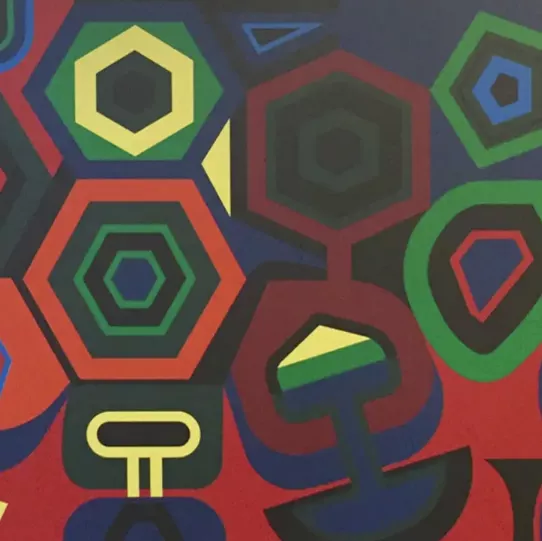
In this case, a painting entitled Don Juan dominated by green and orange dating from 1952 sold for €53 000 in 2022 while it was estimated at around €12 000 to €15 000.
Order of value, from a simple to a more prestigious work
Type of work | Price range |
Estamp | From 10 to 3 750€ |
Painting | From 150 to 81 100€ |
Drawing-watercolor | From 90 to 10 310€ |
Sculpture | From 300 to 1600€ |
Estimate in less than 24h
Jean Dewasne's style and technique
Jean Dewasne is recognized by his abstract aesthetic of geometric figures, inspired by and competing with postcubism.
Notwithstanding this formalism, his desire for a technique that competes with industrial achievements leads him to spurn the injunctions of traditional painting.
He thus chose to adopt materials such as cold enamel, Ripolin, lacquers and glycerophthalic paints without neglecting new supports such as metal and plywood.
He also incorporated mechanized processes such as spray painting into his repertoire of techniques.
The life and career of Jean Dewasne
Jean Dewasne, born in 1921, epitomizes the polymorphous artist of the 20th century. From an early age, he was passionate about art, nurturing his dexterity and embryonic artistic sensibility between musical notes and pencil strokes.
Fascinated by the curves of the human body and the refinement of plaster, Dewasne applied himself to the scrupulous study of the live model.
In his quest for artistic mastery, Dewasne takes care to cultivate his poetic universe by studying a craft with the same seriousness as a woodworking apprentice.
Thus, he enters the prestigious École nationale supérieure des beaux-arts de Paris. At this point, he discovered a real penchant for architecture, providing him with the keys to structural sensibility and opening the door to his future style.
To better educate himself and satisfy his extreme demands, he copied classical monuments but retained a modernist aspiration that would become his future hallmark.
He is also a member of the Académie de la Grande Chaumière, having studied music extensively and played the violin at a high level.
Abstraction was not an obvious choice early in his career, and he experimented with different, more formal and figurative people. On the strength of his first exhibition in 1941, he did not produce his first abstract work until 1943.
Shortly afterwards, he rubbed shoulders with and shared the same aspirations as Nicolas de Staël, Jean Arp, Serge Poliakoff and Hans Hartung. Together, they would defend abstraction as a singular mode of expression.
In 1945, the artist was part of the founding committee of the Salon des réalités nouvelles. The first Salon was held the same year, at which time he received the Kandinsky Prize.
In 1946, Dewasne collaborated with the Denise René gallery, testifying to his commitment at the heart of the artistic hemicycle.
Without abandoning tradition, Dewasne continued to explore oil painting. In 1950, he founded the Atelier d'art abstrait at the Académie de la Grande-Chaumière in collaboration with Edgar Pillet.
With the soul of a Cartesian theorist, he taught the mechanics of painting and enriched his knowledge of color physics and chemistry, applying theorem, square roots and equations.
Despite his admiration for Herbin's art, from which he drew his references, in the early 1950s he definitively established his style, which he singled out by means of geometric flats of bright, brilliant colors, reminiscent of traditional varnish.
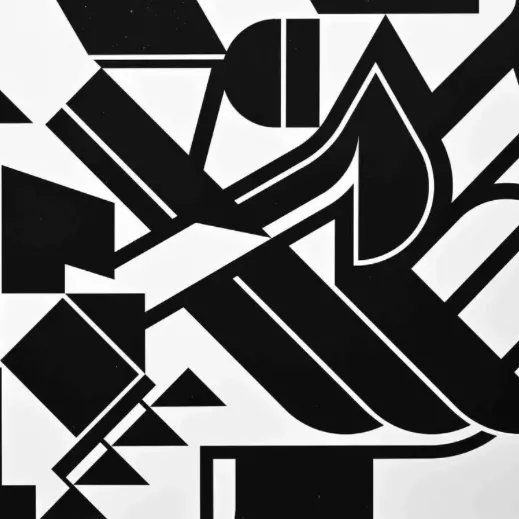
By eschewing the technique of realism and unburdening himself of the complexity of detail, Dewasne profoundly upended his art. It was no longer a question of forms but of surfaces, stripped of that ornament that is the third dimension.
Dewasne produced vast murals such as La Joie de vivre in 1949.
Those who considered his work chimerical and artificial were stunned when, in 1951, he painted a veritable artistic manifesto: L'Apothéose de Marat, which transcended him: " l'admirable, c'est que l'œuvre dit plus que celui qui l'a créé ".
Understanding constructive abstraction
Constructive abstraction, born in the early 20th century, is an artistic movement characterized by a rigorous use of geometric shapes and pure colors, often associated with a rational, methodical approach.
At the crossroads of art and mathematics, this movement rejects chaos and the irrational in favor of strict visual organization, where every element is carefully thought out and calculated.
Its roots dip into geometric abstraction, notably with artists like Piet Mondrianand Kazimir Malevich, who explored the reduction of forms to their purest essence.
The term "constructive" emphasizes the intention to create works that are not simply representations, but constructions in themselves, self-contained, where shapes and colors are used in ways that structure space.
This approach is distinguished by an absence of direct reference to the visible world, in favor of a new reality, constructed by the artist.
Works of constructive abstraction seek to express universal ideas through a stripped-down visual language, often inspired by the scientific and technological advances of the time.
This movement finds particularly marked expression in the work of members of the De Stijl group, founded by Theo van Doesburg, as well as in the works of artists linked to the Bauhaus, such as Josef Albers and László Moholy-Nagy.
These artists saw constructive abstraction as a means of linking art, architecture and design, proposing pure, functional forms that fit harmoniously into everyday life.
Constructive abstraction is not limited to a pictorial style; it also influences sculpture, architecture, and even the design of utilitarian objects.
Constructive artists are distinguished by their desire to rationalize the creative act, often using grids, systems of proportion, or algorithms, to generate compositions where order and harmony are paramount.
This approach, though rigorous, leaves room for great diversity of expression, with each artist interpreting the principles of constructive abstraction in his or her own way to achieve a universal, timeless and resolutely modern art form.
Jean Dewasne at Art Basel in 2013
Focus on Rythme et Couleur, Jean Dewasne, 1971
In 1971, Jean Dewasne created Rythme et couleur, a work that perfectly embodies his evolution towards geometric abstraction marked by precise shapes and vivid colors.
A founding member of the Salon des réalités nouvelles in 1945, Dewasne quickly established himself as a key figure in abstract art in France.
In this composition, Dewasne focuses on the essential: the relationship between form and color.
Flats of vibrant hues, mainly in shades of orange, blue and green, unfold in sharp curves and angles, creating a sense of movement and dynamism.
Each element seems carefully calculated, a reflection of the artist's methodical approach, which is as interested in scientific rigor as it is in aesthetics.
Rhythm and Color also shows Dewasne's ambition to renew pictorial language. By discarding superfluous details, he favors pure geometric forms, reminiscent of mathematical constructions.
This work is both simple and complex: simple in its presentation of clean, colorful forms, complex in the subtle interactions between these elements.
With this work, Dewasne asserts his unique style, far removed from realism, where geometry and color are the main vectors of artistic expression. He thus creates a visual universe where each color, each form, has its place and contributes to the balance of the whole.
Rythme et couleur remains an emblematic work of the period when abstract art was being redefined, carried by artists like Jean Dewasne, who sought to push back the boundaries of artistic creation.
Recognizing Jean Dewasne's signature

The signature of his work by its small size is barely visible and usually appears at the bottom right of the painting when it is not a sculpture.
Knowing the value of a work
If you happen to own a work by Jean Dewasne or after himself, ask without hesitation for a free appraisal via our form on our website.
A member of our team of experts and chartered auctioneers will contact you promptly with an estimate of the value of your work, not forgetting to pass on ad hoc information about it.
If you are considering selling your work, you will also be accompanied by our specialists in order to benefit from alternatives for selling it at the best possible price.
Estimate in less than 24h
Discover in the same theme

Rating and value of works, furniture, tables, sculptures by...
Discover the dreamlike world of scenographer, designer and sculptor Hubert le Gall.
Learn more >

Rating and value of statues, bronzes and marbles by Pierre T...
Pierre Travers is a 20th-century sculptor who has produced works in marble and bronze that are sought-after and quoted on the auction market.
Learn more >

Rating and value of paintings by Maurice Louvrier
Maurice Louvrier is an Impressionist painter of the Rouen School, who produced many highly valued paintings.
Learn more >
Other works from the same period sold at auction

Estimated 18000 € - 20000 €
Paul JOUVE (1878-1973): "Panther on the march

Estimated 80 € - 120 €
Paul COLIN (1892-1985) "Impression de", Rugby au casino de Paris 1928.

Estimated 3.000 - 5.000 €
Henri EPSTEIN (1892-1944), Place du sud de la France, Oil on canvas.

Estimated 4.000 - 6.000 €
GASTON CHAISSAC (1910-1964) Composition 1947, Gouache and Indian ink on paper.

Secure site, anonymity preserved

Auctioneer approved by the State

Free and certified estimates
Frequently asked questions
-
Who is Jean Dewasne, and what is his artistic style?Jean Dewasne (1921–2006) was a leading figure in 20th-century French constructive abstraction. He was known for his use of clean geometric forms and vivid, brilliant colors, which he achieved using modern materials such as cold enamel, Ripolin, and lacquers. A founding member of the Salon des réalités nouvelles in 1945, he developed a rational and methodical approach to creation, influenced by architecture and mathematics, rejecting realism in favor of unadorned geometric surfaces.
-
What are the price ranges for Jean Dewasne's works, broken down by type?Jean Dewasne’s works appear regularly on the art market, with prices varying widely depending on the category: prints range from €10 to €3,750, paintings from €150 to €81,100, watercolor drawings from €90 to €10,310, and sculptures from €300 to €1,600. For example, the painting “Don Juan Dominated by Green and Orange” (1952), initially estimated at €12,000–15,000, sold for €53,000 in 2022.
-
How can you authenticate a work by Jean Dewasne and determine its exact value?To authenticate and appraise a work by Jean Dewasne, we recommend that you request a free, no-obligation appraisal using the form on the Auctie's website. A certified auctioneer or appraiser will contact you within 48 hours to evaluate your artwork, provide you with an estimate of its current market value, and share all relevant information about it.
-
Is this the right time to sell a work by Jean Dewasne?Yes, now is a good time to sell a work by Jean Dewasne. Interest in constructive abstraction and 20th-century geometric art remains steady and strong in the art market. Auction results regularly show works selling above estimate, as illustrated by the example of “Don Juan Dominated by Green and Orange,” attesting to consistent demand for this seminal artist.
-
How does the process of selling a work of art at Auctie's work?Auctie's guides you from appraisal to auction. After a free appraisal conducted by our experts and certified auctioneers, we’ll help you explore the best options for selling your artwork at the best possible price. We manage the entire process leading up to the auction, advising you at every step to maximize the proceeds from your sale.
