



Rating and value of paintings by Henry Émile Vollet

Key takeaways
- Works by Henry Émile Vollet (1861–1945) sell for between €40 and €32,000, with oil-on-canvas paintings fetching the highest prices.
- In 2019, his painting “Night Festival on the Small Lake in Hanoi” sold for €32,000, exceeding its estimate of €15,000 to €18,000.
- A realist and Orientalist artist trained by Fernand Cormon, Vollet developed a style that combines precise drawing with a soft color palette inspired by the Vietnamese landscapes of Indochina.
If you own a work by or after Henry Émile Vollet, and would like to know its value, our state-approved experts and auctioneers will offer you their appraisal services.
Our specialists will carry out a free appraisal of your work, and provide you with a precise estimate of its value on the current market.
Then, if you wish to sell your work, we will direct you to the best possible arrangement to obtain the optimum price.
Rating and value of the artist Henry Émile Vollet
Henry Émile Vollet leaves behind a body of work that is both realistic and orientalist. Prices for his works are now skyrocketing under auctioneers' gavels. His paintings are highly prized, especially by Belgian buyers.
The price at which they sell on the art market ranges from €40 to €32,000, a very substantial gap but one that speaks volumes about the value that can be attributed to Vollet's works.
In 2019, his oil on canvas Night Party on the Little Lake of Hanoi sold for €32,000 while it was estimated at €15,000 to €18,000. Its quotation is stable.
Order of value from a simple work to the most prestigious
Technique used | Result |
|---|---|
Estamp - multiple | From €40 to €1,300 |
Drawing - watercolor | From €60 to €3,400 |
Oil on canvas | From €65 to €32,000 |
Estimate in less than 24h
Style and technique of artist Henry Émile Vollet
Henry Émile Vollet develops a pictorial style in which rigorous drawing structures compositions imbued with a particular sensitivity.
Trained in Fernand Cormon's studio, he retains a pronounced taste for precision of line, which remains the basis of his paintings. His paintings are characterized by a balanced construction, in which the line plays a fundamental role, emphasizing contours and guiding the eye through the scene.
The influence of realism is evident in his attention to detail and the accuracy of proportions, but he moves away from it by introducing a freer, more spontaneous touch.
His work on color bears witness to a dialogue between tradition and modernity. He employs a palette that is often softened, favoring earthy tones and warm hues that recall the luminous atmospheres of Vietnam.
Shadows are rarely abrupt, melting into subtle gradations that lend his canvases a hushed depth. His use of light, diffuse and natural, envelops the scenes in a soft ambience, accentuating the intimate character of his compositions.
Vollet's touch varies according to the subjects he tackles. Sometimes fluid and light when capturing the elegance of a gesture or the finesse of a fabric, it becomes more pronounced and expressive in his landscapes, where impasto and material work contribute to a sense of relief.
The influence of Japanese prints shines through in his way of flattening certain surfaces and purifying settings, while maintaining great expressivity in figures and expressions.
He favors tight framing, giving his scenes a particular intensity, and plays on the contrasts between detailed areas and spaces left more empty, creating a subtle balance between precision and suggestion.
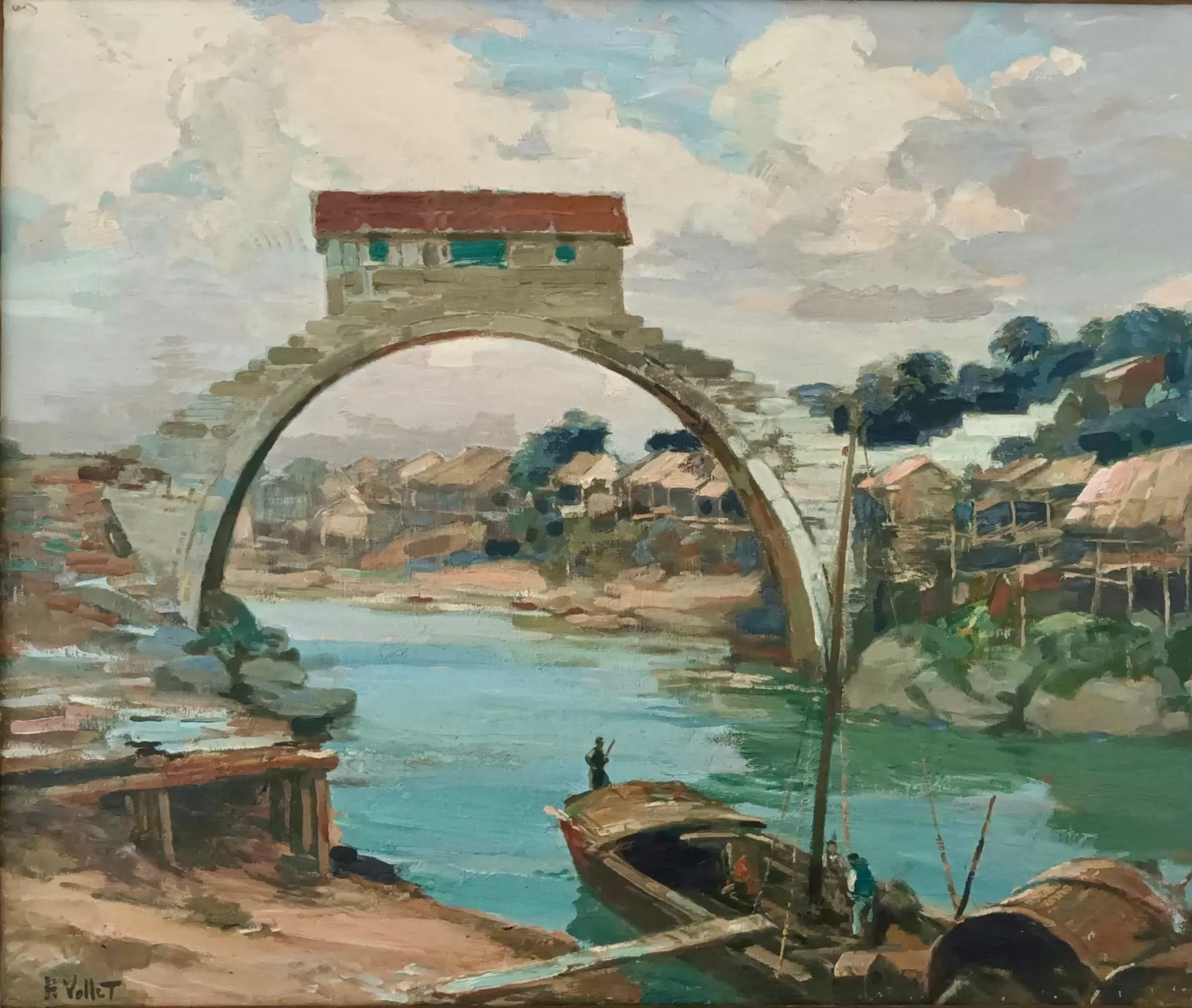
The life of Henry Émile Vollet
Henry Émile Vollet (1861 - 1945) spent much of his life in Indochina, where he found an inexhaustible source of inspiration.
Attracted by the visual and cultural richness of Vietnam, he set out to depict everyday scenes, religious rites and the country's distinctive atmosphere with accuracy and sensitivity.
Like Victor Tardieu and Alix Aymé, he shares with them a keen eye for light and composition, but develops a plastic language of his own, blending rigorous drawing and supple gesture.
His Indochinese works, mainly drawings and paintings, demonstrate a balance between precision and spontaneity.
He captures the elegance of silhouettes, the movement of fabrics, the serenity of landscapes with an economy of means that reinforces the expressiveness of his subjects.
His compositions avoid picturesque anecdote and favor a more sober approach, where the accuracy of the line and the subtlety of nuance are enough to suggest all the depth of a scene, he is in this sense also influenced by Van Gogh.
Vollet receives a bronze medal at the 1900 Universal Exhibition, in recognition of the quality of his work and his contribution to the artistic representation of Indochina.
His view of this territory is not limited to an exotic fascination: he seeks to transcribe its reality with a sensitivity that transcends pure observation.
Through his works, he leaves a delicate, authentic imprint, a testimony to a time when Western art was opening up to other influences, absorbing the light and forms of an elsewhere that he renders with remarkable finesse.
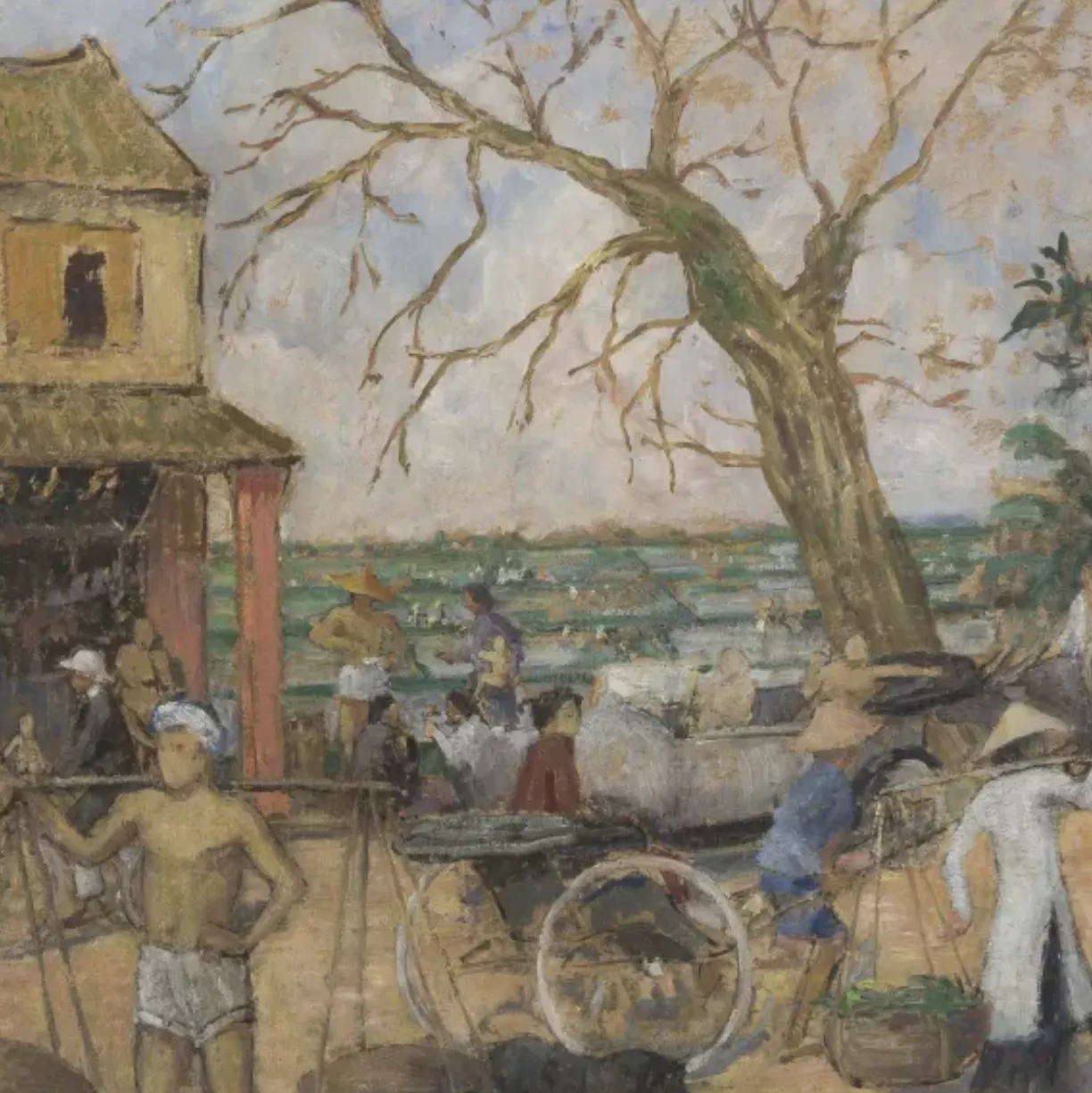
Focus on an Indochinese landscape by Vollet
In one of his iconic works created in Indochina, Henry Émile Vollet captures the very essence of the Vietnamese landscape.
This painting, of great simplicity, blossoms in a soft, subtle palette, where the artist, with his own rigorous draftsmanship, succeeds in rendering all the light and texture of the world around him.
The atmosphere is imbued with a profound serenity, as if suspended in time. The contours of trees, distant mountains and rice paddies, all elements of everyday Vietnamese life, are rendered with almost photographic precision, but always with great economy of detail.
Vollet knows perfectly well how to avoid superfluous anecdote and concentrates on the essentials: a sober composition, but one of great evocative power.
What strikes one immediately is the use of light. The artist succeeds in capturing the warmth of the air and the softness of the light that floods the landscape, in an atmosphere that seems bathed in a kind of unreal calm.
The luminous intensity is reinforced by deep shadow zones, which structure the painting and bewitch the viewer.
Through these plays of light, Vollet invites us to contemplate a world where the human almost blends into nature, a nature that is omnipresent, but always respected, never invasive.
Vollet's strokes do not seek to idealize or romanticize the scene; on the contrary, the artist offers us an honest and fair vision of this Vietnam that he knows intimately.
He pays homage to it, in its simplicity and quiet beauty, elevating the everyday to the status of a work of art. This painting doesn't just pay homage to a place; it conveys an atmosphere, a feeling, an experience.
Through his art, Vollet invites us to a deep immersion, a return to the roots of a Vietnam that few other artists of his time were able to render with such finesse.
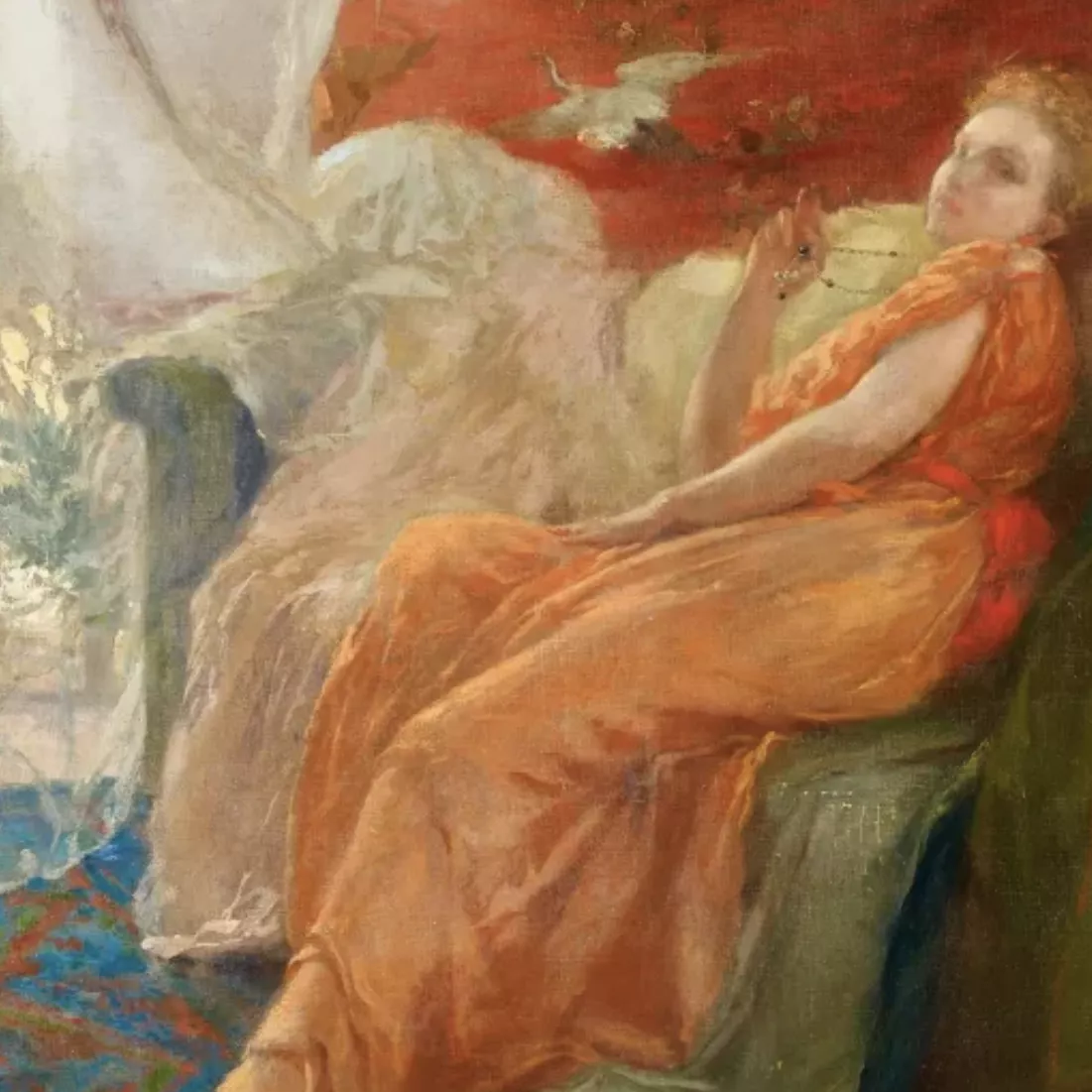
Henry Émile Vollet's imprint on modern Indochinese art
Henry Émile Vollet's imprint on modern Indochinese art is undeniable, not only through his works but also through his lasting influence on a generation of Vietnamese artists.
In settling in Vietnam, Vollet succeeded in building a bridge between Western artistic traditions and those deeply rooted in the country's cultural history.
His view of Vietnam, enriched by his academic training in Paris, fuses the rigor of European realism with the soft light and unique colors of Indochinese landscapes.
This stylistic crossbreeding becomes an essential component in the emergence of a modern Indochinese aesthetic, where local forms and colors are interpreted from a novel angle, closer to Western sensibilities while respecting the grandeur of traditional Vietnamese motifs.
In his landscapes as in his scenes of daily life, Vollet abandons superfluous ornamentation and illusionism to concentrate on the very essence of his subject, with an economy of means and rigor in composition that mark his era.
By capturing the light of Vietnam with the same accuracy he had captured in Europe, Vollet imposed a new approach to landscape painting, particularly in his ability to retranscribe the atmospheres typical of Indochina, a place both familiar and foreign.
He doesn't hesitate to break down his scenes into simple elements, building a special relationship between man and his environment, a relationship of intimacy, but also of deep respect for nature.
His works are also distinguished by their ability to convey a vision of reality that goes beyond appearance, having a lasting influence on modern Vietnamese art, notably the Hanoi School.
Thus, Vollet's contribution lies not only in the quality of his works, but also in the way he paved the way for a new artistic perception of Indochina, a subtle synthesis of East and West.
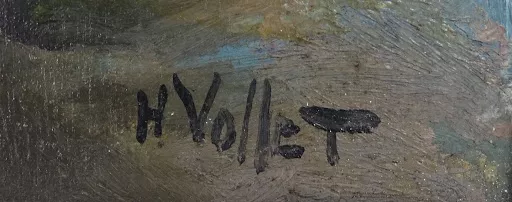
Recognizing the artist's signature
Not all of Henry Émile Vollet's works are signed. They may be at the bottom of the painting, but if you think you own one, it's best to have it appraised to be sure of the originality of your property.
Knowing the value of a work
If you happen to own a work by or after Henry Émile Vollet, don't hesitate to request a free valuation using our form on our website.
A member of our team of experts and licensed auctioneers will contact you promptly to provide you with an estimate of the market value of your work, not forgetting to send you ad hoc information about it.
If you wish to sell your work, you will also be accompanied by our specialists in order to benefit from alternatives to sell it at the best possible price, taking into account market inclinations.
Estimate in less than 24h
Discover in the same theme

Rating and value of paintings by Bengt Lindstorm
Bengt Lindstorm is a twentieth-century Swedish contemporary artist who has produced highly-rated abstract works of art that are valued at auction.
Learn more >

Rating and value of paintings by Jean Roger Sourgen
Jean Roger Sourgen is a 20th-century impressionist painter from the Landes region. He has produced works that are quoted and valued at auction.
Learn more >

Rating and value of Pierre Guariche's lighting fixtures, fur...
Pierre Guariche is a contemporary furniture designer who has produced works that are highly rated and valued on the auction market.
Learn more >
Works from the same period sold at auction

Estimated 15.000 - 20.000 €
Jacques MAJORELLE (1886-1962) - Fishermen embarking, Abidjan, Ivory Coast - Oil on canvas.

Estimated 1000 - 2000 €
NGUYEN TUONG LAN (1906-1947) - Ink and gouache painting on silk depicting a temple.

Estimated 10.000 - 15.000 €
Ebridge Ayer BURBANK(1858-1949), Young African-American boy, Oil on panel.

Estimated 3.000 - 5.000 €
Henri EPSTEIN (1892-1944), Place du sud de la France, Oil on canvas.

Estimated 1.000 - 2.000
TRAN DUY (1920-2014). École des beaux-arts de l'Indochine, preparatory class 1945, ink and color painting on silk

Secure site, anonymity preserved

Auctioneer approved by the State

Free and certified estimates
Frequently asked questions
-
Who was Henry Émile Vollet, and what was his artistic background?Henry Émile Vollet (1861–1945) was a painter trained in Paris in Fernand Cormon’s studio, who spent much of his life in Indochina. He developed a personal style that fused European realism with the sensibility of Vietnamese landscapes, combining rigorous draftsmanship with fluid brushwork. He received a bronze medal at the 1900 World’s Fair and remains a major figure in modern Indochinese art.
-
What is the price range for works by Henry Émile Vollet?Prices for Vollet’s works vary considerably depending on the medium and quality: prints sell for between €40 and €1,300, drawings and watercolors between €60 and €3,400, and oil paintings on canvas between €65 and €32,000. In 2019, the painting “Night Festival on the Small Lake in Hanoi” exceeded its estimate, selling for €32,000. Its market value remains stable in the current market.
-
How can you authenticate a work by Henry Émile Vollet?To verify the authenticity of a work attributed to Vollet, we recommend that you request a free appraisal using the Auctie's form. A certified expert or auctioneer will examine your item and confirm its authenticity, with no obligation on your part. Please note that not all of Vollet’s works are signed, which makes this appraisal all the more valuable.
-
Is this the right time to sell a work by Henry Émile Vollet?Yes, now is a good time to sell. Vollet’s market value is stable, and his paintings are enjoying a resurgence of interest, particularly among Belgian collectors and enthusiasts of Indochinese art. The current market highly values his compositions, in which precise draftsmanship meets a sensitive use of light—qualities that account for the steady demand.
-
How does the appraisal process work at Auctie's?The appraisal is free and non-binding. Simply fill out a form on our website with information and photos of your artwork. A certified expert or auctioneer will contact you promptly to provide an accurate assessment of its market value within 48 hours. If you wish to sell, our specialists will then assist you in obtaining the best possible price.
