



Rating and value of paintings by François Gall

Key takeaways
- François Gall's works sell for between €40 and €39,000, with oil-on-canvas paintings commanding the highest prices.
- A Hungarian Post-Impressionist painter (1912–1987) who settled in Paris in the 1930s, specializing in intimate Parisian scenes and light.
- His painting “Ballerinas Tying Their Shoes” exceeded its initial estimate, selling for €39,000 instead of the estimated €10,000–15,000.
If you own a work by artist François Gall or based on his work and would like to know its value, our state-approved experts and auctioneers will guide you.
Our specialists will carry out a free appraisal of your work, and provide you with a precise estimate of its value on the current market.
Then, should you wish to sell your work, we'll direct you to the best possible arrangement to obtain the optimum price.
Artist's rating and value
Thanks to their serene, luminous atmosphere, François Gall's works are popular with collectors.
On the market, his various realistic compositions are successful at auction. His works are selling for between €40 and €39,000, a significant delta but one that says a lot about the value that can be attributed to these canvases.
Some of the artist's works have thus reached unprecedented amounts, as witness his painting Ballerines lacing their shoes, which fetched €39,000 while it was estimated at between €10,000 and €15,000.
Order of value from the most basic to the most prestigious
Technique used | Result |
|---|---|
Estamp - multiple | From €40 to €500 |
Drawing - watercolor | From €50 to €10,400 |
Oil on canvas | From €110 to €39,000 |
Estimate in less than 24h
The artist's works and style
A post-impressionist artist who practiced mainly in Paris during the 20th century, François Gall is distinguished by his sensitive, vibrant painting of Parisian scenes and intimate moments. His main focus is on scenes of everyday life, where characters are often captured in peaceful moments, whether strolling through Montmartre or family portraits.
His work emphasizes light and color, which he uses to create soft, warm atmospheres. Gall favors oil on canvas, a technique that enables him to play on material effects and nuance his tones with finesse.
Contrary to other contemporary artists, he has not exploited the printmaking medium, preferring to concentrate on direct painting and the immediacy of gesture, to best capture the spontaneity of his subjects.
François Gall's artistic influences
François Gall follows in the footsteps of the great masters of the Impressionist and Post-Impressionist tradition, from whom he draws inspiration to develop his own pictorial language.
An admirer of Pierre-Auguste Renoir, he takes from him this ability to capture the grace and spontaneity of female figures, while focusing on the effects of light that bring colors to life.
Gall is also influenced by the work of Degas, particularly in his approach to intimate scenes and the backstage world, where everyday life takes on poetic overtones.
Gall's quick, expressive touch recalls that of Toulouse-Lautrec, whose influence can be seen in his attentive eye for the details of Parisian life, which he paints with unrivalled tenderness.
Other influences come from Vuillard and Bonnard, whose taste for hushed interiors and warm compositions he shares.
From these great role models, Gall inherits a unique sensibility, blending the heritage of the Impressionists with a more personal, almost narrative touch, which turns his canvases into suspended scenes of life.
His work, inspired yet profoundly original, is part of an artistic continuity while asserting a modern, personal vision of figurative art in the 20th century.
.
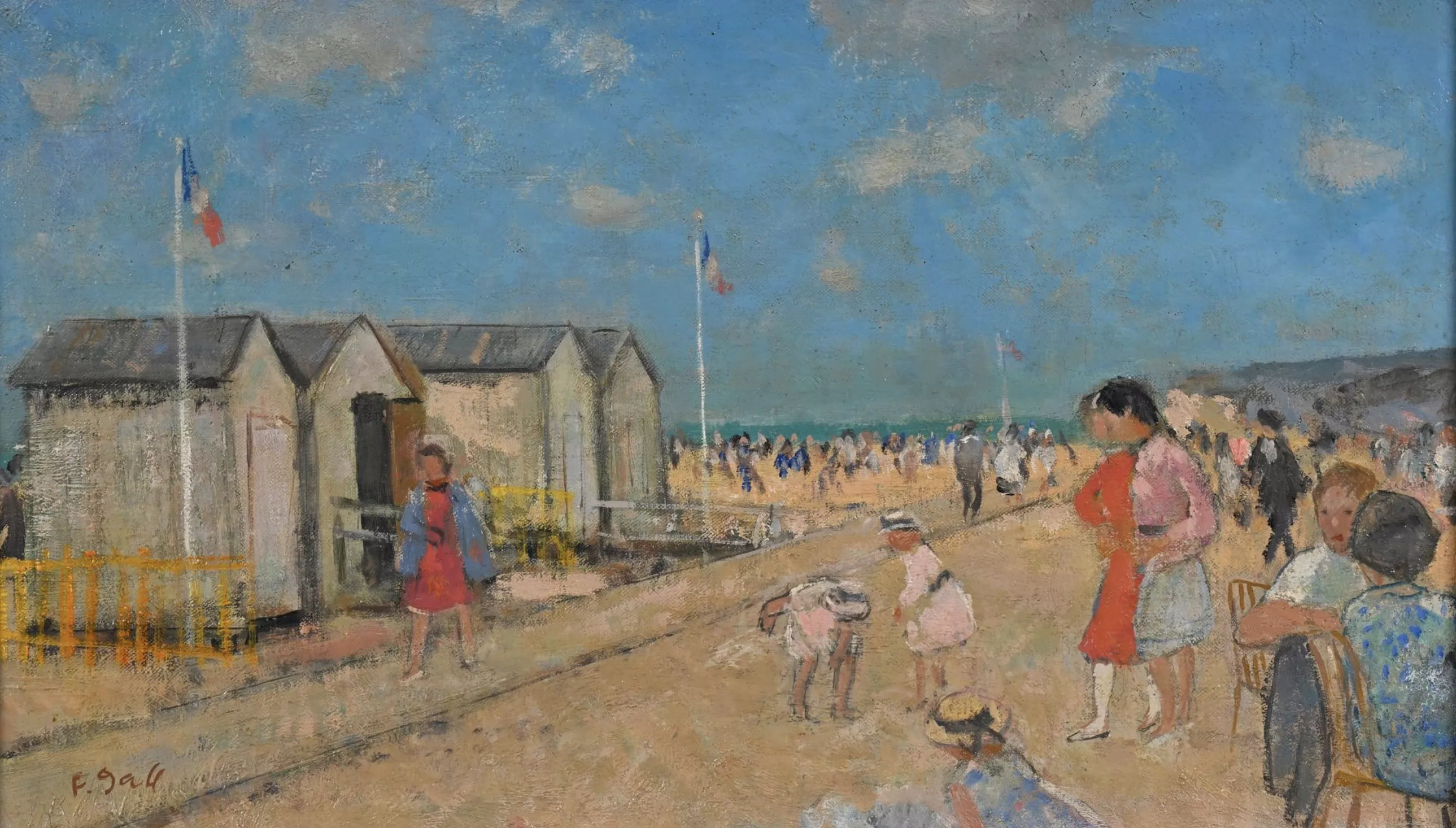
The life and career of François Gall
François Gall (1912-1987) was a Hungarian-born, naturalized French painter whose artistic career was part of the effervescence of twentieth-century Paris.
Born in Cluj-Napoca, in what is now Romania, he developed a passion for painting at an early age and began studying at the Beaux-Arts in Budapest, where he was trained in classical techniques.
Attracted by the Parisian art scene, he moved to France in the 1930s and continued his training at the Académie de la Grande Chaumière, frequenting artists' circles in Montmartre and finding his first supporters in the art world.
He exhibits for the first time at the Salon des Indépendants and, little by little, his post-impressionist work, imbued with light and sensitivity, attracts the attention of art lovers and critics alike.
During the Occupation, Gall continued to paint and exhibit, supported by gallery owners who admired his poetic vision of everyday life.
In the post-war period, he befriended influential artists, including Pablo Picasso, and consolidates his place within the Parisian scene by regularly exhibiting at major salons, such as Salon d'Automne and Salon des Tuileries.
Faithful to the depiction of warm, intimate scenes of life, Gall received several distinctions during his career, including the prestigious Prix Paul-Louis Weiller from the Institut de France.
He devoted much of his career to painting Parisian life and urban landscapes, capturing the unique atmosphere of Paris with aptness and tenderness.
Exhibition François Gall
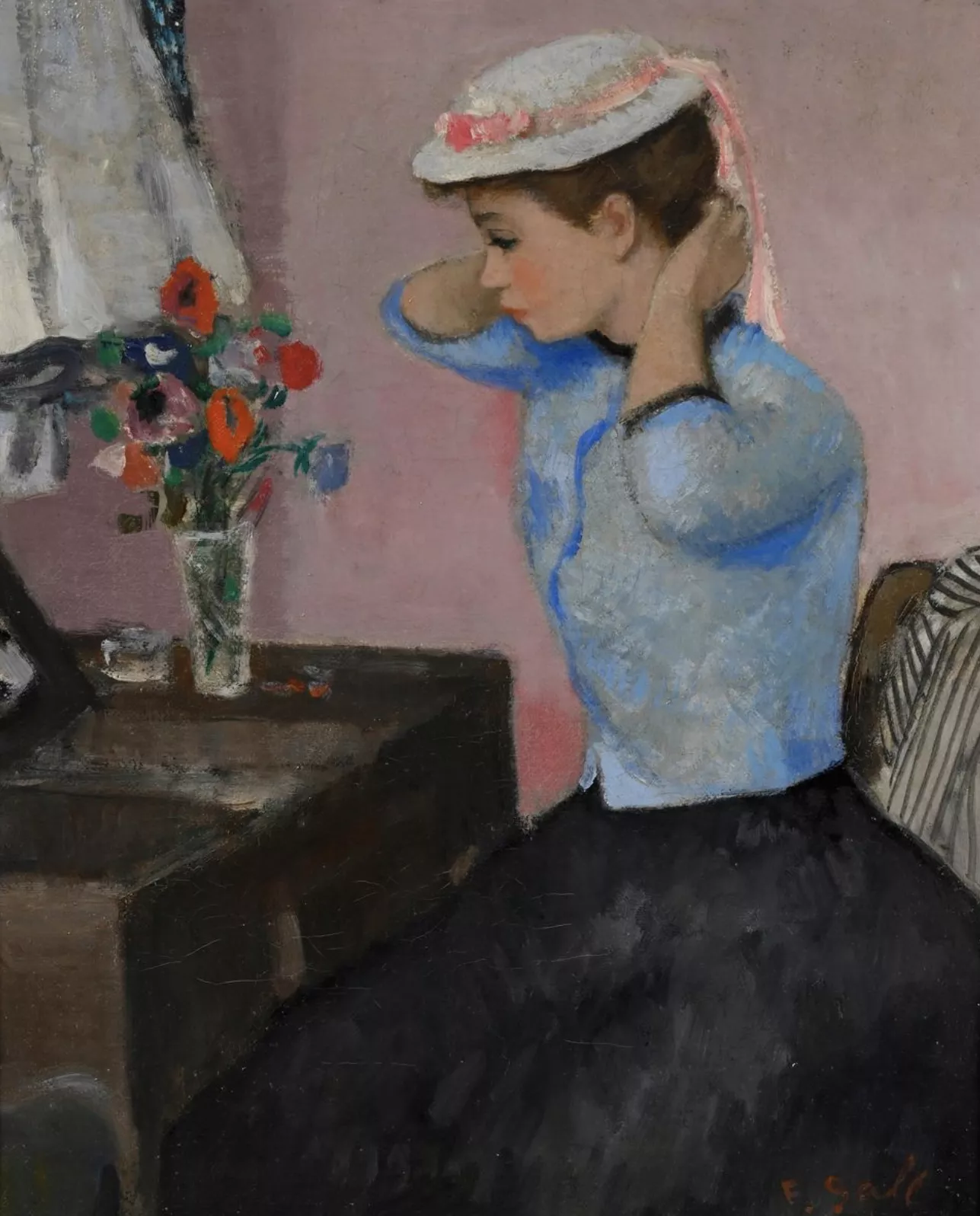
Focus on Jeunes filles au bord de l'eau, François Gall
François Gall, although less famous than some of his post-impressionist contemporaries, asserts himself as an artist with a delicate, sensitive style. His painting Jeunes filles au bord de l'eau perfectly captures the essence of his intimate, poetic vision of everyday life.
It shows two young girls sitting on a riverbank, immersed in gentle conversation, beside a calm, sunlit river. Here, Gall favors a luminous palette dominated by pastel tones, creating a peaceful atmosphere imbued with warmth.
The artist uses light to accentuate the reflections of the water and the soft shadows drawn on the dresses and faces of the young girls, a choice that evokes the play of light prized by the Impressionists.
This theme of childhood and nature, though recurrent in Gall's art, finds a unique, almost meditative expression here, where the moment seems suspended.
In this sense, Jeunes filles au bord de l'eau follows in the footsteps of Impressionist works devoted to quiet moments in the open air, reminiscent of Renoir's paintings and Berthe Morisot's bathing scenes.
The composition is carefully structured: the flowing lines and precise details of the figures contrast slightly with the looser treatment of the landscape, giving an impression of lightness and movement.
Gall, though faithful to a spontaneous approach, retains here a certain rigor in the drawing, particularly in the posture of the young girls and the interplay of shadows, which brings a soothing visual balance.
Through this work, François Gall celebrates not only the beauty of the moment, but also the simplicity and grace of scenes from everyday life.
Post-Impressionism and twentieth-century art criticism
At the beginning of the twentieth century, Post-Impressionism, initially viewed with suspicion, saw its importance reassessed by a changing art criticism. This movement, the successor to Impressionism, took new directions that intrigued and divided observers.
Although controversial for their subjective approach, artists such as Cézanne, Van Gogh and Gauguin gradually began to be recognized for their boldness and ability to go beyond Impressionist research into light and movement.
The first, often unflattering judgments gave way to a more nuanced reading of their work. Influential critic Roger Fry saw in Cézanne's work a redefinition of form and structure, opening up new perspectives on composition and inspiring a whole generation of modern artists.
For Fry, these Post-Impressionist artists no longer seek merely to capture the moment, but to reveal a deeper reality, where color and form express a personal feeling.
Post-Impressionism, far from being limited to an extension of Impressionism, is now seen as a key stage in modernity. Twentieth-century critics saw the movement as a landmark breakaway from convention, heralding the avant-gardes of Cubism and Fauvism.
What was once considered puzzling art became a benchmark for subsequent generations, propelling Post-Impressionism as a pillar of the century's artistic evolution.
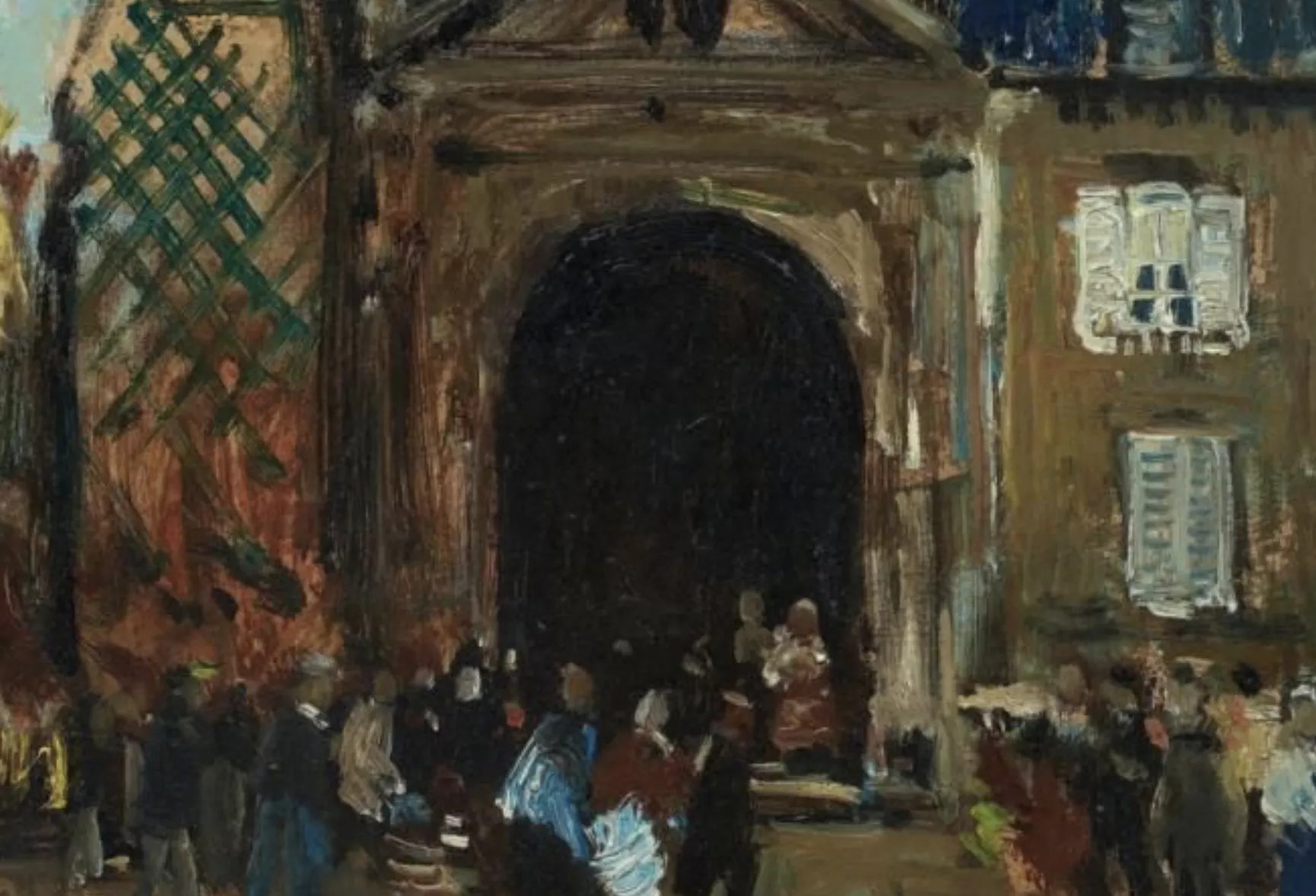
François Gall's imprint on his period
François Gall, although less renowned than some of his contemporaries, marked his era with a sensitive and deeply human figurative style.
In the midst of the 20th century's artistic effervescence, when numerous avant-garde currents were overturning codes, Gall chose to remain faithful to a figurative style imbued with poetry and delicacy.
His work, centered on scenes of Parisian life, intimate portraits and compositions of elegant women, reflects a fascination with the grace and elegance of everyday life. He subtly captures the atmosphere of his time, going beyond simple representation to reveal a certain nostalgia and douceur de vivre.
The critics of the time hailed this singular approach, seen as a return to accessible, sincere painting, in contrast to the more radical experiments of abstraction or surrealism.
Gall succeeded in capturing the emotions of his time while maintaining a classic, assertive style, which inspired a generation of artists seeking to reconcile tradition and modernity.
His influence, discreet but profound, leaves a lasting imprint, reminding us of the importance of sensitivity and emotion in twentieth-century figurative painting.
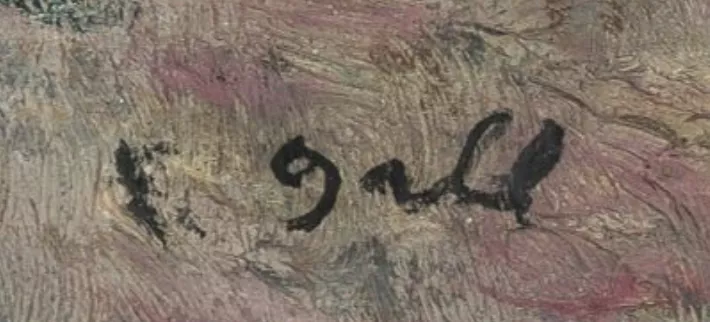
His signature
Not all of François Gall's works are signed.
Although there are variations, here is a first example of his signature:
Expertise your property
If you own a work by François Gall, don't hesitate to request a free appraisal by filling in our online form.
A member of our team of experts and certified auctioneers will contact you to provide an estimate of the market value of your work.
If you are considering selling your work, our specialists will also guide you through the various alternatives available to obtain the best possible price, taking into account market trends and the specific features of each work.
Estimate in less than 24h
Discover in the same theme

Rating and value of works, drawings, paintings by Fernand Lé...
Fernand Léger is a cubist painter of the early 20th century who produced drawings and oil on canvas that are highly prized at auction. Estimated in 24...
Learn more >

Rating and value of paintings, drawings and sculptures by Fr...
François Morellet is a geometric abstraction artist who produces works that are quoted and valued at auction.
Learn more >

Rating and value of paintings by Max Oppenheimer
Max Oppenheimer is an Austrian Expressionist painter who produced many works that are highly valued at auction.
Learn more >
Works from the same period sold at auction

Estimated Gaston BALANDE (1880-1971), Boats at low tide, oil on canvas
Gaston BALANDE (1880-1971), Boats at low tide, oil on canvas

Estimated Between €1,200 and €1,600
Camille HILAIRE (1916-2004), The apple tree in blossom, oil on canvas

Estimated Between €5,000 and €8,000
Jean MIOTTE (1926-2016), acrylic on canvas

Estimated 1.500 - 3.000
Henri MEGE (1904-1984), oil on canvas

Estimated 600 - 1.000
Georges Hanna SABBAGH (1887-1951) "Le moulin Coutot à Chozant" Oil on canvas

Estimated 10.000 - 20.000
Jean Roger SOURGEN (1883-1978), Heather at the foot of the Landes pines, Oil on canvas

Secure site, anonymity preserved

Auctioneer approved by the State

Free and certified estimates
Frequently asked questions
-
Who is François Gall, and what is his artistic background?François Gall (1912–1987) was a Post-Impressionist painter of Hungarian origin who became a naturalized French citizen; he was born in Cluj-Napoca, Romania. Settling in Paris in the 1930s, he distinguished himself with his intimate depictions of Parisian life and urban landscapes, characterized by soft light and a warm color palette. Influenced by Renoir, Degas, and Toulouse-Lautrec, he maintained a sensitive figurative approach throughout the 20th century, remaining faithful to the depiction of everyday life.
-
What are the auction prices for François Gall's works?François Gall’s works sell for between €40 and €39,000, depending on the medium and rarity. Prints and multiples range from €40 to €500, drawings and watercolors from €50 to €10,400, and oil paintings on canvas from €110 to €39,000. Some paintings have far exceeded their estimates, such as the painting *Ballerines laçant leurs chaussures*, which sold for 39,000 € despite being estimated at between 10,000 and 15,000 €.
-
How can you authenticate a work by François Gall?To authenticate a work by François Gall, we recommend that you request a free appraisal from Auctie's by filling out our online form. A state-certified expert or auctioneer will examine the work and provide you with an accurate estimate within 48 hours, with no obligation. This process allows you to verify the authenticity and market value of your item.
-
How does the appraisal process work at Auctie's?Appraisals at Auctie's are free and non-binding. Simply fill out our online form with information about your piece by François Gall. A member of our team of experts and certified auctioneers will contact you to examine the item and provide you with an accurate estimate of its market value within 48 hours.
-
How do I sell a work by François Gall through Auctie's?If you’d like to sell a work by François Gall, Auctie’s will guide you through the process from the initial appraisal to the final sale. After obtaining a free appraisal from our specialists, we’ll guide you through the various sales options available and develop the best strategy to achieve the highest possible price, taking into account market trends and the unique characteristics of your artwork.
