



Rating and value of paintings by Félix Bonnet, dit Tobeen

Key takeaways
- A leading painter of the School of Paris, Tobeen (1880–1968) enjoys considerable recognition among collectors, with prices ranging from 20 to 334,000 euros.
- His paintings sell for between 160 and 360,500 euros, including the oil painting “Pelotaris” (1912), which sold for 360,500 euros in 2013, while his prints and drawings range from 150 to 4,500 euros.
- A unique Cubist influenced by the Bateau-Lavoir, Tobeen developed a more lyrical and poetic approach than Picasso or Braque, enriched by the landscapes of the Basque Country.
If you own a work by or based on the artist Tobeen and would like to know its value, our state-approved experts and auctioneers will guide you.
Our specialists will carry out a free appraisal of your work, and provide you with a precise estimate of its value on the current market.
Then, if you wish to sell your work, we will direct you to the best possible arrangement to obtain the optimum price.
Rating and value of the artist
An important painter of the École de Paris, Félix Bonnet, whose artist name is Tobeen, enjoys certain recognition on the art market.
His works, steeped in Cubism, are popular in auction rooms and sought after by collectors, and the price at which they sell on the auction market ranges from €20 to €334,000.
As such, a work by Tobeen can fetch hundreds of thousands of euros at auction, as evidenced by his oil on canvas Pelotaris, dating from 1912 sold for over €360,500 in 2013, while it was estimated at between €400,700 and €52,300.
Order of value from the most basic to the most prestigious
Technique used | Result |
|---|---|
Estamp - multiple | From €150 to €2,900 |
Drawing - watercolor | From €160 to €4,500 |
Painting | From €160 to €360,500 |
Estimate in less than 24h
The life of Tobeen
Born in Bordeaux in 1880 under the name of Félix Bonnet, Tobeen is an artist whose career embraces the major currents of early 20th-century art, while retaining a rare singularity.
From a modest family, he discovered engraving and drawing at an early age, which led him to move to Paris at the turn of the century, in search of an artistic career.
Tobeen quickly moved into the Parisian effervescence, where he befriended the avant-gardes of the time, most notably the cubists he rubbed shoulders with at the Bateau-Lavoir.
Influenced by the geometric rigor of cubism, he nevertheless developed a pictorial sensibility that set him apart from his contemporaries. While Braque and Picasso focused on deconstructing form to reveal its essence, Tobeen was more lyrical in his approach.
He participated in the Salon d'or exhibition with the Duchamp brothers, notably the cubist Jacques Villon.
His compositions, often marked by landscapes of the Basque country, abound in softness and harmony, where color seems to breathe freely, dialoguing with form. Tobeen's cubism is neither dry nor purely analytical, but rather invites a serene, almost poetic contemplation of the world.
The artist doesn't limit himself to painting. He also excels in the art of engraving, and his commitment to modernity leads him to experiment with several artistic techniques, while remaining true to his love of natural, traditional motifs.
Rooted in his native land, he continues to draw on Basque landscapes, their reliefs, their changing lights, nourishing his work with a narrative depth rarely equaled in cubism.
Tobeen, though discreet on the international art scene, leaves behind a rich and personal oeuvre. His singular vision, subtly blended with the major trends of his time, lends his art a precious timelessness.
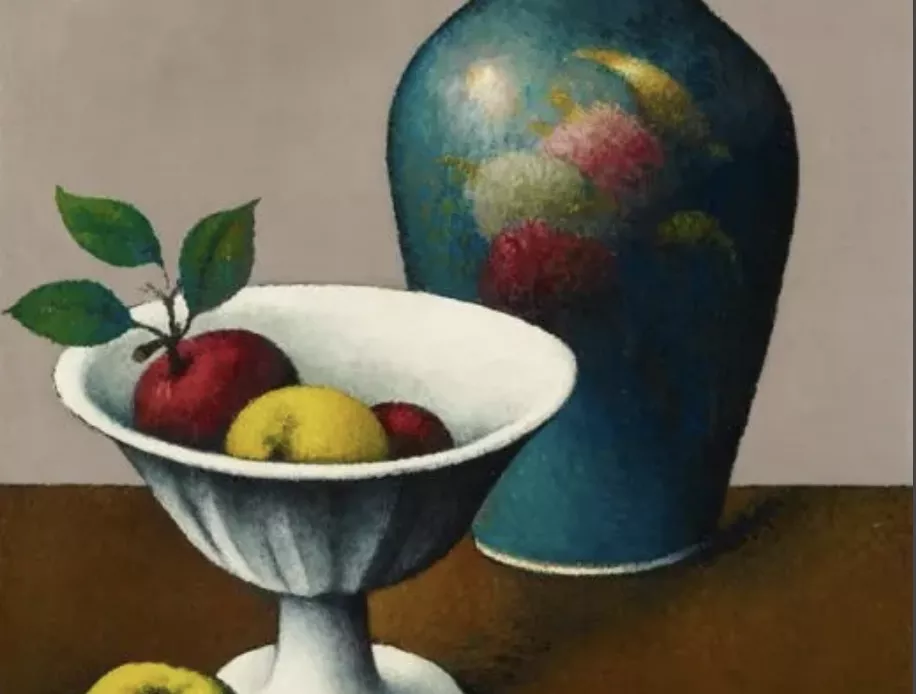
Focus on the painting Paysage basque, Tobeen, 1911
Born in Bordeaux in 1880 under the name Félix Bonnet, Tobeen is an artist whose career embraces the major currents of early 20th-century art, while retaining a rare singularity.
From a modest family, he discovered engraving and drawing at an early age, which led him to move to Paris at the turn of the century, in search of an artistic career.
Tobeen quickly moved into the Parisian effervescence, where he made friends with the avant-gardes of the time, particularly the cubists he rubbed shoulders with at the Bateau-Lavoir.
Influenced by the geometric rigor of cubism, he nevertheless developed a pictorial sensibility that set him apart from his contemporaries. While Braque and Picasso strove to deconstruct form in order to reveal its essence, Tobeen's approach was more lyrical.
His compositions, often marked by landscapes of the Basque country, abound in softness and harmony, where color seems to breathe freely, in dialogue with form. Tobeen's cubism is neither dry nor purely analytical, but rather invites a serene, almost poetic contemplation of the world.
The artist doesn't limit himself to painting. He also excels in the art of engraving, and his commitment to modernity leads him to experiment with several artistic techniques, while remaining true to his love of natural, traditional motifs.
Rooted in his native land, he continues to draw on Basque landscapes, their reliefs, their changing lights, nourishing his work with a narrative depth rarely equaled in cubism.
Tobeen, though discreet on the international art scene,leaves behind a rich and personal body of work. His singular vision, subtly blended with the major trends of his time, lends his art a precious timelessness.
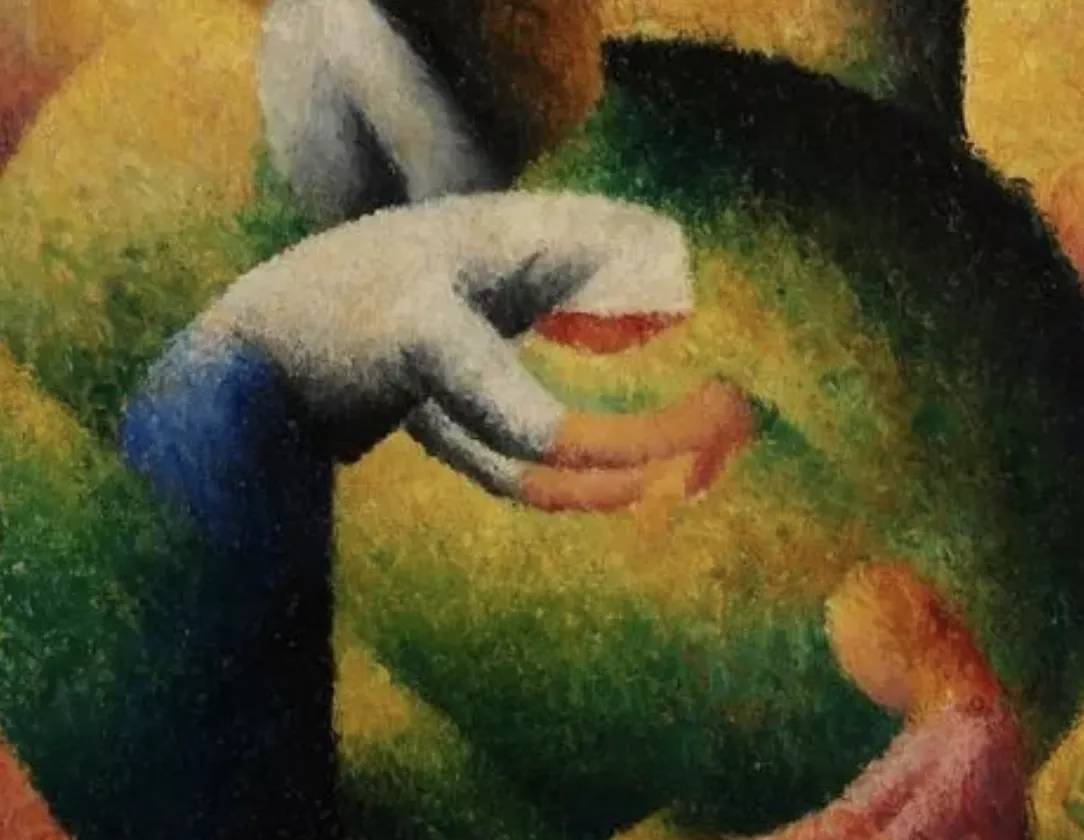
Tobeen and Cubism
Tobeen, whose real name was Félix Elie Bonnet, occupies a singular place in art history, particularly within the Cubist movement, which he interpreted with his own sensibility.
Born in Bordeaux in 1880, Tobeen is often associated with the École de Paris, where he developed his approach to Cubism, without however locking himself into the strict rules of this movement.
While the major figures of Cubism, such as Picasso and Braque, deconstruct forms in a rigorous geometric fragmentation, Tobeen stands out for a more poetic and accessible style, in which abstraction never sacrifices the link with tangible reality.
If we compare his work to that of Braque or Picasso, we immediately notice that Tobeen does not seek to dislocate the subject to the point of incomprehensibility.
Where the two cubist pioneers carry their compositions away in an almost hermetic complexity, Tobeen prefers a gentler simplification of form.
His painting adopts a clear, structured geometry, yet retains an immediate legibility, giving his works an almost narrative quality.
Take, for example, his landscapes of the Basque country: houses, trees, hills are not dissolved into a mosaic of planes and angles, but rather shaped into rounded, almost sculptural forms that invite contemplation rather than deconstruction.
In this respect, Tobeen's approach is more reminiscent of Fernand Léger, another artist who humanized Cubism. Like Léger, Tobeen injects his compositions with a warmth and fluidity that contrasts with the colder rigor of analytical cubism.
With Léger, this translates into an almost industrial monumentality of form; with Tobeen, it's more of an organic approach, where natural elements seem to vibrate under the brush, as in a peaceful scene suspended in time.
It could be said that Tobeen reconciles cubism with a more romantic vision of landscape, one in which nature retains its evocative power despite the geometric reduction of forms.
In this search for balance between modernity and tradition, Tobeen can also be compared to another Basque painter, Jean-Emile Laboureur. Both anchor their cubism in a terroir, in scenes of life and landscapes that resonate with a certain rural simplicity.
But where Laboureur tends towards an almost linear graphic minimalism, Tobeen prefers more carnal compositions, where curves and color take center stage. It is this tension between abstraction and sensuality that sets Tobeen apart in the context of Cubism.
In addition, Tobeen's palette also differs from that of his contemporaries. Where the Cubists liked to exploit sober hues, often dominated by grays, ochres and browns, Tobeen adopts brighter, more contrasting colors, while remaining in a soft, balanced harmony.
His greens and reds, though stylized, retain an earthy quality that reinforces the anchoring of his subjects in an identifiable reality. It's a cubism with landscape accents, where abstraction never completely erases the immediate recognition of the motif.
In the final analysis, Tobeen positions himself as a singular cubist, at the crossroads of several influences. Where Picasso and Braque push abstraction to its limits, he uses Cubist language to celebrate the everyday, landscape and nature.
This approach echoes a need for reconciliation between the avant-garde and a pictorial tradition more rooted in the direct representation of the world. Tobeen is, in this sense, a precursor of a humanized Cubism, an artist who manages to strike a delicate balance between formal modernity and poetic evocation.
In his works, nature is structured into refined forms without losing its emotional dimension, making him a figure apart in the panorama of European Cubism.
Tobeen's imprint on his time
Tobeen is a painter little known to the general public today, but who nevertheless occupies a prominent place on the art market.
His works are prized by collectors, who play the greatest role in preserving his work even though some are kept in museums and open to the public.
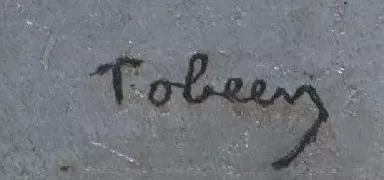
His signature
Not all of Tobeen's works are signed.
Although there are variations, here is a first example of his signature:
Expertise your property
If you own a work by Tobeen don't hesitate to request a free appraisal by filling in our online form.
A member of our team of experts and licensed auctioneers will contact you to provide an estimate of the market value of your work.
If you are considering selling your work, our specialists will also guide you through the various alternatives available to obtain the best possible price, taking into account market trends and the specific features of each work.
Estimate in less than 24h
Discover in the same theme

Rating and value of paintings by Lucien Goubert
Lucien Goubert is a twentieth-century marine painter who produced drawings and oils on canvas that are appreciated and quoted at auction.
Learn more >

Rating and value of paintings by Adolf Weber
Adolf Weber is a twentieth-century Swiss Impressionist painter who produced works that are quite highly rated and have value at auction.
Learn more >

Rating and value of paintings by Joseph Inguimberty
Joseph Inguimberty is a twentieth-century French painter who worked in Indochina, producing works that are highly regarded and valued.
Learn more >
Works from the same period sold at auction

Estimated Between €1,200 and €1,600
Camille HILAIRE (1916-2004), The apple tree in blossom, oil on canvas

Estimated Between €5,000 and €8,000
Jean MIOTTE (1926-2016), acrylic on canvas

Estimated 1.000 - 1.500
Roberto MATTA (1911-2002), The source of calm, carborundum etching

Estimated 20.000 - 30.000
Chaffic ABBOUD (1926-2004) "La visite", Oil on canvas

Secure site, anonymity preserved

Auctioneer approved by the State

Free and certified estimates
Frequently asked questions
-
Who was Tobeen, and what is his significance in art history?Tobeen, whose real name was Félix Elie Bonnet (1880–1966), was a leading painter of the École de Paris. Born in Bordeaux, he moved to Paris at the turn of the 20th century, where he rubbed shoulders with the Cubist avant-garde at the Bateau-Lavoir. He distinguished himself from Cubists such as Picasso and Braque through a more lyrical and poetic approach, while maintaining an immediate clarity in his subjects, particularly his famous landscapes of the Basque Country.
-
What is the price range for Tobeen's works at auction?Prices vary considerably depending on the medium and the rarity of the work. Prints and multiples range from €150 to €2,900, drawings and watercolors from €160 to €4,500, while paintings fetch between €160 and €360,500. Some major works, such as the 1912 oil on canvas “Pelotaris,” have fetched over €360,000 at auction.
-
How do I have a Tobeen artwork authenticated and appraised?Auctie's offers a free, no-obligation appraisal of your artwork. Simply fill out an online form, and a state-certified expert or auctioneer will contact you within 48 hours to provide an accurate estimate of the current market value of your painting, drawing, or print.
-
What artistic techniques did Tobeen master, and which one is the most sought-after?Tobeen excels in several techniques: painting (oil, watercolor), drawing, and printmaking. His paintings are the most sought-after by collectors and fetch the highest prices. However, his prints and drawings also retain great value and offer a good alternative for acquiring his work at more affordable prices.
-
How do I sell a work by Tobeen, and what is the process at Auctie's?Auctie's guides you from the appraisal stage all the way through to the auction. After a free appraisal, our specialists will help you choose the best sales approach, taking into account market trends and the unique characteristics of your artwork, thereby ensuring you achieve the best possible price at auction.
