



Rating and value of paintings by Vasily Surikov

Key takeaways
- A Russian realist painter (1848–1916), Surikov’s works sell for between €200 and €66,000, depending on the medium and rarity.
- Oil-on-canvas paintings fetch higher prices (up to €66,000) compared to watercolor drawings (up to €42,600); his painting *The Dance of the Golden Calf* sold for €66,000 in 2006.
- His historical compositions are distinguished by a spatial composition without a central focal point, utilizing non-linear perspective and prioritizing internal tension over spectacle.
If you own a work by or after the artist Vassili Sourikov, and would like to know its value, our state-approved experts and auctioneers will offer you their appraisal services.
Our specialists will carry out a free appraisal of your work, and provide you with an accurate estimate of its value on the current market.
Then, should you wish to sell your work, we will direct you to the best possible arrangement to obtain the optimum price.
Rating and value of the artist Vasily Surikov
Surikov is a Russian-born painter who is relatively unknown to the general public. He leaves behind a unique artistic repertoire characteristic of Russian realism.
This legacy consists of paintings that are predominantly oils on canvas. At present, prices for his works are flying off the auctioneers' hammers.
His paintings and other works are particularly prized, especially by European and American buyers, and the price at which they sell on the art market ranges from €200 to €66,000, a considerable delta but one that speaks volumes about the value that can be attributed to Surikov's works.
In 2006, his composition The Dance of the Golden Calf, dating from 1870, sold for €66,000 in Germany, while it was estimated at between €8,000 and €12,000.
Order of value from a simple work to the most prestigious
Technique used | Result |
|---|---|
Drawing - watercolor | From €200 to €42,600 |
Oil on canvas | From €280 to €66,000 |
Estimate in less than 24h
Style and technique by artist Vassili Sourikov
In Vassili Sourikov's painting, composition retains this function of narrative structuring, of organizing space through movement, of actively distributing figures in the field.
It is not based on an imposed centrality, but on a series of lateral tensions, shifts and multiple circulations. The eye doesn't follow a line, it explores. The scene is built by density, by opposition of masses, by breaks in rhythm.
Color doesn't seek harmony, it imposes contrasts. It distinguishes, supports and distributes. Light doesn't model, it unifies. It spreads out, it envelops, it binds forms together.
Figures are not accessories to the narrative. They participate in the logic of the surface. Each body, each posture, each face takes its place in a system of balance where narrative never erases construction.
Space acts, it weighs, it frames. The ground, the architecture, the background do not serve as decor: they support the dynamics of the painting.
With Surikov, history painting becomes an overall architecture. Its aim is not to illustrate an episode but to condense a duration, to freeze a tension. The image works in blocks, by interlocking, by taking hold. It imposes a structure.
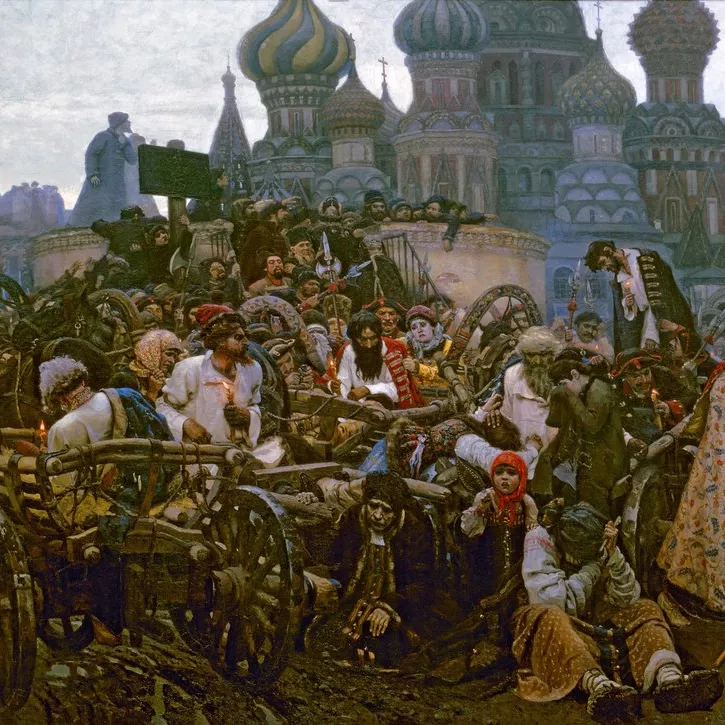
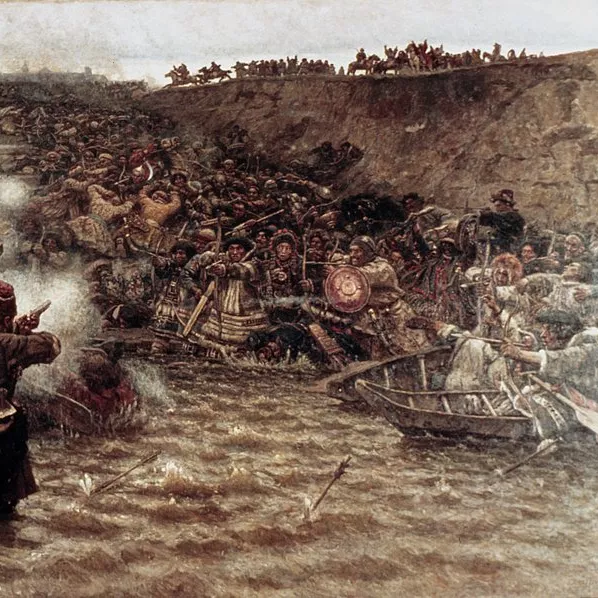
Vassily Surakov, his life, his work
Vassily Ivanovich Surikov (1848 - 1916), was a Russian painter who belonged to the Realism movement.
The artist was born in Krasnoyarsk, in present-day Siberia. He came from a family of Cossacks. His studies were fairly general, and he managed to move to St. Petersburg thanks to a patron, where he studied painting at the Imperial Academy of Fine Arts.
He was trained by Pavel Tchistiakov. From 1877, the artist moved to Moscow, where he created frescoes for the Cathedral of the Holy Savior. Four years later, in 1881, he joined the movement of itinerant painters.
He developed a special way of conceiving space, employing non-linear perspective, which allowed for a particular originality especially with regard to the movement of figures.
He was appointed a full member of the St. Petersburg Academy of Arts in 1893. At the end of his career, he traveled to Spain and returned to his hometown as a painter, where he probably produced the last painting of his career, the Annunciation.
In 1915, the artist was forced to seek medical treatment in the Crimea. He died some time later, in 1916, in Moscow.
Today, the Moscow Art Institute bears his name. In 1948, his hometown helped transform his house into a museum, where some of his works are preserved, although the majority are in the Russian Museum and the Tretyakov Gallery.
Focus on The Execution of Princess Sofia, Vasily Surikov, 1871
In The Execution of Princess Sofia (1879), the composition is based on a tense horizontality, with no center, no opening. The ground rises, the sky weighs down, the figures line up in a cut, jagged rhythm.
No movement crosses the image, nothing guides the gaze: it slides from one group to another, from a closed face to a stopped gesture. The princess, isolated, upright, framed by the architecture, occupies a place that is neither dominant nor marginal.
Her body does not resist, it waits. The crowd in front doesn't oppose, it watches. This face-to-face encounter doesn't produce action, it freezes a state.
The light, diffused, with no point of origin, envelops the scene in a gray tone. It evens out the planes, extinguishes contrasts. Color builds opaque masses, compact wholes.
Dresses, coats and veils form continuous, vibration-free surfaces. Snow on the ground cancels out shadows, crushes footsteps. No dramatic effect, no sparkle. What plays out here is not an execution, but a suspended time.
Expressions do not vary, gestures are reduced to their minimum. The image doesn't illustrate an event, it holds it back, prevents it. With Surikov, history painting doesn't reconstruct the past, it stabilizes it.
It imposes a slow matter, where each figure becomes a fixed point in a space that refuses any resolution. The scene doesn't tell itself, it holds itself.
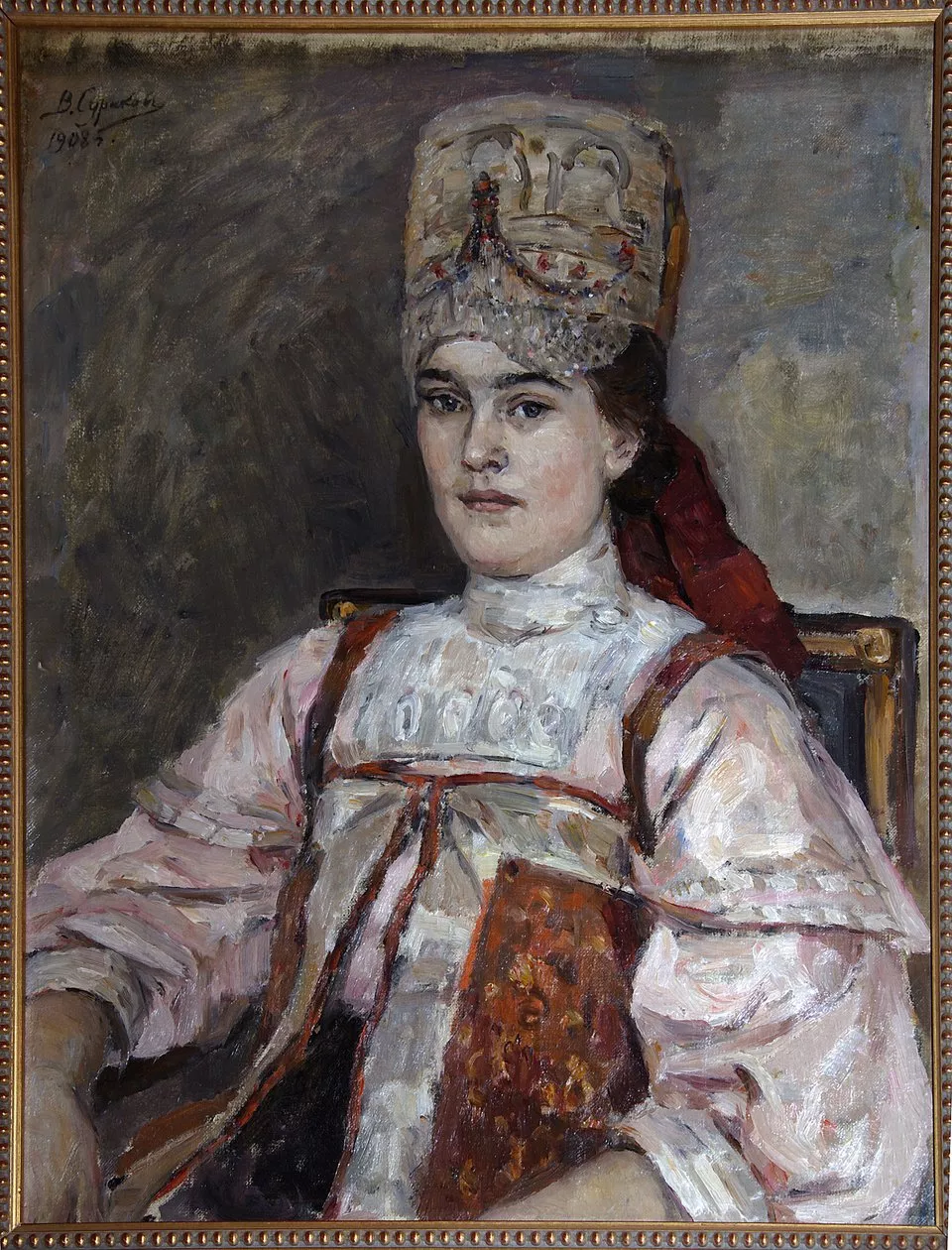
Vassili Sourikov's imprint on his period
In Vassili Sourikov's painting, history is not used as a pretext for illustration, it becomes a building material. He does not seek to exalt the past, nor to freeze it in an expected grandeur.
He extracts from it situations of instability, scenes of waiting, moments with no way out. The figure is not heroic; it is caught in a space that encloses it. The group celebrates nothing, it withdraws, it absorbs itself.
At a time when history painting tended towards the spectacular or the didactic, Surikov imposed another logic: that of internal tension, of blocking, of silence.
His influence is exerted in this way of keeping the narrative at a distance. He doesn't tell, he arranges. He doesn't explain, he poses. He installs figures in a saturated space, where each element acts not through movement but through its presence.
This plastic rigor, this frontality without emphasis, this density without excess mark a lasting inflexion in Russian painting. He doesn't break with tradition, he shifts its rules.
He transforms the historical scene into a heavy, organized surface with no openings. This discreet but constant shift defines the imprint he leaves on his period.
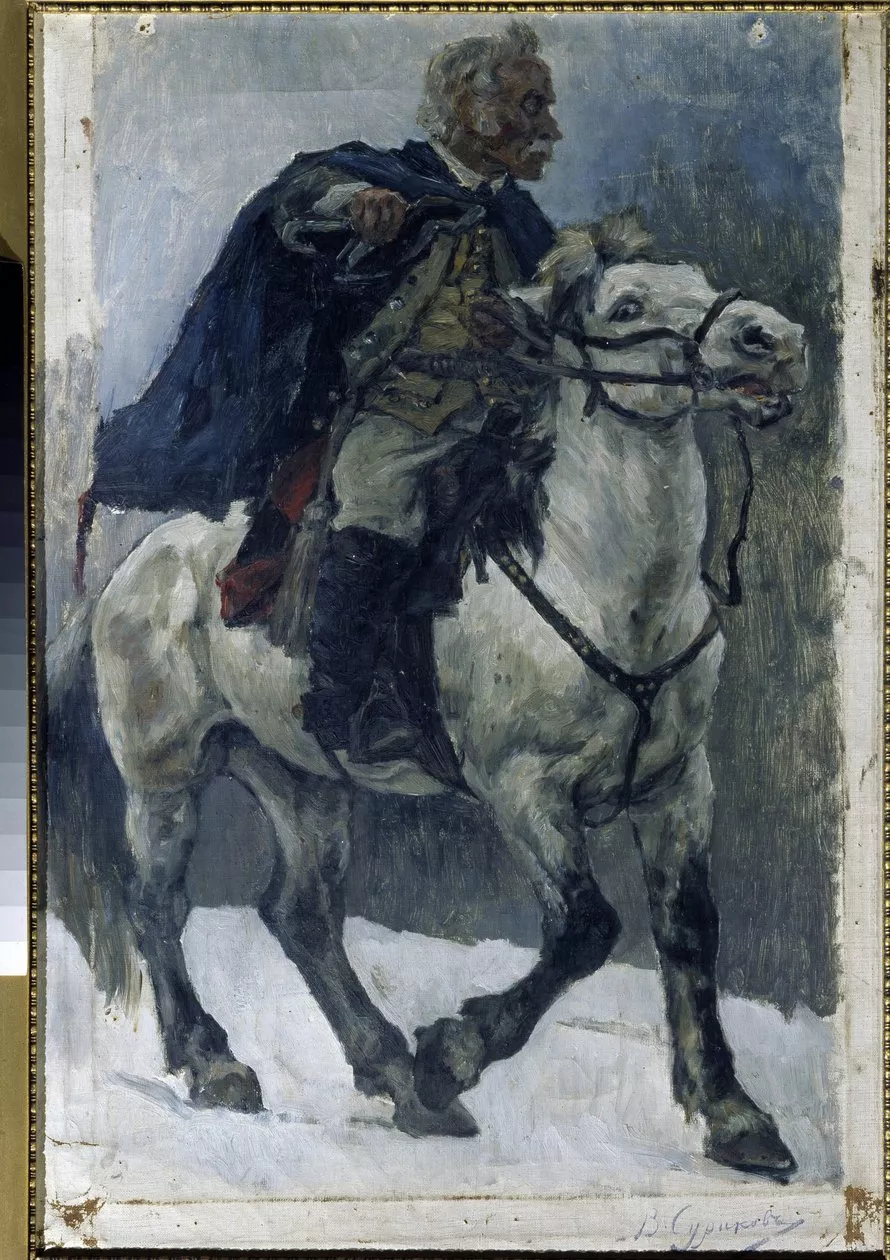
Vassili Surikov's stylistic influences
In Vassili Surikov's painting, the influence of academicism remains visible in the rigor of the drawing, in the solidity of the constructions, in the control of the figures. He knows the rules, he applies them, but without submitting to them entirely.
Unlike a Karl Brioullov, he doesn't seek dramatic impetus, he holds back. Unlike Ivan Aïvazovski, he rejects light effects, the spectacular, surface movement.
His link with the itinerant painters (the Peredvizhniki) goes deeper: like them, he seeks a national scene, a historical anchor, a painting of content. But with him, the subject is never didactic. He doesn't denounce, he observes. He doesn't comment, he installs.
The relationship to Répine is often evoked, but the logic differs. Repine builds on contrast, expressive tension and the dramatization of gestures. Sourikov, on the contrary, organizes by density, by distribution, by silence.
The figure doesn't express itself, it weighs down. Space doesn't open up, it frames. In this restraint, in this tight construction, we find a closeness to certain paintings of Alexeï Savrassov or Arkhip Kouïndji, but without the atmospheric dimension, without the lyricism.
In Surikov, the influence is digested, restrained, transformed into a syntax of his own. He doesn't quote, he rewrites. He integrates without embellishing. It is in this way of diverting codes without breaking them that his position in the Russian painting of his time is defined.
Vassily Sourikov's signature
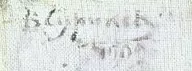
Vassily Sourikov signs his canvases most of the time. However, it is preferable to have your work appraised to ensure its authenticity.
Knowing the value of a work
If you happen to own a work by or after Vasily Surikov, don't hesitate to request a free appraisal using our form on our website.
A member of our team of experts and licensed auctioneers will contact you promptly to provide you with an estimate of the market value of your work, as well as ad hoc information about it.
If you are considering selling your work, you will also be accompanied by our specialists in order to benefit from alternatives for selling it at the best possible price, taking into account the inclinations of the market.
.Estimate in less than 24h
Discover in the same theme

Rating and value of works, paintings, drawings by John Const...
John Constable was a romantic painter of the 19th century, who produced many paintings. His works are highly prized and worth a great deal of money.
Learn more >

Rating and value of paintings by Victor Léon Dupré
Victor Léon Dupré was a landscape painter of the Fontainebleau School who produced works that are highly regarded and valued at auction.
Learn more >

Rating and value of paintings, drawings and engravings by Je...
Jean-François Millet is a twentieth-century naturalist painter quoted on the art market, who has produced works of great value.
Learn more >
D'autres tableaux russes anciens vendus aux enchères


Secure site, anonymity preserved

Auctioneer approved by the State

Free and certified estimates
Frequently asked questions
-
Who is Vasily Surikov, and what is his artistic background?Vasily Surikov (1848–1916) was a leading Russian painter of the Realist movement, trained at the Imperial Academy of Fine Arts in Saint Petersburg. He joined the Peredvizhniki movement in 1881 and distinguished himself through an innovative approach to history painting, using non-linear perspective to create a unique spatial dynamic. His works, held notably at the Russian Museum and the Tretyakov Gallery, had a profound influence on Russian painting of his time.
-
What is the price range for Surikov's paintings and drawings?Prices for Sourikov's works range from €200 to €66,000, with significant variation depending on the medium and the quality of the work. Drawings and watercolors generally range from €200 to €42,600, while oil paintings on canvas, which are more prestigious, can fetch up to €66,000. For example, “The Dance of the Golden Calf” (1870) sold for €66,000 in 2006, far exceeding its initial estimate.
-
How can you authenticate a work by Sourikov and determine its exact value?To authenticate a work of art and obtain an accurate estimate, Auctie's offers a free, no-obligation appraisal conducted by state-certified experts and auctioneers. We recommend having your artwork appraised even if it bears the artist’s signature, as this process guarantees confirmation of its authenticity and a reliable assessment of its current market value.
-
Is this the right time to sell a work by Surikov?Yes, this is a good time to sell a work by Sourikov. Demand for his paintings and drawings continues to rise, particularly among European and American buyers, and the art market for this type of work is showing a positive trend. Prices continue to rise, especially for oil-on-canvas works and major historical compositions.
-
How does the appraisal and sale of a work of art take place at Auctie's?The process begins with a request for a free estimate via the online form. A certified expert or auctioneer will contact you within 48 hours to provide you with an estimate of the value and detailed information about the artwork. If you decide to sell, Auctie's will guide you every step of the way, exploring the best options to achieve the highest possible price while taking market trends into account.
