



Rating and value of paintings by Serguei Vinogradov

Key takeaways
- A 19th-century Russian painter (1869–1938), Sergei Vinogradov combined realism and impressionism with his characteristic luminous technique.
- His works sell for between €130 and €628,500 depending on the medium (prints, watercolors, paintings), with a record sale in 2010 that exceeded the estimate by more than four times.
- An internationally recognized artist who has exhibited in Paris, Berlin, and New York, he influenced modern Russian art by blending academic traditions with Impressionist modernity.
If you own a work by or after the artist Serguei Vinogradov, and would like to know its value, our state-approved experts and auctioneers will offer you their appraisal services.
Our specialists will carry out a free appraisal of your work, and provide you with an accurate estimate of its value on the current market. Subsequently, if you wish to sell your work, we will guide you towards the best device to obtain an optimal price.
Rating and value of the artist
Considered one of the most famous and talented Russian painters of the 19th century, Sergei Vinogradov is the author of a significant production, which attracts many collectors every year.
On the art market, the price at which his works sell ranges from €130 to €628,500, a considerable delta but one that speaks volumes about the value that can be attributed to Serguei Vinogradov's works.
In 2010, his painting View of Ai-Petri, Crimea, dating from 1916, sold for €628,500, while it was estimated at between €120,000 and €180,000, more than four times its low estimate, suggesting strong upside potential for the artist.
Order of value from a classic work to the most prestigious
Technique used | Result |
|---|---|
Estamp - multiple | From €600 to €1,000 |
Drawing - watercolor | From €250 to €9,800 |
Painting | From 130 to 628 500€ |
Estimate in less than 24h
Sergei Vinogradov's style and technique
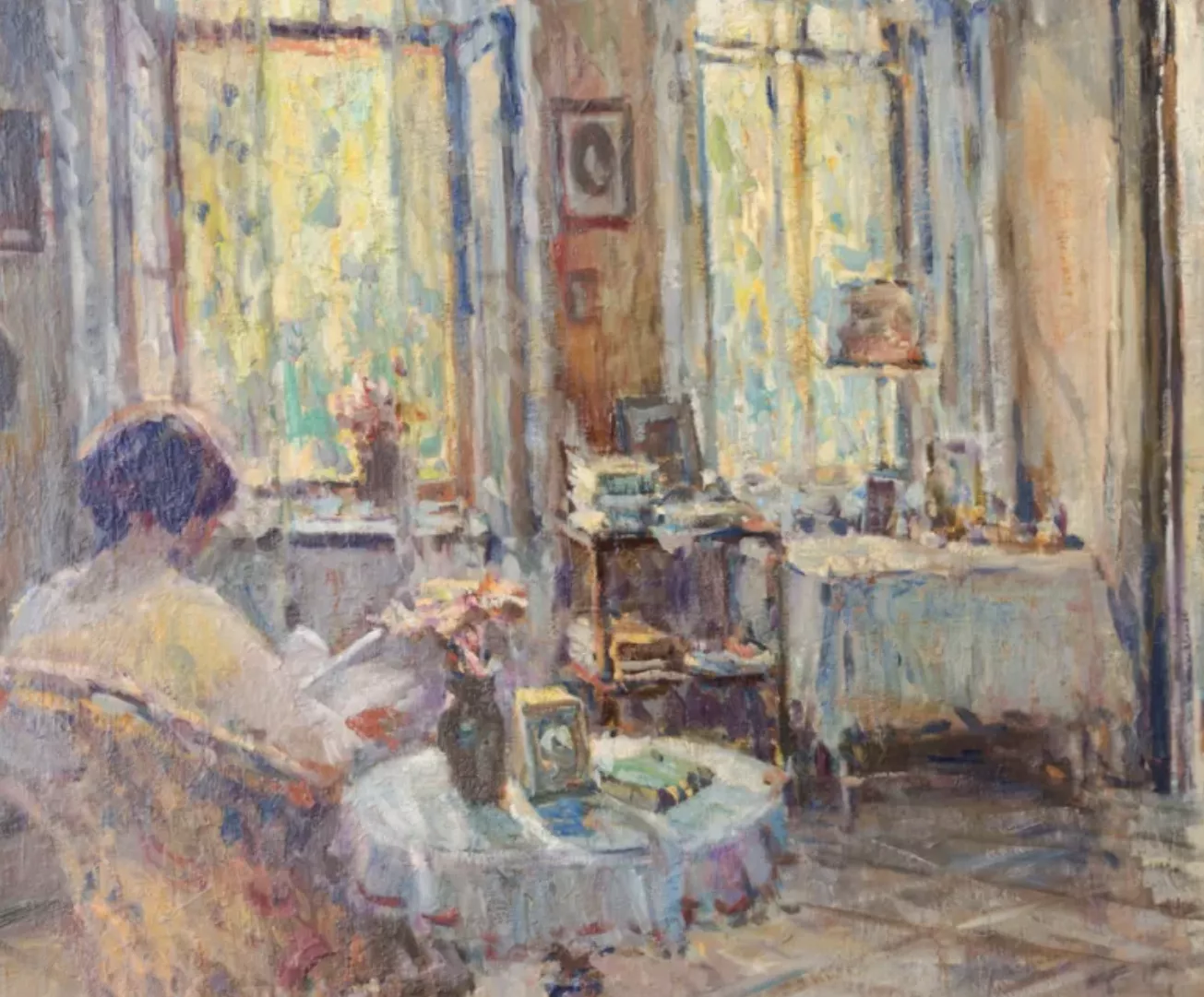
Sergei Vinogradov's style is characterized by luminous, impressionistic painting; he adopts a painterly approach in which light plays a decisive role. His color palette is bright and vibrant.
The visible brushstrokes he applies are reminiscent of Western Impressionism. In his landscapes and interior scenes, he conveys a soft, warm atmosphere, with light as a structuring element.
The touch he infuses into his paintings is free and dynamic, and his rapid, expressive brushstrokes lend his compositions a particular spontaneity and energy. Vinogradov chooses to superimpose light layers of paint, blending juxtaposition and transparency.
Thus, he reinforces the effect of movement and vibration in his canvases. Paying particular attention to the play of reflections and textures, he almost succeeds in creating several dimensions and retranscribing the mood of the scene, whether it's his bourgeois interiors, rural landscapes or flowery gardens.
Serguei Vinogradov also pays particular attention to framing and perspective. Thinking of his compositions as moments in life, he achieves original framing apt to freeze the reality of everyday life.
The angles of view he uses are varied, alternating between plunging and counter-plunging, enabling him to give particular depth and dynamism to his scenes.
The artist also works on a balance between realism and impressionism, like many of his fellow artists in Russia. He is influenced by the Russian realist tradition, but distances himself from it with a freer approach to color and drawing.
Seeking to blend nature and architecture in chromatic harmony, he seeks more the suggestion of an atmosphere than the precision of form.
The painter also asserts a certain taste for intimate scenes, and imposes his stylistic identity through paintings of elegant, hushed interiors, aptly capturing the atmosphere of the Russian intellectual bourgeoisie.
He exudes a certain nostalgia for a bygone era, and excels particularly in depicting salons, libraries and private gardens.
His work is imbued with a certain influence of Western modernism, drawing especially on the French Impressionists and Post-Impressionists - stylistically approaching artists such as Monet, Renoir or Bonnard.
Vinogradov's technique constantly evolved during his career, his style softening and becoming more fluid. He favors quick sketches combined with material effects rather than rigorous drawing.
His versatility allows him to explore a wide range of visual effects, sometimes in thick, vivid strokes and sometimes in the form of light glazes.
The life of Serguei Vinogradov
Serguei Vinogradov (1869 - 1938), was a Russian painter who oscillated between realism and impressionism.
Born in Nekrassovskoye, he trained from 1880 to 1889 at the Moscow School of Painting, Architecture and Sculpture. He studied with Sorokine, Makovski, Polenov and others.
In 1888, he received his artist's status. From 1889, he studied in Boris Willewade's studio, then Carl Weinig's, at the Academy of Fine Arts in St. Petersburg.
During this period, he became a member of the Compagnie des Ambulants.
In 1903, he was a founder of the Society of Russian Artists.
He quickly gained recognition, which enabled him to teach from 1898 to 1913 at the Stroganov Academy in Moscow. In 1912, he was appointed Academician, and became a full member of the Academy in 1916.
During the war, he produced several posters for the Russian Red Cross. Like many of his colleagues, the war forced him to immigrate to Latvia. He taught there for a few years and died in Riga.
During his career, he held several exhibitions in Düsseldorf, Paris, Berlin, Munich, Prague, New York and Riga, giving him international exposure and enabling him to sell his work to numerous collectors.
.Focus on A Summer Afternoon, Serguei Vinogradov
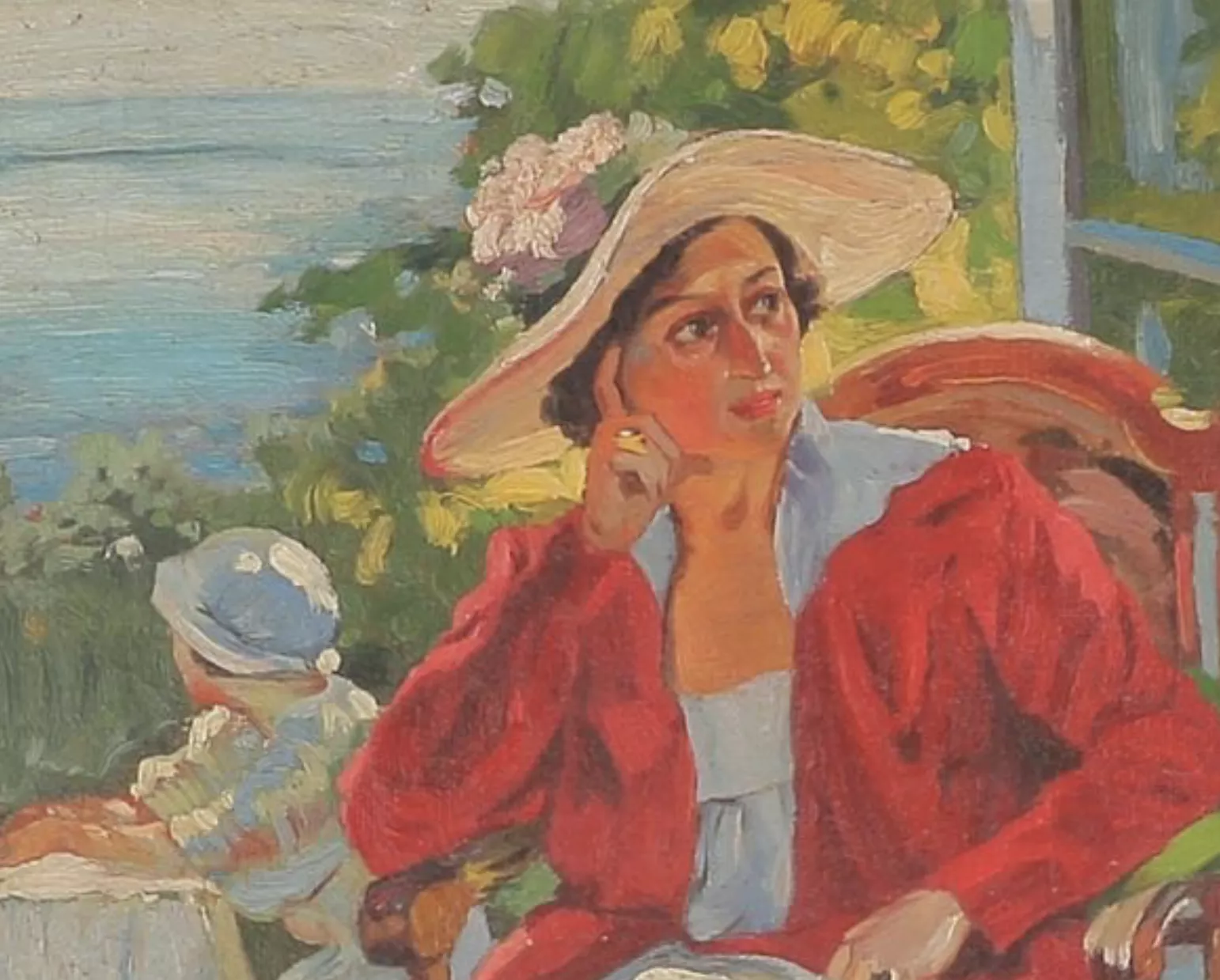
In A Summer Afternoon, Vinogradov creates a peaceful, vibrant atmosphere through an impressionist technique, depicting the reflections of foliage thanks to a contrast worked on the shaded areas.
The color palette used is refined, with luminous greens, brilliant whites, and shades of blue and pink that complement the main nuances on the canvas.
As usual in the artist's compositions, the arrangement of elements is thought out to guide the eye, and the sensation of movement takes over from the rigidity of the forms, just like artists like Alexei Savrassov, Mikhail Guermacheff and Constantin Westchiloff.
Sergei Vinogradov's imprint on his period
Sergei Vinogradov's work stands out as a bridge between tradition and modernity, occupying a pivotal role in Russian art of the late 19th and early 20th centuries, using both the realist heritage of academic conventions and the modern contributions of Impressionism.
He helped breathe new life into genre and landscape painting in Russia, working more on light, sensitivity and chromatic spontaneity.
He also established himself as a major player in the Mir Ikousstva movement, participating in the redefinition of Russian artistic canons. Vinogradov encouraged a freer, more decorative approach to painting, influenced not only by Art Nouveau but also by the European avant-garde.
However, he remained attached to the themes of Russian culture and tradition. He also exerts an influence on younger generations : with his subtle use of color and light, he draws a wake for many Russian painters of the late Empire and early Soviet Union.
Through his role as a teacher and his exchanges with other artists, he helped to transmit a taste for vibrant, expressive painting.
He also set himself up as a privileged witness to an era in the throes of change. Indeed, through elegant interior scenes, he manages to capture the refined atmosphere of the post-revolutionary Russian bourgeoisie and intelligentsia.
His paintings are often perceived as images of a bygone world, which reinforces their historical and nostalgic interest.
He plays an important role in the dissemination of Russian art in the West. Exhibited in Europe and across the Atlantic. His paintings instill a dialogue with Western currents, and he helps to facilitate exchanges between major cultural centers such as Paris and Berlin.
He is also committed to the recognition of the works of his fellow artists, being a member of several art societies and an exhibition organizer, he helps to promote many artists who fall midway between academic realism and impressionism.
Obligated to immigrate after the Russian Revolution, his work is also marked by exile : he continues to paint and exhibit in Latvia, but his work will be durably impacted by this, and will become part of the dispersal of the talents of Russian artists after 1917.
His pictorial legacy nevertheless remains highly valued, both in Russia and in Europe. Collectors are currently rediscovering and valuing his work, recognizing more than ever his ability to converge Impressionism and Russian culture.
Today, although his works are present in several Russian museums, private collectors play the greatest role in preserving his work.
Recognizing the artist's signature
Serguei Vinogradov often signs his works. Here's an example of his signature :

Knowing the value of a work
If you happen to own a sculpture by Serguei Vinogradov or after the artist, don't hesitate to request a free appraisal by filling in our form on our website.
A member of our team of experts and licensed auctioneers will contact you promptly to provide you with an estimate of the market value of your work, not forgetting to send you ad hoc information about it.
If you are considering selling your work, you will also be accompanied by our specialists in order to benefit from alternatives for selling it at the best possible price, taking into account the inclinations of the market and its specificities.
.Estimate in less than 24h
Discover in the same theme

Rating and value of works, sculptures by Jules Aimé Dalou
Jules Aimé Dalou was a realist sculptor of the 19th century, who produced a number of highly-regarded works that are valued at auction.
Learn more >

Rating and value of works, drawings, paintings by Louis Hers...
Louis Hersent was a 19th-century neoclassical history painter. He produced drawings and canvases quoted on the auction market.
Learn more >

Rating and value of sculptures, bronzes and marbles by Édoua...
Édouard Drouot is a figurative sculptor on the border between the 19th and 20th centuries, who produced many highly-prized works.
Learn more >
D'autres tableaux modernes russes vendus aux enchères

Estimated Between €800 and €1,500
Alexandre ROUBTZOFF (1884-1949), View of Notre Dame de Paris, oil on canvas

Estimated 2.000 - 4.000
Serge POLIAKOFF (1900-1969), Composition en rouge et bleu. 1965, Lithograph

Estimated 8.000 - 12.000
Robert Rafaïlovitch FALK (Moscow, 1886-1958) View of Paris at night.

Estimated 40.000 - 80.000
Alexandre ROUBTZOFF (1884-1949), Portrait of Arbia, oil on canvas

Estimated 20.000 - 30.000
Alexandre ROUBTZOFF (1884-1949), Portrait of Marie-Madeleine Leroy, oil on canvas

Estimated 3.000 - 5.000
Georges LAPCHINE (1885-1951) The port of St Tropez Oil on canvas

Secure site, anonymity preserved

Auctioneer approved by the State

Free and certified estimates
Frequently asked questions
-
Who is Sergei Vinogradov, and what is his historical context?Sergei Vinogradov (1869–1938) was a major Russian painter of the 19th and early 20th centuries, trained at the Moscow School and later at the St. Petersburg Academy. He oscillated between realism and impressionism, played a key role in the Mir Ikousstva movement, and became an academician in 1912. Forced to emigrate to Latvia after the Russian Revolution, his work remains highly prized by contemporary collectors.
-
What is the price range for works by Serguei Vinogradov?On the current market, prices for Vinogradov’s works range from €130 to €628,500, depending on the medium and the artist’s reputation. Prints sell for between €600 and €1,000, drawings and watercolors between €250 and €9,800, and paintings between €130 and €628,500. His painting “View of Ai-Petri, Crimea” (1916) sold in 2010 for €628,500, well above its initial estimate.
-
How can you authenticate and appraise a work by Serguei Vinogradov?Auctie's offers a free, no-obligation appraisal of your artwork by its state-certified experts and auctioneers. Simply fill out the appraisal form on the website, and a specialist will contact you promptly to provide you with an accurate estimate of the market value of your painting, drawing, or artwork.
-
Is this a good time to sell a work by Serguei Vinogradov?Yes, now is a good time to sell a work by Vinogradov. Collectors are rediscovering and increasingly appreciating his work, recognizing his unique ability to blend Impressionism with Russian culture. His artistic legacy is in growing demand among private collectors, both in Russia and in Europe.
-
How does the sale of a work of art work at Auctie's?After our experts provide a free appraisal of your artwork, Auctie's will guide you through the entire sales process from start to finish. Our specialists will advise you on the best options for selling your piece at the best possible price, taking into account the trends and specific characteristics of the current art market, right up to the final sale.
