



Rating and value of paintings by Louise Adéone Drölling

Key takeaways
- Louise Adéone Drölling (1797–1834) was a Neoclassical painter who specialized in portraits and interior scenes; she trained in her father Martin Drölling’s studio.
- Her oil-on-canvas works fetch estimates ranging from 600 to 13,270 euros, such as “The Drawing Lesson,” which sold for 13,270 euros in 2027.
- Her market value is on the rise among 19th-century female artists; she was rediscovered in the 20th century for her academic rigor and her intimate portrayal of cultured femininity.
If you own a work by or after the artist Louise Adéone Joubert Droling, and would like to know its value, our state-approved experts and auctioneers will offer you their appraisal services.
Our specialists will work to carry out a free appraisal of your work, and provide you with an accurate estimate of its value on the current market.
Then, if you wish to sell your work, we will direct you to the best possible arrangement to obtain the optimum price.
Rating and value of the artist Louise Adéone Joubert Droling
Louise Adéone Droling is an artist known to portrait enthusiasts. Compared with other painters in the same situation - artistically speaking, as well as in terms of visibility, one assumes that her works could achieve unheard-of amounts at auction.
Women artists of the 19th century, pupils in the studios of undisputed grandmasters such as David or Ingres, such as Adelaïde Labille-Guiard, are seeing their valuations rise considerably on today's art market.
Her oil on canvas La leçon de dessin sold for €13,270, while it was estimated at between €6,000 and €9,000.
Order of value from a simple work to the most prestigious
Technique used | Result |
|---|---|
Oil on canvas | From €600 to €13,070 |
Estimate in less than 24h
Style and technique of artist Louise Adéone Droling
Louise Adéone Droling (1797 - 1834) was a painter trained in the neoclassical tradition and active under the Restoration. She was a pupil of her father Martin Drölling, and consequently the sister of Michel Martin Drölling.
She adopts a style marked by a concern for sharpness of drawing, legibility of form and balance of composition, in a rather Davidian tradition.
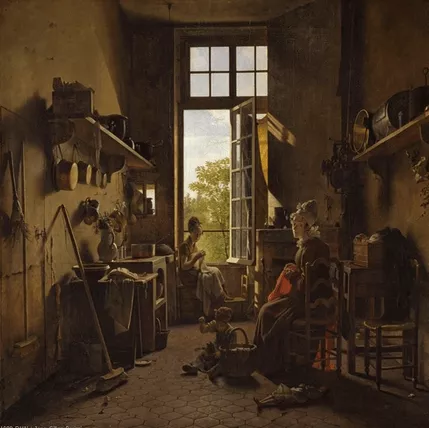
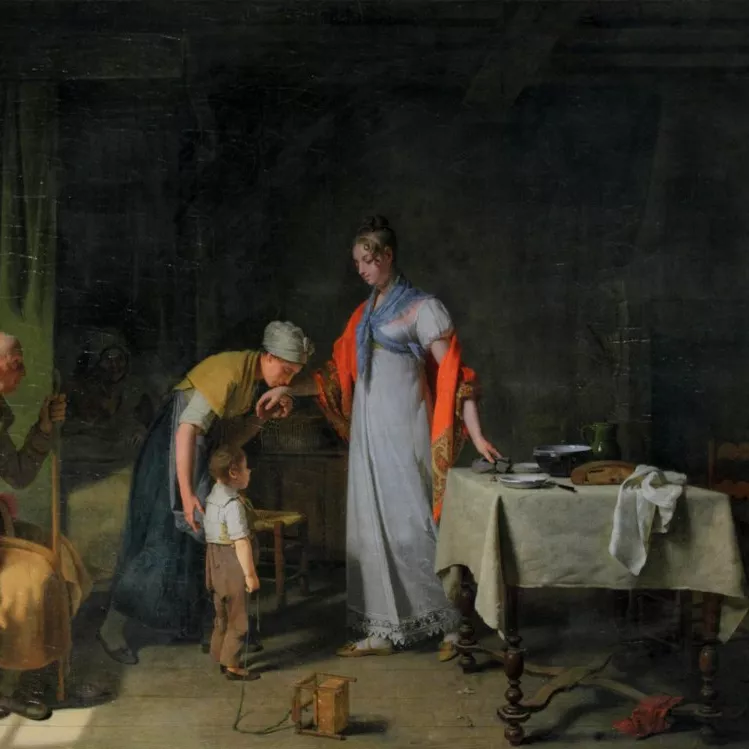
Her painting is part of a domesticated neoclassical aesthetic, applied to interior subjects, on the border between portraiture and genre scene. She attaches great importance to preparatory drawing, with rigorous treatment of contours and volumes.
Objects, fabrics, furniture and accessories are painted with almost photographic meticulousness, in a quest for material accuracy. Her touch is smooth and unobtrusive, with no material effects, which is typical of the French academic finish in the early 19th century.
Her palette is refined but restrained between warm browns (a shade whose use she certainly inherited from her father, with the famous story of mummie powder), deep reds, pearl grays and milky whites, all illuminated by soft light.
She modulates light with subtlety, avoiding violent contrasts, to highlight textures and create a calm atmosphere. The light never dramatizes but clarifies and unifies the scene, in a hushed atmosphere.
The figures she depicts, often women and children, are envisaged in calm, absorbed postures typical of neo-bourgeois interior painting. The faces are pensive, modestly restrained, without marked expressivity, but imbued with an underlying psychological truth.
The elegance of her canvases comes from restraint, controlled composition and attention to the smallest detail. Louise Adéone Drölling thus develops an art deeply rooted in the neoclassical tradition, but oriented towards interior, feminine and private subjects, making her a voice apart.
She stands out for her ability to introduce softness and interiority into an aesthetic often marked by coldness or grandeur. Her painting thus combines formal rigor and domestic warmth, heralding in some respects the bourgeois sensibility of the Second Empire.
The life of Louise Adéone Droling
Louise Adéone Droling or Drölling (her name is spelled both ways on the art market) was born in Paris in 1797. She is famous for her interior scenes, but also for being the daughter of Martin Drölling, who trained her, and Michel Martin Drölling, history painter and teacher at the École des Beaux-Arts.
She was integrated into a structured artistic world from an early age, and benefited from instruction in her father's studio with other students. Louise Adéone Drölling grew up in an environment where learning to draw, academic rigor and technical mastery were passed on daily.
Trained exclusively in the studio, she developed solid skills in drawing, oil painting and composition from an early age. She adopted her family's neoclassical composition, oriented towards refined, quiet genre painting.
As a teenager, she began to paint portraits and intimate scenes of the highest quality. She presented her work at the Paris Salon, where she exhibited notably in 1827, winning praise for the finesse of her brushwork, the clarity of her drawing and the interiority of her figures.
Her works, though few in number, were noted for their academic rigor combined with a soft, hushed atmosphere, in the tradition of her father. She concentrated on subjects deemed appropriate for her time, namely portraits, interior scenes, studies of children or young women.
Like many female artists of her time, she remained in the shadow of the male figures in her family, although her talent was recognized. Unfortunately, she did not receive major state commissions or full institutional recognition.
Her work testifies to a discreet but assured sensibility, at a time when women's practice of art remained confined within a very strict framework.
The artist died young, aged 37 in 1834 in Paris, probably without having been able to deploy her full potential. Her name and output were long confused with those of her father and brother, with some paintings wrongly attributed to them.
The life of Louise Adéone Droling
Louise Adéone Droling or Drölling (her name is spelled both ways on the art market) was born in Paris in 1797. She is famous for her interior scenes, but also for being the daughter of Martin Drölling, who trained her, and Michel Martin Drölling, history painter and teacher at the École des Beaux-Arts.
She was integrated into a structured artistic world from an early age, and benefited from instruction in her father's studio with other students. Louise Adéone Drölling grew up in an environment where learning to draw, academic rigor and technical mastery were passed on daily.
Trained exclusively in the studio, she developed solid skills in drawing, oil painting and composition from an early age. She adopted her family's neoclassical composition, oriented towards refined, quiet genre painting.
As a teenager, she began to paint portraits and intimate scenes of the highest quality. She presented her work at the Paris Salon, where she exhibited notably in 1827, winning praise for the finesse of her brushwork, the clarity of her drawing and the interiority of her figures.
Her works, though few in number, were noted for their academic rigor combined with a soft, hushed atmosphere, in the tradition of her father. She concentrated on subjects deemed appropriate for her time, namely portraits, interior scenes, studies of children or young women.
Like many female artists of her time, she remained in the shadow of the male figures in her family, although her talent was recognized. Unfortunately, she did not receive major state commissions or full institutional recognition.
Her work testifies to a discreet but assured sensibility, at a time when women's practice of art remained confined within a very strict framework.
The artist died young, aged 37 in 1834 in Paris, probably without having been able to deploy her full potential. Her name and output were long confused with those of her father and brother, with some paintings wrongly attributed to them.
She was rediscovered in the 20th century as part of research into the women artists in the 19th century, and is today considered one of the finest painters in the French neoclassical intimist tradition.
Focus on Jeune fille au livre, Louise Adéone Droling, circa 1825
Jeune fille au livre is a painting by Louise Adélone Droling, emblematic of her refined, intimate production, executed in oil on canvas. It depicts a young woman seated in profile, holding a book on her lap, in a feminine interior, at the crossroads of portraiture and genre scene.
The young girl, who is absorbed in her reading, is depicted with dignity and restraint, her eyes lowered and her features peaceful. Her attitude is natural, without pose or theatricality, in a posture of recollection or concentration.
The treatment of the face and hands is fine and precise, allowing us to emphasize the artist's attention to the model's real presence. The composition is centered, stable, with a sober background (curtain, armchair back, unobtrusive table) that highlights the figure without distracting from it.
The background is treated in calm, neutral tones, reinforcing the hushed atmosphere of the whole. No anecdotal or decorative objects disturb the purity of the moment depicted.
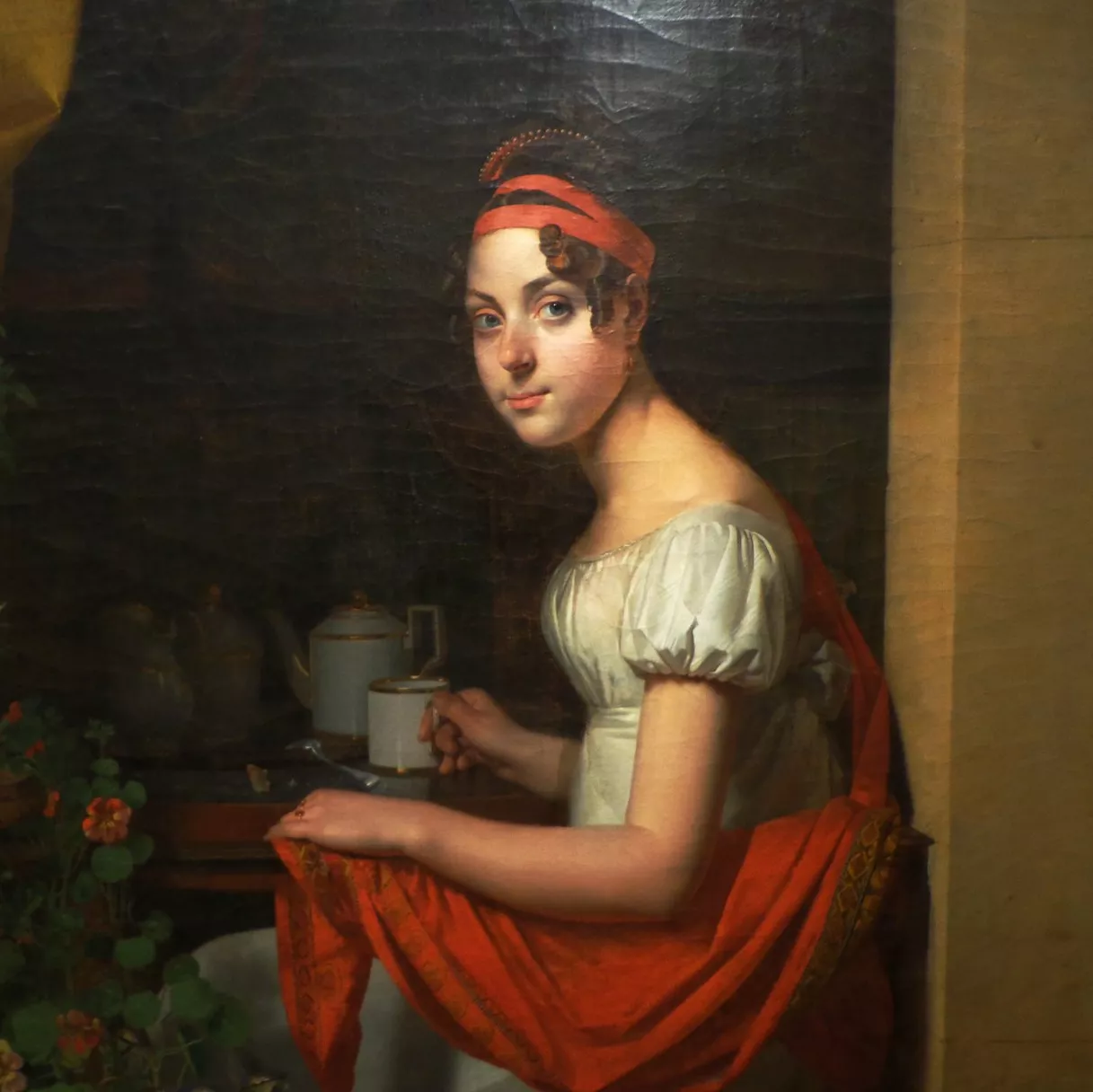
The colors used are dark and warm (browns, beiges, pale pink, ivory, applied in thin layers, in a smoothed neoclassical style. The painting is thus bathed in an atmosphere of silent clarity, close to the French tradition of morally appeased interior painting.
The work evokes an ideal vision of cultivated femininity, combining reading, calm and interiority in a posture that is both active (that of reading) and contemplative. It is part of a modest iconography of feminine knowledge, still in line with the social expectations of the time, but valued with sincerity.
Jeune fille au livre therefore fully embodies Louise Adéone Drölling's intimate, masterful style, at the crossroads of portraiture and moral scene. In it, she asserts a discreet yet resolute feminine voice, in a pictorial world that is still largely codified.
This work therefore aptly illustrates neoclassical gentleness adapted to the domestic world, a field in which Louise Adéone Drölling excels with elegant restraint.
Recognizing the artist's signature
Louise Adéone Droling doesn't necessarily sign her works. Copies may exist, which is why expertise remains important.
Knowing the value of a work
If you happen to own a work by Louise Adéone Droling or after the artist, don't hesitate to request a free appraisal using our form on our website.
A member of our team of experts and certified auctioneers will contact you promptly to provide you with an estimate of the market value of your work, as well as ad hoc information about it.
If you are considering selling your work, you will also be accompanied by our specialists in order to benefit from alternatives for selling it at the best possible price, taking into account the inclinations of the market.
.Estimate in less than 24h
Discover in the same theme

Rating and value of works, drawings, paintings by Alphonse O...
Alphonse Osbert was a Symbolist painter of the 19th and 20th centuries who produced a number of paintings that were highly prized at auction.
Learn more >

Rating and value of paintings by Emilio Sivilla Torres
Emilio Sivilla Torres was a Spanish Orientalist painter who produced views of Tangier that can be highly valued.
Learn more >

Rating and value of drawings and paintings by Jules Jacques...
Jules Jacques Veyrassat was a 19th-century painter associated with the Barbizon School whose works command high prices and are highly valued.
Learn more >
Similar works sold at auction

Estimated 2 000 € - 4 000 €
DANISH SCHOOL circa 1790, entourage of Jens JUEL Presumed portrait of Sophie of Hesse-Cassel, Queen Consort of Denmark.

Estimated 4.000 - 6.000
Atelier d'Antoine Jean, baron GROS (Paris 1771-1835 Meudon), oil on canvas

Estimated 6.000 - 8.000
Michel Martin DRÖLLING (1786-1851), Portrait of Dominique Alexandre "Charles" Legrand (1790-1808), oil on canvas

Estimated 1.500 - 2.500
Attributed to Michel Hubert-Descours (Bernay 1707-1775 Bernay) Portrait d'une demoiselle en Diane, circa 1750 Oil on canvas

Estimated 500 - 800
French school of the second half of the 18th century, follower of Hyacinthe Rigaud (Perpignan 1659-1743 Paris) Portrait in cuirass of a Marshal of France

Estimated 3000€ - 5000€
Entourage of Pierre Révoil (Lyon 1776-1842 Paris) The...

Secure site, anonymity preserved

Auctioneer approved by the State

Free and certified estimates
Frequently asked questions
-
Who is Louise Adéone Drölling, and what is her artistic background?Louise Adéone Drölling (1797–1834) was a Parisian painter trained in her father Martin Drölling’s studio in the Neoclassical tradition. She was the sister of the history painter Michel Martin Drölling and specialized in portraits and intimate interior scenes, exhibiting notably at the Paris Salon in 1827. Although her talent was recognized for her delicate brushwork and precise draftsmanship, she remained overshadowed for a long time by the male figures in her family, and her rediscovery did not occur until the 20th century during research on 19th-century women artists.
-
What is the price range for Louise Adéone Drölling's paintings?Louise Adéone Drölling's oil-on-canvas paintings generally sell for between approximately 600 and 13,000 euros. For example, her painting “La leçon de dessin,” initially estimated at between 6,000 and 9,000 euros, ultimately sold for 13,270 euros at auction. The value varies depending on the condition, provenance, subject matter, and significance of the work.
-
How can you authenticate a work by Louise Adéone Drölling and determine its exact value?To authenticate a work of art and obtain an accurate estimate, we recommend that you submit a request for a free appraisal to Auctie's via our online form. Our experts and state-certified auctioneers will examine your painting and provide you with a detailed assessment of its current market value, with no obligation on your part.
-
Is this a good time to sell a work by Louise Adéone Drölling?Yes, now is a good time to sell. Female artists of the 19th century—particularly those trained by great masters such as David or Ingres—are seeing their market value rise significantly in today’s art market. Louise Adéone Drölling is benefiting from this trend of rediscovery and revaluation of female painters from the Neoclassical period.
-
How does the sale of a work of art work at Auctie's?Auctie's supports you every step of the way: after a free appraisal by our experts within 48 hours, we’ll guide you toward the best sales strategy to get the best possible price. If you decide to sell, we’ll handle the listing and auction process as an auction house, while our specialists advise you on the necessary steps and timelines.
