



The value of Hyppolite Lazerges' paintings

Key takeaways
- Works by Hippolyte Lazerges (1817–1887) are valued between €20 and €74,700, with oil-on-canvas paintings commanding the highest prices.
- An Orientalist painter trained at the École des Beaux-Arts in Paris, he drew inspiration from Algeria and combined academic rigor with sensitivity in his treatment of light.
- His portraits and genre scenes, particularly prized by French and English collectors, are distinguished by a rare psychological depth and remarkable technical finesse.
If you own a work by or after Hippolyte Lazerges and would like to know its value, our state-approved experts and auctioneers will offer you their appraisal services.
Our specialists will carry out a free appraisal of your work, and provide you with an accurate estimate of its value on the current market.
Then, should you wish to sell your work, we will direct you to the best possible arrangement to obtain the optimum price.
Rating and value of the artist Hippolyte Lazerges
The artist Hippolyte Lazerges leaves behind a very singular body of work, categorized as Orientalist. He is also steeped in Romanticism. He studied at the Ecole Supérieure des Beaux-Arts in Paris.
His works are now fetching higher prices under the auctioneers' gavels. His paintings are particularly prized, especially by French and English buyers. The price at which they sell on the art market ranges from €20 to €74,700, a substantial gap but one that says a great deal about the value that can be attributed to Lazerges' works.
In 2022, a predominantly blue oil on canvas sold for €22,400 while it was estimated at between €9,500 and €14,100.
Estimate in less than 24h
Order of value from simplest to most prestigious work
Technique | Estimation |
|---|---|
Crayon | From 20 to 5700€ |
Watercolor | From 25 to 2350€ |
Oil painting (on canvas) | From 37 to 74 700€ |
Style and technique of the artist Hippolyte Lazerges
Hippolyte Lazerges deploys an art where the rigor of drawing and the subtlety of color unite to reveal the intensity of a look, the softness of a light or the richness of a setting.
Heir to the academic tradition, he pays meticulous attention to volumes and the balance of compositions, while infusing his work with a sensibility peculiar to Orientalism.
His portraits, with a realism imbued with finesse, reflect an almost intimate approach to the model, where expression and posture reveal a profound humanity.
In his genre scenes, he excels at capturing movement and suspended moments, giving his compositions a poignant authenticity.
His landscapes, inspired by the enchanting scenery of Algeria, oscillate between a faithful rendering and a poetic evocation of luminous atmospheres.
Lazerges places an essential emphasis on the play of light, which shapes forms and sculpt faces with subtle precision.
He works with the contrasts between deep shadows and diffuse light, bringing a singular vibrancy to his canvases, where the pictorial matter seems animated by a breath of its own.
His supple, controlled touch, far removed from any academic rigidity, lends his works a measured spontaneity, where emotion shines through in the delicacy of the strokes and the richness of the nuances.
A painter of the intimate and the distant, he composes a universe where technical refinement always serves expressivity, bearing witness to a deeply sensitive vision of the world around him.
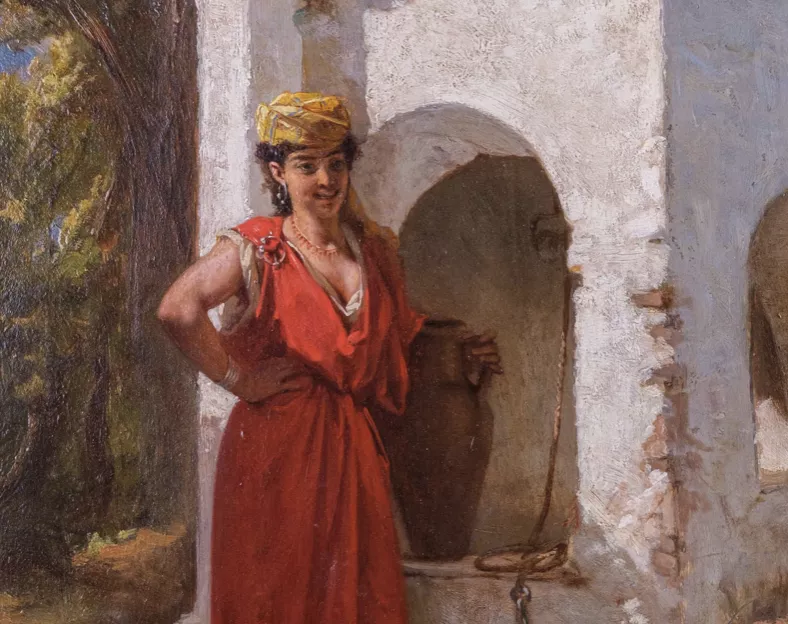
The life of Hippolyte Lazerges
Hippolyte Lazerges (1817-1887), a French artist, remains a little-known figure, but his work deserves to be rediscovered. Born in France, he spent a large part of his childhood in Algeria, a country whose imprint he would retain throughout his career.
Recalled to France for his military service, he took the opportunity to enter the Beaux-Arts, where he trained with François Bouchot and David d'Angers.
Left to his own devices with no family support, he endured difficult years, making a living from official commissions for the state as well as religious decorations for churches and cathedrals.
Later, he returned to Algeria, where he fully embraced orientalism. His portraits, genre scenes and landscapes capture the atmosphere and light of Algiers.
His paintings bear witness to an attentive observation of everyday life and a sincere attachment to his subject, far removed from the idealized visions of some of his contemporaries.
Lazerges did not limit himself to painting. An essayist, he published several treatises on art and reflected on the issues of representation.
He also composed a number of musical works, now forgotten. A complete artist, he left a discrete body of work marked by a double anchorage: that of the academic tradition and the attraction of elsewhere.
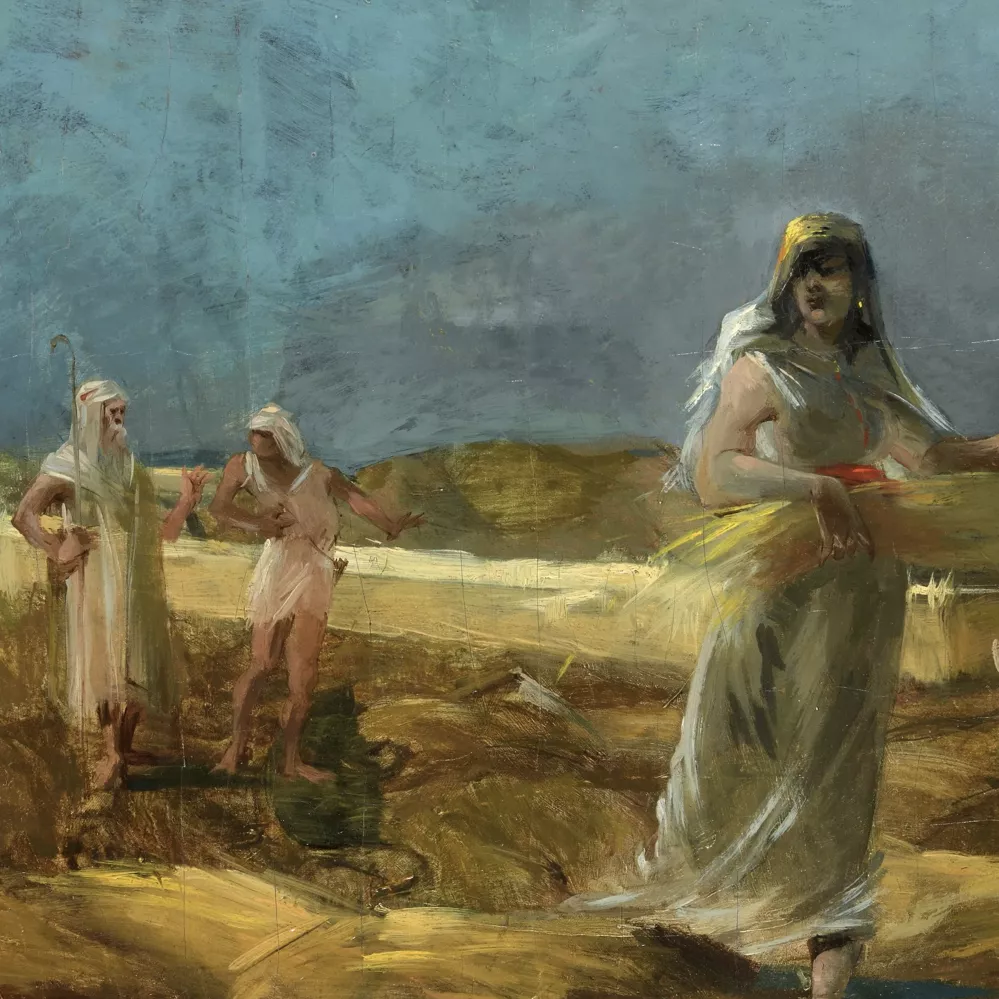
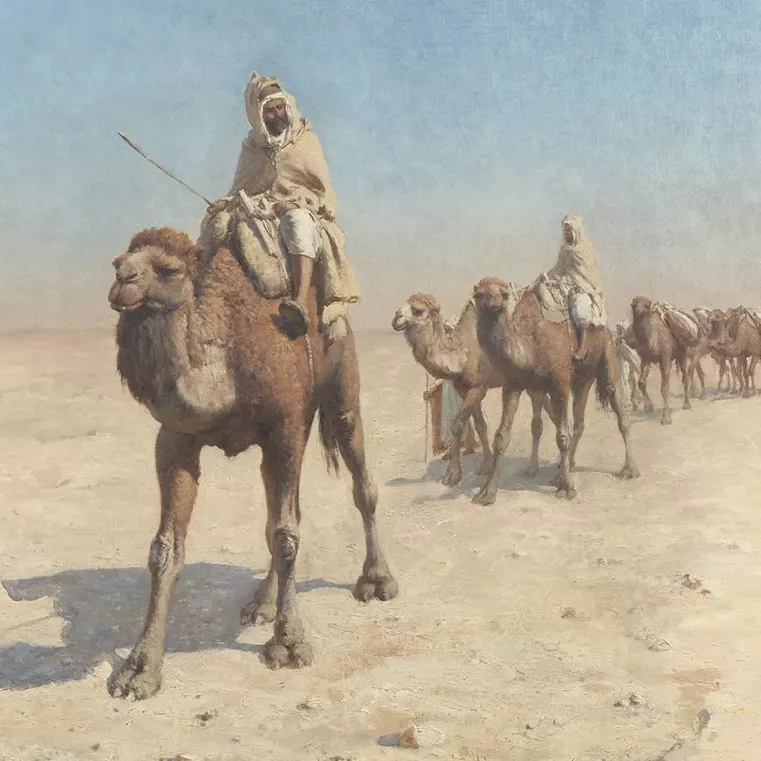
Focus on Le Portrait de l'Emir Abd el-Kader
The work Le Portrait de l'Emir Abd el-Kader, by Hippolyte Lazerges, is distinguished by a remarkable intensity in capturing the subject's gaze and posture, a challenge the artist meets with great technical mastery.
The figure of the prince, bathed in soft, slightly subdued light, takes on an almost sacred dimension, symbolizing both the dignity and resilience of a man emblematic of 19th-century Algeria.
The face, meticulously detailed, reveals great psychological depth, where fine features and skilfully placed shadows underline the Emir's inner drive, while allowing a form of indomitable serenity to shine through.
Lazerges succeeds in rendering, beyond mere likeness, the essence of his model's personality, thanks to his particular attention to light, which modifies the texture of skins and the shine of fabrics.
The draperies surrounding the Emir's face are rendered with a richness of appearance that seems almost tactile, and the soft colors and harmonies of tone emphasize the nobility of the individual, while enriching the composition with an intimate dimension.
The relatively restrained treatment of the background amplifies the subject's impression of majestic solitude, his intense gaze seeming to escape beyond the frame, capturing both the figure's strength and the silent reflection it elicits.
The construction of the image, faithful to academic rigor, is here transcended by the subtlety of an emotional rendering that makes this portrait much more than a simple representation: it is a true evocation of the greatness of a man and his era.
Hippolyte Lazerges' imprint on his period
Hippolyte Lazerges' imprint on his period is seen in his art, which is deeply rooted in Orientalism, a dominant trend of the 19th century.
His works, marked by his stays in Algeria, subtly blend local influences with the academic canons to which he remained faithful. Through genre scenes and portraits, Lazerges delivers a unique vision of colonial Algeria.
His canvases, of great finesse, reflect a particular attention to light and to the details of the Algerian setting, from arid landscapes to traditional costumes.
The artist is not content to reproduce stereotypes of the Orient; he succeeds in capturing the soul of the place, with a sensitivity that eludes mere decorative representation.
His portraits, in particular, go beyond the simple model: they reveal a certain psychology of the characters, an intimacy that confers on his subjects a dignity rare in Western art of the time.
In this sense, Lazerges succeeds in establishing himself as a singular artist, capable of transforming Orientalism into a genuine aesthetic and human quest, where painting becomes a means of exploring the complex links between cultures.
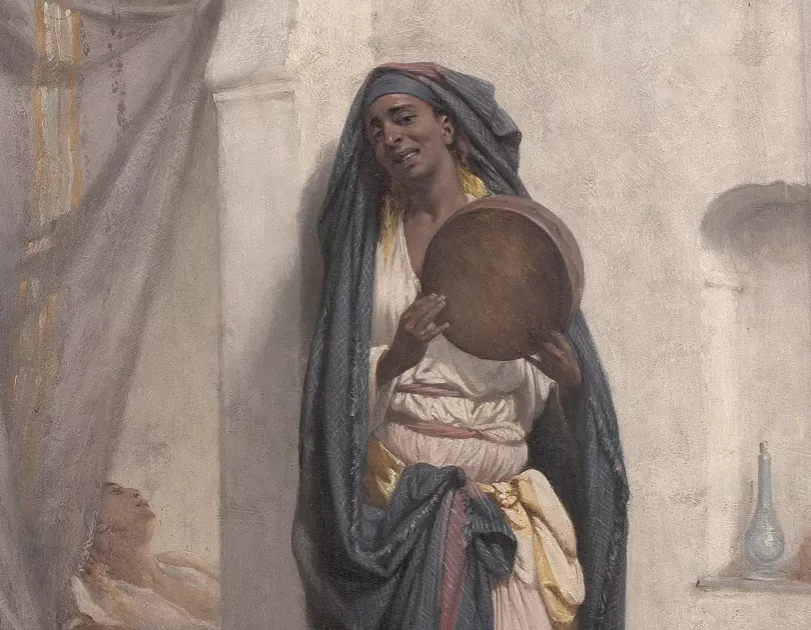
The stylistic influences of Hippolyte Lazerges
The stylistic influences of Hippolyte Lazerges are multiple and rooted in the spirit of his time, marked by orientalism and academic currents.
The artist, who first trained under François Bouchot and David d'Angers, embraced the classical approach while being deeply attracted to representations of the Orient.
He drew his inspiration from landscapes and scenes of daily life in Algeria, a subject that was very popular with artists of the time.
His treatment of light and rendering of atmospheres can be compared with the work of Jean-Léon Gérôme, a master of Orientalism whose precise, exotic scenes marked a generation.
But Lazerges, unlike Gérôme, sometimes leaves more room for the intimacy of his subjects, whether depicted in portraits or more intimate scenes, in the manner of a Eugène Delacroix who, although he had a freer approach to the Orient, was also able to move away from simple exotic representations.
With his sense of detail, texture and light, Lazerges is also part of an academic tradition that links him to artists such as Paul Delaroche or Adolphe-William Bouguereau.
However, his ability to capture the spirit of Algeria and render the soul of the places he frequented made him a privileged witness to his era, distilling a singularity rare in Orientalist painting, just like Henri Pontoy.
How to recognize the artist's signature
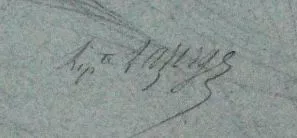
The works of Hyppolite Lazerges are generally unsigned, but an inscription may be mentioned on the frame or on the back of the canvas.
However, with or without a mention, it is important for you to have the work appraised to ensure its originality and to be able to date it.
Knowing the value of a work
If you happen to own a work by Lazerges or after the artist, don't hesitate to request a free appraisal using our form on our website.
A member of our team, made up of experts and certified auctioneers, will contact you promptly to provide you with an estimate of the market value of your work, not forgetting to pass on ad hoc information about it.
If you wish to sell your work, you will also be accompanied by our specialists in order to benefit from alternatives to sell it at the best possible price, taking into account market inclinations.
Estimate in less than 24h
Discover in the same theme

Rating and value of works, paintings by Gustave Courbet
Gustave Courbet was a 19th-century painter and leader of the realist movement. He painted many canvases of high value.
Learn more >

Rating and value of paintings and drawings by Jean-Joseph We...
Jean-Joseph Weerts is a 19th-century neoclassical painter. His paintings are appreciated on the art market and have a stable value.
Learn more >

Rating and value of bronzes and sculptures by Alexandra Laza...
Alexandra Lazareff is a contemporary artist who has created numerous bronze sculptures that command high prices and are highly valued.
Learn more >
Objects from the same period sold at auction

Estimated 9 000 - 12 000 €
Guillaume FOUACE (1837-1895) Pheasant and hare.

Estimated 600 € - 800 €
Henri ZUBER (1844-1909), Bridge at Artemare. Oil on canvas.

Estimated 2.000 - 4.000
Henri PONTOY (1888-1968), The Telouet kasbah in the Ounila valley, Oil on canvas

Estimated 1.500 - 2.500
Henri PONTOY (1888-1968) Animated view of a kasbah in the Atlas Mountains

Estimated 20.000 - 30.000
Auguste RENOIR (1841-1919) Entrance to houses, circa 1895-1896, Oil on canvas.

Estimated 4.000 - 6.000
Ary Scheffer (Dordrecht 1795-1858 Argenteuil) One of the three holy women (meditating on Christ's resurrection after the vision in the tomb?) Oil on canvas

Secure site, anonymity preserved

Auctioneer approved by the State

Free and certified estimates
Frequently asked questions
-
Who was Hippolyte Lazerges, and what was his artistic background?Hippolyte Lazerges (1817–1887) was a French painter who trained at the École des Beaux-Arts in Paris under François Bouchot and David d’Angers. A major Orientalist artist of the 19th century, he spent much of his life in Algeria, where he developed a unique vision of Orientalism by blending academic rigor with a sensitivity to local atmospheres. His works, characterized by a subtle treatment of light and great attention to detail, make him an important, though little-known, figure in Orientalist painting.
-
What are the price ranges for Hippolyte Lazerges' works, broken down by medium?The prices of Lazerges’s works vary considerably depending on the technique used. Pencil drawings range from €20 to €5,700, watercolors from €25 to €2,350, while oil paintings on canvas—his major works—can fetch between €37 and €74,700. These variations reflect the complexity, size, and historical significance of each piece, with a general upward trend in the market for his works.
-
How can you authenticate a work by Hippolyte Lazerges and determine its exact value?To authenticate a work by Lazerges and obtain an accurate estimate of its value, contact Auctie's using the form available on our website. A state-certified expert or auctioneer will examine your artwork and provide you with a detailed, no-obligation estimate. This free appraisal is completed quickly (usually within 48 hours) and takes into account the condition, provenance, technique, and current market trends.
-
Is this the right time to sell a work by Hippolyte Lazerges?Yes, now is an excellent time to sell a work by Lazerges. Prices for his paintings are rising steadily at auction, and demand remains strong, particularly among French and British buyers. The growing rediscovery of this Orientalist artist and the increased interest in this artistic movement are creating a favorable market for sales.
-
How does the sale of a work by Lazerges at Auctie's work?Auctie's supports you every step of the way: first, a free, no-obligation appraisal by our experts, followed by personalized advice on the best options for selling your artwork at the highest price. If you decide to proceed, our auctioneers will manage the entire process through to the auction, taking into account market trends and buyer profiles to maximize the value of your item.
