



Rating and value of paintings by Lady Elizabeth Thompson

Key takeaways
- Lady Elizabeth Thompson is a British painter who specializes in 19th-century military scenes and is known for her realistic and humanistic approach to war.
- The value of her works varies widely depending on the medium: from €40 to €170 for prints, up to €308,000 for major paintings such as *Dawn of Waterloo* in 2021.
- A pioneering artist in a field traditionally reserved for men, she stands out for her meticulous compositions, understated color palette, and particular focus on ordinary soldiers rather than spectacular heroism.
If you are in possession of a work by or after painter Rosalba Carriera, and would like to know its value, our state-approved experts and auctioneers will offer you their appraisal services.
Our specialists will carry out a free appraisal of your work, and provide you with an accurate estimate of its value on the current market.
Moreover, if your wish is to sell your work, we will advise you on the best device to obtain the maximum price.
Rating and value of the artist Elizabeth Thompson
Elizabeth Thompson is an artist known to portrait lovers. Her visibility on the art market continues to grow, her stock is exploding and she is increasingly in demand : it is speculated that her works could reach unprecedented amounts at auction.
Women artists of the 19th century, pupils in the studios of undisputed grand masters, produced works that are extremely sought-after today.
In 2021, her painting Dawn of Waterloo, The 'Reveille' in the bivouac of the Scots Greys on the morning of the battle, dating from 1895, sold for €308,000, while it was estimated at between €94,800 and €142,150.
Order of value from a simple work to the most prestigious
Technique used | Result |
|---|---|
Estamp - multiple | From €40 to €170 |
Drawing - watercolor | From €200 to €9,120 |
Painting | From €25 to €308,000 |
Estimate in less than 24h
Style and technique of a history painter
Lady Butler Elizabeth Thompson is a British painter of military scenes. She specializes in military history painting, in particular the battles of the 19th-century British army.
She introduces a narrative and human reading of the battlefield, often going against the grain of the spectacular or traditional heroism. She distinguishes herself in a genre reserved for men, renewing the treatment of war through a realistic, empathetic and rigorous approach.
The majority of her works are produced in oil on canvas, often on large format. The drawing is precise and structured, heir to academic training (notably at the Female School of Art in London and Florence).
She uses a relatively muted palette, dominated by browns, grays and blues, in keeping with the earthy tones of military campaigns. Her work is focused on overall composition, with rigorous management of depth, successive planes and lines of force.
She places great importance on the accuracy of uniforms, postures and attitudes, which are the result of constant documentiare research. The artist often focuses on ordinary soldiers, wounded or survivors, figures of expectation, weariness or sacrifice.
Faces are rarely idealized, features are marked, inner expressions are expressed and glances are absent or lost. She introduces a form of controlled pathos, without dramatic overacting, which reinforces the emotional impact of the scenes.
She strives for emotional veracity since the scene is not aimed at the spectator but at the rendering of a suspended moment, often posterior or anterior to the action (withdrawal, return, expectation, injury).
The skies, mists and dust are carefully rendered to create an atmospheric reading of the war. The framing, sometimes tight or panoramic, establishes a cinematic rhythm before its time, playing on the immersion effect.
It is both inspired by classical history painting (Géricault, Gros, Meissonnier) and by a documentary and humanistic drive close to social realism. She is also influenced by contemporary war narratives, military diaries and direct testimonies from soldiers.
In places, her approach prefigures 20th-century war painting, notably in its disillusioned or compassionate tone.
.
The life of Lady Elizabeth Thompson
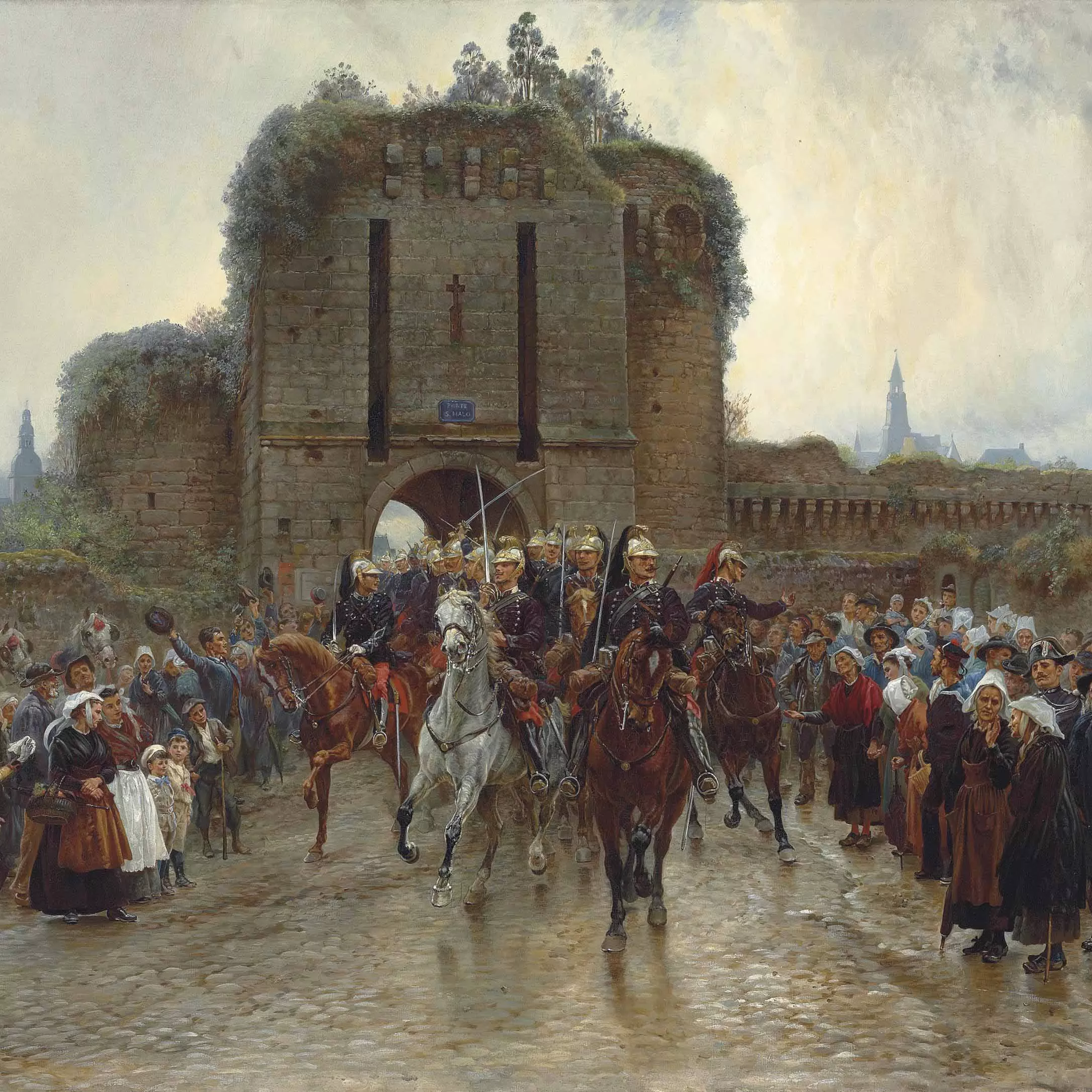
Lady Elizabeth Thompson (1846 - 1933), also known as Lady Butler, was a major figure in 19th-century British military painting. Born in Switzerland into a cultivated and cosmopolitan British family, she received a careful artistic education in London, then followed a thorough training at the Female School of Art in South Kensington.
She completed her studies in Florence at the Accademia di Belle Arti, where she trained in history painting and academic techniques. She traveled extensively in Europe, particularly in Italy, nurturing her eye and visual culture.
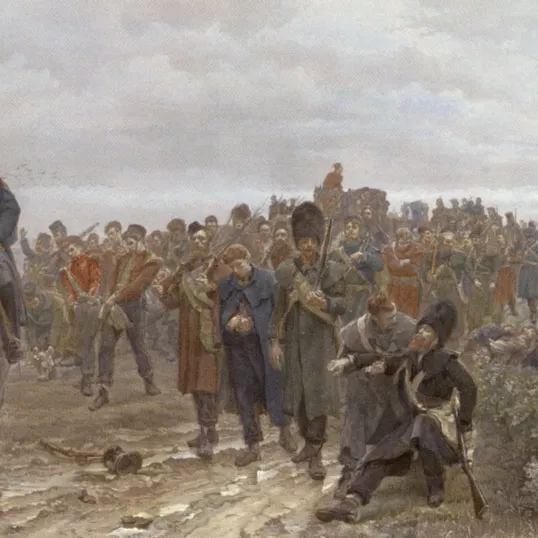
Lady Elizabeth Thompson made a name for herself in 1874 with The Roll Call, a large-scale tableu depicting a line of exhausted soldiers returning from the Crimean front. The work was an immediate success at the Royal Academy Summer Exhibition, which drew large crowds and was purchased by Queen Victoria.
She was one of the few women to make a place for herself in the then strictly male field of military history painting. In 1877, she married Sir William Butler, an officer in the British army, giving her the title of Lady Butler.
She followed her husband to various foreign postings (Ireland, South Africa, Canada), which influenced her subjects and partially distanced her from the London art scene. Mother of six children, she nevertheless managed to maintain a steady artistic activity.
She exhibited regularly at the Royal Academy and other prestigious salons, but was refused entry to the Royal Academy despite several attempts, on account of her genre more than her merit.
The artist continued to produce major works until the end of the century, with themes ranging from the Napoleonic War to the Egyptian campaign, the Crimean War and colonial expeditions. She wrote her autobiography, From Sketch-Book and Diary (1909), which recounts her work and travel memories.
She died in 1933 in Gormanston Castle, Ireland, aged 86. Largely forgotten for part of the 20th century, she has enjoyed a resurgence of interest since the 1980s with studies on women artists and the critical representation of war.
Now considered a pioneering figure, at the crossroads of military realism and narrative sensibility, she influenced the perception of war in Victorian art.
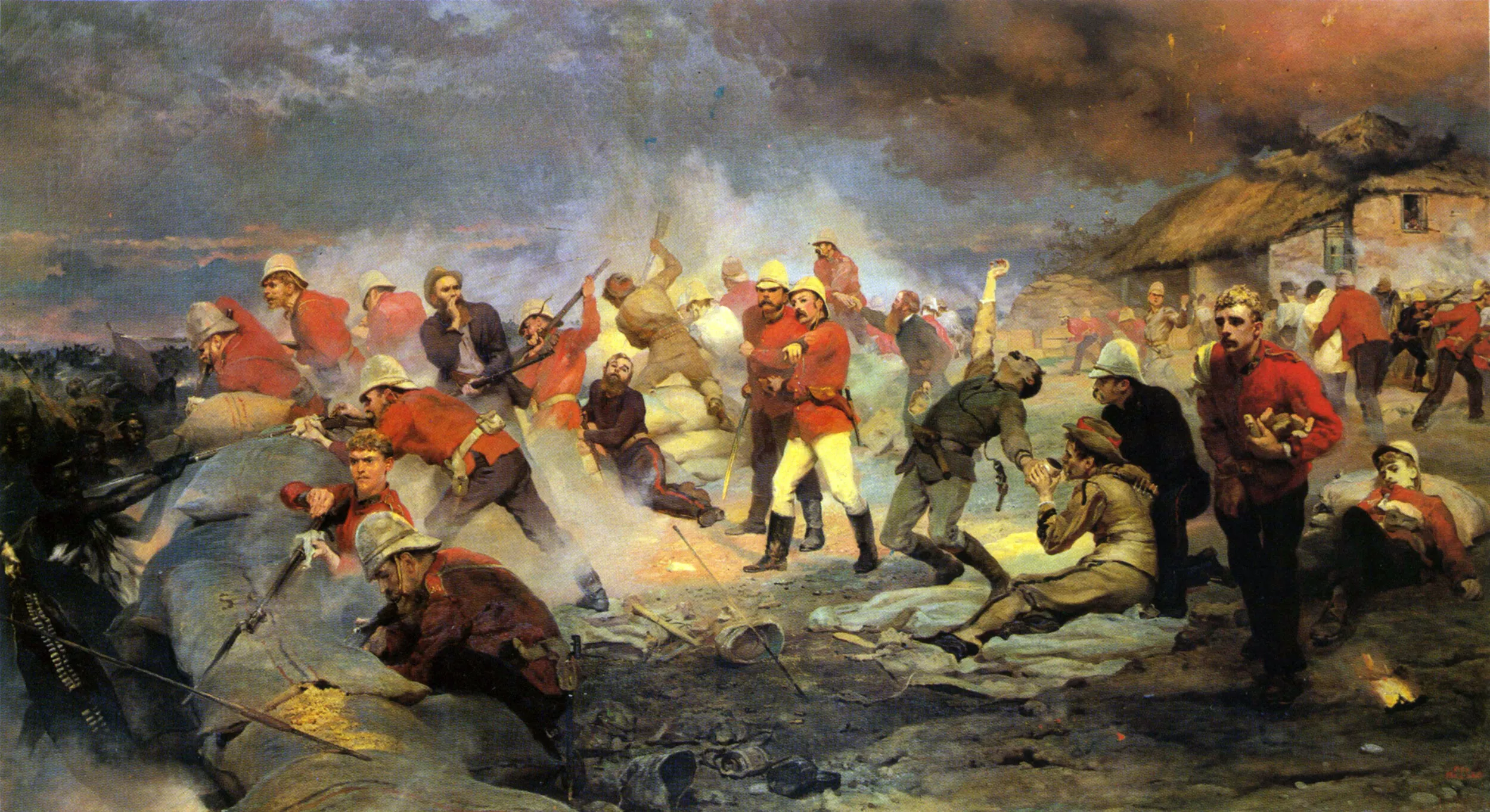
Focus on The Roll Call, Lady Thompson, 1874
The Roll Call is an oil-on-canvas painting measuring 93 x 183 cm, depicting a tired group of British soldiers standing in formation for roll call after a battle in the Crimean War.
It was exhibited at the Royal Academy in 1874, and the painting was immediately purchased by Queen Victoria, now in the Royal Collection, Windsor.
The soldiers are supported by a comrade, while the officer reads out the names : the human and collective dimension of the trauma is central. The palette is dominated by earthy, muddy, cold tones, reinforcing the gray, overwhelmed atmosphere of the moment.
The light, zenithal and cold, partly illuminates the faces and sodden uniforms, reinforcing the effect of realism. Details of uniforms, weapons and tired faces are meticulous. Every element contributes to an impression of truth.
Any dramatic action is absent, since the tension is born of immobility, restraint and pictorial silence. Here, war is materialized through fatigue, destitution and anonymity.
The painting introduces a humanistic and empathetic reading of military events, through the eyes of a woman artist, which was exceptional for the time. It was one of the first British examples of war realism, even before the great campaigns of the First World War.
It was an immediate success, with both the press and the public praising the scene's restrained emotion. The work caused a sensation because of its author, a woman dealing authoritatively with a virile, historical subject.
The Roll Call consequently founded Lady Butler's reputation and opened a breach in the hitherto structurally masculine field of military painting.
.
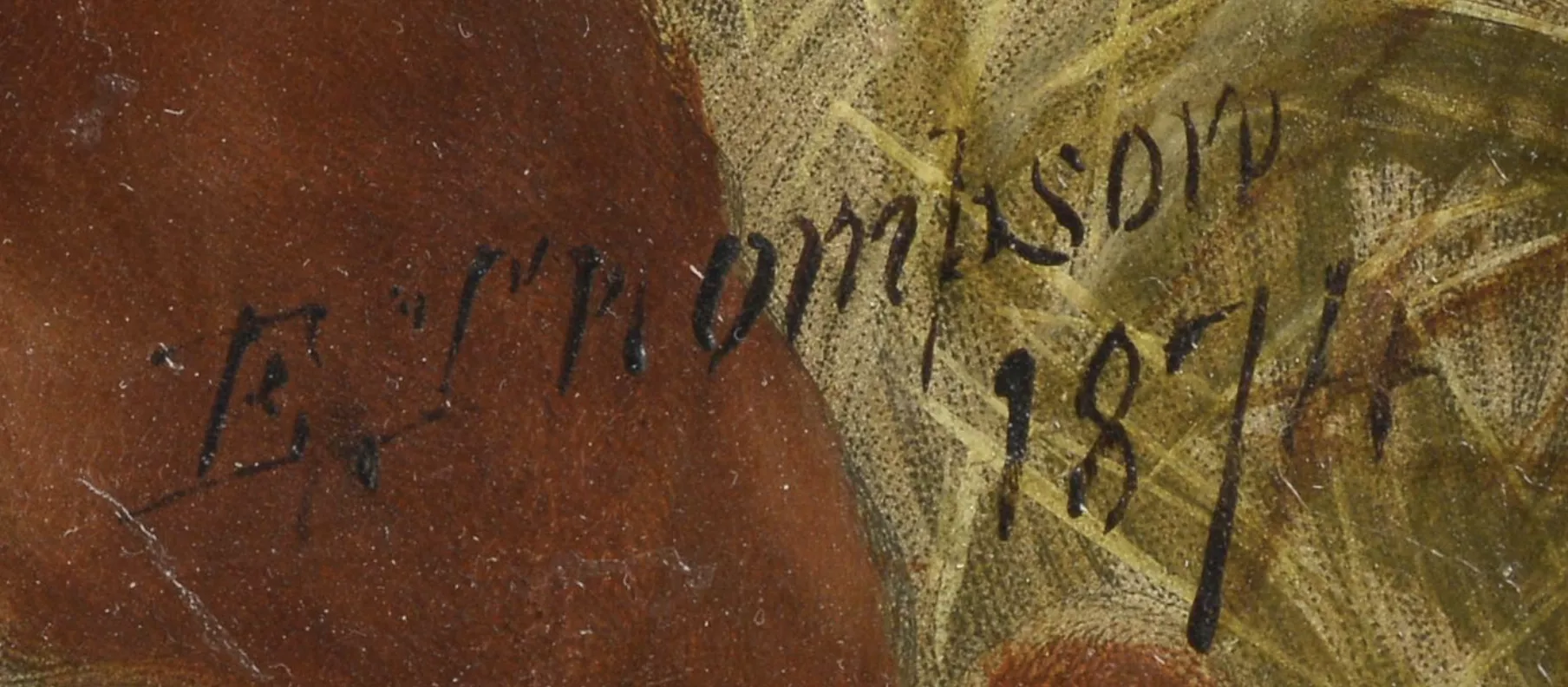
Recognizing the signature of Lady Elizabeth Thompson
Artists do not necessarily sign their works, which is why expertise remains necessary to ensure the authenticity of your property.
How to find out the value of a work
If you own a painting by Lady Elizabeth Thompson or after the artist, don't hesitate to request a free valuation by filling in our online form.
A member of our team of experts and licensed auctioneers will contact you to provide an estimate of the market value of your work.
If you are considering selling your work, our specialists will also guide you through the various alternatives available to obtain the best possible price, taking into account market trends and the specific features of the work.
Estimate in less than 24h
Discover in the same theme

Rating and value of works, paintings, drawings by Eva Gonzal...
Eva Gonzalès is a 19th-century Impressionist painter. The price of her works is rising sharply.
Learn more >

Rating and value of works, paintings by Jules Breton
Jules Breton was a 19th-century naturalist and realist painter who produced many valuable and successful works at auction.
Learn more >

Rating and value of sculptures, bronzes and marbles by Augus...
Auguste Clésigner is a French sculptor who has produced a number of sculptures that are highly valued at auction.
Learn more >
Other similar paintings sold at auction

Estimated 3.000 - 4.000
Entourage by Jean-Léon Gérôme (Vesoul 1824-1904Paris) Young androgynous Moorish smoker, dressed in Polish style, wearing a Baroque pearl (Angelo Soliman?) Oil on canvas

Estimated 1.500 - 3.000
Jules Victor Génisson (Saint-Omer 1805-1860 Bruges) The procession of the Blessed Sacrament in the ambulatory of the collegiate church of Saint-Pierre de Louvain Oil on panel

Estimated 1500€ - 2000€
French neoclassical school, circa 1800 Head of expression of...

Estimated 400€ - 600€
Édouard DETAILLE (1848-1912) Rider and his troop Watercolor...

Estimated 800€ - 1500€
Georges Louis HYON (1840-1913) Hussars saluting Napoleon at...

Estimated 500€ - 800€
Henri DUVIEUX (c. 1855-1902) View of the Bosphorus Oil...

Estimated 100€ - 200€
Paul TAVERNIER (1852-1943) Dogs at rest after the...

Secure site, anonymity preserved

Auctioneer approved by the State

Free and certified estimates
Frequently asked questions
-
Who was Lady Elizabeth Thompson, and why are her works so sought after?Lady Elizabeth Thompson (1846–1933), also known as Lady Butler, was a pioneering British painter of military scenes in the 19th century. Her works are highly sought after today because she revolutionized the genre by introducing a humanistic and realistic approach to war scenes, focusing on ordinary soldiers rather than spectacular heroism. Largely forgotten in the 20th century, she has seen a resurgence of interest since the 1980s thanks to studies on women artists and her critical perspective on war.
-
What is the price range for Lady Elizabeth Thompson's paintings?The value of Lady Elizabeth Thompson’s works varies considerably depending on the type and significance of the piece. Prints range from €40 to €170, drawings and watercolors from €200 to €9,120, while paintings can fetch much higher prices, ranging from €25 to over €300,000. For example, her painting “Dawn of Waterloo” (1895) sold in 2021 for €308,000, exceeding the initial estimate of €94,800 to €142,150.
-
How can you authenticate and appraise a work by Lady Elizabeth Thompson?To authenticate and appraise a work by Lady Elizabeth Thompson, we recommend that you submit a request for a free appraisal with Auctie's. Our team of experts and state-certified auctioneers will examine your piece and provide you with an accurate estimate of its market value, with no obligation on your part. You will receive a response from our specialists within 48 hours.
-
Is this the right time to sell a work by Lady Elizabeth Thompson?Yes, now is an excellent time to sell a work by Lady Elizabeth Thompson. Her visibility in the art market continues to grow, her market value is on the rise, and she is increasingly sought after by collectors. There is unprecedented interest in 19th-century female artists who trained under the great masters, and Lady Butler’s paintings could fetch record prices at auction.
-
How does the sales process work at Auctie's?At Auctie's, we guide you every step of the way, from appraisal to auction. After requesting a free online appraisal, an expert will contact you to evaluate your artwork. If you decide to sell, our specialists will walk you through the various options available and advise you on the best approach to achieve the highest possible price, taking into account market trends and the unique characteristics of your artwork.
