



Rating and value of paintings by Alexandre Cabanel

Key takeaways
- Works by Cabanel (1823–1889), a leading academic painter of the Second Empire, sell for between €10 and €768,000, depending on their prestige and the technique used.
- “The Birth of Venus” set a record at €768,000; large mythological nudes and portraits of women are the most sought-after segment (€80,000 to €150,000).
- Historical paintings and allegorical works exceed €500,000, while academic drawings remain more affordable (€5,000 to €20,000), with the condition of the work being a determining factor for delicate glazes.
If you own a work by or after the artist Alexandre Cabanel, and would like to know its value, our state-approved experts and auctioneers will offer you their appraisal services.
Our specialists will carry out a free appraisal of your work, and provide you with a precise estimate of its value on the current market.
Then, if you wish to sell your work, we will direct you to the best possible arrangement to obtain the optimum price.
Rating and value of the artist Alexandre Cabanel
Mostly creating paintings of History, Alexandre Cabanel is a French painter, sculptor, engraver and sculptor.
This prolific painter is now relatively well regarded on the art market, with his less prestigious works selling for €10, rising exponentially to €768,000.
A painting entitled La naissance de Vénus, depicting the goddess and cherubs, sold for €768,000, while it was estimated at €410,000 and €614,500.
Order of value from a simple work to the most prestigious
Technique used | Result |
|---|---|
Estamp - multiple | From €80 to €400 |
Drawing - watercolor | From €10 to €4,200 |
Painting | From €270 to €768,000 |
Estimate in less than 24h
Artist's style and technique
Alexandre Cabanel (1823 - 1889) was a major figure in 19th-century French academic painting. His preferred medium was oil on canvas, in the academic tradition. He sometimes made preparatory drawings in pencil, charcoal or chalk, and sometimes in wash, to define composition and gesture.
His palette is rich and nuanced, with a predilection for pearly, vaporous and luminous tones. His drawing is rigorous and precise, a legacy of his training at the École des Beaux-Arts under Picot.
His application of successive glazes is meticulous, giving a smooth, polished rendering with no visible impasto. The execution is characterized by a meticulous finish, the surfaces are perfectly blended and the transitions between light and shade are imperceptible.
The work on complexions is particularly refined, they appear idealized and diaphanous. Compositions are often horizontal and balanced, inherited from classical models. The staging is often theatrical, with a clear hierarchy between foreground (main figures) and background (narrative or landscape setting).
He frequently uses studied poses and complex drapery, inherited from the classical and Renaissance traditions. His depictions of the human figure are idealized, often feminine, with a search for anatomical perfection.
His aesthetic is academic and neoclassical, tinged with romantic idealism. He specialized in allegorical or mythological female nudes, characterized by controlled sensuality, as in Naissance de Vénus.
His style is marked by a balance between realism of anatomy and idealism of form, and chiaroscuro is prominent, soft and graduated, helping to create an ethereal atmosphere.
Glazes are superimposed to obtain translucent complexions and a rendering " pâte de verre ", with a mastery of drapery effects, which are silky, brilliant, with vibrant colors, reinforcing the theatrical aspect.
Perspective is mastered, but often attenuated in favor of the monumentality of the figures. Cabanel embodied the official academic art of the Second Empire, appreciated by Napoleon III and the Parisian elite.
He placed himself in stylistic opposition to the avant-garde (Courbet's realism, impressionism) and defended an aesthetic of the ideal and refinement. His works are emblematic of the tension between academic tradition and protest modernity in the 19th century.
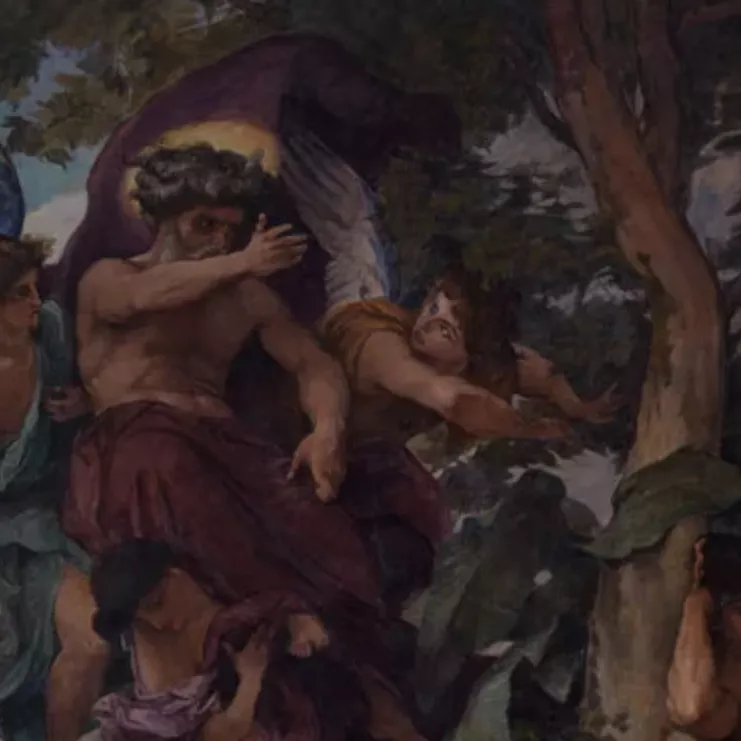
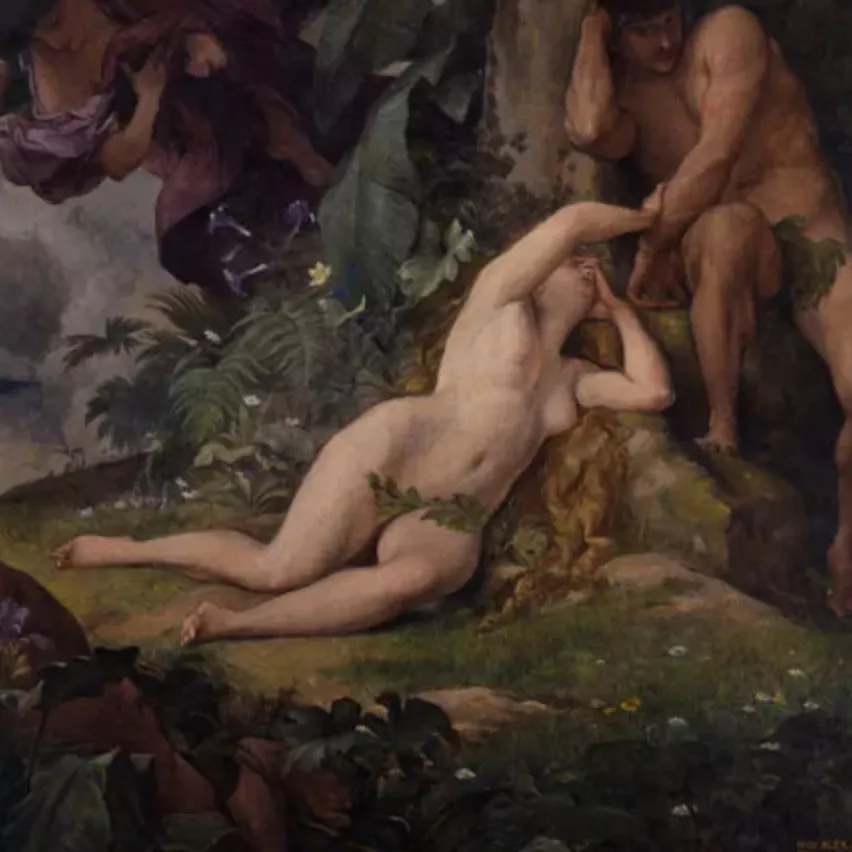
Alexandre Cabanel, his life, his work
Alexandre Cabanel (1823 - 1889) was born in Montpellier, into a modest family. He showed an early talent for drawing, supported by local patrons. In 1840, he entered the École des Beaux-Arts in Paris, where he was a pupil of Charles Gleyre and then above all of François-Édouard Picot.
He was trained in the academic tradition, with a discipline centered on drawing, mythology and history. In 1845, he won the Prix de Rome and stayed at the Villa Medici. In Italy, he discovered Renaissance art (Raphael, Michelangelo), which had a lasting influence on his style.
On his return to Paris, he began exhibiting at the Salon, where his works were noted for their academic perfection. In 1863, he triumphed at the Salon with The Birth of Venus, purchased by Napoleon III for Empress Eugénie.
He became one of the preferred painters of the imperial court and Parisian high society, and multiplied his official commissions (decorations, state portraits, large-scale historical canvases). As a professor at the École des Beaux-Arts de Paris, he trained a large number of students, including both academic artists and future independents. His influence on the academic system is considerable (Salon jury, role in the selection of the Prix de Rome.
He is an advocate of noble, idealized art, in opposition to the realism of Courbet and the Impressionists. His works are dominated by mythological, religious and historical subjects.
His reputation is international thanks to his idealized female nudes, and his embodiments of academic elegance. He was a portraitist sought after by the elite, and imposed an aesthetic of grace and distinction.
Alexandre Cabanel continued to exhibit regularly until his death in 1889. At the time of his death, he was considered one of the greatest academic painters of his century. Nevertheless, his prestige rapidly declined in the face of the rise of the Impressionist and Naturalist avant-garde.
Today, Cabanel is being rediscovered as an emblematic figure of 19th-century academicism, and a witness to the tensions between tradition and modernity.
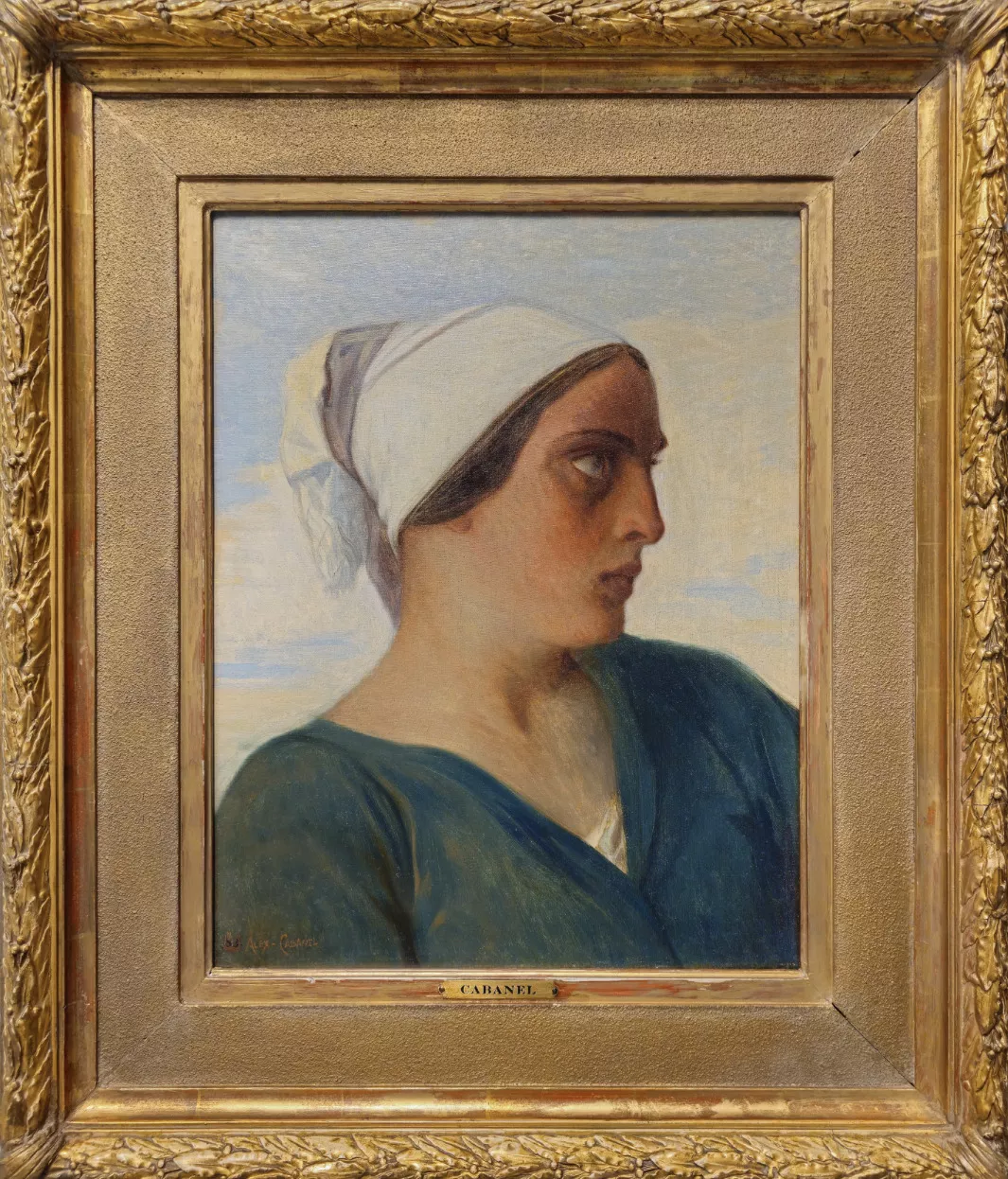
Market segmentation and artist's price
Alexandre Cabanel is now recognized as a major figure of 19th-century French academicism. He has a regular presence on the international market, notably in Paris, London and New York.
His stock is boosted by the rediscovery of academic painters and growing interest in the great masters of the Second Empire. Great mythological nudes such as the Birth of Venus are extremely rare at auction. Their heritage value is very high.
History paintings and allegories constitute a high-end segment, which can exceed €500,000 depending on subject and provenance. He produced an abundant output of portraits, often of high society; this is an intermediate segment, with estimates ranging from €50,000 to €200,000.
Academic drawings and studies are a more accessible market, generally fetching between €5,000 and €20,000, depending on size, subject and quality of execution. The record set for the artist reached almost €800,000.
Fine female portraits regularly sell for between €80,000 and €150,000, and secondary religious and historical works trade for between €30,000 and €70,000. Preparatory drawings and sketches sometimes fetch €10,000 to €20,000, sometimes more if they are linked to well-known masterpieces.
Mythological nudes and female portraits are therefore the most sought-after. Works from prestigious collections or presented at official Salons command a significant premium, while large academic formats fetch higher prices than modest-sized canvases.
The state of preservation is decisive for 19th-century works, especially those with delicate glazes. His rating is comparable to Bouguereau or Henner, but is below Gérôme, who is more sought-after on the Anglo-Saxon market.
Institutional and collector interest in this type of painting is growing.
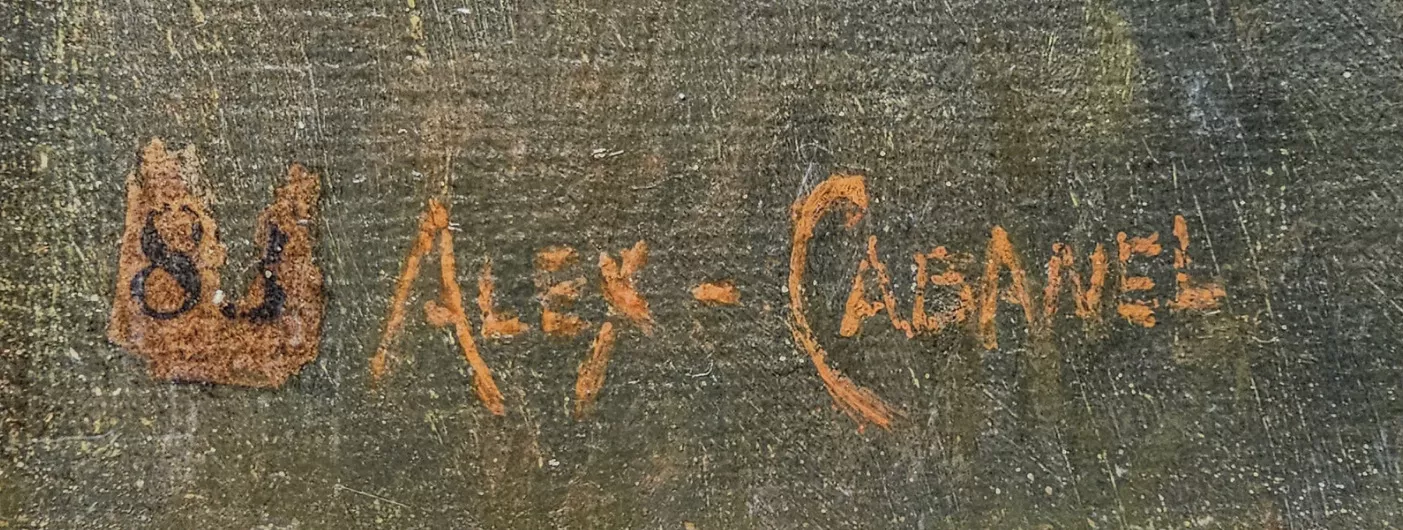
Recognizing the artist's signature
Alexandre Cabanel signs his works with his full name in a cursive, graphic script with a clean, assertive pencil stroke.
Know the value of a work
If you happen to own an Alexandre Cabanel work, request a free appraisal without further delay via our form on our website.
A member of our team of experts and licensed auctioneers will contact you promptly to provide you with an estimate of the value of your work, as well as any relevant information about it.
If you are considering selling your work, our specialists will also be on hand to help you find alternatives for selling it at the best possible price.
.Estimate in less than 24h
Discover in the same theme

Rating and value of works, drawings, paintings by Martin Joh...
Martin Johnson Heade is an American painter of the Hudson River School, who produced landscape paintings that are highly valued at auction.
Learn more >

Rating and value of paintings by Serguei Vinogradov
Serguei Vinogradov is a Russian painter somewhere between realism and impressionism, who has produced numerous works of great value.
Learn more >

Rating and value of aquarelles and paintings by William Call...
William Callow is a painter who primarily created watercolors that command high prices at auction. 100% free appraisal
Learn more >
Nos records d'enchères à l'hôtel Drouot

Estimated 10.000 - 15.000 €
Ebridge Ayer BURBANK(1858-1949), Young African-American boy, Oil on panel.

Estimated 20.000 - 30.000
EXCEPTIONAL LARGE OVAL DISH IN VINCENNES SOFT PASTE PORCELAIN FROM THE "BLEU CÉLESTE" SERVICE OF KING LOUIS XV AT THE CHÂTEAU DE VERSAILLES

Estimated 20.000 - 30.000
MANUFACTURE ROYALE DE SÈVRES, 18th century "L'Empereur de la Chine" - Portrait of the Emperor Qianlong, Hard porcelain bisque, 1775

Estimated 1.500 - 3.000
HERMÈS, "Kelly" 32 saddle bag in black box calf

Estimated Between €5,000 and €8,000
KRACHKOWSKY (1854-1914), Before the storm, oil on canvas

Estimated 40.000 - 80.000
Alexandre ROUBTZOFF (1884-1949), Portrait of Arbia, oil on canvas

Secure site, anonymity preserved

Auctioneer approved by the State

Free and certified estimates
Frequently asked questions
-
Who was Alexandre Cabanel, and what was his artistic context?Alexandre Cabanel (1823–1889) was a leading figure in 19th-century French academic painting. Trained at the École des Beaux-Arts in Paris under François-Édouard Picot, he won the Prix de Rome in 1845 and established himself as the favorite painter of Napoleon III and Parisian high society. He embodied the official academic art of the Second Empire, in contrast to modern avant-garde movements such as Realism and Impressionism.
-
What are the price ranges for Alexandre Cabanel's works, by type?Prices vary considerably depending on the technique and subject matter: prints range from €80 to €400, drawings and watercolors from €10 to €4,200, and paintings from €270 to €768,000. Major mythological nudes such as *The Birth of Venus* are extremely rare and highly sought after, while refined portraits of women sell for between €80,000 and €150,000, and academic drawings for between €5,000 and €20,000.
-
How can you authenticate a work by Alexandre Cabanel?To authenticate a work attributed to Cabanel, request a free, no-obligation appraisal using the Auctie's form. A certified expert or auctioneer will examine the work, verify Cabanel’s distinctive signature (cursive and graphic), analyze its provenance and condition, and provide you with an accurate appraisal within 48 hours.
-
Is this the right time to sell a work by Alexandre Cabanel?Yes, now is a good time to sell a work by Cabanel. The rediscovery of 19th-century academic painters, the growing interest in the great masters of the Second Empire, and the regular presence of works at international auctions (Paris, London, New York) are creating favorable conditions for sales.
-
How does the sale of a work of art work at Auctie's?Auctie's supports you every step of the way: request a free, no-obligation estimate; receive an appraisal from a certified auctioneer with a response within 48 hours; and then be guided toward the best sales options to get the highest possible price. As an auction house, Auctie's manages the entire process until your artwork is sold.
