



Rating and value of paintings by Adolphe Monticelli

Key takeaways
- Monticelli (1824–1886), a painter from Marseille and a precursor of Impressionism, worked in oil on canvas using thick impasto and a rich palette dominated by warm tones.
- His works sell for between €45 and €432,000 depending on the technique and prestige, with oil-on-canvas works priced from €90 to €432,000.
- A still life dated 1880, “Grande nature morte au pichet,” sold for 432,000€ despite an initial estimate of 119,000 to 178,700€, demonstrating a significant rise in prices.
If you own a work by Adolphe Monticelli or after, and you d like to know its value, our state-approved experts and auctioneers will offer you their appraisal services.
Our specialists will work to carry out a free appraisal of your work, and provide you with an accurate estimate of its value on the current market.
Then, should you wish to sell your painting, we'll direct you to the best possible arrangement to obtain the optimum price.
Rating and value of the artist Adolphe Monticelli
Considered one of the precursors of Fauvism, Adolphe Monticelli quickly established himself in twentieth-century art. This legacy is made up of various creations : mainly oils on canvas, including landscapes.
At present, prices for his works are rising enormously under the auctioneers' hammer.
His oils on canvas are particularly prized, and the price at which they sell on the art market ranges from €45 to €432,000, a considerable gap but one that speaks volumes about the value that can be attributed to Monticelli's paintings.
A still life dating from 1880, entitled Grande nature morte au pichet, was sold for €432,000 while it was estimated at between €119,000 and €178,700.
Order of value from a simple work to the most prestigious
Technique used | Result |
|---|---|
Drawing - watercolor | From 45 to 5 000€ |
Oil on canvas | From 90 to 432 000€ |
Estimate in less than 24h
Style and technique of Adolphe Monticelli
Adolphe Monticelli (1824 - 1886) was a painter from Marseilles, a precursor of Impressionism, who worked almost exclusively in oil on canvas. Sometimes, he also used wood panels.
He showed a preference for medium or small formats, suited to his impasto and material work. He uses thick brushes and knives, which enable him to build up the pictorial paste.
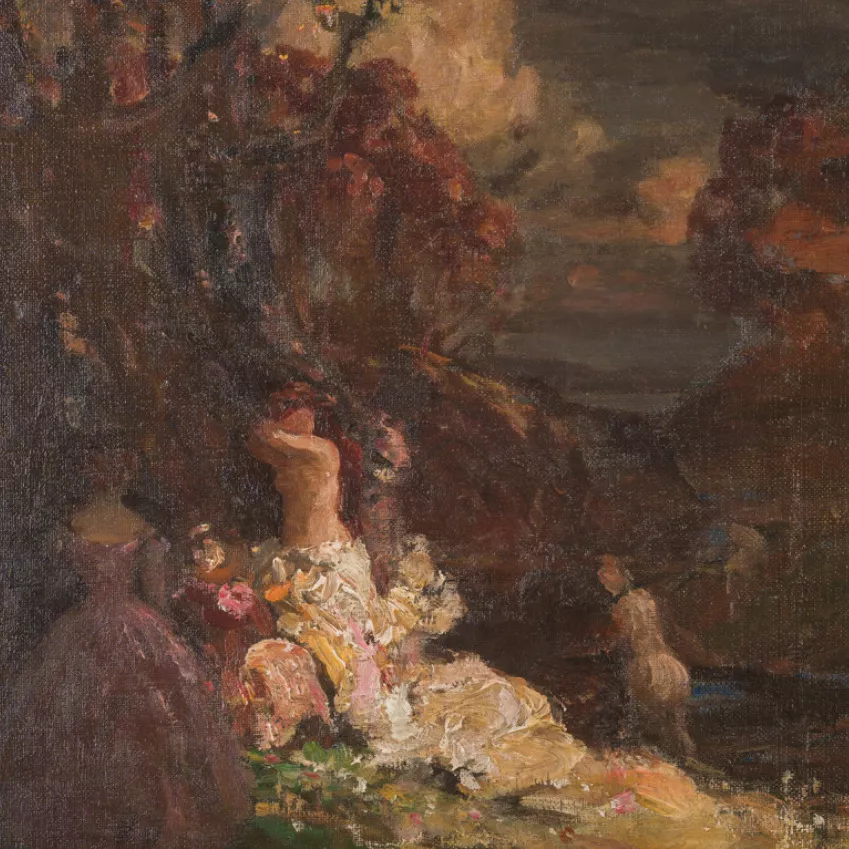
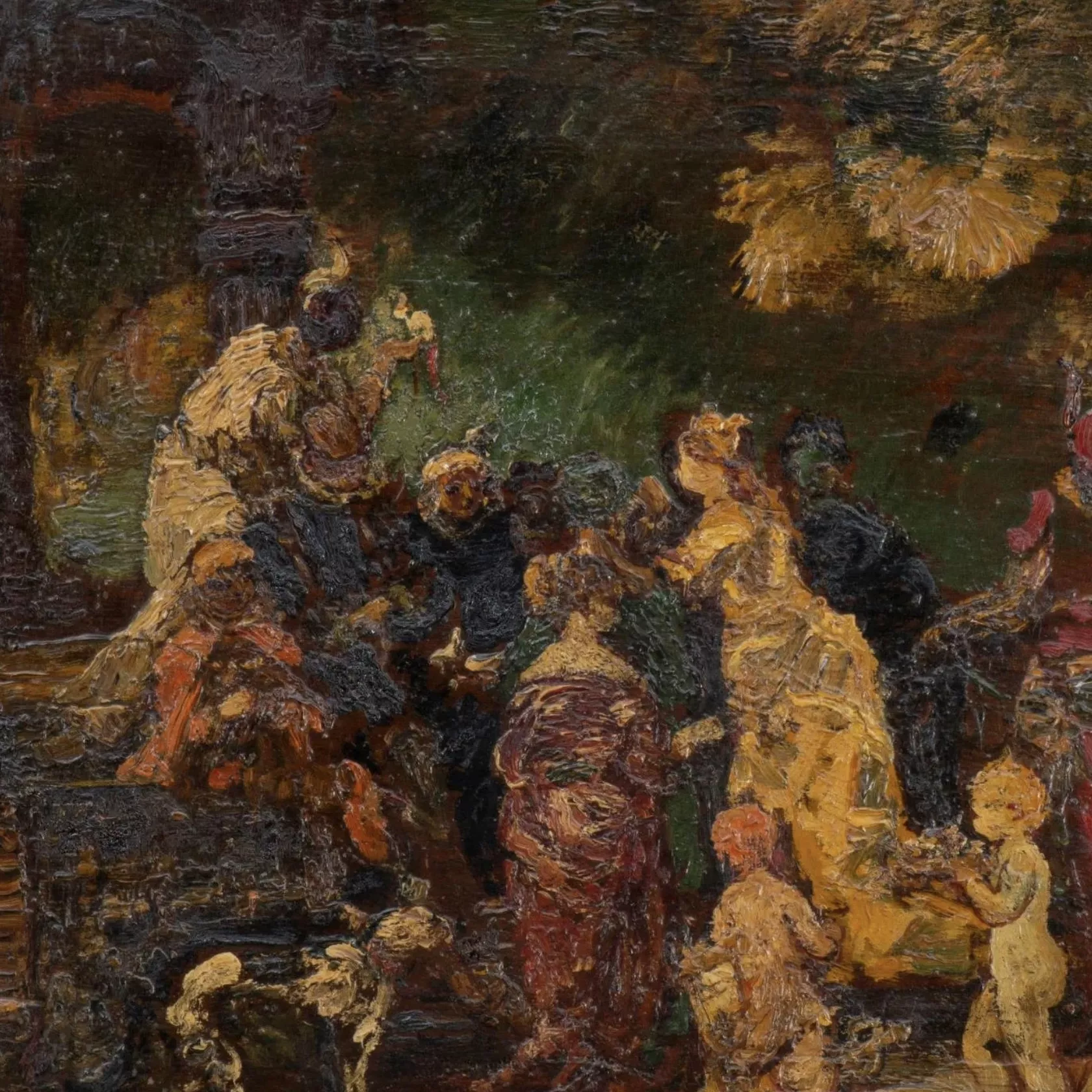
His style is characterized by dense, heavy paste painting, with very thick impasto. The pictorial surface is regularly striated, rough or uneven, giving the canvas a strong materiality.
The workmanship is vibrant and gestural, with visible brushstrokes, thus asserting the presence of gesture. The effect of transparency is limited, the paste being applied in successive opaque layers.
The artist's palette is rich and saturated, dominated by warm tones (reds, oranges, golds, browns, enhanced by greens and blues). His work shows a taste for sumptuous, decorative harmonies, where color prevails over drawing.
He frequently uses intense contrasts of light, which reinforces the dramatic, baroque dimension. His subjects are often difficult to read from a distance, with figures and objects dissolving into the colored matter.
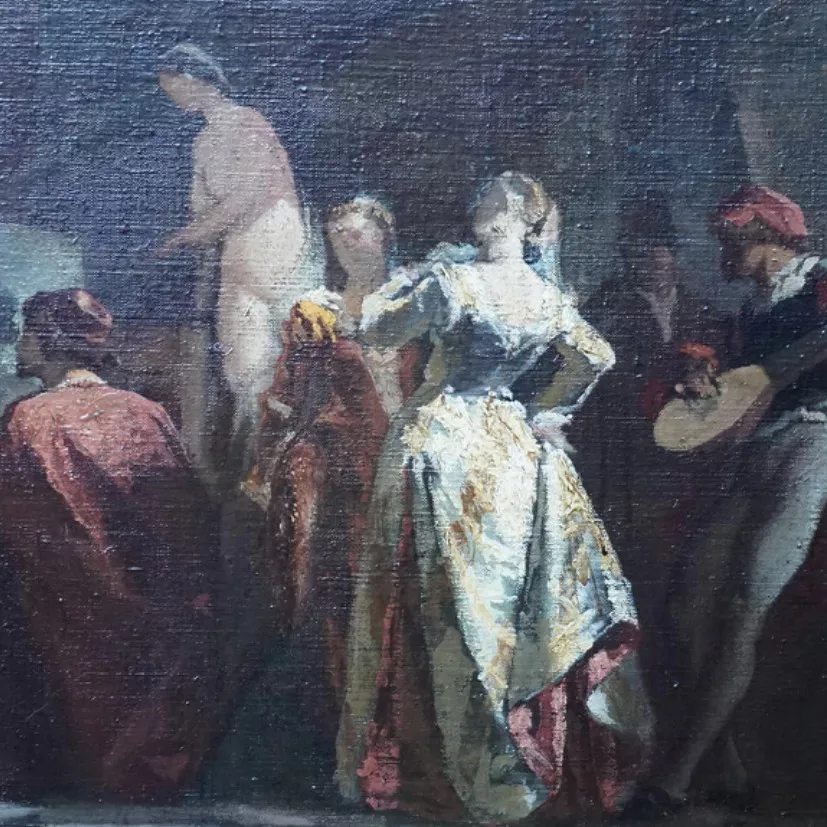
He constructs his compositions in clusters and juxtaposed strokes rather than sharp contours. His recurring themes of choice are galant festive scenes (in the tradition of Watteau), bouquets of flowers, still lifes and Provencal landscapes.
The compositions favor a painterly, luminous mood over precise narrative. Monticelli inherited his work from Delacroix, whose sense of color and movement he admired.
He was also a precursor of Impressionism, thanks to his taste for free brushstrokes and light announcing the research of Cézanne and Van Gogh. His style is sometimes described as Provençal Baroque Romanticism, in which the pictorial material takes precedence over the subject depicted.
His canvases give an impression of chromatic and tactile luxuriance, akin to mosaic or enamel. The reading is often sensory before figurative, calling on the viewer to perceive color as an experience in itself.
His style, sometimes judged " unfinished " by his academic contemporaries, was in fact a pictorial revolution that was admired by Van Gogh. The latter saw in him a master in the use of matter and color.
The life of Adolphe Monticelli
Adolphe Monticelli (1824 - 1886) was born in Marseille, into a modest family. He trained as a painter at the École des Beaux-Arts de Marseille between 1838 and 1846, where he learned academic drawing.
He then moved to Paris in 1846, where he briefly frequented Paul Delaroche's studio and copied the Old Masters at the Louvre, notably Watteau and Delacroix. He exhibited for the first time at the Paris Salon in the 1850s.
He worked in Marseille and then in Paris, painting mainly portraits, landscapes and genre scenes. The artist quickly developed a singular style, which is marked by a thick paste and a pronounced taste for color.
Insettled in Paris in the 1850s-1860s, he made friends with Romantic painters and writers. An admirer of Delacroix and Venetian painting, Monticelli asserted a freer, more colorful approach than his academic contemporaries. His art, now considered too daring and " unfinished ", remains marginal in the face of official standards.
He returned to Marseille in 1870, after the war and the fall of the Second Empire. The artist lived and painted in relative isolation, with no real institutional recognition. He produced numerous works on Provence, including landscapes, bouquets and gallant scenes.
Monticelli died in Marseille in 1886, virtually forgotten by institutions and little recognized during his lifetime. Van Gogh, who arrived in Arles in 1888, admired his work and called him a precursor in the expressive use of color and matter.
His works also influenced Cézanne and heralded some of the research of Expressionism. Today, Monticelli is seen as a visionary painter of the South, and an inventor of an autonomous pictorial language.
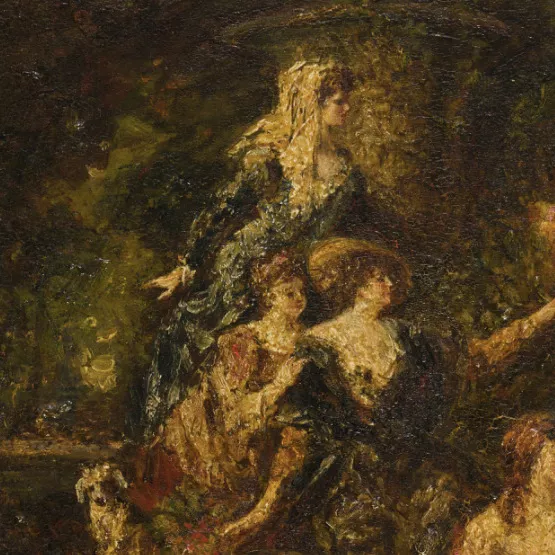
Focus on Scène galante dans un parc, Adolphe Monticelli, 1870
This painting by Monticelli, a medium-format oil on canvas, is a gathering of elegant figures outdoors, inherited from the tradition of Watteau and fêtes galantes.
The composition is materialized by a group of figures gathered in the foreground, sometimes seated, sometimes standing. The background is treated as vaporous and indistinct, suggesting a park, trees and a sunny sky.
The organization is deliberately blurred, and moving, with no clear contours. The scene reads like a cloud of colored shapes. The palette is warm (gold, red, ochre, brown, orange), punctuated by deep greens and blues. The light is not localized but diffuse, permeating the entire surface of the painting.
The colors are laid down in thick masses, blending directly onto the canvas, producing vibrating effects. The impastos are very dense, almost sculptural, bringing out the materiality of the painting.
The knife brush marks are visible, giving the surface a rather rough texture. There is no apparent preparatory drawing; the work is based on direct, intuitive painting.
The figures appear and disappear in the colored paste, giving an impression of transience and dreaminess. The gallant scene creates a festive atmosphere rather than telling a story.
The dissolution of forms in color, meanwhile, announces Monticelli's desire to paint the impression of a moment rather than descriptive reality.
Van Gogh, when he discovered Monticelli, admired this ability to give color expressive autonomy and transform pictorial matter into language. The work illustrates the transition between decorative Romanticism (inherited from Watteau and Delacroix) and a pictorial modernity that heralds Impressionism and even, according to some art historians, Expressionism.
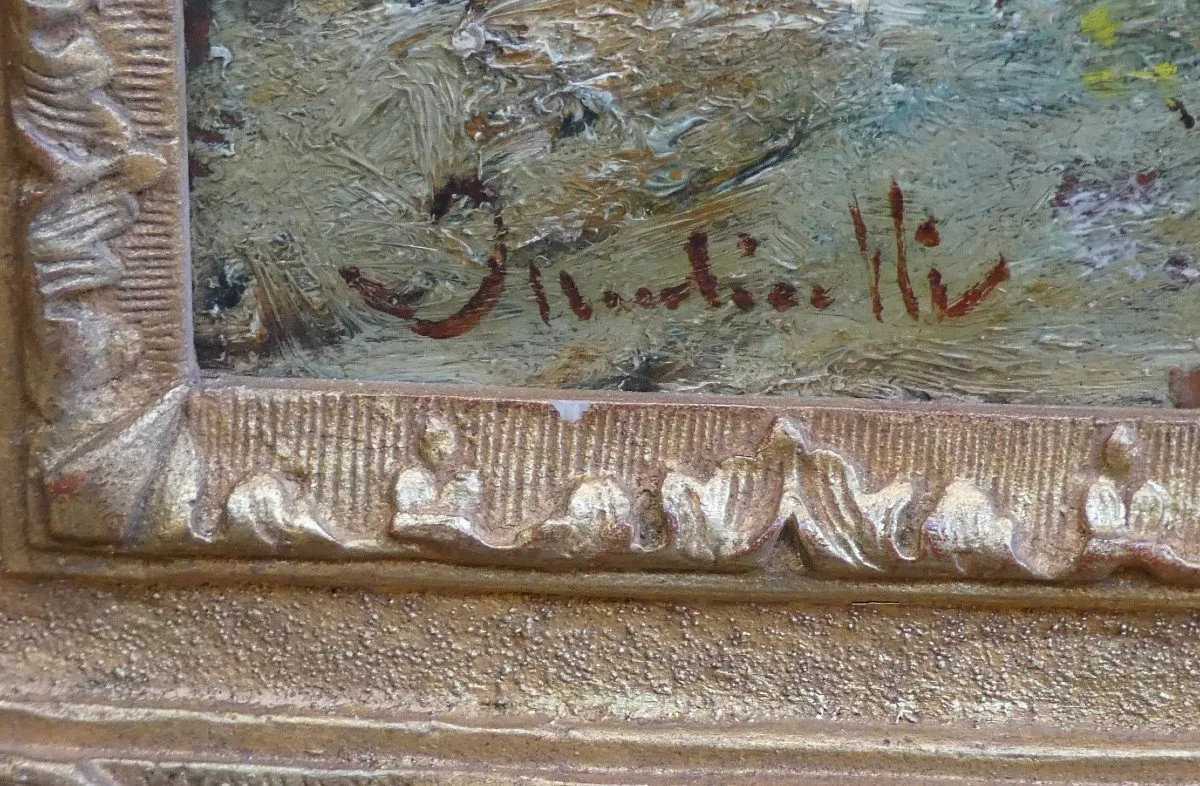
Recognizing the artist's signature
Adolphe Monticelli's works are often signed, his signature can vary from year to year. Here's an example.
Expertise your property
If you own a work by Adolphe Monticelli, don't hesitate to request a free appraisal by filling in our online form.
A member of our team of experts and certified auctioneers will contact you to provide an estimate of the market value of your work.
If you are considering selling your work, our specialists will also guide you through the various alternatives available to obtain the best possible price, taking into account market trends and the specific features of each work.
Estimate in less than 24h
Discover in the same theme

Rating and value of works, drawings and paintings by Eugène...
Eugène Louis Gillot is a little-known but sought-after 19th-century painter of military and marine art. His quotation is fairly high and stable.
Learn more >

Rating and value of works, drawings, paintings by Étienne Bo...
Étienne Bohot was a 19th-century painter influenced by Romanticism, who produced drawings and oils on canvas that are highly prized at auction.
Learn more >

Market Value and Price of the Sculptures and Bronzes by Jean...
Jean Baptiste Germain is a French sculptor who produced bronzes that are highly valued at auction. Estimate in 24h.
Learn more >
D'autres tableaux impressionnistes vendus aux enchères

Estimated 6.000 - 8.000
Mikhail Markianovich GUERMACHEFF (1867 - 1930) House under the snow, oil on canvas

Estimated 2.000 - 4.000
Jean DUFY (1888-1964) Vase of anemones, Watercolor

Estimated 600 € - 800 €
Henri ZUBER (1844-1909), Bridge at Artemare. Oil on canvas.

Secure site, anonymity preserved

Auctioneer approved by the State

Free and certified estimates
Frequently asked questions
-
Who is Adolphe Monticelli, and what is his historical context?Adolphe Monticelli (1824–1886) was a painter from Marseille considered a precursor of Impressionism and Expressionism. Trained at the École des Beaux-Arts in Marseille, he developed a distinctive style characterized by thick impasto and a rich palette of warm tones, influenced by Delacroix and the tradition of Watteau. Admired in particular by Van Gogh, his revolutionary work marked the transition from decorative Romanticism to modern painting, although he remained a marginal figure and received little recognition during his lifetime.
-
What is the price range for Monticelli's works on the market?The prices of Monticelli's works vary considerably depending on the medium and quality. Drawings and watercolors range from €45 to €5,000, while oil-on-canvas paintings—his most sought-after works—range from €90 to €432,000. This variation reflects differences in format, subject matter, and condition. A major still life such as the “Large Still Life with a Pitcher” (1880), for example, exceeded its initial estimate, fetching €432,000 at auction.
-
How can you authenticate a work by Monticelli?To authenticate a work by Monticelli, we recommend that you request a free appraisal from our experts and state-certified auctioneers. Our team will examine the characteristics of your painting, including the signature (which is often present but varies), the thick impasto technique, the warm color palette, and the painterly texture characteristic of the artist. You will receive a detailed response within 48 hours, with no obligation on your part.
-
Is this the right time to sell a work by Monticelli?Yes, now is a good time to sell a work by Monticelli. Prices for this artist’s paintings are rising steadily on the art market, and his recognition as a pioneer of major movements (Impressionism, Expressionism) continues to grow. Collectors are showing sustained interest in his works, particularly his oil-on-canvas paintings, which creates favorable conditions for an optimal sale.
-
How does the appraisal and sale process work at Auctie's?At Auctie's, appraisals are free and non-binding. You fill out an online form with the details of your artwork, and a certified auctioneer will contact you to refine the appraisal. If you’d like to sell, our specialists will guide you through the various options available, taking into account market trends and the specific characteristics of your painting, to help you achieve the best possible price at auction.
