



Rating and value of paintings and drawings by Henri Regnault

Key takeaways
- Regnault’s naturalistic landscapes fetch several hundred thousand euros, notably his oil painting “Automedon and Horses of Achilles,” which sold for €200,000 in 2022.
- Estimates vary depending on the medium: prints range from €20 to €700, watercolors from €40 to €157,800, and oil paintings from €70 to €200,000.
- A major 19th-century Orientalist painter, Regnault revolutionized academic art with his bold use of color before his untimely death in 1871 at the age of twenty-seven.
If you own a work by the artist Henri Regnault or based on his work and would like to know its value, our state-approved experts and auctioneers will guide you.
Our specialists will carry out a free appraisal of your work, and provide you with an accurate estimate of its value on the current market.
Then, should you wish to sell your work, we will direct you to the best possible arrangement to obtain the optimum price.
Artist's rating and value
Henri Regnault produced a variety of works, including paintings, watercolors and prints. He mainly depicted countryside landscapes.
His naturalistic landscapes are particularly sought-after at auction, and can fetch several hundred thousand euros in bidding.
As witness his oil on canvas Automedon and Horses of Achille, bid €200,000, whereas it was estimated at between €150,000 and €230,000.
Order of value from the most basic to the most prestigious
Technique used | Result |
|---|---|
Estamp - multiple | From €20 to €700 |
Drawing - watercolor | From €40 to 157,800 |
Painting | From €70 to 200,000 |
Estimate in less than 24h
Henri Regnault's style and technique
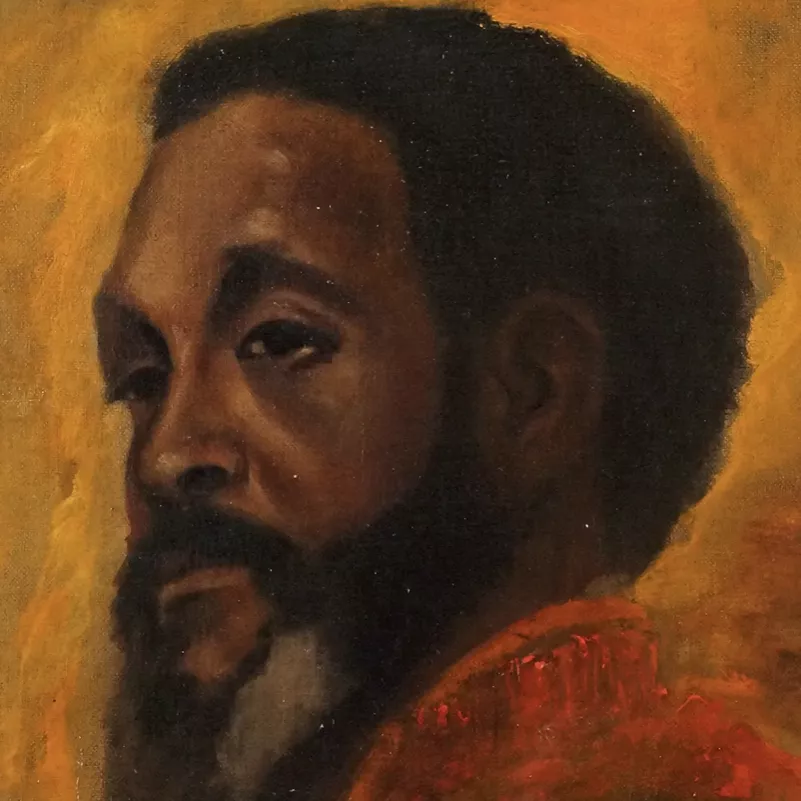
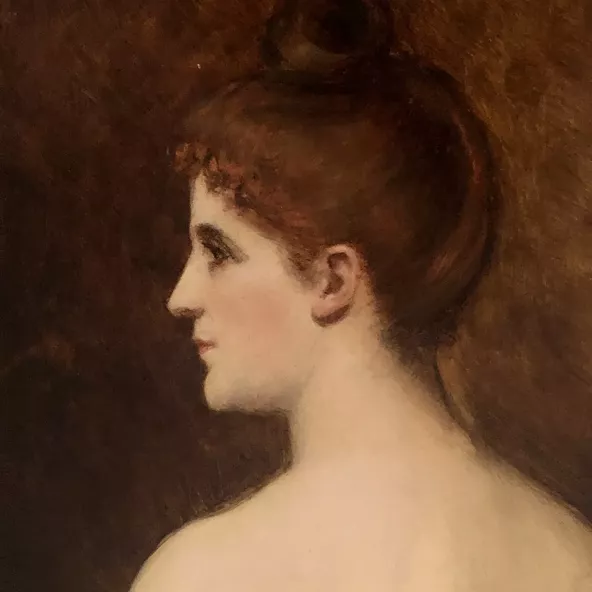
Henri Regnault deploys a dazzling style of painting, where fiery gesture is combined with almost goldsmith's precision. Heir to academicism, he nonetheless hijacks its codes with a flamboyant approach, seeking less cold perfection than dramatic intensity.
His impeccably rigorous line comes alive under the impetus of a bold palette, where burning reds and sumptuous golds exalt his compositions.
Fascinated by the Orient, he transcribes its splendors with a luxury of detail that evokes Persian miniatures, but injects a dynamism derived from Baroque painting, playing on contrasts of light to amplify the effect of relief and movement.
His brush, agile and incisive, sculpts shapes in deep shadows, while the pictorial material, generous without being heavy, gives his works an almost tactile vibration. His attention to rendering, particularly of fabrics and armor, sometimes verges on illusionism, with every reflection and transparency rendered with dizzying precision.
But beneath this dazzling virtuosity lies a tension, an epic breath that inscribes his figures in a dramatic space where majesty rubs shoulders with fury.
Through this fusion of academic rigor and chromatic exaltation, Regnault fashions a unique style, at the crossroads of classicism and visionary orientalism, whose dazzling modernity would only be fully measured after his premature death.
The life of Henri Regnault
Henri Regnault embodies that dazzling brilliance typical of fates broken too soon. Born in 1843 into a cultured family, he trained at the Beaux-Arts in Paris under the tutelage of prestigious figures, but it was the confrontation with the Academy that sculpted his ambition.
He quickly made his mark with the precision of his line and the power of his coloring, two qualities that placed him at the crossroads between academic classicism and the more innovative explorations of the time.
Winner of the prestigious Prix de Rome in 1866, he stayed at the Villa Medici, where his work unfolded under the influence of tradition while being nourished by the discovery of Antiquity.
But it was above all in Spain and Morocco that he forged his artistic identity.
Seville, Granada, Tangiers: each stage nourished his eye, and Orientalism became a language that he appropriated with brilliance.
Regnault ventured into large-scale scenes, translating the light of these foreign lands with a vibrant palette, capturing the sublime in the dramatic tension of the figures he painted.
Salomé and L'Exécution sans jugement sous les rois maures de Grenade reflect this fascination with exoticism and restrained violence, where every movement is frozen in rare intensity.
With his bold compositions and powerfully expressive figures, he seems to capture the soul of the place, the brutality of the moment and the beauty of the light, while foreshadowing the more radical painting that was to emerge at the end of the century.
On the eve of the 1870 war, just as his career was shaping up to be triumphant, he voluntarily enlisted in the National Guard, an act that sealed his fate.
On January 19, 1871, he fell to Prussian bullets in Buzenval, aged just twenty-seven.
His name remains that of a virtuoso of dazzling talent, whose chromatic audacity and nascent modernity never had time to reach their full potential.
In just a few years, Regnault demonstrated his ability to break free from academic dogma, and will forever remain the painter of an era that was both moving and tragic.
.Focus on Salomé, Henri Regnault, 1870.
In 1870, Henri Regnault painted Salomé (Musée d'Orsay, Paris), a work that not only renders the sensuality of the biblical character, but places her in a darker context, where beauty becomes an accomplice to violence.
Salomé, though a mythological figure of seduction, here becomes the embodiment of icy sensuality, a being suspended between desire and pain, in a moment of pure dramatic intensity.
Regnault, true to his bold approach, transforms this biblical scene into a kind of confrontation between eroticism and terror.
Salomé's very posture, frozen in a hypnotic dance movement, is enhanced by the brilliance of her drapery, where warm tones of red and gold seem almost to burn the canvas.
The light, playing on the reflections of her body, accentuates this sensation of contrast between the softness of the skin and the hardness of the message.
Everything in this work speaks of tension: the volumes of the body, enhanced by the light, the fixed expression, at once devoid of emotion and yet perceived as an act of violence.
This is no simple portrait of a woman; Regnault pushes the viewer to see beyond beauty, confronting him with the tormented soul of the character, while offering a fascinating vision of the ambiguity of desire.
Thus, far from being a simple image of seduction, Salomé becomes a tragic work where light and shadow intermingle, and where the viewer perceives the underlying dangers of a too-perfect universe.
Regnault succeeds in unveiling this double face, that of beauty and threat, in a canvas of rare power.
Henri Regnault's imprint on his time
Henri Regnault, in his time, embodied the archetypal painter whose imprint on the art scene went far beyond a simple aesthetic quest.
In the 1860s and 1870s, when art was searching between an academic heritage and the first influences of modernism, Regnault established himself as a resolutely audacious creator, transforming the representation of emotion and movement.
He moved away from the conventions of his time, notably the pompous classicism that still dominated the art world, to venture into territories where the character's psychology is just as paramount as the scene itself.
His compositions, marked by a palpable tension, bring a revival to genre and history painting, fields hitherto dominated by a more formal approach and devoid of the psychological depth he infuses into them.
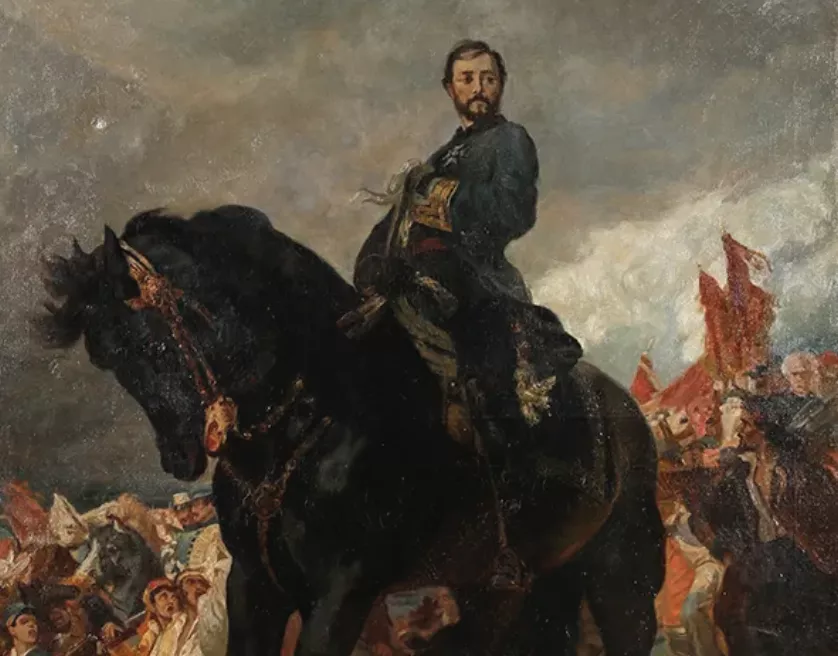
Thus, in works such as Salomé or Le Bataille de Gravelotte, he would seek to highlight beauty in a new light, often more dramatic, more tragic, seeking to awaken in the viewer not only aesthetic admiration, but also a questioning of the human condition and its flaws.
In this respect, Regnault participates in an aesthetic evolution that undermines academicism, where protagonists are no longer simply depicted in idealized poses, but in moments of tension where emotion takes precedence over appearance.
This unique approach, blending the sublime and the dramatic, profoundly marked his period, placing Regnault at the forefront of an art that, while remaining attached to tradition, ventured towards new forms of expression and perception of the human figure.
Henri Regnault's stylistic influences
At the beginning of the 1860s, the influence of academism is still marked in Henri Regnault's work, particularly in his early historical compositions.
His admiration for Antiquity, the Italian Renaissance masters and Classicism is manifested in rigorous execution and meticulous attention to detail.
However, in the manner of Delacroix and l'École de Barbizon, Regnault's art gradually moves towards a more intense exploration of light and color effects.
This stylistic evolution was refined during his stay in Spain where, struck by the works of Velázquez, he learned to render a greater intensity in the rendering of human forms, while approaching characters with a whole new empathy.
Following this trip, the painter, while remaining faithful to an academic structure of composition, sought to insert a more narrative and expressive dimension into his canvases.
He also borrows from realist painting, adopting a more immediate approach to the subject and introducing elements of movement and dramatic tension.
This evolution, between the legacy of the classical masters and the emergence of a more direct pathos, crystallizes a reflection on the nature of beauty, which moves away from idealized representations to open up to the evocative power of reality.
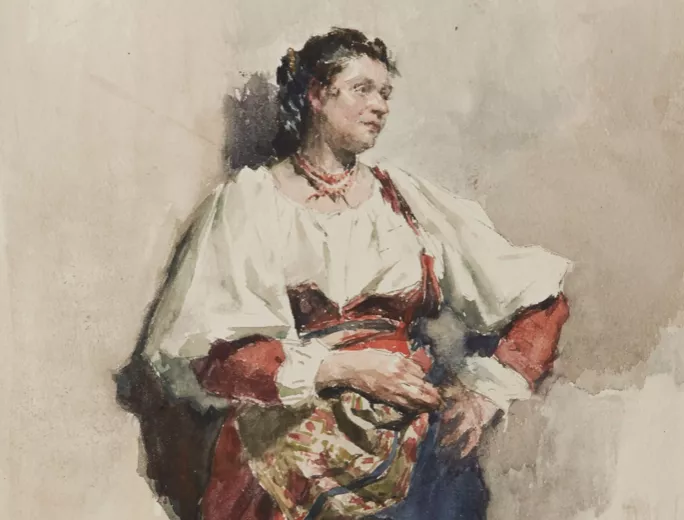
His attachment to the representation of Orientalist subjects enabled him to establish himself as one of the most talented Orientalist artists of his time, alongside painters such as Henri Pontoy or Émile Aubry.
Through these influences, Regnault, at the frontier of several styles, builds a visual universe where the ideal is tinged with the complexity of emotion, oscillating between academic tradition and the search for a more personal art, more rooted in the reality of the subject.
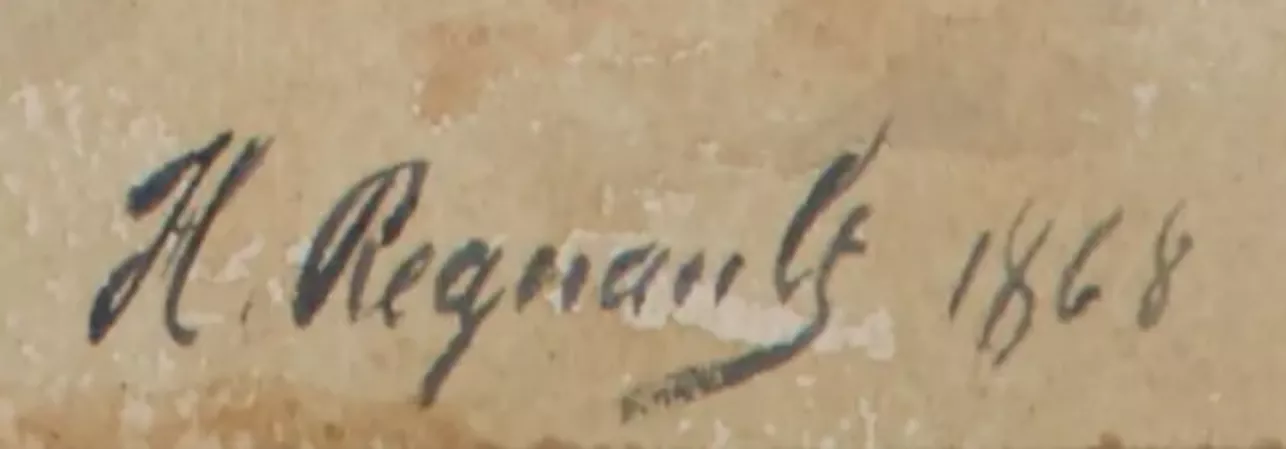
His signature
Not all of Henri Regnault's works are signed.
Although there are variations, here's a first example of his signature:
Expertise your property
If you own a work by Henri Regnault, don't hesitate to request a free appraisal by filling in our online form.
A member of our team of experts and certified auctioneers will contact you to provide an estimate of the market value of your work.
If you are considering selling your work, our specialists will also guide you through the various alternatives available to obtain the best possible price, taking into account market trends and the specific features of each work.
Estimate in less than 24h
Discover in the same theme

Rating and value of works, drawings, paintings by Lazare Bru...
Lazare Bruandet was a landscape painter of the early 19th century. His paintings are appreciated and sought-after at auction.
Learn more >

Rating and value of paintings by Marius Borgeaud
Marius Borgeaud is a 19th-century luminist painter who produced paintings that are increasingly popular and valuable at auction.
Learn more >

Rating and value of paintings by César Pattein
César Pattein was a realist painter of the 19th century, whose paintings are highly valued at auction.
Learn more >
D'autres tableaux orientalistes vendus aux enchères

Estimated 15.000 - 20.000 €
Jacques MAJORELLE (1886-1962) - Fishermen embarking, Abidjan, Ivory Coast - Oil on canvas.

Estimated 40.000 - 80.000
Alexandre ROUBTZOFF (1884-1949), Portrait of Arbia, oil on canvas

Estimated 5.000 - 8.000
Alexandre ROUBTZOFF (1884-1949), The Sidi Makhlouf Mosque, oil on canvas

Estimated 2.000 - 4.000
Henri PONTOY (1888-1968), The Telouet kasbah in the Ounila valley, Oil on canvas

Estimated 1.500 - 2.500
Henri PONTOY (1888-1968) Animated view of a kasbah in the Atlas Mountains

Estimated 3.000 - 4.000
Henri PONTOY (1888-1968), Fantasia at the foot of the Atlas, Oil on canvas

Secure site, anonymity preserved

Auctioneer approved by the State

Free and certified estimates
Frequently asked questions
-
Who was Henri Regnault, and what was his artistic context?Henri Regnault (1843–1871) was a French painter of dazzling talent who won the Prix de Rome in 1866. He epitomized the transition from classical academicism to a more radical modernism, combining academic rigor with a bold color palette and a fascination with Orientalism. Although his career was brief, cut short by his death in battle in 1871 at the age of twenty-seven, his work profoundly influenced the painting of his time.
-
What are the price ranges for Henri Regnault's works, broken down by medium?Regnault’s prints sell for between €20 and €700, his drawings and watercolors for between €40 and €157,800, and his paintings for between €70 and €200,000. His naturalistic landscapes and Orientalist compositions are particularly sought after at auction, with notable examples fetching several hundred thousand euros.
-
How can you authenticate and appraise a work by Henri Regnault?Auctie's offers a free, no-obligation appraisal of your artwork. Simply fill out an online form, and a certified expert or auctioneer will contact you to provide an accurate estimate of its market value. This appraisal takes into account current market trends and the unique characteristics of each piece.
-
Is this the right time to sell a work by Henri Regnault?Yes, now is a good time to sell. Regnault’s naturalistic landscapes and Orientalist compositions remain in high demand at auction. The market particularly values his major works, and interest in this 19th-century artist remains steady, especially among collectors of academic and Orientalist art.
-
How does the sale of a work of art work at Auctie's?The process begins with a free, no-obligation appraisal by our experts and certified auctioneers. After the appraisal, we’ll guide you toward the best option for selling your artwork and getting the best possible price, taking market trends into account. We’ll support you every step of the way, from the appraisal to the auction.
