



Rating and value of paintings by Émile Aubry

Key takeaways
- Paintings by Émile Aubry, a French figurative artist trained at the Beaux-Arts, sell for between €40 and €33,800 at auction, depending on the technique and the prestige of the work.
- Winner of the Prix de Rome in 1907, Aubry created monumental paintings for prestigious institutions such as the Sorbonne, blending classicism and modernity.
- His oil-on-canvas works, particularly those with Orientalist themes, are highly sought after by collectors and fetch prices ranging from €40 to €33,800, as seen with his 1909 painting *Après-midi*, which sold for the latter amount.
If you own a work by artist Émile Aubry or based on his work and would like to know its value, our state-approved experts and auctioneers will guide you.
Our specialists will carry out a free appraisal of your work, and provide you with an accurate estimate of its value on the current market.
Then, should you wish to sell your work, we'll direct you to the best possible arrangement to obtain the optimum price.
Artist's rating and value
Émile Aubry is a French figurative artist who worked in Franc and Algeria, and is enjoying great success on the art market today.
Presented in a number of museums but mainly in private homes, his Orientalist paintings are prized by collectors and sell for between €40 and €33,800 at auction, a sizeable gap but one that speaks volumes about the value that can be attributed to the artist's works.
As witness his painting Après-midi, dating from 1909 sold for €33,800 while it was estimated at between €27,000 and €36,000.
Order of value from the most basic to the most prestigious
Technique used | Result |
|---|---|
Estamp - multiple | From €40 to €200 |
Drawing - watercolor | From €50 to €5,300 |
Oil on canvas | From €40 to €33,800 |
Estimate in less than 24h
The artist's style and technique
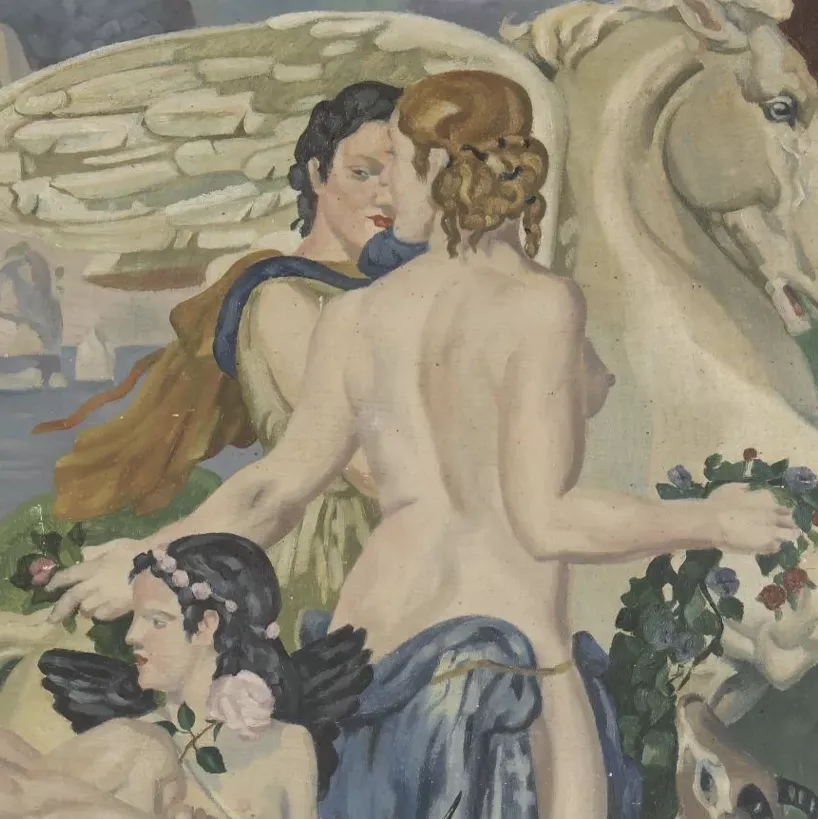
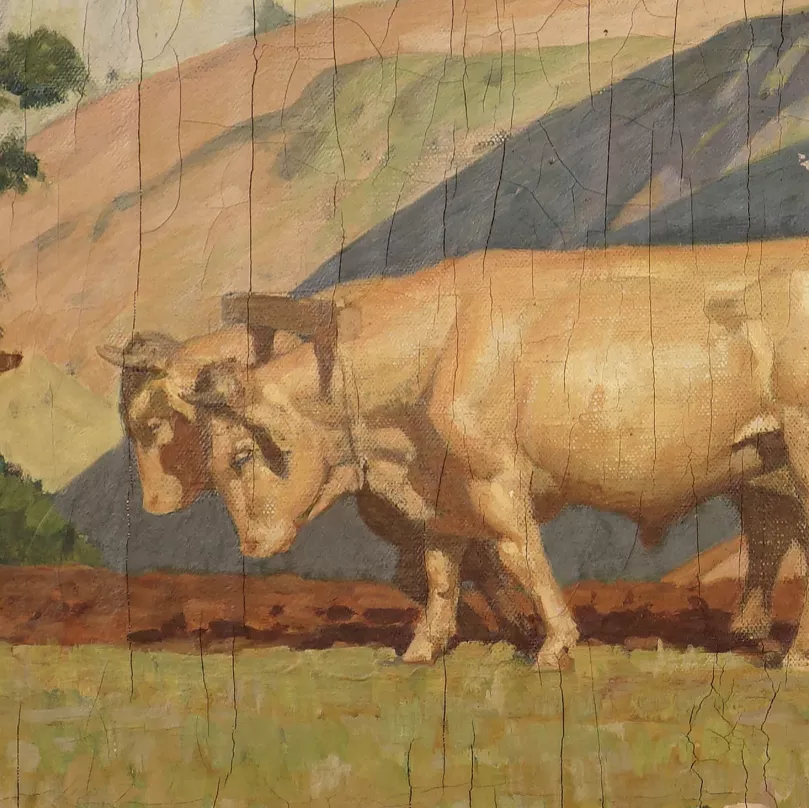
It is precisely in the alliance of classicism and modernism that Émile Aubry deploys a singular style, testifying to a deep rootedness in academic traditions while opening himself up to the influences of his time.
Trained in the exacting standards of the Beaux-Arts, Aubry excels in a technical mastery that shines through in his monumental compositions. His meticulous, precise brushstrokes are distinguished by a work on modeling that lends his figures a sculptural presence.
His murals, produced in particular for public buildings, reflect a search for balance and harmony, where forms are organized in rigorous, almost architectural compositions.
His color is never too intense or too pigmented; it is temperate, subtle, at the service of an atmosphere that is both soothing and solemn.
In his practice, Aubry follows a tradition inherited from Puvis de Chavannes and the French muralists, while incorporating a stylization of form that evokes Art Deco.
In the manner of his contemporaries Jean Dupas or Paul-Albert Laurens, he explores a pared-down aesthetic, where line, firm and precise, structures space.
However, he retains a humanity in his subjects, often imbued with a discreet lyricism and a particular attention to faces and gestures, which we find in his major public commissions.
This skilful blend of tradition and modernity lends his work a timeless scope, oscillating between classicism and stylistic renewal.
Emile Aubry's career
In 1880, Émile Aubry was born in Algiers, then a French colonial territory, against the backdrop of France's artistic effervescence. Trained at the École des Beaux-Arts in Paris, he imbibed the rigorous teachings of the academic tradition, while cultivating a sensibility specific to his era.
Winner of the prestigious Prix de Rome in 1907, Aubry stayed at the Villa Medici, where he immersed himself in the study of the Renaissance masters, whose influence would have a lasting impact on his career.
A complete artist, he distinguished himself as much for his easel paintings as for his monumental works, created for civil and religious buildings, which testify to his ability to combine classicism and modernity.
On his return to France, he joined the muralist movement, creating frescoes for emblematic sites such as the Sorbonne and churches in the Paris region.
Attached to his Mediterranean origins, he also devoted part of his work to scenes inspired by the light and landscapes of North Africa. Aubry lived through the tumult of the twentieth century without ever denying his attachment to humanist values and the quest for art that served the community.
Dying in 1964, he left behind a body of work marked by an ideal of harmony and beauty, in which we find both the rigor of the academicians and the elegance of the great decorators of his time.
.Focus on Peace and Labor, Émile Aubry.
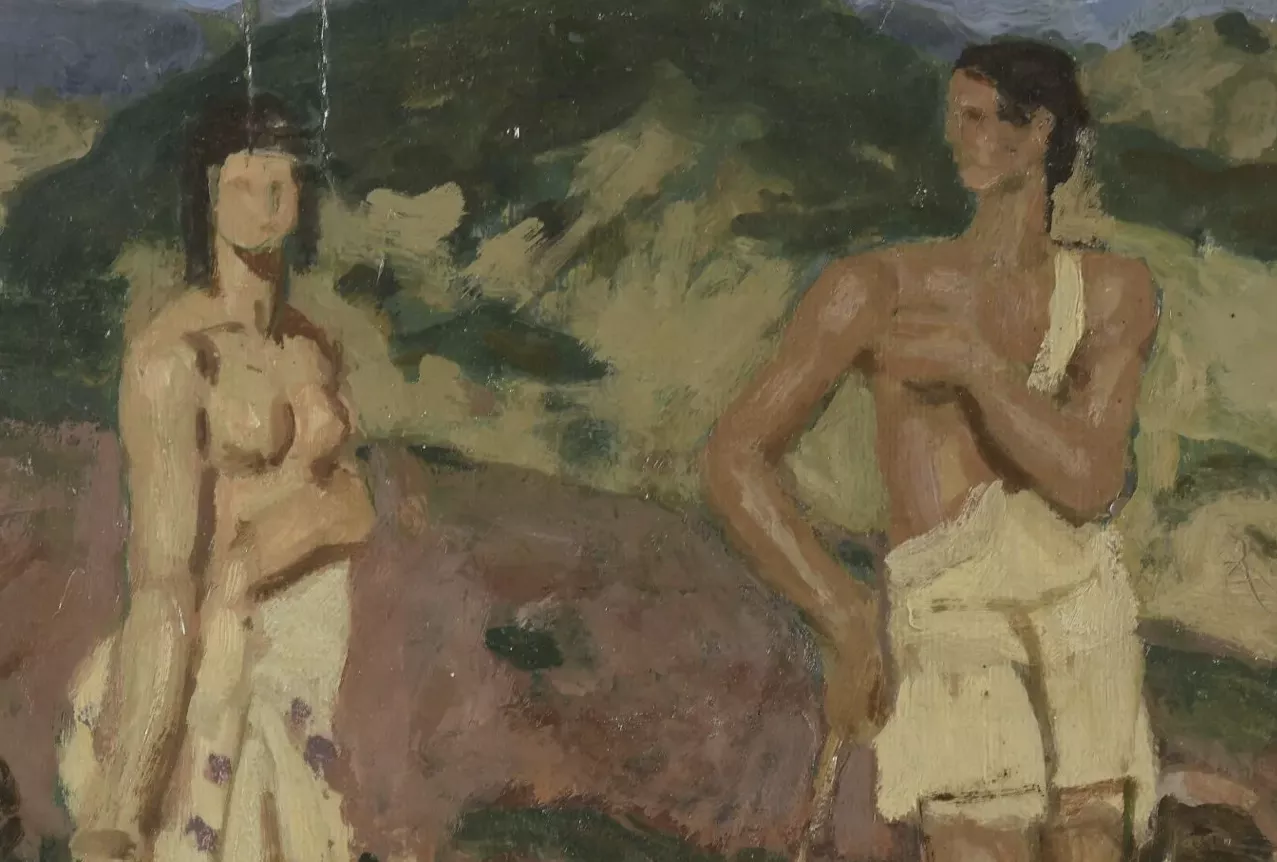
The work Peace and Labor, created by Émile Aubry for the amphitheater of the Paris law faculty, embodies a monumental painting in which collective symbolism is expressed through a classically rigorous composition.
The arrangement of the figures is based on controlled symmetry: on the left, Peace, clad in flowing drapery, seems to embody regained serenity, while on the right, Work, solidly anchored, evokes collective effort and reconstruction.
The dominant tones, oscillating between shades of deep blue and luminous beige, lend a visual harmony that immediately grabs attention without sinking into decorative excess.
The drapery, with its almost sculptural refinement, reflects a technical mastery inherited from classical frescoes, while the precise modeling of the faces is in keeping with an academic tradition, seeking to magnify the human ideal.
Furthermore, the details, from the robust hands to the serious gazes, reinforce the allegorical reading by combining humanity and abstraction.
Aubry here belongs to a line of academic artists, where monumental painting becomes a tool for transmitting social and moral values.
However, far from limiting himself to an exercise in formal virtuosity, he anchors his work in the preoccupations of the post-war period, where the quest for stability and order is echoed in this representation that is both solemn and soothing.
Art, for Aubry, remains a search for balance, translating a vision of man that is both idealized and deeply rooted in its time.
Emile Aubry's stylistic influences
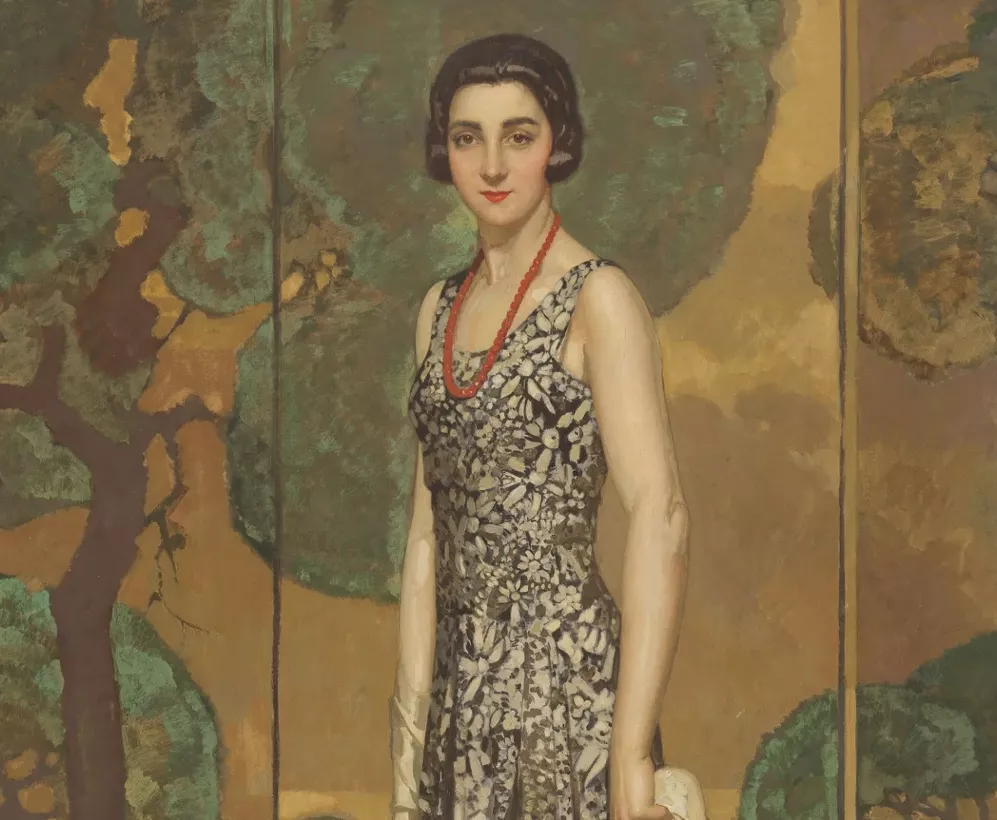
Émile Aubry is part of an artistic lineage in which classical and academic influences interact with the aesthetic concerns of his time.
Heir to neoclassical traditions, he takes from David and Ingres this attachment to clear line and balanced composition, where each element fits into a rigorous structure. However, Aubry does not stop at a pure celebration of the past.
His works also show the imprint of 19th-century historicism, blending Greco-Roman inspirations with a more modern sensibility, notably through his attention to textures and light.
Compared to artists like Puvis de Chavannes, Aubry shares a propensity for monumentality and a quest for serenity in his compositions, but where Puvis favors an almost ethereal approach, Aubry imbues his figures with a more marked carnal density, sometimes recalling the intensity of Italian Renaissance frescoes.
He also draws on the lessons of the previous century's masters, such as Delacroix, incorporating a subtly contrasting palette that, without renouncing idealization, evokes a certain vibrancy.
In his work, the academic line is not a straitjacket but a framework for the expression of universal ideas, enriched by varied influences.
This stylistic synthesis places Aubry at the crossroads between tradition and modernity, offering a body of work deeply rooted in history while responding to the humanist and social aspirations of his time.
Emile Aubry's imprint on his period
Émile Aubry was part of a period when the tensions between tradition and modernity redefined the contours of monumental art.
His imprint, though discreet compared to that of the avant-gardes of his time, is manifest in his ability to revitalize academic muralism while adapting it to the aspirations of a society in search of accessible, unifying art.
Through his frescoes, which he created for prestigious institutions such as the Sorbonne and churches, Aubry helped reaffirm the role of public art in embellishing common spaces, recalling the importance of a dialogue between classical culture and contemporary concerns.
His style, imbued with a classical mastery inherited from his academic training, offers an alternative to the radical breaks advocated by avant-garde movements, proposing a return to more solemn, narrative forms of expression.
In a France marked by the political and social upheavals of the first half of the 20th century, Aubry's work stands out for its ability to establish continuity with the past, while reflecting modern sensibilities.
This positioning, halfway between tradition and innovation, helped shape a section of French monumental art of its time, where the search for aesthetic balance took on its full meaning.
His signature
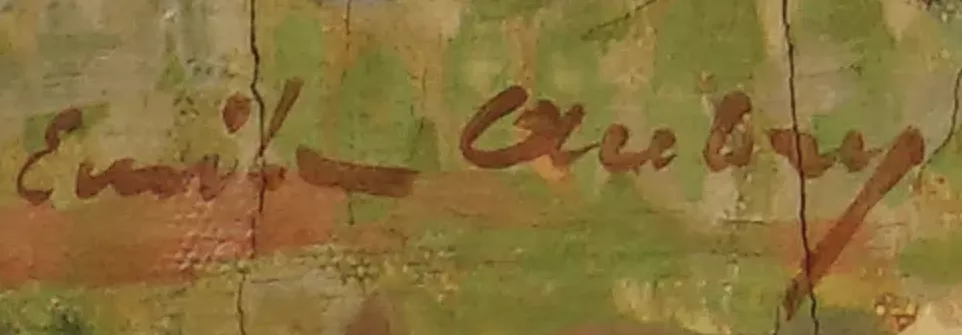
Not all Émile Aubry's works are signed.
Although there are variations, here's a first example of his signature:
Expertise your property
If you happen to own a work by or after Émile Aubry, don't hesitate to request a free appraisal by filling in our form on our website.
A member of our team of experts and certified auctioneers will contact you promptly to provide you with an estimate of the value of your work, and will ensure that you receive ad hoc information about it.
If you're thinking of selling your work, our specialists will also help you find alternatives to sell it at the best possible price, taking into account the inclinations of the market and its specificities.
Estimate in less than 24h
Discover in the same theme

Rating and value of works, sculptures by Igor Mitoraj
Twentieth-century sculptor Igor Mitoraj produced a number of highly prized surrealist and abstract statues.
Learn more >

Rating and value of paintings by Pierre Hodé
Pierre Hodé is a Cubist painter who produced paintings that are now highly valued at auction. Estimate in 24h.
Learn more >

Rating and value of paintings, drawings and lithographs by P...
Peter Klasen is a German artist of narrative figuration, whose works in a variety of media are highly regarded.
Learn more >
Works from the same period sold at auction

Estimated 1.500 - 2.500
Henri PONTOY (1888-1968) Animated view of a kasbah in the Atlas Mountains

Estimated 3.000 - 5.000
Alphonse OSBERT (1857-1939) "Le soir" Oil on canvas

Estimated 2.000 - 4.000
Maximilien LUCE (1858-1941), Moulineux, l'entrée du village, circa 1903, Oil on canvas

Estimated 2.000 - 4.000
Ramiro ARRUE (1892-1971,) Landscape in front of the Rhune, Oil on panel

Estimated 1.500 - 3.000
Macario VITALIS (1898-1989) Portrait of Marie Thérèse, Oil on canvas

Estimated 2.000 - 4.000
Macario VITALIS (1898-1989) Still life with a bouquet of flowers. Oil on canvas.

Secure site, anonymity preserved

Auctioneer approved by the State

Free and certified estimates
Frequently asked questions
-
Who was Émile Aubry, and what was his artistic background?Émile Aubry (1880–1964) was a French figurative artist trained at the École des Beaux-Arts in Paris and winner of the Prix de Rome in 1907. He followed in the tradition of academic muralists, blending classicism with modernity, and created monumental frescoes for prestigious institutions such as the Sorbonne. His work lies at the intersection of the neoclassical legacy and the humanist concerns of the 20th century.
-
What is the price range for Émile Aubry's paintings at auction?Émile Aubry's paintings sell for between €40 and €33,800 at auction. This wide range depends on the medium used: prints range from €40 to €200, drawings and watercolors from €50 to €5,300, and oil paintings on canvas from €40 to €33,800. For example, his painting “Après-midi” (1909) sold for €33,800 in 2009.
-
How can you authenticate a work by Émile Aubry and determine its value?To authenticate and appraise a work by Émile Aubry, we recommend that you request a free appraisal from Auctie's by filling out the appraisal form on our website. A state-certified expert or auctioneer will contact you within 48 hours to provide you with an accurate estimate of your artwork’s value on the current market.
-
Is this the right time to sell a work by Émile Aubry?Yes, now is a good time to sell a work by Émile Aubry. The artist is currently enjoying great success in the art market, and his Orientalist paintings are highly sought after by collectors. Demand for his paintings—particularly his monumental compositions and scenes inspired by North African landscapes—remains strong.
-
How does the appraisal and sale of a work of art take place at Auctie's?The appraisal is free and non-binding: simply fill out an online form, and an Auctie's expert will contact you within 48 hours to appraise your artwork. If you’d like to sell, our specialists will guide you through the process from appraisal to auction, offering you the best options to achieve the highest possible price based on current market trends.
