



Rating and value of Thomire clocks, sculptures and candelabra

Key takeaways
- Thomire (1751–1843) excelled in bronze chasing and gilding, having been trained by the great masters Pajou, Houdon, and Gouthière.
- Thomire’s clocks fetch between €3,000 and €200,000, while his candelabras sell for between €10,000 and €500,000.
- A leading artist of the Empire style, Thomire was granted the title of purveyor to Their Majesties in 1809, and his works are housed at Versailles, the Hermitage, and Windsor.
The beginnings of Thomire
Pierre-Philippe Thomire was born in Paris in 1751 and died in 1843. Grand maître du bronze de la fin du XVIIIème siècle et début du XIXème siècle, il apprend auprès des plus grands maîtres de la statuaire : Augustin Pajou and Jean-Antoine Houdon. The artist then trained with bronze-maker Pierre Gouthière. In contact with the great master - who himself worked for Marie-Antoinette - Thomire excelled with his talents in bronze gilding and chasing. At the age of 25, he set up on his own and created the bronzes for Louis XVI's coronation carriage. He is then appointed to the Manufacture de Sèvres. At the same time, he received commissions for the great royal castles from Queen Marie-Antoinette and executed prestigious works preserved, for example, at Versaillesbut also at the Château de Compiègne.
Estimate in less than 24h
Rating and value of Thomire bronze creations
These price estimates are based on authentic, quality Thomire bronzes, but it should be noted that actual prices may vary depending on the historical significance, rarity, provenance, size, complexity of the sculpture and state of preservation of each individual piece. It is recommended to consult specialized experts and auctioneers for accurate and up-to-date appraisals of Thomire bronzes.
Object type | Estimation |
|---|---|
Candelabras | 10,000 - 500,000 € |
Anders | 3,000 - 200,000 € |
Vases | 3,000 - 150,000 € |
Sculptures | 5,000 - 300,000 € |
Decorative objects | 2,000 - 100,000 € |
Estimate in less than 24h
The Thomire house in the 19th century
At the end of the 18th century and the abolition of guilds, Thomire suffered the throes of the revolution. The artist nevertheless came to prominence again during theFirst Empire, when he won a gold medal at the Exposition Publique des Produits de l'Industrie. His success spread beyond France's borders, with the artist devoting much of his production to export. In 1809, he was awarded the brevet de fournisseur de Leurs Majestés Impériales et royales. The " Empire fashion" of the period allowed the artist to flourish. Fascinated by mythology and antiquity, his works feature nymphs, gods and other mythological references, to which he incorporates thoroughly Empire elements, and he makes a specialty of subject clocks, where he chisels more lifelike works from bronze, which achieve significant results at auction. After the fall of the Empire, his popularity continued unabated, and Thomire continued to supply the royal clientele during theRestoration.
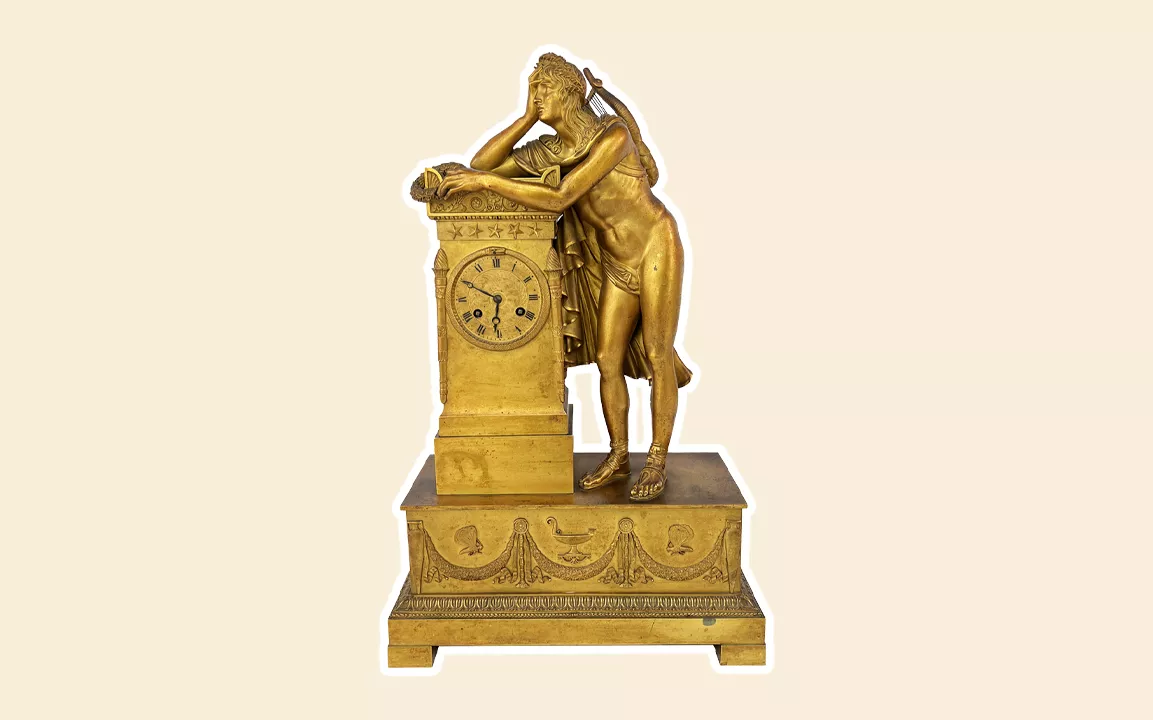
The example of a Thomire clock at auction
This Thomire clock features significant dimensions : 60 cm high ! It could almost be described as a "ministry clock". It features the god Apollo, wearing his lyre on his back and leaning on a column in which the dial is inscribed. At the top of the column is a frieze of acanthus leaves, a reference to antiquity, and five stars, typically Empire motifs. The base of the clock is adorned with Empire style motifs as well: garland, butterflies (traditionally associated with Empress Josephine but which here may be a reference to Psyche), and a frieze of lotus leaves. It is gilded with matte.
The representation of the god of song, the arts and beauty is a subject particularly appreciated by the artist. Similar clocks can be found at the Hermitage Museum in St. Petersburg, the Château de Windsor in England, the château de la Malmaison and the Musée des arts décoratifs in Paris.
An exceptional model sold at auction, at Hôtel Drouot for 3120€.
Estimate in less than 24h
Discover in the same theme

The value of Jacob Petit porcelain
Jacob Petit, a 19th-century porcelain artist, left a considerable and varied output that is highly valued. Estimate in less than 24h.
Learn more >

Rating and value of paintings by Adolphe Monticelli
Adolphe Monticelli was a 19th-century painter admired by Van Gogh, who produced a number of highly valued paintings.
Learn more >

Rating and value of paintings by Giuseppe de Nittis
Giuseppe de Nittis is an Italian artist of 19th-century modernity who lives in Paris. His works are highly valued.
Learn more >
Other objects from the same period sold at auction

Estimated 600 € - 800 €
MEISSEN, 18th century, porcelain wall stoup.

Estimated 800 € - 1 200 €
MANUFACTURE NATIONALE DE SEVRES Rare porcelain cookie obelisk.

Estimated 9 000 - 12 000 €
Guillaume FOUACE (1837-1895) Pheasant and hare.

Estimated 600 € - 800 €
Henri ZUBER (1844-1909), Bridge at Artemare. Oil on canvas.

Secure site, anonymity preserved

Auctioneer approved by the State

Free and certified estimates
Frequently asked questions
-
Who was Pierre-Philippe Thomire, and what was his historical context?Pierre-Philippe Thomire (1751–1843) was a master bronze castor of the late 18th and early 19th centuries, trained by the greatest Parisian sculptors, such as Houdon and Pajou, and later by the renowned bronze castor Pierre Gouthière. A highly regarded court artist, he worked for Marie Antoinette, then flourished during the Empire by becoming an official supplier to the court, before continuing his work until his death in 1843.
-
What types of works has Thomire created, and what are their price ranges?Thomire primarily created candelabras (€10,000 to €500,000), clocks (€3,000 to €200,000), sculptures (€5,000 to €300,000), vases (€3,000 to €150,000), and decorative objects (€2,000 to €100,000). These estimates vary considerably depending on the historical significance, rarity, provenance, size, and condition of each piece.
-
How can a work attributed to Thomire be authenticated?To authenticate a work by Thomire, we recommend submitting your piece for a free appraisal at Auctie's, which brings together auctioneers and experts specializing in prestigious bronzes. Our appraisal is non-binding, and you will receive a detailed response within 48 hours.
-
Is this a good time to sell a Thomire clock, sculpture, or candelabra?Yes, now is a good time to sell a work by Thomire. This artist’s creations—particularly the clocks featuring mythological themes that are characteristic of the Empire period—regularly fetch high prices at auction and are in high demand among collectors and institutions in France and abroad.
-
How does the sale of a Thomire artwork at Auctie's work?At Auctie's, we support you every step of the way: a free, no-obligation appraisal by our experts, followed by an auction listing if you wish. Our auction house has the expertise and network of collectors needed to ensure your Thomire bronze fetches the best possible price at auction.
