



Rating and value of paintings and drawings by Ferdinand Georg Waldmüller

Key takeaways
- Waldmüller, a 19th-century Austrian realist painter, continues to command remarkably high prices, with works selling for between 470 and 2,253,500 euros.
- His oil paintings fetch the highest prices (up to 2.25 million), while his drawings and watercolors range from 1,050 to 132,400 euros.
- A master of light and detail, he is distinguished by his realistic approach, which emphasizes direct observation of nature over conventional academicism.
If you own a work by or after the artist Ferdinand Georg Wäldmuller, and would like to know its value, our state-approved experts and auctioneers will offer you their appraisal services.
Our specialists will carry out a free appraisal of your work, and provide you with an accurate estimate of its value on the current market.
Then, if you'd like to sell your work, we'll direct you to the best possible arrangement to get the best price for it.
Rating and value of the artist Ferdinand Georg Wäldmuller
An Austrian academic painter of the 19th century, Wäldmuller was one of the most active masters of his time in Austria and remains remarkably highly rated on the art market.
His works sold for between €470 and €2,253,500, a substantial delta but one that speaks volumes about the value that can be attributed to the artist's works.
An oil on canvas entitled Grandfather's birthday sold for €2,253,500, while it was estimated at between €670,000 and €1,000,000.
Order of value from a simple work to the most prestigious
Technique used | Result |
|---|---|
Miniature | From €390 to €10,000 |
Drawing - watercolor | From 1,050 to 132,400€ |
Painting | From 470 to 2,253,500€ |
Estimate in less than 24h
The artist's style and technique
Ferdinand Georg Waldmüller established himself as one of the masters of Austrian realism, meticulously exploring the effects of light and the richness of detail.
His rigorous approach, inherited from the academic tradition, is distinguished by a precise observation of the world around him.
Attached to scenes of everyday life, he translates with striking accuracy the expressions on faces, the texture of fabrics and the subtle variations of nature.
His masterful use of light, often compared to that of the 17th-century Dutch masters, lends his compositions a special radiance, where every element seems bathed in vibrant clarity.
In his landscapes, he adopts a luminous palette and precise modeling that amplify the depth of Alpine panoramas and Austrian countryside.
His realism never dwells on cold technical exactitude, but always seeks to infuse his scenes with emotional intensity, whether delicate portraits or rural playlets imbued with gentle nostalgia.
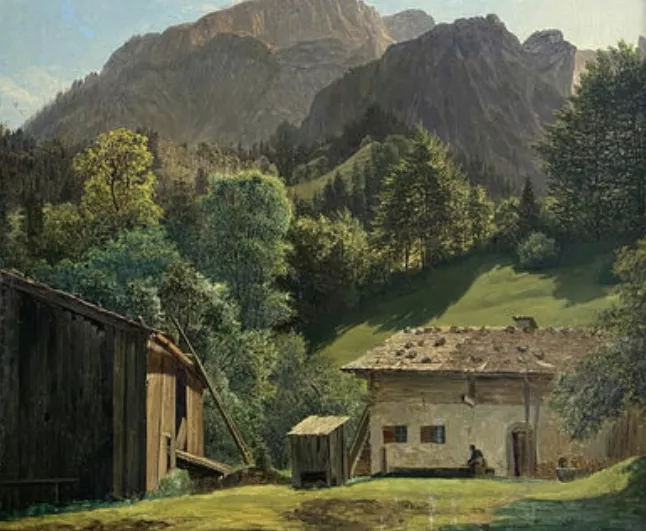
The life of Ferdinand Georg Waldmüller
Ferdinand Georg Waldmüller was born in Vienna in 1793, where he received early training at the Academy of Fine Arts. Gifted and ambitious, he began as a miniaturist before turning to history painting, then to portraiture, a field in which he quickly excelled.
His talent opened the doors to the imperial court, where he carried out official commissions while developing a personal eye, more rooted in the observation of reality.
But it was in the depiction of landscapes and scenes of daily life that he found his true calling.
A tireless observer, he roamed the Austrian countryside, capturing with remarkable precision the changing light of the seasons, the harshness of the rural world and the simplicity of peasant life.
Each canvas becomes a lesson in naturalism, where matter is worked with an almost tactile meticulousness and the brilliance of color faithfully restores the richness of the Austrian landscape.
His independent character and bold ideas on art education earned him tensions with the Academy, which he openly criticized, advocating learning based on direct study of nature rather than imitation of past masters.
Away from academic circles, he nevertheless continued to paint with unwavering rigor, multiplying works in which attention to detail and the strength of chiaroscuro lend his compositions a dramatic intensity.
His taste for realism, far from being purely documentary, is accompanied by an almost poetic approach, where light becomes a narrative element in its own right.
Until his death in 1865, he remained faithful to his vision, asserting, through the force of his brush, a sincere and demanding approach to the world around him.
His work, rich and varied, had a lasting influence on Austrian painting, foreshadowing, in certain respects, the concerns of the realist currents that would emerge after him.
Focus on The Return from School, 1836, Ferdinand Georg Wäldmuller
Ferdinand Georg Waldmüller here captures an everyday moment with remarkable precision. The Return from School features a group of children advancing along a path bordered by greenery, bathed in bright, generous light.
Every detail, from expressions to clothing, is treated with a meticulousness that testifies to the artist's keen eye for the times.
In this painting, light plays an essential role. It cuts the shapes sharply, accentuating contrasts and giving the scene an almost tangible dimension.
The atmosphere is peaceful, but far from static: the movement of the children, the play of light and shadow enliven the composition with discreet vitality.
Nature, omnipresent, is no mere backdrop; it envelops the scene and dialogues with the figures, reminding us of the importance of the link between man and his environment.
Through this rural scene, Waldmüller goes beyond mere testimony. He magnifies the everyday, giving the simplest gestures an emotional depth.
It's not just a matter of representing, but of revealing, with an almost intimate sincerity, the beauty of a fleeting moment.
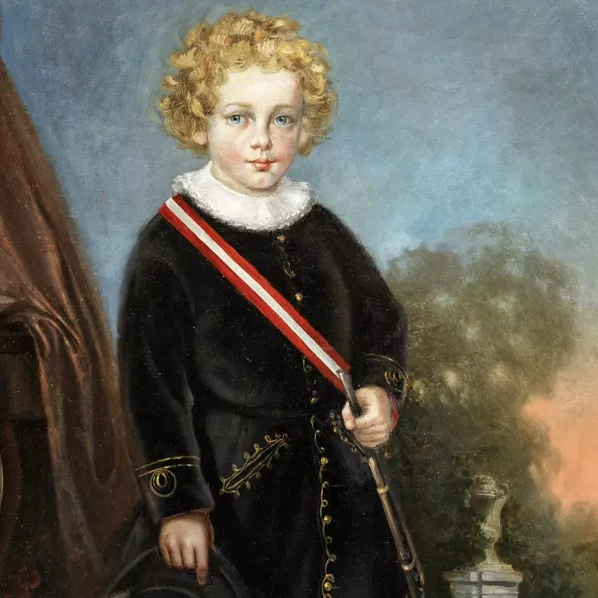
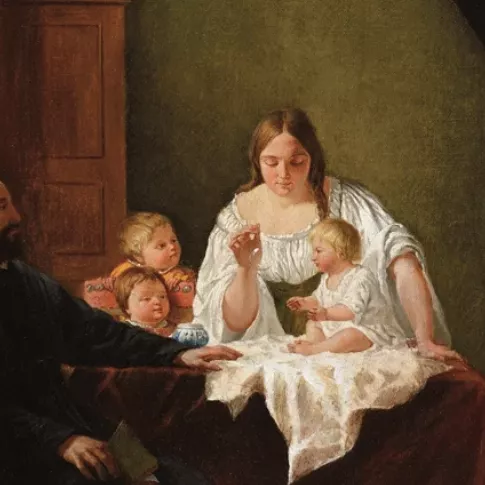
Ferdinand Wäldmuller's imprint on his period
Ferdinand Georg Waldmüller established himself as a key figure of Austrian realism in the XIXᵉ century.
At a time when official art still favored a certain idealization, he set out to depict everyday life with uncompromising acuity, capturing the harshness as well as the poetry of popular life.
His approach, based on meticulous observation of nature and human figures, had a lasting influence on genre and landscape painting, inspiring subsequent generations with his luminous treatment and precision of detail.
His talent for rendering the clarity of low-angled light or the texture of clothing lends his works a striking truth, anchoring each of them in a narrative that is both intimate and universal.
His attention to detail, his mastery of contrasts and his attachment to the sincerity of the motif herald future developments in naturalism, while prefiguring certain aspects of nascent impressionism.
While his work was sometimes deemed too far removed from the academic conventions of his time, his legacy today proves fundamental in the rediscovery of an authentic art, rooted in reality and freed from artifice.
Waldmüller didn't just leave his mark on his era: he also left behind a lesson in painting, in which the accuracy of the gaze takes precedence over conventional aestheticism, rehabilitating everyday life as a noble and worthy subject.
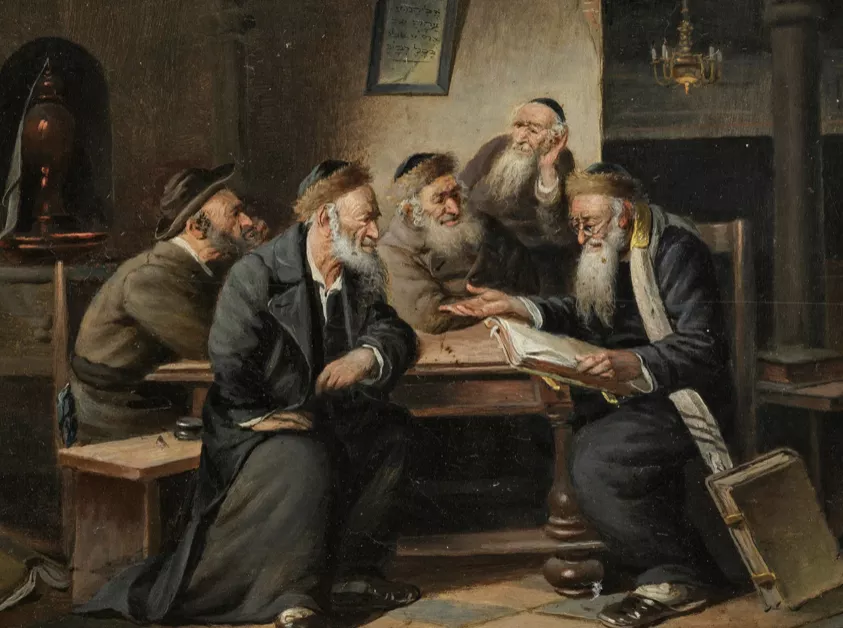
Ferdinand Wäldmuller's place in 19th-century Austrian painting
Ferdinand Georg Waldmüller occupies a singular place in 19th-century Austrian painting, asserting himself as one of the most fervent defenders of realism at a time when idealism still dominated the academies.
While France saw the emergence of Courbet, Corot and Millet, champions of an art that claimed the truth of the peasant and working-class world, Waldmüller, too, focused on faithful depictions of everyday life, but with a brighter, more detailed approach, close to a technical perfection that set him apart from his contemporaries.
Facing Hans Makart, the figurehead of Viennese historicism with his theatrical, exuberant compositions, Waldmüller chose a radically opposite path: the simplicity of domestic scenes, the sincerity of portraits and the purity of light that models his landscapes with an almost scientific precision.
His view of Austrian rural life is reminiscent in some respects of Jean-François Millet's French peasantry, but Waldmüller does not dwell on the harshness of toil, preferring to exalt the harmony between man and nature, in a vision that is sometimes idealized, but always rooted in reality.
In the Austrian tradition, he also distances himself from Rudolf von Alt, whose watercolors capture the architectural grandeur of imperial cities, while he favors the silence of the countryside and the warmth of bourgeois interiors.
In this, he more readily joins Germany's Adolph Menzel, whose obsession with detail and precision of rendering echo his own concern with naturalism.
At the crossroads of classical influences and a nascent modernism, Waldmüller embodies an essential transition, imposing realism as a credible alternative to the pomp of Viennese academicism, and paving the way for a more intimate, authentic painting.
Recognizing the artist's signature
It's not always easy to identify Ferdinand Georg Wäldmuller's signature. As a rule, he signs the canvas with his name in cursive script.
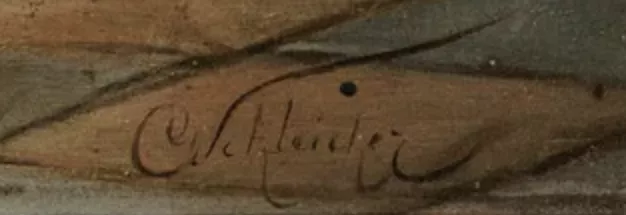
Knowing the value of a work
If you happen to own a work by Ferdinand Georg Wäldmuller, request a free appraisal without delay via our website form.
A member of our team will contact you promptly to provide you with an estimate of the value of your work, as well as ad hoc information about it.
If you are considering selling your work, you will also be accompanied by our specialists in order to benefit from alternatives for selling it at the best possible price.
.Estimate in less than 24h
Discover in the same theme

Rating and value of sculptures, bronzes and marbles by Augus...
Auguste Clésigner is a French sculptor who has produced a number of sculptures that are highly valued at auction.
Learn more >

Rating and value of paintings by Charles Euphrasie Kuwasseg
Charles Euphrasie Kuwasseg was a 19th-century figurative painter whose landscapes and seascapes are highly valued.
Learn more >

Rating and value of drawings and paintings by Gustave Caille...
Gustave Caillebotte is a French Impressionist painter whose work is rare and highly prized at auction. His works are very valuable.
Learn more >
Works from the same period sold at auction

Estimated 1.000 - 2.000
French school, circa 1860 Presumed portrait of Églé Ney de la Moskowa (1832-1890), Duchess of Persigny

Estimated 6.000 - 8.000
Michel Martin DRÖLLING (1786-1851), Portrait of Dominique Alexandre "Charles" Legrand (1790-1808), oil on canvas

Estimated 20.000 - 30.000
Auguste RENOIR (1841-1919) Entrance to houses, circa 1895-1896, Oil on canvas.

Estimated 4.000 - 6.000
Ary Scheffer (Dordrecht 1795-1858 Argenteuil) One of the three holy women (meditating on Christ's resurrection after the vision in the tomb?) Oil on canvas

Estimated 1.500 - 3.000
Olivier Charles DE PENNE (1831-1897) The Pack, Oil on panel

Estimated 3.000 - 4.000
Entourage by Jean-Léon Gérôme (Vesoul 1824-1904Paris) Young androgynous Moorish smoker, dressed in Polish style, wearing a Baroque pearl (Angelo Soliman?) Oil on canvas

Secure site, anonymity preserved

Auctioneer approved by the State

Free and certified estimates
Frequently asked questions
-
Who was Ferdinand Georg Waldmüller, and what was his artistic style?Ferdinand Georg Waldmüller (1793–1865) was a leading Austrian painter of the 19th century and one of the masters of Austrian Realism. His style is characterized by meticulous observation of nature, an exceptional mastery of light comparable to that of the 17th-century Dutch masters, and precise attention to detail in scenes of everyday life. He distinguished himself by his rejection of academic idealization, advocating a direct study of nature and embracing a sincere and rigorous approach to the world around him.
-
What is the price range for Waldmüller's works?Waldmüller’s works sell for between 470 and 2,253,500 euros, depending on the medium and quality. Miniatures range from €390 to €10,000, drawings and watercolors from €1,050 to €132,400, and paintings from €470 to €2,253,500. This wide range reflects the diversity of techniques used and the historical significance attributed to certain major paintings.
-
How can I have a Waldmüller artwork authenticated and appraised?To authenticate and appraise a work by Waldmüller, we recommend that you submit a request for a free appraisal via our online form. A state-certified auctioneer will contact you shortly and provide you with an accurate assessment of your work’s current market value, with no obligation.
-
Is this the right time to sell a work by Waldmüller?Yes, now is a good time to sell a work by Waldmüller. The artist continues to command remarkably high prices on the art market, and his reputation has grown steadily since his rediscovery. There is renewed interest in the Austrian Realism he embodies, and his paintings continue to fetch significant prices at auction. Our experts will guide you toward the best approach to achieve the highest possible price.
-
How does the sale of a work of art work at Auctie's?At Auctie's, we guide you every step of the way, from the initial appraisal to the final sale. After you request a free, no-obligation appraisal, our specialists will present you with the best options for selling your artwork. We manage the entire process to maximize the sale price, drawing on the expertise of our renowned auctioneers and appraisers.
