



Rating and value of paintings, drawings and engravings by Jean-François Millet

Key takeaways
- Millet’s paintings fetch between €400 and €2,454,000 at auction, while his prints range from €10 to €19,200 depending on the technique used.
- A master of French realism, Millet (1814–1875) is known for his moving depictions of peasant life, rendered in a subdued palette that favors earthy and ochre tones.
- His major works, such as *The Angelus* (1859) and *The Gleaners* (1857), influenced the Barbizon School and the Impressionists through their pursuit of authenticity and spirituality.
A master of the natural scene and a source of inspiration for the Impressionists, Jean-François Millet (1814-1875) brought a revival to the traditional landscape genre. As a theorist, this artist succeeded in freeing himself from the teachings of the École des Beaux-Arts in order to paint nature more authentically.
If you own a work by or based on the artist Jean-François Millet and would like to know its value, our state-approved experts and auctioneers will guide you.
Our specialists will carry out a free appraisal of your work, and provide you with a precise estimate of its value on the current market. Then, if you wish to sell your work, we will guide you towards the best possible arrangement to obtain the optimum price.
Artist's rating and value
Jean-François Millet produced a variety of works, including paintings, watercolors and prints. He mainly depicted travel landscapes, portraits and genre scenes.
His naturalistic landscapes are particularly sought-after at auction, and can fetch several hundred million euros. A case in point is his oil on canvas La Cardeuse, which fetched over €2 million at Christie's, whereas it was estimated at between €1,200,000 and €1,600,000.
Order of value from the most basic to the most prestigious
Technique used | Result |
|---|---|
Estamp - multiple | From €10 to €19,200 |
Drawing - watercolor | From €20 to €1,302,500 |
Painting | From €400 to €2,454,000 |
Estimate in less than 24h
Style and technique of Jean-François Millet
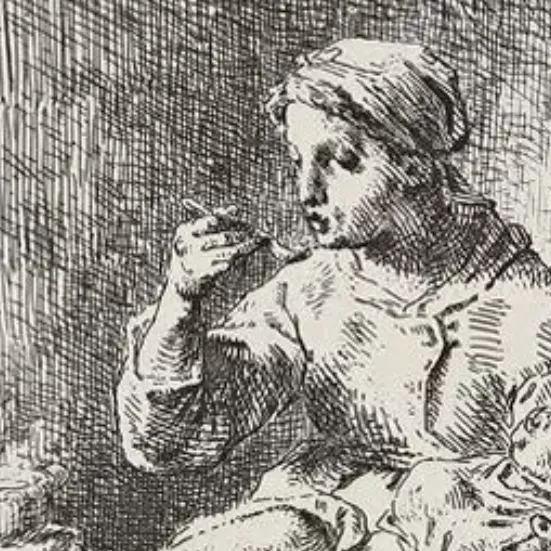
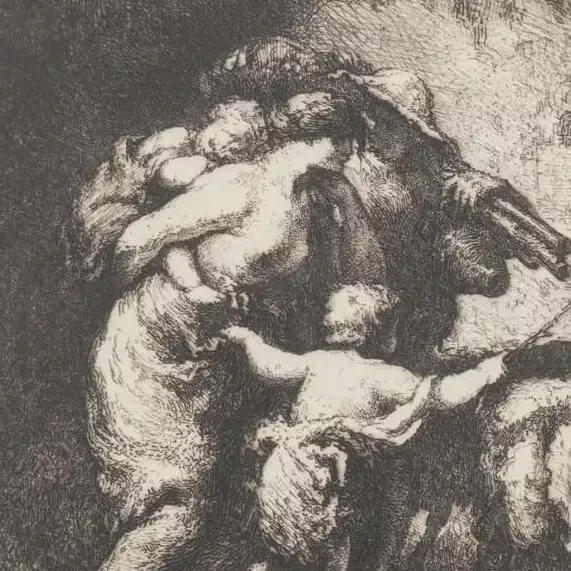
Jean-François Millet, a leading figure of French realism, is renowned for his powerful and moving depictions of peasant life. Inspired by his rural childhood, Millet developed a style deeply rooted in the reality of the farming world. His works focus on the workers of the land, and his way of capturing their dignity in physical effort makes him a humanist painter who is close to everyday life.
Millet excels in his treatment of human figures, whom he depicts in simple gestures, often sowing, plowing or harvesting. He succeeds in retranscribing the fatigue, monotony, but also the moral strength of the peasants, while avoiding idealization.
His work is imbued with compassion for the working classes, as shown in famous works such as L'Angélus and Les Glaneuses. These emblematic paintings testify to his attention to detail and his quest for social truth.
Technically, Millet adopts a subtle use of light and shadow, often subdued to accentuate the humble, modest character of the scenes he paints. His palette, sober and limited, favors earthy tones - ochres, browns and greens - that recall the landscapes of fields and meadows he loved.
This choice of natural colors reflects a closeness to the earth, reinforcing the realistic and spiritual dimension of his works.
Drawing occupies an important place in his artistic practice. Millet uses strong, expressive lines to structure his compositions, which he refines with black chalk, charcoal or graphite. His preparatory studies, often precise and detailed, reveal his mastery of anatomical drawing and postures.
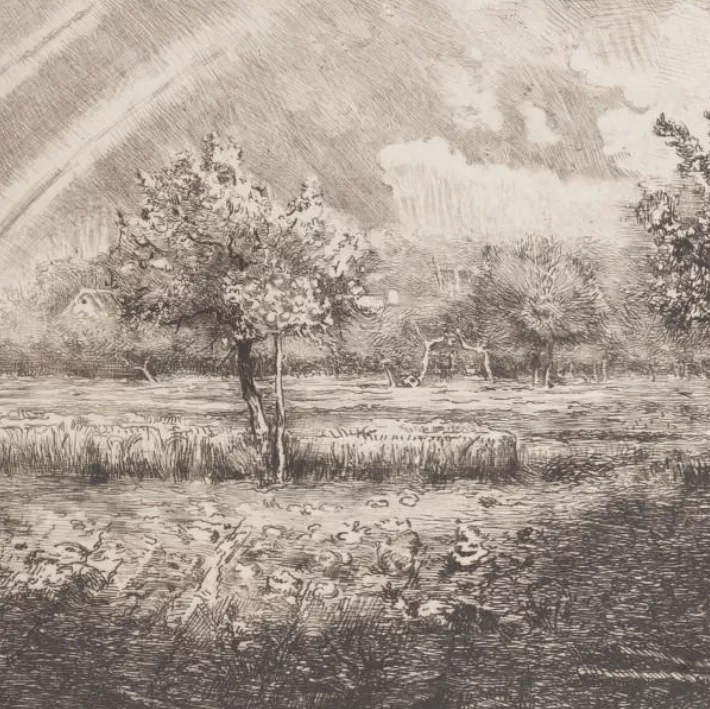
Millet reached artistic maturity in the 1850s, when his style became increasingly introspective. He concentrates on intimate scenes, pastoral landscapes where man and nature coexist harmoniously.
This period also marks a search for simplicity and austerity, far removed from academic flourishes. Inspired by his own memories, he creates poetic, melancholy works, revealing a certain nostalgia for lost rurality.
So, like Corot, Millet focuses on reality while infusing his works with a spiritual, universal dimension. His compositions balance nature and the human in a quest for authenticity that marked his era, while influencing many artists after him, notably those of l'école de Barbizon and the precursors of Impressionism.
The life of Jean-François Millet
Jean-François Millet was born on October 4, 1814 in Gruchy, a small hamlet in La Manche, into a farming family. From an early age, he was deeply influenced by rural life, which was to become the main source of his artistic inspiration. His father, a pious and literate man, encouraged his interest in drawing.
In 1837, Millet moved to Cherbourg to receive artistic training under the tutelage of Théophile Langlois, a former pupil of David. Thanks to a municipal grant, he was then sent to Paris to complete his apprenticeship in Paul Delaroche's studio.
His beginnings in the capital were difficult. Millet failed several times in the Prix de Rome competition and did not immediately receive the recognition he had hoped for. However, he persevered and, influenced by masters such as Nicolas Poussin and Eugène Delacroix, began to develop his own style.
In 1849, after meeting artists such as Théodore Rousseau and Charles-François Daubigny, he joined the École de Barbizon, a group of landscape painters of which he became a central figure. In Barbizon, Millet found an ideal setting for painting nature and the peasants who inhabited it.
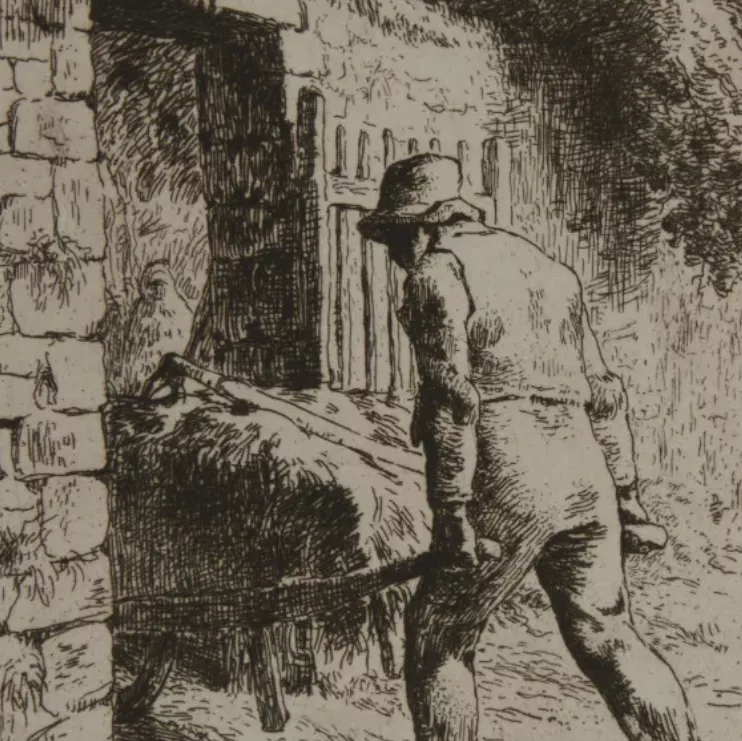
Millet stands out for his ability to capture the everyday life of farm workers with a rare emotional depth. His works, such as Les Glaneuses (1857) or L'Angélus (1859), bear witness to great humanity and are often seen as tributes to the dignity of peasants.
Contrary to the artists of his time who idealized rural life, Millet depicted his subjects with realism and sobriety, which earned him criticism from the Parisian bourgeoisie, who sometimes saw it as social criticism.
In 1867, although his works were controversial, Millet finally received official recognition. He was awarded the Légion d'honneur at the Paris Universal Exhibition. Yet Millet continued to lead a modest life in Barbizon, far from the Parisian mundanities.
Religion played an essential role in his existence, and his deep Catholicism shines through in his paintings, particularly in the silent spirituality of scenes like L'Angélus.
His last years were marked by illness, but he continued to work until his death on January 20, 1875. The following year, the Impressionist School made its debut, and Millet was hailed as an influential figure for artists such as Vincent van Gogh, who admired his work for its sincere depiction of peasant life.
Focus on Jean-François Millet's Angelus
Jean-François Millet's painting "L'Angélus" embodies a profound and spiritual dimension in the rural world of the 19th century. In this work, the artist demonstrates an exceptional mastery of drawing, which occupies a central place in his artistic practice.
The rigorous, expressive lines he uses structure this composition. He uses techniques such as black chalk and charcoal, instruments that enable him to give life to his figures while making palpable the heaviness of their peasant condition.
His detailed and meticulous preparatory studies reveal his marked interest in the faithful rendering of human postures and attitudes.
Millet reached artistic maturity in the 1850s, a period when he refined his introspective and poetic approach. He then turned his work towards intimate, pastoral scenes, where man and nature respond to each other in silent harmony. L'Angélus is a perfect example.
The choice to depict peasants at prayer, stopping their work at the sound of church bells, testifies to this quest for simplicity and austerity.
The two figures, a man and a woman, are depicted in a humble, recollected posture, their faces turned towards the earth, reinforcing the impression of a communion between man and nature.
As in many of his works, Millet succeeds in infusing a spiritual dimension into this scene, which is nonetheless deeply rooted in everyday reality. The evening light that bathes the composition, combined with the low horizon line, lends the work an almost mystical aspect.
The vast, dark sky, characteristic of this search for sobriety, dominates the scene and seems to accentuate the modest, insignificant character of the characters in the face of the immensity of nature.
Millet, in L'Angélus, also shows a certain nostalgia for a disappearing rural world, swept away by the industrial upheavals of his time. His view of peasants is imbued with empathy, but also with a broader reflection on the human condition.
Through this prayer scene, he not only paints peasant life; he explores the relationship between man, work, and spirituality, in a quest for authenticity that sets him apart from his contemporaries.
Far from being a mere realistic representation, this painting carries a universal and timeless significance that will profoundly influence subsequent generations, notably the artists of the Barbizon school and the early Impressionists.
Jean-François Millet: Angelus and Gleaners
Jean-François Millet's imprint on his time
In the 1850s, Millet reached an artistic maturity characterized by increased introspection. His works then focused on scenes of rural life, often spare and imbued with gravity.
Contrary to the academic trends of the time, he rejected embellishments and preferred simplicity. Inspired by his childhood memories of Normandy, he depicts peasants at work, lending these scenes a latent spirituality.
His works, such asL'Angélus or Les Glaneuses, are imbued with nostalgia and a quest for authenticity. Far from idealizing rurality, he shows its harshness while emphasizing its sacred dimension.
This mature period also sees Millet explore the intimate relationship between man and nature. His compositions carefully balance the human figure and the landscape, creating a dialogue between the two. His peasants, often depicted in moments of work or prayer, seem to melt into their surroundings, embodying a silent harmony with the land they cultivate.
Through this treatment, Millet manages to transcend simple realistic representation and offer a poetic and universal vision of the human condition.
Millet's imprint goes beyond the technical aspect. He influenced not only the Barbizon school, of which he was a founding member, but also subsequent generations, notably the Impressionists.
Like Corot, Millet focuses on tangible reality, but infuses this reality with a spiritual dimension. His seemingly simple works are deeply imbued with a quest for authenticity, a quest that would resonate with many twentieth-century artists, making him one of the pillars of realist and landscape painting of his time.
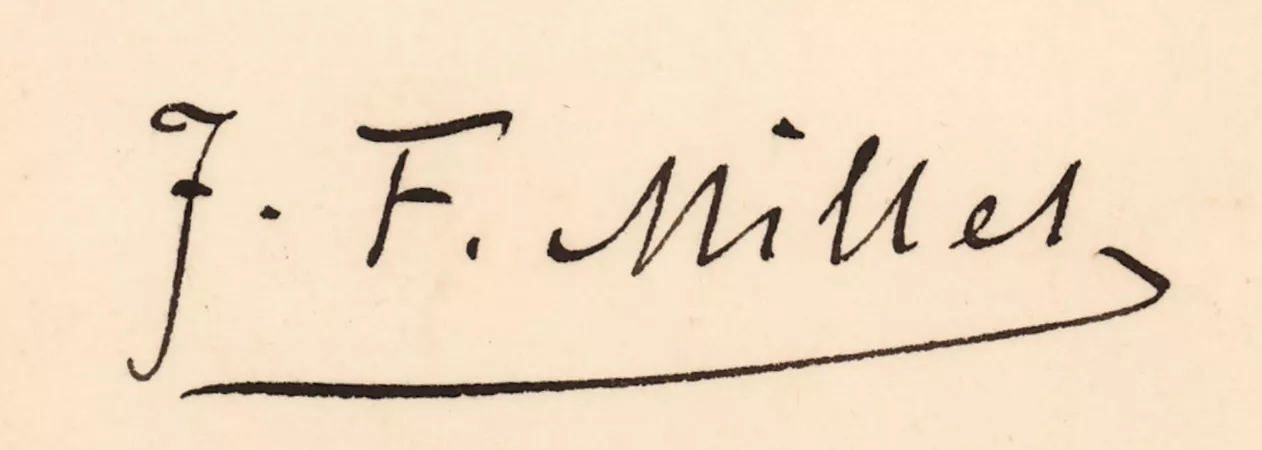
His signature
Not all of Jean-François Millet's works are signed.
Although there are variations, here is a first example of his signature:
Expertise your property
If you own a work by Jean-François Millet, don't hesitate to request a free appraisal by filling in our online form. A member of our team of experts and licensed auctioneers will contact you to provide an estimate of the market value of your work.
If you are considering selling your work, our specialists will also guide you through the various alternatives available to obtain the best possible price, taking into account market trends and the specific features of each work.
.Estimate in less than 24h
Discover in the same theme

Rating and value of vases, bowls, dishes by Henri Husson
Henri Husson was a 19th-century coppersmith and wrought-iron worker who produced works of considerable value at auction.
Learn more >

Rating and value of paintings by César Pattein
César Pattein was a realist painter of the 19th century, whose paintings are highly valued at auction.
Learn more >

Rating and value of bronzes and sculptures by Pierre Lenorde...
Pierre Lenordez is a 19th-century animal sculptor whose sculptures are highly prized at auction.
Learn more >
Similar works sold at auction

Estimated 200 - 400
Eugène Napoléon FLANDRIN (1809-1889), charcoal drawing

Estimated 2.000 - 3.000
Edgar MAXENCE (1871 - 1954), study in black stone and chalk

Estimated 1.000 - 2.000
Lucien GOUBERT (1887-1964), Rochers à Fermanville, oil on canvas

Estimated 200 - 400
Joseph Gabriel TOURNY (Paris 1817-1880 Montpellier) Portrait of a painter with a moustache, in bust form, Pastel on paper, oval format

Estimated 5.000 - 10.000
Victor Gabriel GILBERT (1847-1935), Le marché aux fleurs, oil on canvas

Secure site, anonymity preserved

Auctioneer approved by the State

Free and certified estimates
Frequently asked questions
-
Who was Jean-François Millet, and what is his significance in art history?Jean-François Millet (1814–1875) was a master of French realism and a leading figure of the Barbizon School. Known for his moving depictions of peasant life and farmworkers, he brought a major renewal to landscape painting by breaking free from academic conventions to paint nature in an authentic way. His influence extended to the Impressionists and beyond, notably to artists such as Vincent van Gogh.
-
What is the price range for Millet's paintings, drawings, and engravings at auction?Prices vary considerably depending on the technique and provenance. Prints range from €10 to €19,200, drawings and watercolors from €20 to €1,302,500, and paintings from €400 to €2,454,000. His most prestigious naturalistic landscapes, such as *La Cardeuse*, which sold for over 2 million euros, are among the most sought-after on the market.
-
How do I have a work by Jean-François Millet appraised?Auctie's offers a free, no-obligation appraisal of your artwork. Simply fill out an online form to be contacted by a state-certified expert or auctioneer, who will provide you with an accurate estimate of your artwork's market value within 48 hours.
-
How do you sell a work by Jean-François Millet?Auctie's, an auction house, supports you from the appraisal stage through to the final sale. Following a free appraisal, our specialists will guide you toward the best sales strategy, taking into account market trends and the unique characteristics of your artwork to achieve the best possible price.
-
Why is now the right time to sell a work by Millet?Millet's naturalistic landscapes remain particularly sought-after at auction, and his major works continue to fetch record prices. The market for French Realism and the Barbizon School remains robust, making this artist a stable investment with consistent demand from international collectors.
