



Rating and value of print and drawings by Kitagawa Utamaro

Key takeaways
- Works by Kitagawa Utamaro sell for between €10 and €5,023,170, with a drawing sold in Hong Kong in 2025 exceeding its estimate of €700,000–900,000.
- A specialist in bijin-ga (depictions of women) and ukiyo-e, Utamaro (1753–1806) revolutionized Japanese woodblock printing with his expressive and individualized treatment of figures.
- Prices for multiple prints range from €10 to €600,000, while drawings and watercolors can reach up to €5,023,170; expert appraisal is essential since his works are unsigned.
Kitagawa Utamaro’s paintings and drawings sell for up to €5,023,170 at auction. An appraisal allows us to accurately determine the current market value of your Kitagawa Utamaro artwork and, if applicable, optimize the sale of the piece.
If you own a work by Kitagawa Utamaro and would like to know its value, our state-certified auctioneers will provide a free appraisal based on authenticity, market rating, and recent auction results.
Market Value and Appraisal of Kitagawa Utamaro
Kitagawa Utamaro left behind a body of work in its own right as a master of ukiyo-e. Today, prices for his works are reaching unprecedented levels at auction.
His works are particularly sought after, especially by Japanese buyers. The prices at which they sell on the art market range from €10 to €5,023,170—a considerable gap that speaks volumes about the value that can be attributed to Kitagawa Utamaro’s works.
In 2025, an ink drawing titled *Fukagawa in Snow*, dating from 1802 – 1806, sold for €5,023,170 in Hong Kong, even though it had been estimated at between €700,000 and €900,000.
Ranking of value from a simple work to the most prestigious
Technique used | Result |
|---|---|
Print - multiple | From €10 to €600,000 |
Drawing - watercolor | From 50 to 5,023,170€ |
Estimate in less than 24h
Placing the Artist in Context
Period
Kitagawa Utamaro (1753–1806) was a Japanese artist whose career spanned the late 18th century to the early 19th century, at the height of Japan’s Edo period.
He worked against the backdrop of a boom in urban arts, in a society shaped by the merchant classes and a culture of pleasure (entertainment districts, theater, teahouses).
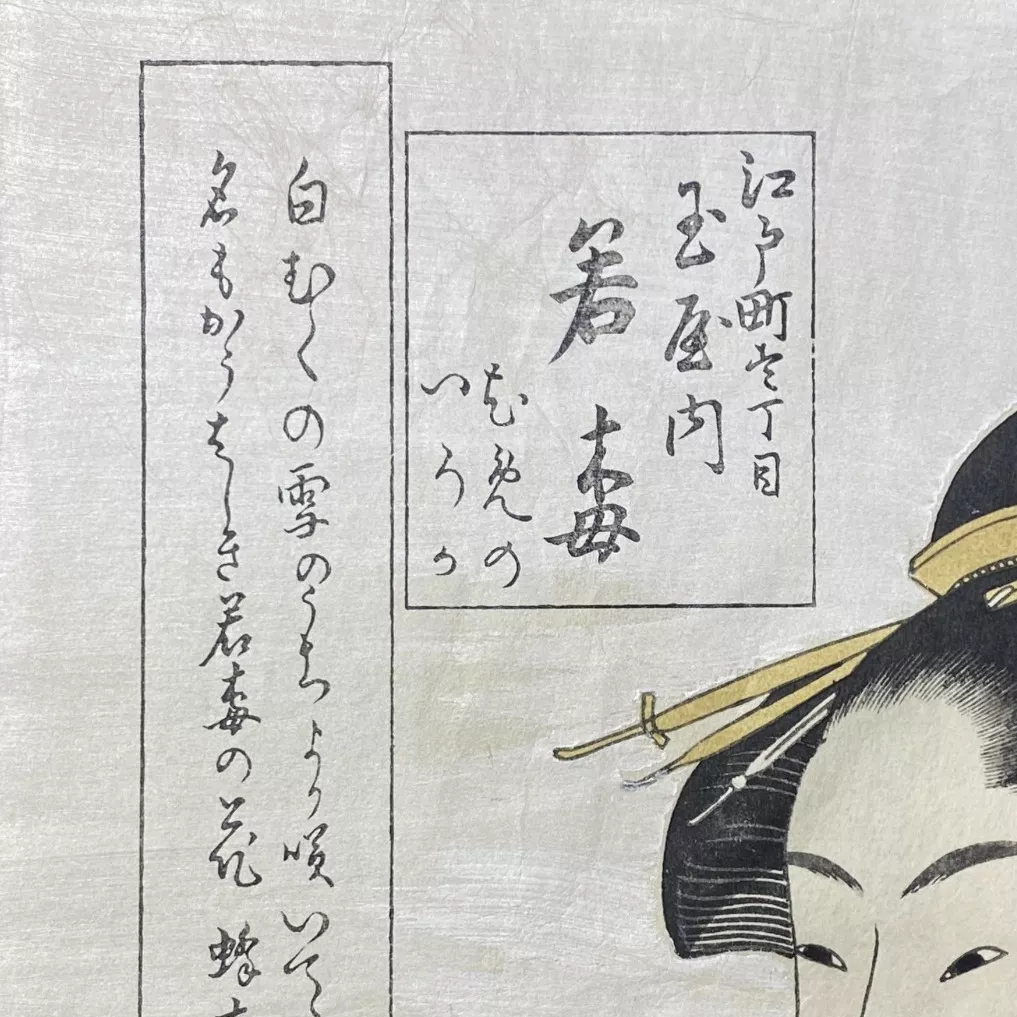
His work flourished within the context of woodblock print production, a collaborative process involving an artist, an engraver, and a printer.
Artistic Movements
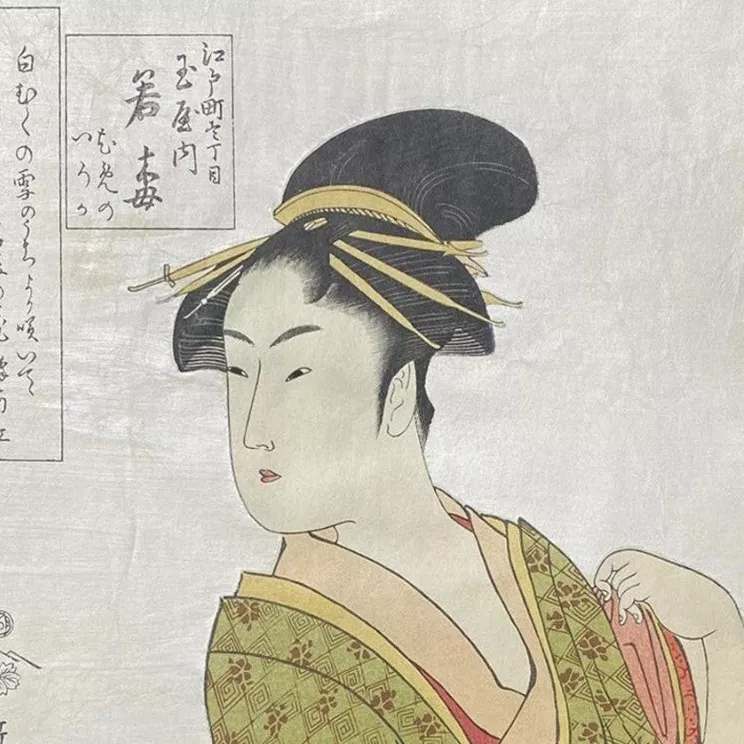
Utamaro specialized in ukiyo-e, a major movement in Japanese woodblock printing focused on depicting the “floating world” (courtesan scenes, actors, urban life).
We can also mention Bijin-ga, depictions of women (courtesans, elegant ladies) characterized by refined stylization and a focus on psychological expression.
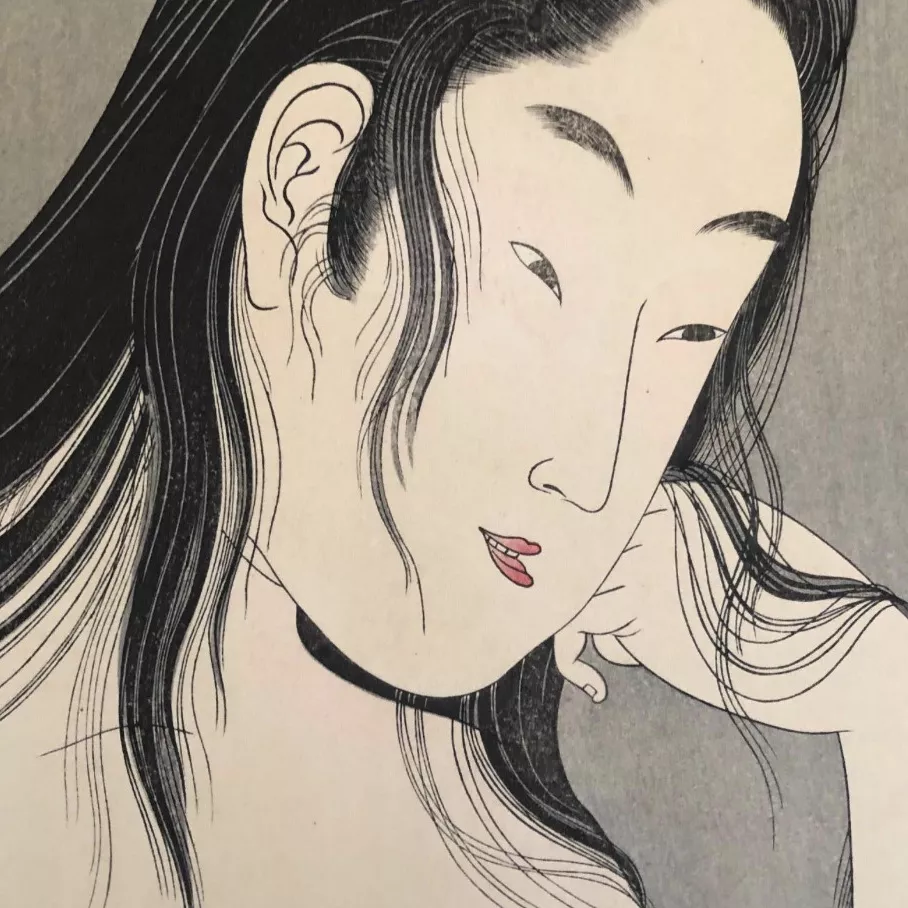
The artist focused heavily on the aesthetics of the line, emphasizing the outline, the elegance of the stroke, and the simplification of forms, all to ensure the image’s immediate clarity.
He individualizes his figures and moves toward more expressive and distinct portraits, marking a break from the more stereotypical female types of earlier traditions.
His work is also steeped in Edo-period visual culture, as he aimed his art at a broad urban audience, alongside artists such as Katsushika Hokusai and Toshusai Sharaku, contributing to the rise of the Japanese woodblock print as an independent art form.
The Life of Kitagawa Utamaro
Cultural Context
Kitagawa Utamaro was active during the Edo period, a time characterized by the development of a refined urban culture and the rise of Japanese woodblock printing.
His work is part of an artistic milieu centered on the depiction of the “floating world”—that is, the fleeting pleasures of urban life, particularly in the entertainment districts.
He specialized in the bijin-ga genre (depictions of beautiful women), which he revitalized by paying particular attention to the individualization of faces and psychological expression.
His work is distinguished by an exceptional mastery of line, an elegant stylization of figures, and a subtle exploration of variations in posture and emotion. He helped elevate Japanese woodblock printing to a high degree of formal sophistication.
Artistic and Intellectual Circle
He worked closely with the publisher Tsutaya Juzaburo, a key figure in the distribution of woodblock prints and the development of the art market in Edo.
His work is part of the ukiyo-e artistic milieu, in dialogue with Toshusai Shakaru and Katsushika Hokusai, who were instrumental in the genre’s evolution. He was part of a collective artistic production system involving draftsmen, engravers, and printers—a characteristic feature of Japanese woodblock prints during the Edo period.

The Artist's Techniques
Kitagawa Utamaro was a master of Japanese woodblock printing during the Edo period, associated with the ukiyo-e movement, which focused on depicting the “floating world.” He specialized in the bijin-ga genre, characterized by an elegant idealization of female figures.
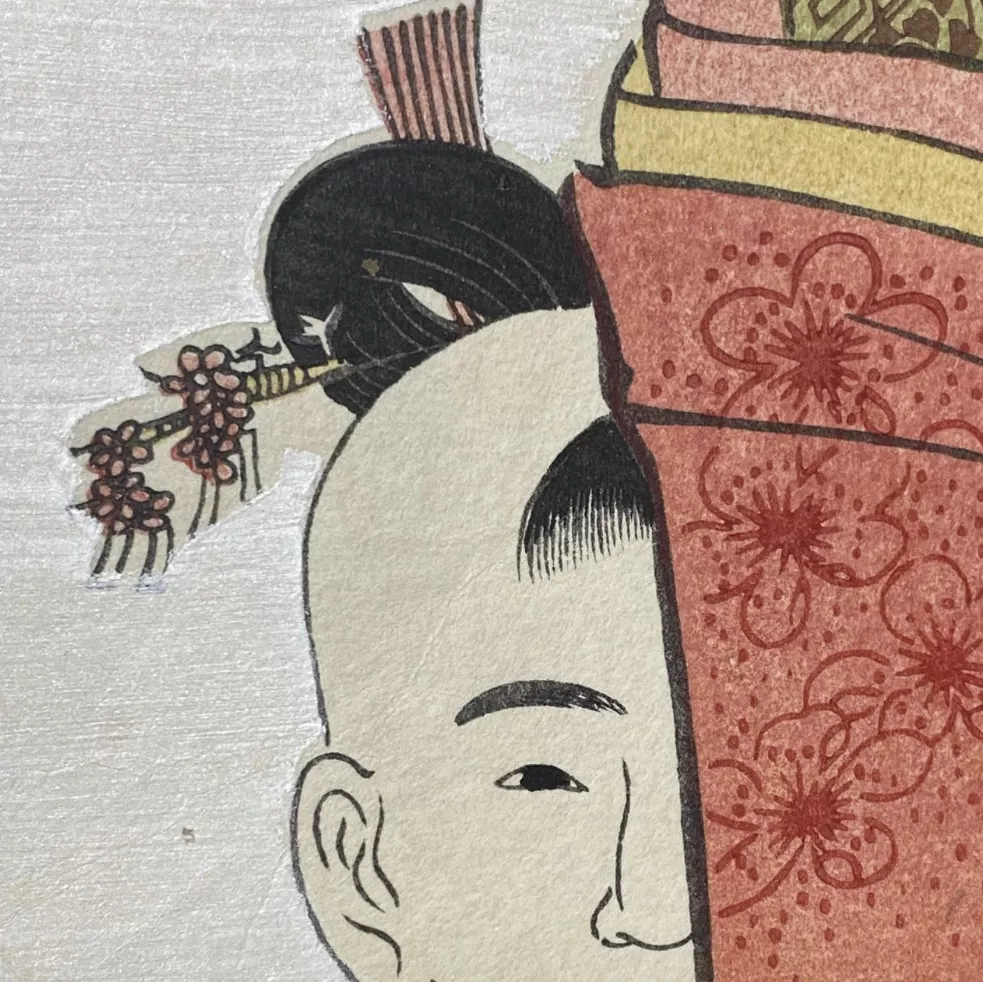
He focused on elongating silhouettes and refining faces to an extreme degree, reducing them to clean, stylized lines. Linear drawing was of great importance, with sharp, precise contours that structured the entire composition.
He makes subtle use of color in polychrome woodblock prints, employing delicate flat areas of color and gradients (bokashi). He demonstrates an interest in expressions, postures, and gestures, allowing for the psychological individualization of the figures.
His compositions are often compact and asymmetrical, highlighting the figure against a minimalist background.
Spotlight on a Key Work
Three Beauties of the Present Day (circa 1793)
This close-up composition features three female figures arranged in a balanced triangular pattern. The stylization of the faces is characterized by fine lines, elongated eyes, and a minimalist approach.
He uses soft colors and subtle gradations, enhancing the print’s visual elegance. He distinguishes the figures through slight variations in expression and hairstyle.
There is no marked sense of depth, as space is treated as a flat, decorative surface. This work is emblematic of bijin-ga, illustrating Utamaro’s ability to reconcile idealization, observation, and graphic refinement.
His works are today just as sought-after as those of modern artists such as Yayoi Kusama, Takaseda Matsutani, and Kazuo Shiraga.
Recognizing the Artist’s Signature
Kitagawa Utamaro’s works are not signed. For this reason, if you believe you own a work by the artist or based on his work, it is essential to have it appraised by an expert who can authenticate it.
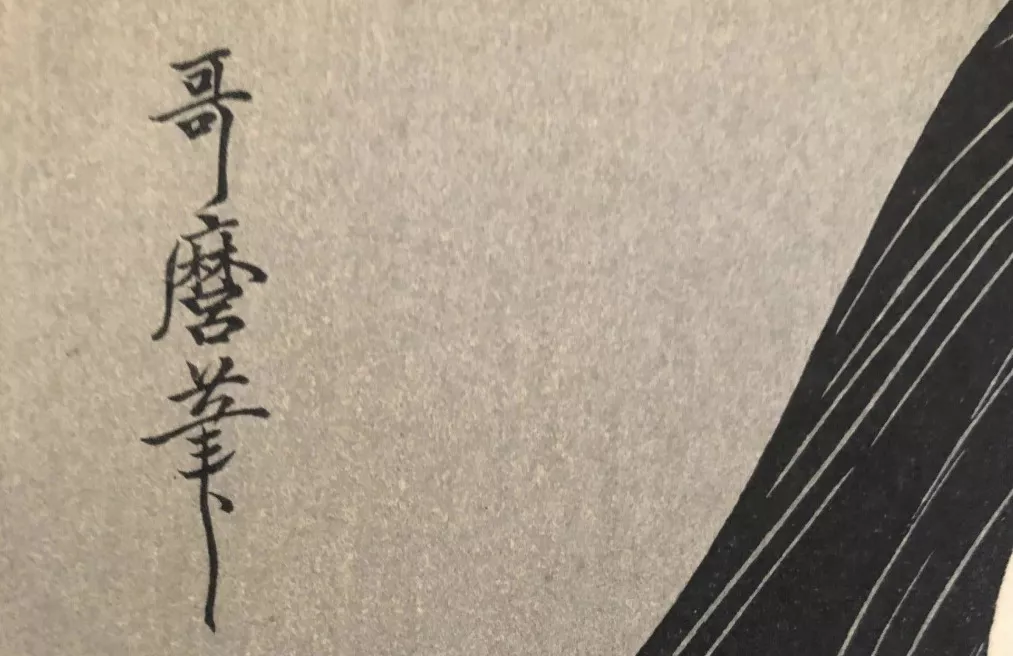
Get Your Kitagawa Utamaro Artwork Appraised
If you own a work by Kitagawa Utamaro, an appraisal will help you determine its current market value.
Using our online form, our experts and certified auctioneers will conduct a free appraisal and provide you with a reliable estimate of your artwork’s market value.
If you’re considering selling it, we’ll work with you to ensure you get the best possible price.
Estimate in less than 24h
Nos records d'enchères à l'hôtel Drouot

Estimated 10.000 - 15.000 €
Ebridge Ayer BURBANK(1858-1949), Young African-American boy, Oil on panel.

Estimated 20.000 - 30.000
EXCEPTIONAL LARGE OVAL DISH IN VINCENNES SOFT PASTE PORCELAIN FROM THE "BLEU CÉLESTE" SERVICE OF KING LOUIS XV AT THE CHÂTEAU DE VERSAILLES

Estimated 20.000 - 30.000
MANUFACTURE ROYALE DE SÈVRES, 18th century "L'Empereur de la Chine" - Portrait of the Emperor Qianlong, Hard porcelain bisque, 1775

Estimated 1.500 - 3.000
HERMÈS, "Kelly" 32 saddle bag in black box calf

Estimated Between €5,000 and €8,000
KRACHKOWSKY (1854-1914), Before the storm, oil on canvas

Estimated 40.000 - 80.000
Alexandre ROUBTZOFF (1884-1949), Portrait of Arbia, oil on canvas
Discover in the same theme

Get a free estimate for your Chinese furniture
Chinese furniture is in great demand on the French and American auction markets. You may be unaware of its value - get it appraised!
Learn more >

Rating and value of Chinese porcelain vases
Chinese porcelain vases are highly sought-after items at auction. They are prized by collectors.
Learn more >

Rating and value of Hue porcelain from Vietnam
Vietnamese porcelain is a highly valued collectible at auction. Estimates within 24 hours.
Learn more >

Secure site, anonymity preserved

Auctioneer approved by the State

Free and certified estimates
Frequently asked questions
-
Who was Kitagawa Utamaro, and what was his artistic context?Kitagawa Utamaro (1753–1806) was a Japanese master printmaker of the Edo period who specialized in ukiyo-e (“the floating world”). He became famous for the bijin-ga genre, depicting women with refined stylization and a particular focus on psychological expression. His work, characterized by exceptional mastery of line and clean contours, helped elevate Japanese woodblock prints to a high degree of formal sophistication, alongside artists such as Hokusai and Sharaku.
-
What is the price range for Utamaro's prints and drawings?Kitagawa Utamaro’s works sell at auction for between €10 and €5,023,170, depending on the technique and quality. Single prints generally range from €10 to €600,000, while drawings and watercolors show greater variability, ranging from €50 to several million euros for exceptional pieces such as “Fukagawa in Snow ” (1802–1806), which sold for €5,023,170 in 2025.
-
How can you authenticate a work by Kitagawa Utamaro?Kitagawa Utamaro’s works are unsigned, which makes authentication difficult. It is essential to have your work appraised by a qualified expert. Auctie's offers a free, no-obligation appraisal by state-certified auctioneers, who will examine the authenticity, condition, and authenticity of your piece based on recent market trends. You will receive an appraisal report within 48 hours.
-
Is this a good time to sell a print or drawing by Utamaro?Yes, now is a good time to sell a work by Utamaro. His prints and drawings are in high demand, particularly among Japanese buyers, and prices regularly reach record highs at auction. The market for Japanese ukiyo-e prints remains vibrant and internationally recognized, which bodes well for the value of your piece.
-
How do I sell a work by Kitagawa Utamaro at Auctie's?Auctie's, an auction house, guides you from the free appraisal all the way through to the final sale. After you submit your artwork via our online form, our experts will provide a reliable, no-obligation appraisal. If you decide to proceed, we’ll manage the entire sales process, ensuring the best possible price for your Utamaro print or drawing.
