



Rating and value of drawings and prints by Utagawa Kunisida

Key takeaways
- Utagawa Kunisada's works sell for between €10 and €80,000 at auction, with woodblock prints commanding the highest prices on the market.
- A specialist in ukiyo-e active from 1786 to 1865, Kunisada distinguished himself through his portraits of kabuki actors with expressive and stylized features.
- Authentication remains crucial because his works are unsigned; a professional appraisal is essential to determine their true value.
Utagawa Kunisada’s paintings and drawings fetch up to €80,000 at auction. An appraisal allows us to accurately determine the current market value of your Utagawa Kunisada artwork and, if applicable, optimize the sale of the piece.
If you own a work by Utagawa Kunisada and would like to know its value, our state-certified auctioneers will provide a free appraisal based on authenticity, market rating, and recent market results.
Market Value and Appraisal of Utagawa Kunisada
Utagawa Kunisada left behind a body of work in its own right as a master of ukiyo-e. Today, prices for his works are reaching unprecedented levels at auction.
His works are particularly sought after, especially by Japanese buyers. The prices at which they sell on the art market range from €10 to €80,000—a considerable spread that speaks volumes about the value that can be attributed to Utagawa Kunisada’s works.
In 2012, a woodblock print titled “Actor Ichikawa Danjuro VII as Kan Shojo, Exiled Statesman” sold for €80,000 in Paris, despite an estimate of between €5,000 and €6,000.
Ranking of value from a simple work to the most prestigious
Technique used | Result |
|---|---|
Drawing - watercolor | From €30 to €19,400 |
Print - multiple | From 10 to 80,000€ |
Estimate in less than 24h
Placing the Artist in Context
Period
Utagawa Kunisada was an artist active during the Edo period (1786–1865). He was particularly prolific in the first half of the 19th century, a time when the production of Japanese woodblock prints for a broad urban audience reached its peak.
He worked within a popular visual culture shaped by kabuki theaters, entertainment districts, and the print publishing market.
Artistic Movements
Utagawa Kunisida was part of the major movement in Japanese woodblock printing known as ukiyo-e, which focused on depicting the “floating world.”
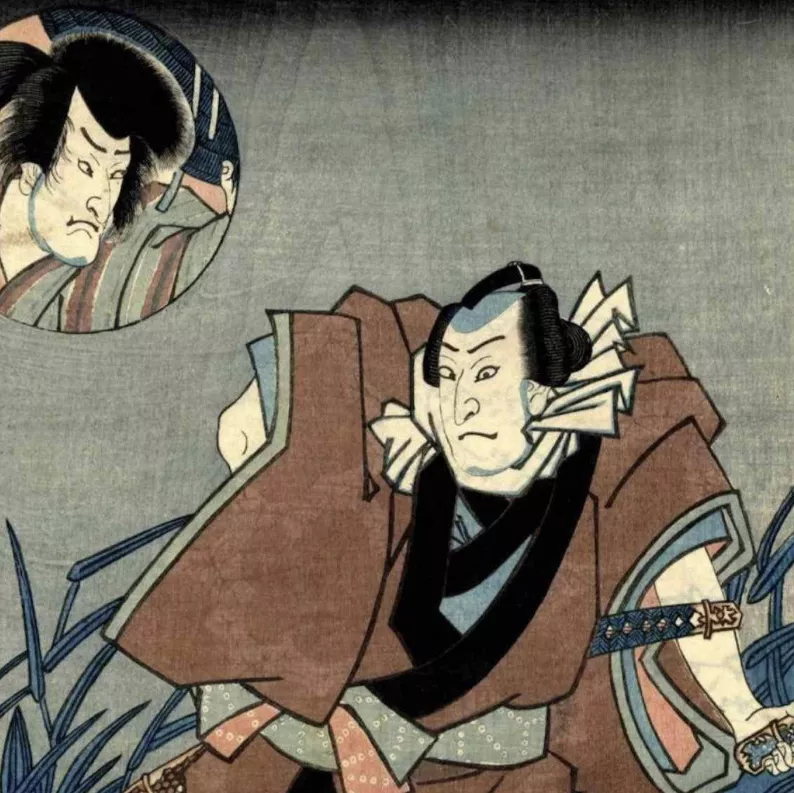
He specialized in portraits of kabuki actors (yakusha-e), characterized by expressive stylization and an emphasis on distinctive features, as well as in bijin-ga, producing images of elegant women.
His aesthetic is linear and decorative, emphasizing outlines, rich textile patterns, and a flat composition.

The Life of Utagawa Kunisida
Cultural Context
Utagawa Kunisida, also known as Toyokuni III, was active during the Edo period, the heyday of ukiyo-e, characterized by the widespread popularity of woodblock prints among an urban audience.
He belonged to the Utagawa school, one of the most influential in Japanese woodblock print production, which specialized in depictions of kabuki actors, female figures, and scenes of everyday life.
He contributed to the visual codification of kabuki actors by developing expressive and instantly recognizable portraits, thereby playing a role in the mass visual culture of the era.
Artistic and Intellectual Circle
He moved in circles that included major figures of ukiyo-e such as Utagawa Hiroshige and Katsushika Hokusai, with whom he shared a space for production and distribution.
Like other printmakers, he collaborated with publishers, engravers, and printers, situating his work within a collective system unique to Edo’s visual culture.
His works are today just as sought after as those of modern artists such as Yayoi Kusama, Takaseda Matsutani, and Kazuo Shiraga.

The Artist's Techniques
The Artist’s Style
Utagawa Kunisada was a central figure in 19th-century Japanese printmaking within the ukiyo-e movement. His style is characterized by a codified stylization of faces and gestures, in keeping with Japanese theatrical conventions.
He uses vivid, contrasting colors, enhancing the visual impact and dramatic quality of his compositions, which are often dynamic and tightly composed, highlighting the main figure in a shallow space.
Spotlight on a Key Work
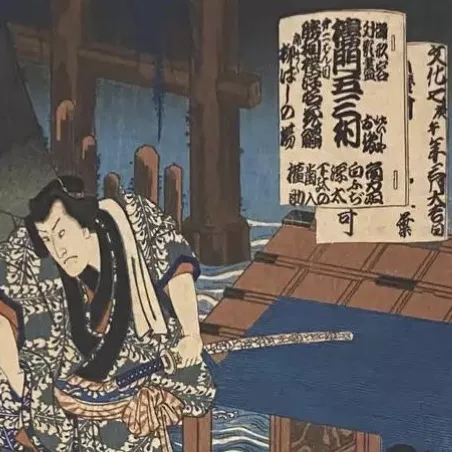
Kabuki Actor in the Role of a Warrior (circa 1920–1830)
This composition centers on an actor depicted in a bust or half-length portrait, emphasizing the intensity of expression. The artist stylizes facial features and postures, reflecting the conventions of Kabuki theater.
His color palette is vivid and high-contrast, contributing to the drama of the scene. The costumes are rendered in great detail, revealing the richness of the patterns and the narrative function of the clothing.
There is no illusion of depth; the image is conceived as a decorative surface. This work is representative of Kunisada’s oeuvre, which combines theatrical expressiveness, graphic stylization, and visual impact.

FAQ – How do you appraise a work by Utagawa Kunisada?
1) What iconographic criteria specific to Kunisada are key?
The analysis focuses on depictions of kabuki actors (yakusha-e), female figures (bijin-ga), or narrative scenes, evaluating the quality of the drawing, the clarity of the composition, and the richness of detail.
2) How important are the quality of the print and the colors?
Particular attention is paid to the vibrancy of the colors, the precision of the outlines, the quality of the inking, and the possible presence of specific pigments—all essential elements for assessing the condition of the print.
3) What role do the publisher and the series play in the appraisal?
Identifying the publisher, the series, and the context of publication helps situate the print within the artist’s body of work, as certain series or collaborations are particularly sought after.
Recognizing the Artist’s Signature
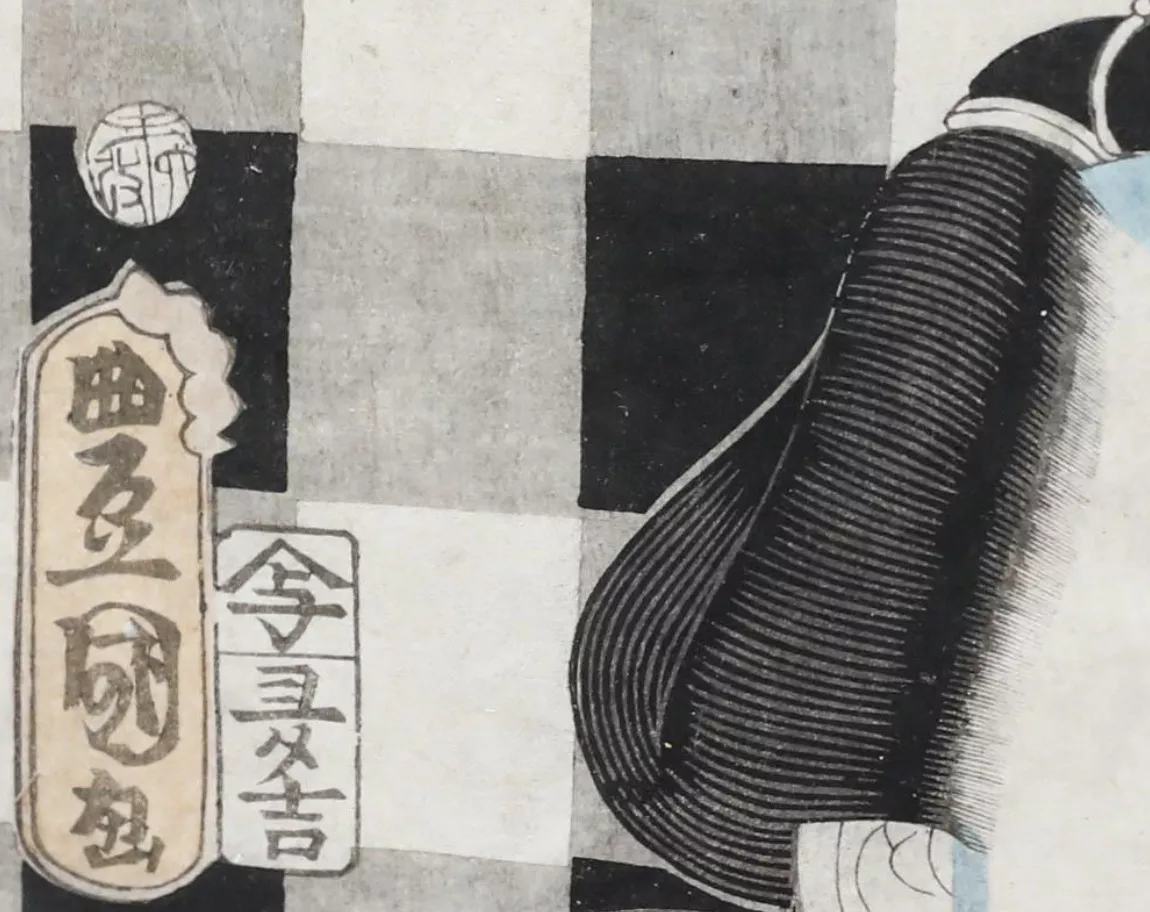
Utagawa Kunisida’s works are not signed. For this reason, if you believe you own a work by the artist or based on his style, it is essential to have it appraised by an expert who can authenticate it.
Get Your Utagawa Kunisida Artwork Appraised
If you own a work by Utagawa Kunisida, an appraisal will help you determine its current market value.
Using our online form, our experts and certified auctioneers will conduct a free appraisal and provide you with a reliable estimate of your artwork’s market value.
If you’re considering selling it, we’ll guide you through the process to ensure you get the best possible price.
Estimate in less than 24h
Discover in the same theme

Get a free estimate for your Chinese, Asian and imperial dre...
Chinese dresses are unique and fascinating pieces of art. Having them appraised by an impartial expert is essential.
Learn more >

Rating and value of Japanese porcelain: Imari and Satsuma...
Japanese porcelain is known the world over and appreciated by bidders. It is stable and valuable. Estimated in 24h.
Learn more >

Rating and value of works, paintings by Thuong Lan Nguyen
Thuong Lan, a little-known Vietnamese artist, is nevertheless appreciated at auction. His works are very valuable. Estimated in less than 24h.
Learn more >
Nos records d'enchères à l'hôtel Drouot

Estimated 10.000 - 15.000 €
Ebridge Ayer BURBANK(1858-1949), Young African-American boy, Oil on panel.

Estimated 20.000 - 30.000
EXCEPTIONAL LARGE OVAL DISH IN VINCENNES SOFT PASTE PORCELAIN FROM THE "BLEU CÉLESTE" SERVICE OF KING LOUIS XV AT THE CHÂTEAU DE VERSAILLES

Estimated 20.000 - 30.000
MANUFACTURE ROYALE DE SÈVRES, 18th century "L'Empereur de la Chine" - Portrait of the Emperor Qianlong, Hard porcelain bisque, 1775

Estimated 1.500 - 3.000
HERMÈS, "Kelly" 32 saddle bag in black box calf

Estimated Between €5,000 and €8,000
KRACHKOWSKY (1854-1914), Before the storm, oil on canvas

Estimated 40.000 - 80.000
Alexandre ROUBTZOFF (1884-1949), Portrait of Arbia, oil on canvas

Secure site, anonymity preserved

Auctioneer approved by the State

Free and certified estimates
Frequently asked questions
-
Who is Utagawa Kunisada, and what is his artistic background?Utagawa Kunisada, also known as Toyokuni III, was a leading ukiyo-e artist active during the Edo period (1786–1865), particularly in the 19th century. He belonged to the Utagawa school, one of the most influential in Japanese woodblock printing, and specialized in portraits of kabuki actors (yakusha-e) and images of elegant women (bijin-ga). His linear and decorative style, characterized by expressive stylization and a wealth of textile patterns, made him a central figure in Edo’s mass visual culture.
-
What is the price range for works by Utagawa Kunisada?Prices for works by Utagawa Kunisada vary considerably depending on the type and quality. Watercolor drawings range from €30 to €19,400, while prints fetch between €10 and €80,000. In 2012, a woodblock print titled “Actor Ichikawa Danjuro VII” exceeded its estimate (€5,000–6,000) when it sold for €80,000 in Paris. Value depends on authenticity, condition, the publisher, and the series.
-
How can you authenticate a work by Utagawa Kunisada?Since Utagawa Kunisada’s works are unsigned, an appraisal by a specialist is essential to confirm their authenticity. Auctie’s offers a free, no-obligation appraisal conducted by state-certified auctioneers and experts. The analysis focuses on the subject matter (yakusha-e or bijin-ga), the quality of the print, the colors, the precision of the outlines, and the identification of the publisher and the series.
-
Is this a good time to sell a print by Utagawa Kunisada?Yes, now is a good time to sell a work by Kunisada. His prints are fetching record prices at auction and are particularly sought after by Japanese collectors. The market remains strong for this type of ukiyo-e, with high international demand for yakusha-e and major historical compositions.
-
How does the free appraisal work at Auctie's?Auctie's offers a free, no-obligation estimate via an online form. Our certified auctioneers and experts will conduct a comprehensive analysis of your artwork and provide you with a reliable estimate within 48 hours. If you decide to sell, Auctie's will then guide you through the process from the estimate to the auction to ensure you get the best possible price for your item.
