



Value and quotation of works, paintings by Jean-Gabriel Domergue

Key takeaways
- Works by Jean-Gabriel Domergue, a French painter (1889–1962), sell for between €20 and €194,600, with oil-on-canvas paintings commanding the highest prices.
- Domergue, known as the “creator of the pin-up,” painted more than 3,000 portraits of Parisian women, characterized by large eyes and elongated necks.
- A free appraisal by certified auctioneers allows you to accurately estimate the value of your artworks before achieving the best possible sale.
If you own a work by artist Jean-Gabriel Domergue or after, and would like to know its value, our state-approved experts and auctioneers will offer you their appraisal services.
Our specialists will carry out a free appraisal of your work, and provide you with a precise estimate of its value on the current market.
Then, if you wish to sell your work, we will direct you to the best possible arrangement to obtain the optimum price.
Rating and value of artist Jean-Gabriel Domergue
Domergue is a primarily a painter of female portraits. His legacy consists of paintings, watercolor drawings and prints. At present, prices for his works are rising under the auctioneers' gavels.
His paintings are particularly prized especially by French buyers, and the price at which they sell on the art market ranges from €20 to €194,600, a considerable delta but one that speaks volumes about the value that can be attributed to Domergue's works.
In 2017, an oil on canvas depicting a portrait of a woman sold for €105,000 while it was estimated at between €15,000 and €20,000. The artist's quotation is quite high and varies according to the quantity of work present on the auction market.
Order of value of a Jean-Gabriel Domergue painting (from the most basic to the most prestigious)
Technique used | Result |
|---|---|
Estamp | From €20 to €4,000 |
Drawing - watercolor | From €80 to €23,000 |
Oil on canvas | From €800 to €194,600 |
Estimate in less than 24h
Jean-Gabriel Domergue, creator of the pin-up
Jean-Gabriel Domergue is a French artist who richly deserves the appellation "creator of the pin-up" for his depictions of 1920s Parisiennes, characterized by large eyes and long, graceful necks.
Born on March 4, 1889 in Bordeaux, he is the cousin of Henri de Toulouse-Lautrec. At an early age, he entered the École Nationale Supérieure des Beaux-Arts in Paris, where he trained alongside the great masters.
At the age of 17, he was already exhibiting his work at the Salon des Artistes Français, and in 1920 he was honored with the prestigious Prix de Rome, a recognition that marked a turning point in his career.
At first, he devoted himself to landscape painting, but it was in the 1920s that he made a decisive transition, specializing in female portraits.
He distinguished himself by a particular approach to the female body, where faces are drawn with huge eyes and long, elegant necks. This style enabled him to capture the essence of the modern Parisian woman, elegant and glamorous, earning him the nickname "the creator of the pin-up".
Domergue quickly became a highly sought-after portraitist, particularly in aristocratic circles, where his works found a place of prominence.
He produced over 3,000 portraits throughout his career, painting refined women who embodied a certain vision of feminine beauty.
In parallel, he worked with couturiers. Some inspire him like Paul Iribe, Yves Saint Laurent or Elsa Schiaparelli, imagining clothes and accessories for his models, bringing his personal touch to the fashion of the time.
Domergue didn't limit himself to portrait painting. He was also an acclaimed poster artist, and for the Cannes Film Festival, he produced posters that quickly became symbols of 1930s glamour.
In 1955, he was appointed curator of the Musée Jacquemart-André in Paris, where he was actively involved in enhancing the collections.
Shortly afterwards, he was made a Chevalier de la Légion d'honneur, a distinction that rewards his work and influence in the art world.
Jean-Gabriel Domergue died on November 16, 1962 in Paris, leaving behind a body of work comprising over 3,000 paintings. His influence endures long after his death.
His distinctive style, with its Parisiennes with exaggeratedly large eyes and elongated necks, continues to inspire, and his legacy, somewhere between art and fashion, remains an essential reference.
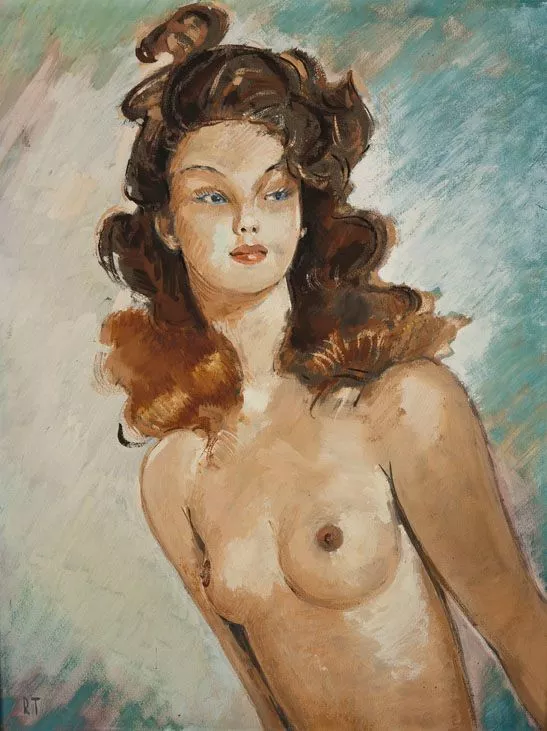
Focus on La Parisienne en bleu, Jean-Gabriel Domergue, 1920's
The work by Jean-Gabriel Domergue that particularly stands out is La Parisienne en bleu, produced in the 1920s. This painting perfectly embodies the spirit of the period, where elegance and sensuality blend to create a female figure that is both modern and timeless.
The subject of the work is a young woman dressed in a navy blue dress, the fabric draped with fluidity, highlighting the model's long, graceful figure.
The Parisienne, with her poised gaze and delicately turned face, embodies the archetypal woman of the Roaring Twenties, sophisticated, refined, but also free and emancipated.
The most striking element of this work is undoubtedly the woman's piercing gaze, her large, expressive eyes that immediately capture the viewer's attention. These eyes, of rare intensity, seem to reveal a depth of thought and emotion.
They are a reflection of the modernity of the time, when women asserted themselves and became a central figure in society, both active and seductive. The model's long neck, slender and graceful, is another significant detail of Domergue's style.
This choice highlights an idealized silhouette, but also a form of lightness and fluidity that stand in contrast to the bustle of the time.
The blue of the dress is another major element in this composition. The color, both cool and soothing, contrasts subtly with the warmth of the tones present on the model's face and skin.
This opposition creates a harmonious balance that invites the viewer to linger on every detail. The use of light on the woman's face and hands reinforces the effect of softness, emphasizing the model's sensuality while maintaining great modesty.
The accessories, such as pearls and delicately coiffed hair, are details that testify to Domergue's attention to fashion and the presentation of his models.
La Parisienne en bleu is a work that goes beyond simple portraiture. It embodies the era of the 1920s, a time when fashion, sensuality and elegance became essential values in art and society.
Through this painting, Domergue manages to capture the very essence of the modern Parisienne, combining aesthetics and emotion, and thus offering an unforgettable visual testimony to her era.
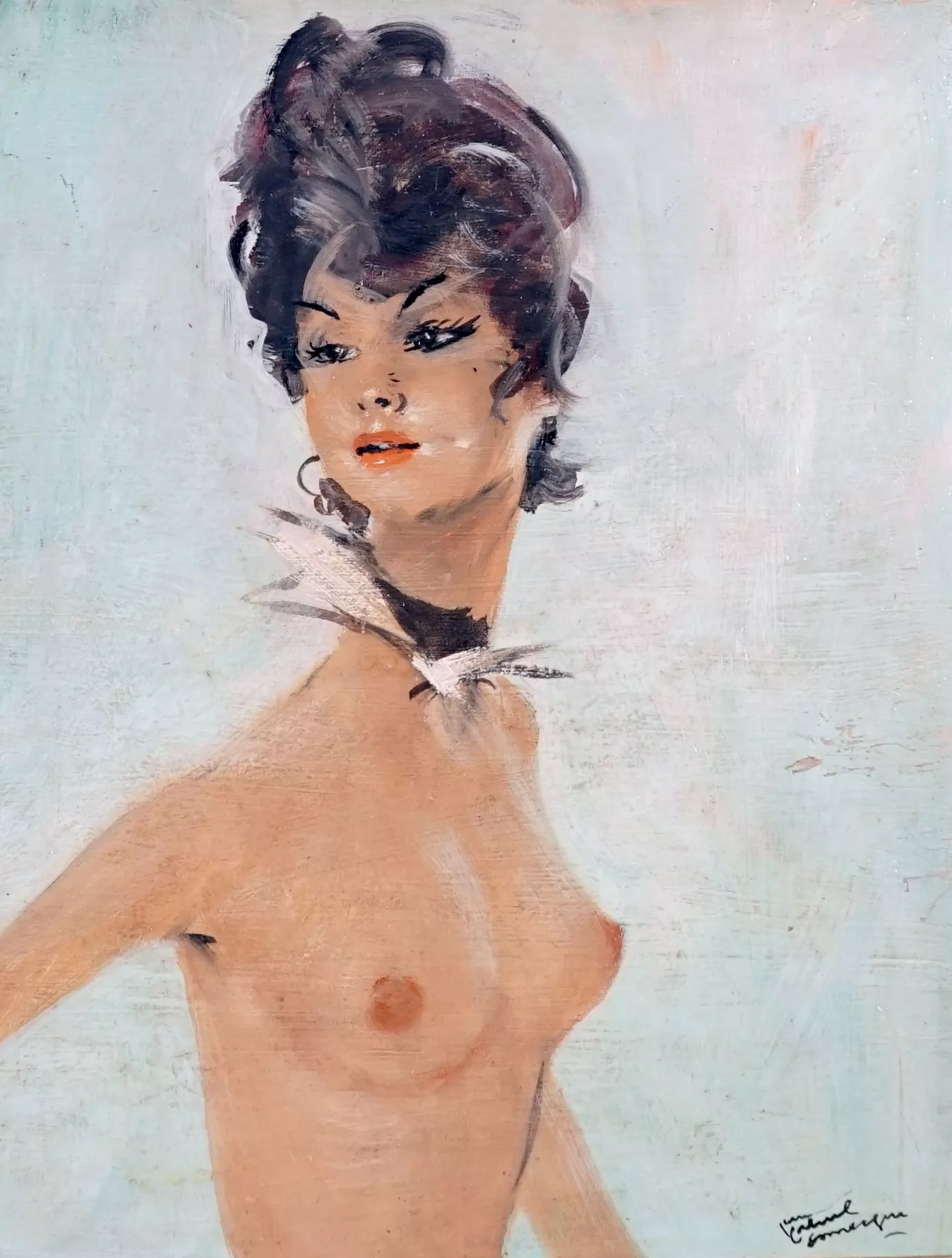
Jean-Gabriel Domergue's imprint on his era
Jean-Gabriel Domergue's works are distinguished primarily by their depiction of elegant, seductive women, often referred to as "pin-ups".
These portraits of Parisian women from the 1920s capture a particular essence of femininity, underscored by characteristic features: large, expressive eyes and long, graceful necks.
Through his brushwork, Domergue highlights feminine softness and grace, seeking to capture the moment of splendor and sensuality that makes his models so unique.
His meticulous attention to detail, whether in clothing, hairstyles or accessories, reveals a keen eye for the social and aesthetic codes of his time.
His paintings, where sophistication mingles with palpable sensuality, wonderfully convey the spirit of the 1920s, an era marked by a liberation of mores and a wind of modernity.
Beyond his portraits, Jean-Gabriel Domergue also explored other artistic genres, notably landscapes, during his early career.
These works testify to his technical mastery and sense of composition, color and light, qualities that would enable him to deepen his work as a portraitist with a more intuitive and poetic approach.
However, it was in his portraits of women that Domergue found his true recognition, ensuring his place of choice in the history of French art.
These paintings became a mirror of his time, where art and fashion came together, and the female silhouette became the emblem of modern glamour.
His contribution to the world of fashion, collaborating with couturiers such as Paul Poiret and Henry Marque, further broadened the impact of his art, making him a key player in the aesthetics of the 1920s.
His portraits were not just works of art, but windows onto the collective imagination of the time, where elegance and sensuality were erected as cultural symbols.
Domergue not only influenced the art world, but also left his mark on fashion, consolidating his major role in the visual culture of the early 20th century.
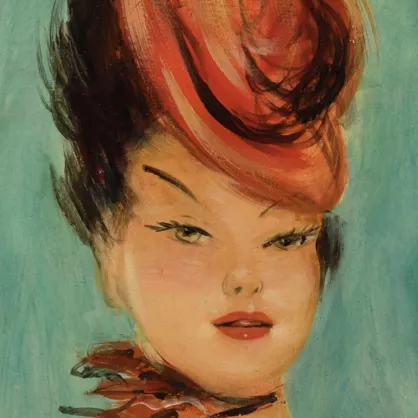
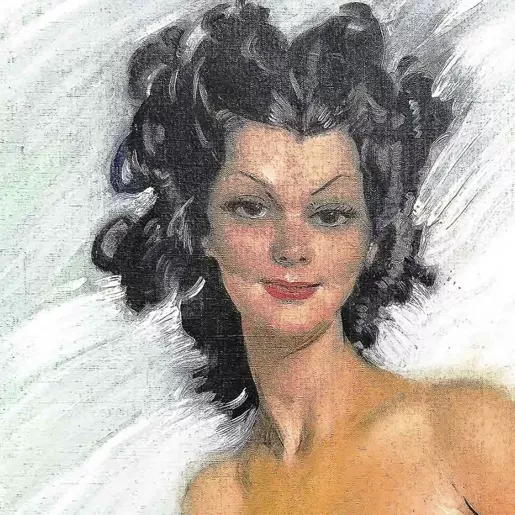
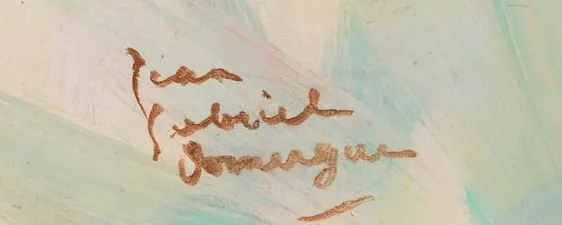
Recognizing the artist's signature
Jean Gabriel Domergue doesn't necessarily sign his works. What's more, his signature may have changed over the years. That's why expertise remains paramount.
To find out the value of a work by Domergue
If you happen to own a work by Domergue or after the artist, don't hesitate to request a free valuation using our form on our website.
A member of our team of experts and certified auctioneers will contact you promptly to provide you with an estimate of the market value of your work, not forgetting to send you ad hoc information about it.
If you are considering selling your work, you will also be accompanied by our specialists in order to benefit from alternatives for selling it at the best possible price, taking into account market inclinations.
Estimate in less than 24h
Other works from the same period sold at auction

Estimated 600 € - 800 €
Louis TOFFOLI (1907-1999), The maternity of flowers. Tapestry.

Estimated 3.000 - 5.000
Henri Adrien TANOUX (1865-1923) The Slave Trader, oil on canvas

Estimated 200 - 400
Tsuguharu FOUJITA (1886-1968), Fillettes au pot de lait et aux baguettes, Lithograph

Estimated 1.000 - 2.000
Georges Hanna SABBAGH (1887-1951), Portrait of a woman in a red tunic, Oil on cardboard

Estimated 1.200 - 2.000
Émile FRIANT (Dieuze 1863-1932 Paris) Bust portrait of a smiling smoker, oil on canvas
Discover in the same theme

Rating and value of works, drawings, paintings by Claude Via...
Claude Viallat is a twentieth-century visual artist who has produced watercolors, collages and paintings listed on the auction market.
Learn more >

Rating and value of furniture, armchairs and coffee tables b...
François Monnet is a twentieth-century French architect and designer whose furniture has become increasingly popular and valuable at auction.
Learn more >

Rating and value of paintings by Virginie Demont Breton
Virginie Demont Breton is a 19th-century naturalist artist whose paintings are highly valued at auction.
Learn more >

Secure site, anonymity preserved

Auctioneer approved by the State

Free and certified estimates
Frequently asked questions
-
Who is Jean-Gabriel Domergue, and why are his works valuable?Jean-Gabriel Domergue (1889–1962) was a renowned French artist, nicknamed the “creator of the pin-up” for his portraits of Parisian women from the 1920s, characterized by large, expressive eyes and long, graceful necks. He produced more than 3,000 portraits during his career, becoming a highly sought-after portrait artist in aristocratic circles and collaborating with prestigious fashion designers. His official recognition, marked by the Prix de Rome in 1920 and his appointment as a Chevalier of the Legion of Honor, cemented his significance in the history of 20th-century French art.
-
What is the price range for a work by Jean-Gabriel Domergue?The prices of Domergue’s works vary considerably depending on the medium and quality. Prints sell for between €20 and €4,000, watercolor drawings for between €80 and €23,000, and oil paintings on canvas—the most sought-after—for between €800 and €194,600. This variation reflects the work’s condition, provenance, size, and subject matter. For example, in 2017, an oil portrait of a woman exceeded estimates, selling for €105,000.
-
How can you authenticate a work by Domergue and determine its exact value?To authenticate a work by Domergue, it is essential to seek a professional appraisal, as the artist did not consistently sign his paintings and his signature varied over the years. Auctie's offers a free, no-obligation appraisal: simply fill out a form on the website to be contacted by a certified expert or auctioneer, who will provide an accurate appraisal within 48 hours.
-
Is this the right time to sell a work by Domergue?Yes, now is a good time to sell a work by Domergue. Prices for his paintings are rising steadily at auction, and his portraits of women remain highly sought after, particularly by French buyers. The art market recognizes the historical and aesthetic significance of his work, which supports strong valuations.
-
How does the sale of a work of art work at Auctie's?At Auctie's, the process is simple and transparent: after a free, no-obligation appraisal conducted by our experts within 48 hours, we’ll guide you through the entire process from start to finish if you decide to sell. Our team of licensed auctioneers identifies the best options for selling your artwork at the best price based on market trends, right through to the final sale.
