



Rating and value of paintings by Dimitri Mikhailovich Krasnopevtsev

Key takeaways
- Russian painter (1925–1995), a pioneer of abstraction and a leading figure in Soviet nonconformist art, with works held in the MoMA collection.
- His paintings fetch several million euros at auction, notably “Still Life with Three Jugs,” which sold for €656,800 in 2006.
- A specialist in metaphysical still lifes, he used a limited color palette (browns, ochres, grays), treated objects as relics, and employed rigorous architectural composition.
If you own a work by the artist Dimitri Mikhailovich Krasnopevtsev or based on his work, and would like to know its value, our state-approved experts and auctioneers will guide you.
Our specialists will carry out a free appraisal of your work, and provide you with an accurate estimate of its value on the current market.
Then, should you wish to sell your work, we'll direct you to the best possible arrangement to obtain the optimum price.
Artist's rating and value
A Russian artist who pioneered abstraction, Dimitri Mikhailovich Krasnopevtsev established himself as a major artist of his time. He produced works inspired by several twentieth-century currents and his native country, mixing media.
On the art market, his works sell for very good prices and keep a stable quotation.
As such, a work signed by the artist's hand can fetch millions of euros at auction, as witness his oil on canvas Still life with three jugs dating from 1976, fetched €656,800 in 2006.
Order of value from the most basic to the most prestigious
Technique used | Result |
|---|---|
Drawing - watercolor | From €300 to €16,500 |
Painting | From €450 to €656,800 |
Estimate in less than 24h
The artist's works and style
Dimitri Mikhailovich Krasnopevtsev (1925 - 1995) was a Russian painter associated with the unofficial Soviet metaphysical current, active in Moscow's underground art circles. He developed a visual language based on metaphysical still life, detached from the dominant socialist realism.
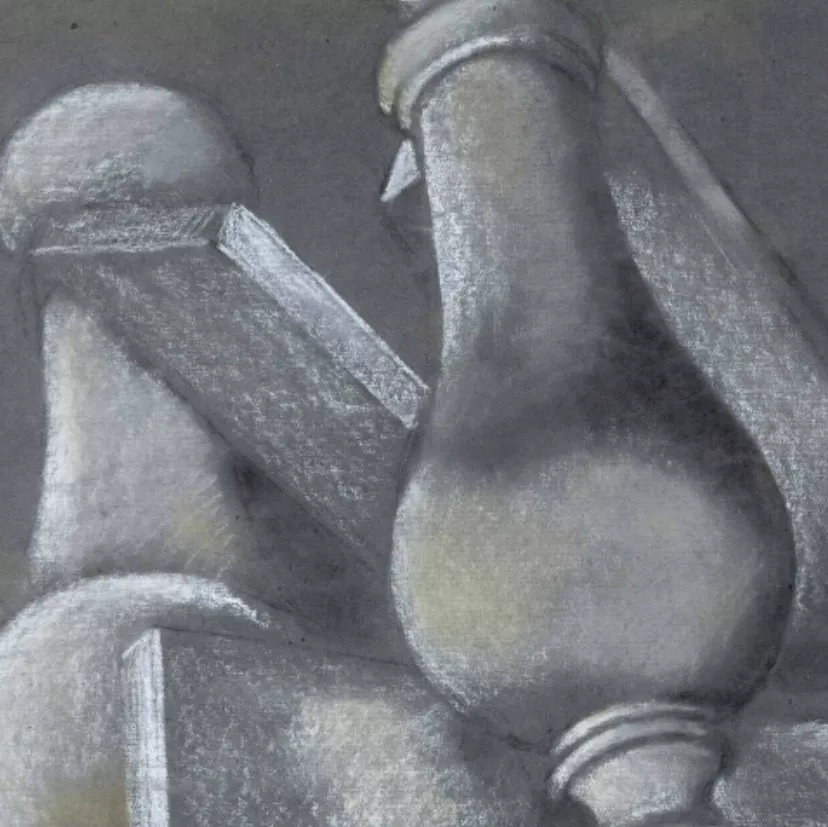
In his works, he seeks a silent, timeless atmosphere akin to Giorgio Morandi, but with a much more pronounced symbolic dimension. The recurring objects are shells, animal skeletons, corals, pebbles, boxes, tool fragments and found objects, always treated as relics or relics.
There is a total absence of direct narrative. The compositions function as visual meditations, focused on order, matter and memory. There is a strong stylization of forms, reduced to their essence : volumes are simplified, contours soft and organization almost architectonic.
He makes constant use of the horizontal table or plan-socle that supports the objects (also used in traditional still life at Clara Peeters or Balthasar van der Ast), generally set very low and reinforcing the effect of monumentality. The construction is stable and often frontal, with implicit symmetries, alignments, strict verticals and an almost ceremonial arrangement of elements.
He works with repetitive sequences of objects (shells, stones, boxes) that establish a meditative rhythm. The chromatic range is deliberately restrained (browns, ochres, greys, muted greens, off-whites), with the occasional hint of iridescence on the shells.
The light is diffused, with no identifiable source, and a homogeneous illumination that cancels out dramatic effects and inscribes the object in a suspended atmosphere. He makes moderate use of contrasts, favoring muted, even powdery tones.
Dimitri Mikhailovich Krasnopevtsev mainly uses oil on canvas or cardboard, in very controlled application : the strokes are fine, the superimpositions transparent and there is no impasto. He works meticulously with texture, rendering chalky, pearly or eroded surfaces with a " smooth surface " effect, the brushstroke is almost invisible, creating a subtle, austere materiality.
The linearity is discreet, with contours slightly emphasized to isolate objects in space. Still life becomes an instrument of metaphysical contemplation, evoking fragility, memory and the passage of time.
The artist uses no contemporary elements of everyday life: the objects seem uprooted from the real world and carried into a non-place. The spiritual dimension is strong, but not religious, with an almost monastic approach rooted in the Russian tradition of iconic objects.
The work of Dimitri Mikhailovich Krasnopevtsev weaves a conceptual proximity with Morandi, Chardin or Italian metaphysical painting, while remaining profoundly Russian in sensibility. He is associated with the Second Russian Avant-Garde movement, marked by interiority and silent resistance to socialist realism.
The life of Dimitri Mikhailovich Krasnopevtsev
Dimitri Mikhailovich Krasnopevtsev (1925 - 1995) was a Russian painter. From 1942 to 1947, he trained at Moscow's " 1905 " Regional Academy of Fine Arts. He then studied at Moscow's Surikov Art Institute (" V. Surikov ") from 1949 to 1955.
From 1956 - 1957, he began exhibiting in the USSR and abroad. He is considered one of the leading representatives of the " Shestidesiatniki " generation (artists of the 1960s) in the context of Soviet non-conformist art.
In 1993, he received the informal Prix Triumph award for his body of work. After the publication of one of his still lifes in Life magazine, he was criticized for " formalism ", and found himself expelled from the Soviet Artists' Union, living in seclusion while continuing to work.
His recognition in Russia only increased after the Perestoyka period, with several institutional exhibitions. His work is held in several museums, including the MoMA collection. He produced over a thousand paintings in his career, notably metaphysical still lifes.
Focus on a still life by Dimitri Mikhailovich Krasnopevtsev
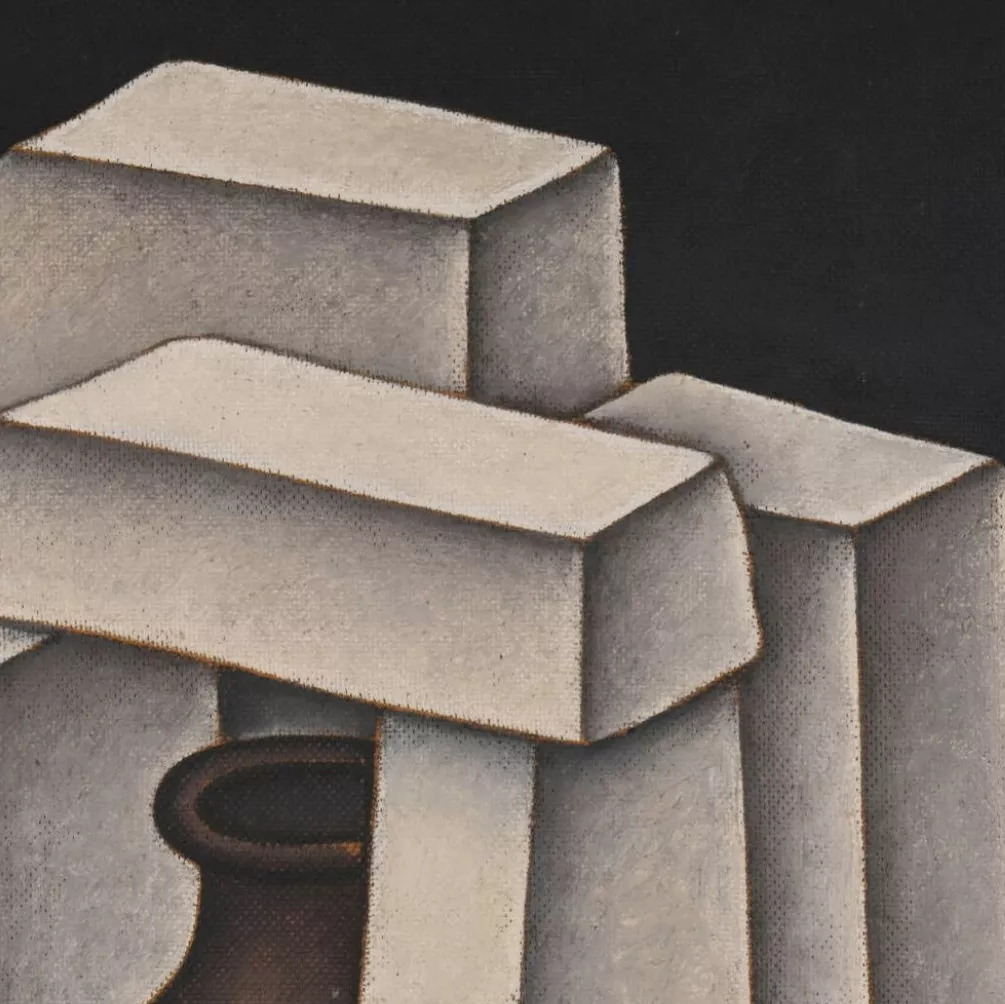
This oil on masonite dated 1969 and measuring 51 x 60 cm constructs the motif architectonically. The artist depicts a set of rectangular stone blocks, with a frontal organization, a quasi-megalithic structure that evokes an altar or ritual enclosure.
The stacking is strict, verticalized and perfectly stable. The artist seeks to express " statism ". The brown vase, centered and partially obscured, functions as a sacralized object, protected or buried in a deliberately archaizing construction.
The partitioning is rigorous, the blocks forming an enclosed space that isolates the vase from the rest of the visual field. There is an absence of real depth, and the scene appears as a slow, meditative mise en plan, in which each object is independent but ordered according to a severe inner logic.
The surrounding black space, with no horizon and no identifiable light, cancels out any external spatiality and gives the objects a timeless character. The palette is restrained, with cool grey-whites for the blocks, a deep brown for the vase and a matte black background.
The light is diffuse, directionless and reveals the powdery materiality of the stone and the soft modelling of the vase. The absence of sharp contrast contributes to the composition's silent serenity. Surfaces are smooth but subtly grainy, with meticulous texture work, typical of the artist, giving each object a relic-like status.
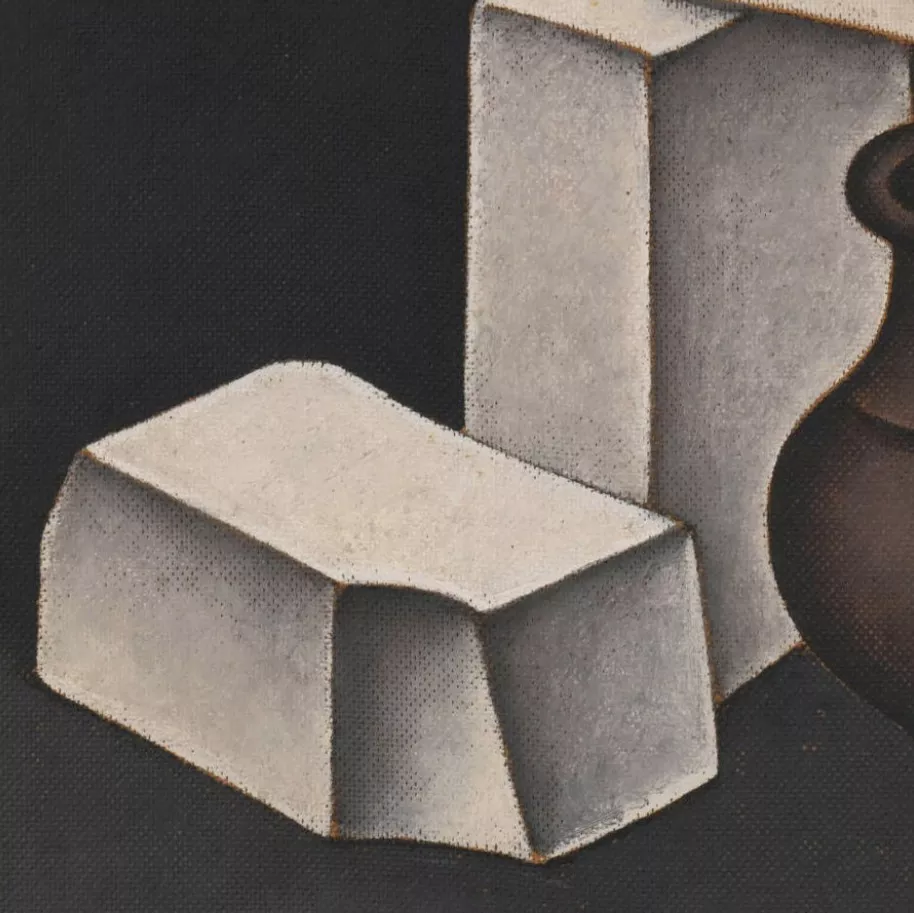
The edges are slightly softened, with a reinforcement of the effect of calm monumentality rather than geometric hardness. The vase appears as an ancient artifact or protected vestige. It is not an object of use but an object of memory.
True to his aesthetic, Dimitri Mikhailovich Krasnopevtsev gives objects an existential status; they are out of the world, frozen in an inner temporality. The quasi-ritual arrangement of the forms evokes ceremony, permanence and meditation, in radical contrast to the dynamics of Soviet socialist realism.
This painting recalls Giorgio Morandi in the simplicity of the objects and the stripping back, but with more symbolic density, but also sacral or prehistoric architecture (megaliths, dolmens), the blocks don't represent identifiable stones, but archetypes of solid form.
This is typical of his mature 1960s period, with absolute rigor of form, a deliberately austere palette and objects reduced to their essence. The 1969 date corresponds to a moment when the artist reached the full definition of his " metaphysical still life ", based on stasis, meditation and verticality.
This work perfectly illustrates Krasnopevtsev's fundamental principles of formal asceticism, stability, timelessness and the sacralization of the object. Through the protective structure and monumentalization of the vase, the artist creates a space where the object describes nothing but is content to exist in density.
The work as a whole is a paradigmatic example of Soviet unofficial painting, where resistance comes through interiority and the poetic reformulation of material reality.
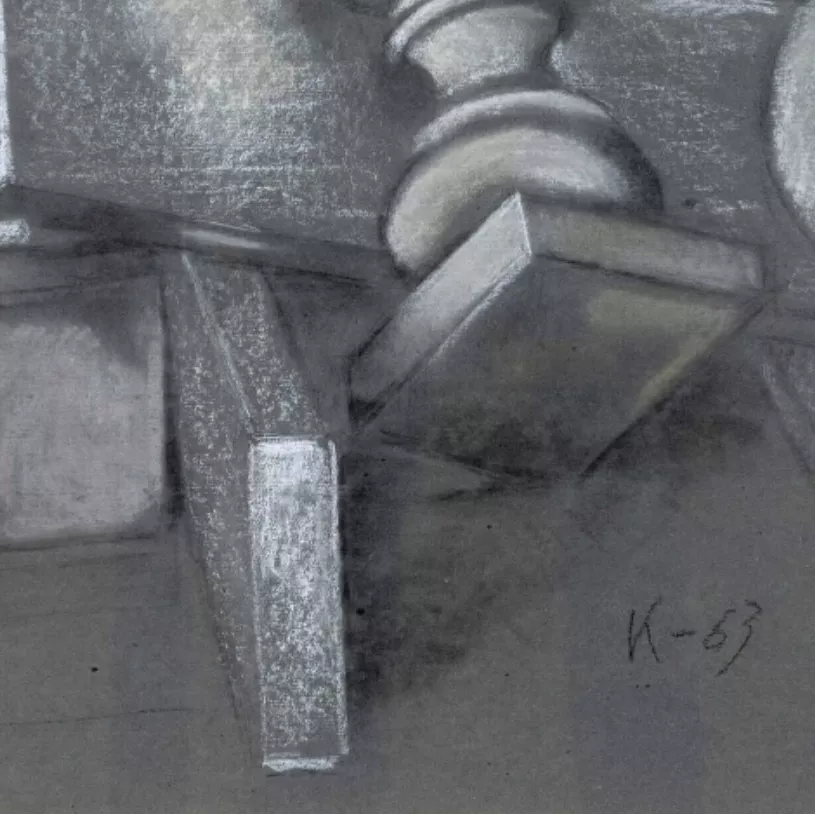
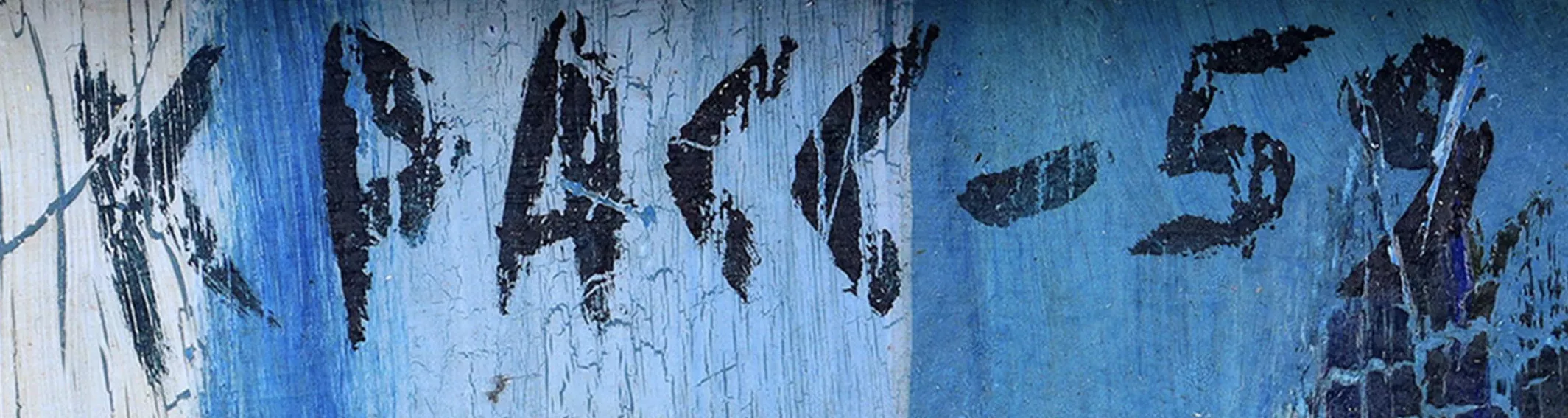
His signature
Not all of Dimitri Mikhailovich Krasnopevtsev's works are signed.
Although there are variations, here is a first example of his signature:
Expertise your property
If you own a work by Dimitri Mikhailovich Krasnopevtsev, don't hesitate to request a free appraisal by filling in our online form.
A member of our team of experts and licensed auctioneers will contact you to provide an estimate of the market value of your work.
If you are considering selling your work, our specialists will also guide you through the various alternatives available to obtain the best possible price, taking into account market trends and the specific features of each work.
Estimate in less than 24h
Discover in the same theme

Rating and value of works, paintings, sculptures by Max Erns...
Max Ernst is a 20th-century Surrealist painter who produced many highly-regarded paintings and sculptures, which have a high value at auction.
Learn more >

Rating and value of paintings, drawings and lithographs by P...
Paul Delvaux is a Belgian surrealist artist whose works are highly valued on the auction market.
Learn more >

Rating and value of paintings by Pierre Alechinsky
Pierre Alechinsky is a founding member of the CoBra group. His works are highly valued. Estimated 24h.
Learn more >
D'autres natures mortes vendues aux enchères

Estimated 15.000 - 20.000
Anthony II CLAESZ (1616-1642), Still life of flowers, oil on canvas

Estimated 8.000 - 12.000
Guillaume FOUACE (1837 - 1895), Still life with lobster, oil on canvas

Estimated 8.000 - 15.000
Maurice de VLAMINCK (1876-1958), Still life with jugs and leeks, oil on canvas

Estimated 4.000 - 6.000
Guillaume FOUACE (1837-1895), Still life with Roquefort cheese, Oil on canvas

Estimated 12.000 - 15.000
Paul AIZPIRI (1919-2016), Still life of flowers, Oil on canvas

Estimated 800 - 1.500
Pascal DAGNAN-BOUVERET (Paris 1852-1929 Quincey) Still life with apple and books, Oil on cardboard

Secure site, anonymity preserved

Auctioneer approved by the State

Free and certified estimates
Frequently asked questions
-
Who is Dimitri Mikhailovich Krasnopevtsev, and what is his artistic background?Dimitri Mikhailovich Krasnopevtsev (1925–1995) was a leading Russian painter of the Soviet nonconformist movement, associated with the “Shestidesiatniki” generation (the 1960s). A pioneer of abstraction and metaphysical still life, he quietly opposed official Socialist Realism by developing a contemplative visual language inspired by Giorgio Morandi, with a strong symbolic and spiritual dimension. His work is held in the MoMA collection, and his international recognition grew following Perestroika.
-
What are the price ranges for Krasnopevtsev's works based on the medium?Krasnopevtsev’s drawings and watercolors range in price from €300 to €16,500, while his paintings fetch much higher prices, ranging from €450 to €656,800. The latter figure corresponds to the 2006 auction price of “Still Life with Three Jugs” (1976), a landmark oil on canvas. The artist’s signed works maintain a stable market value and sell for very good prices on the art market.
-
How can you authenticate a work by Krasnopevtsev and determine its value?To authenticate and appraise a work by Krasnopevtsev, we recommend that you request a free appraisal from Auctie's by filling out our online form. A state-certified expert or auctioneer will contact you within 48 hours to provide you with an accurate estimate of the market value, with no obligation.
-
Is this the right time to sell a work by Krasnopevtsev?Yes, now is a good time to sell a work by Krasnopevtsev. His paintings maintain a stable market value and sell for very good prices on the contemporary art market. The growing recognition of non-conformist Soviet art and the presence of his works in prestigious museums (including MoMA) are boosting both the demand for and the value of his creations.
-
How does the sales process work at Auctie's for a work by Krasnopevtsev?At Auctie's, the process is simple and transparent: you start with a free, no-obligation appraisal conducted by our experts and licensed auctioneers. After the appraisal, if you decide to sell, our specialists will guide you through the best options for achieving the optimal price, taking into account market trends and the unique characteristics of your artwork.
