



Tableaux Alix Aymé - Value, quotation, artist

Key takeaways
- Oil-on-canvas works by Alix Aymé, a major 20th-century artist, sell for between €120 and €345,000, with prices on the rise since 2024.
- The work “Pastorale” (1938–1940) exceeded its estimate, selling for €345,000 against an estimated range of €120,000–200,000.
- Prints and watercolor drawings range from €30 to €78,000, offering more affordable options for collectors.
If you own a work by or after the artist Alix Aymé, and would like to know its value, our state-approved experts and auctioneers will offer you their appraisal services.
Our specialists will carry out a free appraisal of your work, and provide you with a precise estimate of its value on the current market.
Then, if you wish to sell your work, we will direct you to the best possible arrangement to obtain the optimum price.
Rating and value of the artist Alix Aymé
Alix Aymé is a major artist of 20th century painting. Now, the prices of her works are rising at the auctioneers' gavel.
Her oils on canvas are particularly prized, especially by French buyers, and the price at which they sell on the art market ranges from €30 to €345,000, a considerable delta but one that speaks volumes about the value that can be attributed to the artist's works.
In 2024, an oil on canvas entitled Pastorale, painted between 1938 and 1940, sold for €345,000, whereas it was estimated at between €120,000 and €200,000. Its value is on the rise.
Order of value from a simple work to the most prestigious
Technique used | Result |
|---|---|
Estamp | From €55 to €6,500 |
Drawing - watercolor | From €30 to €78,000 |
Oil on canvas | From €120 to €345,000 |
Estimate in less than 24h
Style and technique by artist Alix Aymé
Alix Aymé seems to have always made a point of distancing herself from the major movements of her time.
Far from the raw, liberated expression that marked contemporary trends, she turned to a more controlled, almost methodical style of writing.
Her technique is sober, but shouldn't be confused with austerity. Aymé knows how to handle nuances and materials with finesse. Every brushstroke, every line is part of a desire for order, for discipline.
Her compositions are never too dense or complex. Instead, she chooses pared-down forms, a certain softness that, on closer inspection, testifies to great technical mastery.
What strikes above all is the subtle use of space, never excessive, always balanced. The color palette, though sometimes restricted, remains effective.
It plays with light and shadow, without resorting to striking contrasts, but favoring a softer gradation.
It is in this simplicity that Aymé succeeds in capturing an almost invisible form of poetry, a calm that doesn't need to be demonstrated. His technique, all restraint, thus manages to exude great strength, but in a discreet way.
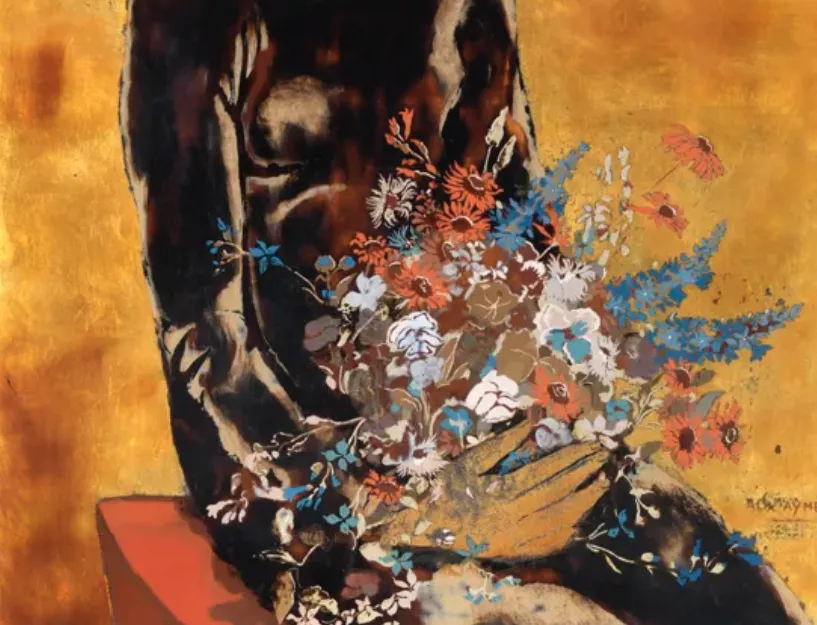
Alix Aymé, painter en vogue
Alix Aymé (1894-1989) was a renowned French artist. Born in Marseille, she studied drawing and music at the Toulouse Conservatoire. She proved to be extremely gifted in both fields, but chose drawing to pursue her career.
Aymé therefore moved to Paris, where she studied painting in Maurice Denis's studio.
Some time later, she married a literature professor whom she accompanied to Hanoi and Shanghai, and went on to teach painting and drawing at Hanoi's French lycée.
On her return to France, she separated from her husband and left for Indochina with her son: the French government had commissioned her to organize the 1931 Colonial Exhibition.
She married Georges Aymé, a lieutenant-colonel, with whom she had a second son. She also traveled to Laos, where she found new sources of inspiration.
Alix Aymé was then appointed professor at the Ecole des Beaux-Arts d'Indochine, founded by Victor Tardieu, where she was keen to keep alive the tradition of Vietnamese lacquerware.
She is also interested in the technique of silk painting, as were Vietnamese artists such as Nam Son Nguyen and Thuong Lan Nguyen. Today, these artists are immensely successful on the auction market, highly sought-after by collectors, and their value is exploding.
Late in her career, she created the Stations of the Cross of Notre Dame de Fidélité, entirely in Vietnamese lacquer, an absolutely original work that blends her Western inspirations with Far Eastern artistic techniques. She died in 1989.
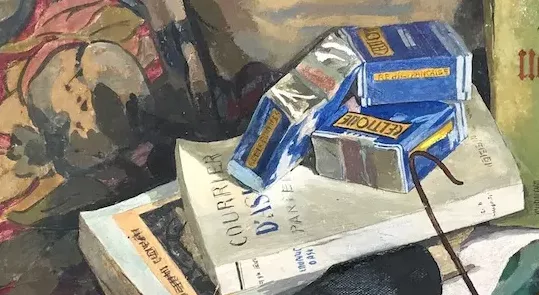
Alix Aymé's Indochinese period
Little is known about Alix Aymé's Indochinese period, yet this stage of her career does not fail to leave its mark on her work.
Far from the conventions and European concerns of the time, Aymé immersed herself in a totally new universe.
There, she captures scenes of daily life, portraits of individuals, but also tropical landscapes, whose vivid colors and sometimes surprising shapes will enrich her work.
In her paintings from this period, we find a more spontaneous approach, less fixed than in her previous productions. Light, like a special guest, seeps onto the canvas, making the scenes lively, almost vibrant.
If one pays attention to her depictions of landscapes, one will notice a certain fluidity in the paint strokes, as if she had wanted to convey the idea of a world in motion.
The colors, meanwhile, move away from the classical palette to offer warmer, more exotic hues - deep reds, oranges and greens - that bring a new dimension to her painting.
Through these paintings, Aymé bears witness to a time and place, but she never tries to freeze them in a realistic image.
She captures moments, like fleeting bursts of emotion, in everyday scenes where movement blends with light, and where the artist seems to merge with the environment she observes.
Focus on an Indochinese fishing scene, Alix Aymé
This aspect of his work has rarely been dwelt on, although it deserves particular attention. Indeed, in this specific painting, Aymé doesn't simply describe a scene, but captures its very essence.
The canvas, which depicts an Indochinese fishing port, is distinguished by a subtle blend of reality and personal interpretation.
The deep blue of the water, slightly swirling in the breeze, contrasts with the luminous reflections of the boats, as if the artist had sought to capture the precise moment when light and shadow dance together.
The silhouettes of the fishermen, treated in an almost abstract manner, fit into the scenery without clashing with it, forming a whole.
Far from a geometric study or rigid perspective, Aymé leaves room for a certain fluidity in the forms, as if the environment were reorganizing itself under the influence of light and movement.
The brushstrokes are visible, sometimes nervous, sometimes softer, and render the sensation of flow and life.
The painting seems to invite us to feel rather than understand, immersing us in a vibrant atmosphere where sea and people, in their simplicity, melt into each other.
With this approach, Aymé is not so much trying to tell a story as to express its raw emotion, capturing the soul of the place with astonishing freedom.
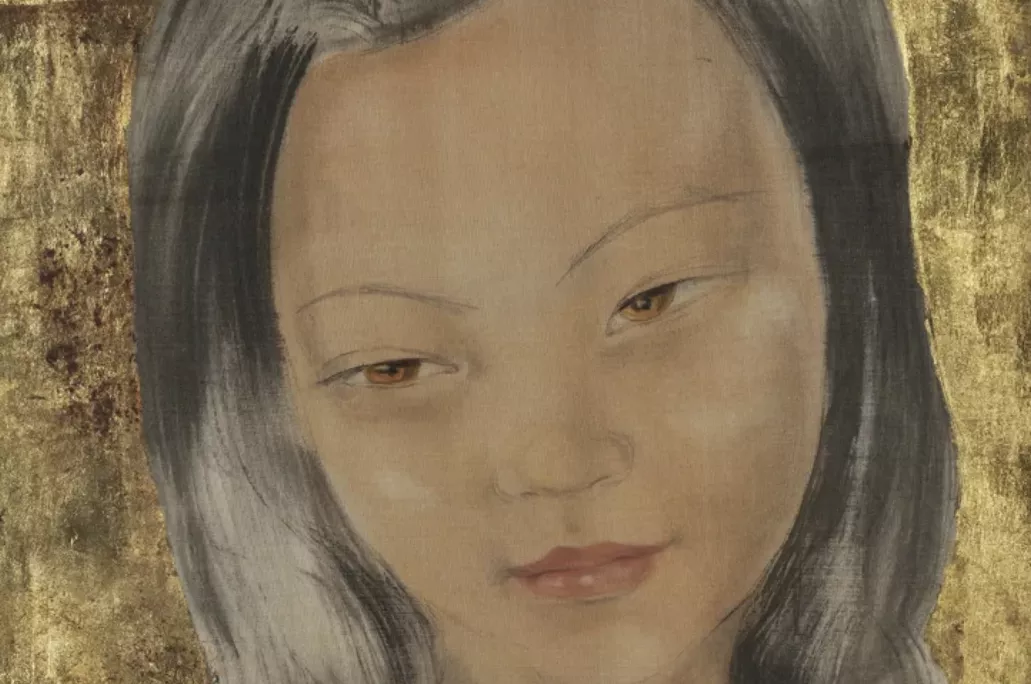
Alix Aymé's imprint on her period
Alix Aymé left a lasting imprint on her era by finely reinterpreting Asian artistic traditions through the prism of her Western training.
In the paintings she produced during her Indochinese period, she integrated the richness of local motifs, the subtleties of exotic landscapes and the demanding techniques of lacquer, giving rise to works of striking depth.
Her subtly balanced compositions are distinguished by a remarkable mastery of light and a unique ability to instill a poetic, timeless atmosphere.
Alix Aymé, far from being content with mere observation, has plunged into the heart of Vietnamese know-how, respecting their traditions while infusing modern touches from European art.
This skilful fusion has enabled him to stand out among his contemporaries, asserting a bold and refined artistic vision.
By reconciling the aesthetic heritage of the East with the Western avant-garde, she enriched the decorative and pictorial art of her time, becoming a key figure in the cultural dialogue between two worlds.
Her work, deeply rooted in its time, continues to fascinate by its ability to transcend artistic and cultural boundaries.
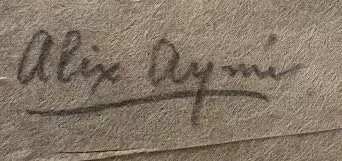
Recognizing the artist's signature
Aymé often signs her name at the bottom of her drawings, or oils on canvas. Copies may exist, so expertise remains important.
Knowing the value of a work
If you happen to own a work by or after Alix Aymé, don't hesitate to request a free valuation using our form on our website.
A member of our team of experts and licensed auctioneers will contact you promptly to provide you with an estimate of the market value of your work, not forgetting to send you ad hoc information about it.
If you are considering selling your work, you will also be accompanied by our specialists in order to benefit from alternatives for selling it at the best possible price, taking into account market inclinations.
Estimate in less than 24h
Works from the same period sold at auction

Estimated 2500 - 5000 €
Henri EPSTEIN (1892-1944), View of the village through the trees, Oil on canvas

Estimated 3 000 - 5 000
Gaston SUISSE (1896-1988), Engraved polychrome lacquer panel on tortoiseshell lacquer background.

Estimated 4.000 - 6.000 €
EUGÈNE LEROY (1910-2000), Maison dans un sous bois, oil on canvas mounted on panel.

Estimated 15.000 - 20.000 €
Jacques MAJORELLE (1886-1962) - Fishermen embarking, Abidjan, Ivory Coast - Oil on canvas.

Estimated 1000 - 2000 €
NGUYEN TUONG LAN (1906-1947) - Ink and gouache painting on silk depicting a temple.

Estimated 4.000 - 6.000 €
GASTON CHAISSAC (1910-1964) Composition 1947, Gouache and Indian ink on paper.
Discover in the same theme

Rating and value of works, drawings, paintings by Michel Kik...
Michel Kikoine is an expressionist painter of the Paris School who produced sought-after and valuable drawings and oils on canvas.
Learn more >

Rating and value of paintings by Jean Fautrier
Jean Fautrier is an abstract painter of the 20th century, quoted at auction, who produced works whose value is quite high. 24h estimate.
Learn more >

Rating and value of paintings by Adolphe Louis Gaussen
Adolphe Louis Gaussen is a marine painter who produced numerous paintings that command high prices at auction. 24-Hour Estimate
Learn more >

Secure site, anonymity preserved

Auctioneer approved by the State

Free and certified estimates
Frequently asked questions
-
Who was Alix Aymé, and what is her artistic background?Alix Aymé (1894–1989) was a major 20th-century French artist, born in Marseille and trained in Maurice Denis’s studio in Paris. She distinguished herself through a controlled and refined approach, distinct from the Expressionist movements of her time, before finding a new source of inspiration during her stay in Indochina, where she fused Asian artistic traditions with her Western training.
-
What is the price range for Alix Aymé's paintings?The prices of Alix Aymé’s works vary considerably depending on the medium and quality. Prints sell for between €55 and €6,500, drawings and watercolors for between €30 and €78,000, and oil paintings on canvas for between €120 and €345,000. In 2024, her painting “Pastorale” (1938–1940) exceeded its estimates, fetching €345,000, confirming the rise in her market value.
-
How can you authenticate a work by Alix Aymé?Authenticating a work by Alix Aymé requires professional expertise. Auctie's offers a free, no-obligation appraisal request, conducted by state-certified auctioneers and experts. Our team examines the artwork, verifies the signature (usually located at the bottom of the painting), and provides you with a detailed estimate within 48 hours.
-
Is this a good time to sell a work by Alix Aymé?Yes, now is a good time to sell a work by Alix Aymé. Her market value is on the rise, particularly for her oil-on-canvas paintings, which are attracting growing interest from French collectors. Recent auction results, such as the sale of “Pastorale,” which exceeded estimates, demonstrate sustained demand.
-
How does the appraisal and sale process work at Auctie's?The appraisal is free, with no obligation, and is conducted by our experts and auctioneers within 48 hours. If you’d like to sell, Auctie’s supports you every step of the way: we appraise your artwork, advise you on the best sales strategies based on the current market, and guide you through the auction process to secure the best possible price.
