



Ratings and values of paintings by Willem de Kooning

Key takeaways
- Willem de Kooning’s works fetch auction prices ranging from €10 to €54.5 million, with prices in France remaining generally stable and high.
- Paintings constitute the highest-valued segment (€40 to €54.5 million), while prints and watercolor drawings remain less expensive (€10 to €4.9 million).
- A leading figure in Abstract Expressionism, de Kooning (1904–1997) explored the boundary between abstraction and the human figure—particularly the female form—with a style characterized by impulsive brushstrokes and intense colors.
If you own a work by or based on the work of artist Willem de Kooning and would like to know its value, our state-approved experts and auctioneers will guide you.
Our specialists will carry out a free appraisal of your work, and provide you with an accurate estimate of its value on the current market.
Then, if you wish to sell your work, we will direct you to the best possible arrangement to obtain the optimum price.
Artist's rating and value
Characterized by bold, luminous compositions, Willem de Kooning's works are a big hit with collectors. On the market, their value remains stable and high overall, especially in France.
At auction, the price at which his works sell ranges from 10 to 54,457,900, a considerable range but one that speaks volumes about the value that can be attributed to Willem de Kooning's works.
Some of the artist's works, for example, can fetch thousands of euros at auction, as evidenced by his painting Untitled XXV, which fetched €54,457,900 in 2016, whereas it was estimated at between €53,000,000 and €70,000,000.
Order of value from the most basic to the most prestigious
Technique used | Result |
|---|---|
Estamp - multiple | From €10 to €415,230 |
Drawing - watercolor | From €300 to €4,928,000 |
Painting | From €40 to €54,457,900 |
Estimate in less than 24h
The artist's works and style
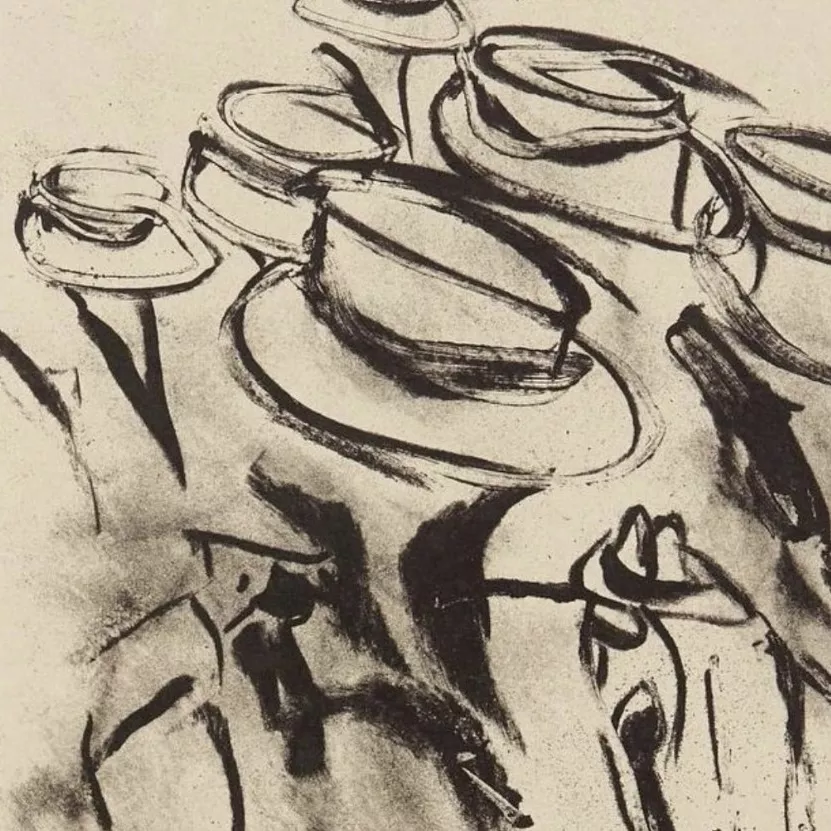
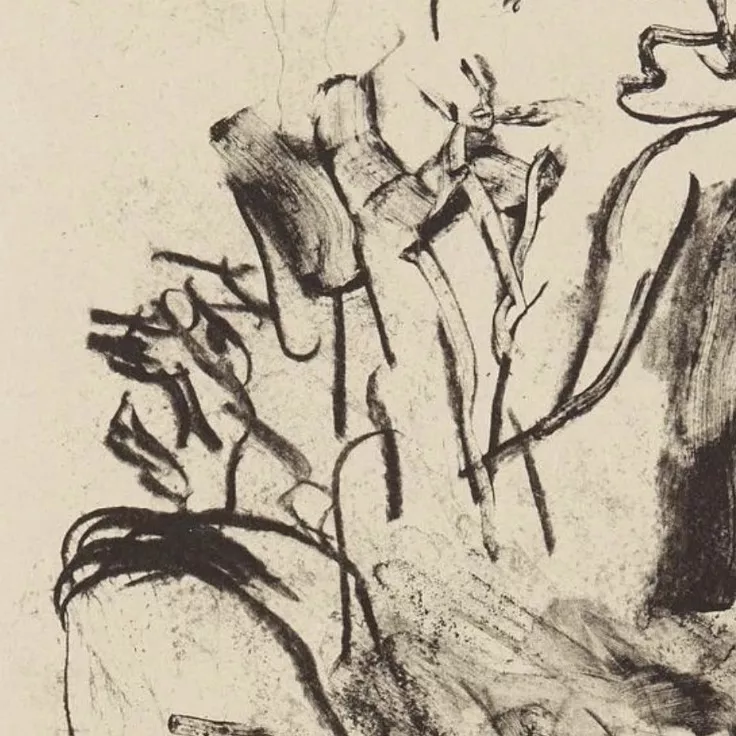
Willem de Kooning (1904 - 1997) is a major figure in American abstract expressionism. He is known for his constant exploration of the unstable boundary between abstraction and the human figure, particularly the female figure. He refused pure formalism: even his most abstract canvases are inhabited by the body, the memory or the anatomical fragment.
His style remains fluid, shifting from highly gestural compositions to more structured, sometimes almost landscape-like phases. His technique is marked by the use of broad brushes, painting knives and scrapers, with sweeping, rapid, almost impulsive gestures.
Layers of paint are often superimposed, scraped, smeared and partially erased or reworked, creating a chaotic, living texture. He seeks imbalance, rupture and spontaneity in a deliberately unstable painting style.
He uses frank and sometimes very bright colors (acid pinks, lemon yellows, vivid reds, toxic greens) often in jarring contrasts. The colors don't shape the form, but participate in a violent deconstruction of the surface. In his later series, his palette becomes softer and more fluid, but retains an instinctive intensity.
His famous Women series from the 1950s show distorted, massive, grotesque and dynamic female figures, bordering on the monster and the caricature. These figures are both overwhelming physical presences and objects of pure painting, neither icons nor portraits.
In Willem de Kooning's work, the body becomes a plastic battlefield where the painter's gestures are inscribed like marks of struggle. The artist claims a painting freed from rules, but always in tension with tradition, particularly that of European painting (Rubens, Soutine, Ingres...)
He seeks to leave traces of action, while retaining the memory of looking at the world, which makes his work intensely corporeal. His style is akin to a painting of process, accident and constant revision.
The life of Willem de Kooning
Willem de Kooning was born in Rotterdam (Netherlands) in 1904, into a modest family. He was trained in the decorative arts from an early age, and studied at the Academy of Fine Arts and Techniques in Rotterdam.
De Kooning worked from adolescence as an apprentice decorator, forging his physical relationship with the material. He emigrated illegally to the United States in 1926, hiding aboard a ship, and settled in New York, where he initially worked as a house painter and decorator.
From the 1930s onwards, he frequented the Manhattan art scene, rubbing shoulders with Arshille Gorky, a painter who was to exert a great influence on him. He worked at the WPA Federal Art Project, which enabled him to paint while surviving the Great Depression.
The artist began to make a name for himself in the 1940s, with works that blended lyrical abstraction with some figurative reminiscences. He was one of the founders of what critics would later call Abstract Expressionism, alongside Jackson Pollock and Franz Kline or Mark Rothko.
His style, which is at once violent, sensual and unstable, is distinguished by its attachment to the human body, particularly the female figure. In 1943, he married the painter Eliane Fried, also a figure on the New York scene, although their relationship was complicated.
Between 1950 and 1953, he produced the Women series, which has become emblematic of his work, and which today arouses as much admiration as scandal. His work continued to evolve, moving from dense, saturated canvases to a more fluid, refined style in the 1980s, even when he fell ill.
In 1980, he was diagnosed with Alzheimer's disease. He continued to paint until 1991, and died in 1997 in East Hampton (Long Island), in the house-studio where he had lived since the 60s.
Willem de Kooning is today considered one of the greatest American artists of the 20th century, and has left a lasting mark on art history through his plastic energy, gestural freedom and constant tension between figure and abstraction.
Focus on Woman I, 1950 - 52, Willem de Kooning
Woman I is an oil on canvas created by de Kooning in the years 1950 - 52. It measures 192.7 x 147.3 cm and is kept at the Museum of Modern Art in New-York. It is the first completed work in a series of monumental women painted between 1950 and 1955.
The canvas depicts a standing, mid-body woman with deliberately distorted features (prominent breasts, huge mouth, fixed eyes and massive arms). The body is barely contained by the limits of the canvas and is almost overflowing, bursting and convulsive.
This is neither a portrait nor an allegory, as this work imposes a raw, ambivalent presence, somewhere between primitive goddess, advertising icon and monster.
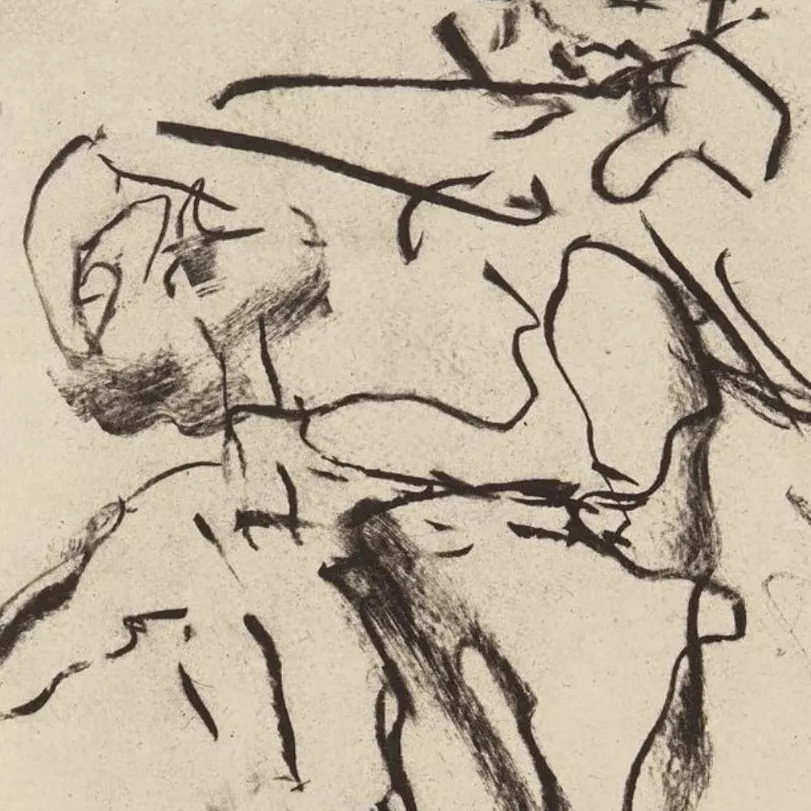
The pictorial gesture spans almost two years, the work testifying to an obsessive work (paint laid down, scraped, erased, restarted and impastoed). The surface is a dense stratification of matter, marked by choppy brushstrokes, rubbing and nervous rework.
The gesture remains visible throughout, exposing the process as an integral part of the result. Colors are contrasting, often dissonant (flesh yellow, sickly green, fuchsia pink, off-white, charcoal black). He uses no classical modeling, and the colors assault more than they describe, in a desire for visual shock.
The figure seems to spring from a pictorial chaos, as if forcibly held to the surface. Woman I was the subject of controversy from the moment it was first shown to the public. It was perceived by some as misogynistic or violent, and by others as a radical reinvention of the female nude.
Woman I embodies a tension between attraction and repulsion, beauty and menace, stability and collapse. The painting is as much a pictorial struggle as an iconographic one. De Kooning manages to blur the boundaries between archaic figuration and contemporary abstraction, and to stretch the thread between desire and anguish.
This oil on canvas is the founding act of his Women series, but also a key moment in Abstract Expressionism. It marks a break with the pure abstraction of his contemporaries and an assertion of a visceral, embodied and contradictory art.
Today, the work is considered a cornerstone of 20th-century American art, at once fascinating, disturbing and intensely topical.
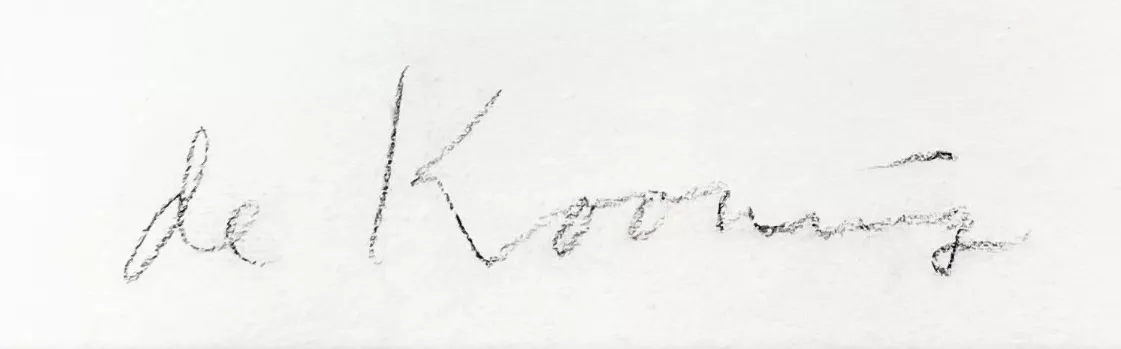
His signature
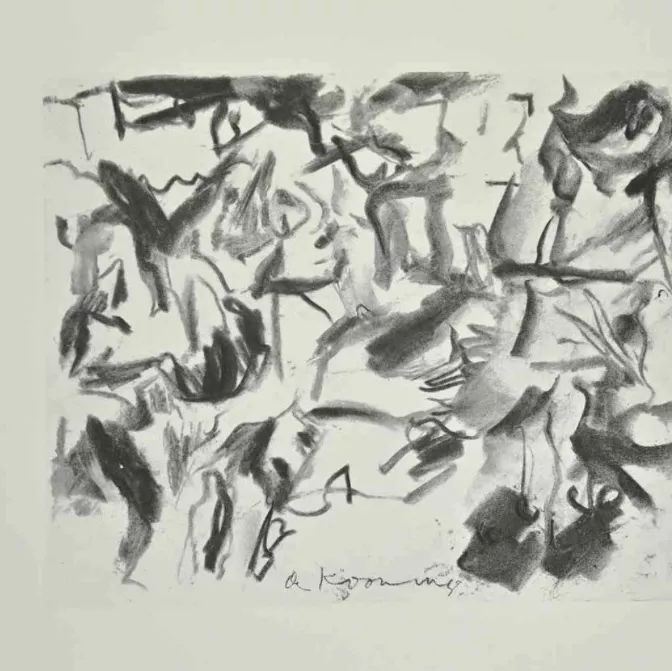
Not all of Willem de Kooning's works are signed.
Although there are variations, here's a first example of his signature:
Expertise your property
If you own a work by Willem de Kooning, don't hesitate to request a free appraisal by filling in our online form.
A member of our team of experts and licensed auctioneers will contact you to provide an estimate of the market value of your work.
If you are considering selling your work, our specialists will also guide you through the various alternatives available to obtain the best possible price, taking into account market trends and the specific features of each work.
Estimate in less than 24h
Discover in the same theme

Rating and value of Ettore Sottsass furniture, lighting and...
Ettore Sottsass is a twentieth-century Italian designer whose works are highly valued at auction.
Learn more >

Rating and value of paintings by Maurice Louvrier
Maurice Louvrier is an Impressionist painter of the Rouen School, who produced many highly valued paintings.
Learn more >

Rating and value of drawings and paintings by Hilma af Klint
Hilma af Klint was a Swedish painter and pioneer of abstract art whose paintings command high prices at auction.
Learn more >
D'autres tableaux abstraits vendus aux enchères

Estimated 2.000 - 4.000
Serge POLIAKOFF (1900-1969), Composition en rouge et bleu. 1965, Lithograph

Estimated Between €5,000 and €8,000
Jean MIOTTE (1926-2016), acrylic on canvas

Estimated 3.000 - 5.000
Roberto MATTA (1911-2002), Composition, Gouache on canvas

Secure site, anonymity preserved

Auctioneer approved by the State

Free and certified estimates
Frequently asked questions
-
Who is Willem de Kooning, and what is his contribution to modern art?Willem de Kooning (1904–1997) was a leading figure in American Abstract Expressionism. He revolutionized painting by exploring the fluid boundary between abstraction and figuration, particularly through his famous “Women” series from the 1950s. His style, characterized by broad, impulsive brushstrokes, vivid and contrasting colors, and a technique involving layering and scraping, has left a lasting mark on the history of 20th-century art.
-
What are the prices at which Willem de Kooning's works sell at auction?The prices of Willem de Kooning’s works vary widely depending on the medium and the size of the piece. Prints sell for between 10 and 415,000 euros, drawings and watercolors for between 300 and 4.9 million euros, and paintings for between 40 and over 54 million euros. His major paintings, particularly those from the “Women” series, command the highest prices on the contemporary art market.
-
How do you authenticate a work by Willem de Kooning?To authenticate a work by Willem de Kooning, we recommend that you request a free appraisal from Auctie's. Our team of experts and state-certified auctioneers will examine your artwork and provide you with an accurate assessment of its market value, with no obligation on your part. You will receive a response within 48 hours.
-
Is this the right time to sell a work by Willem de Kooning?Yes, now is a good time to sell a work by Willem de Kooning. His market value remains generally stable and high, particularly in France, and his bold, luminous compositions are very popular with collectors. Current trends in the Abstract Expressionism market are supporting the values of his works.
-
How does the appraisal of a Willem de Kooning artwork work at Auctie's?Appraisals at Auctie's are free and non-binding. You fill out an online form, and a member of our team of experts and licensed auctioneers will contact you to examine your piece and provide you with an estimate of its market value. If you’re considering selling, our specialists will then guide you through the best options for getting the highest possible price.
