



Rating and value of works, drawings, engravings, paintings by Félix Vallotton

Key takeaways
- Works by Félix Vallotton (1865–1925) sell for between €20 and €2,700,020, with oil paintings dominating the market and commanding the highest prices.
- A Swiss painter influenced by the Nabis, Vallotton was skilled in drawing, printmaking, and painting, and is recognizable for his bold blocks of vibrant color and minimalist compositions imbued with subtle irony.
- In 2019, the painting *En promenade* sold for €2,164,287, surpassing its initial estimate of €1,403,860 to €1,871,815, confirming growing demand from collectors.
If you own a work by or after Félix Vallotton, and would like to know its value, our state-approved experts and auctioneers will offer you their appraisal services.
Our specialists will carry out a free appraisal of your work, and provide you with a precise estimate of its value on the current market.
Then, if you wish to sell your work, we will direct you to the best possible arrangement to obtain the optimum price.
Rating and value of the artist Félix Vallotton
The artist Félix Vallotton leaves behind a unique body of work, composed mainly of paintings stemming from the influence of the Nabis. Now, prices for his works are rising under auctioneers' gavels.
His paintings are highly prized, especially by Swiss buyers. The price at which they sell on the art market ranges from €20 to €2,700,020, a very substantial range but one that speaks volumes about the value that can be attributed to Vallotton's works.
In 2019, a painting entitled En promenade sold for €2,164,287 while it was estimated at between €1,403,860 and €1,871,815.
Order of value from a simple work to the most prestigious
Technique used | Result |
|---|---|
Drawing - watercolor | From 90 to 58,160€ |
Estamp | From 20 to 123 910€ |
Oil painting | From 400 to 2 700 020€ |
Estimate in less than 24h
Style and technique of the artist Félix Vallotton
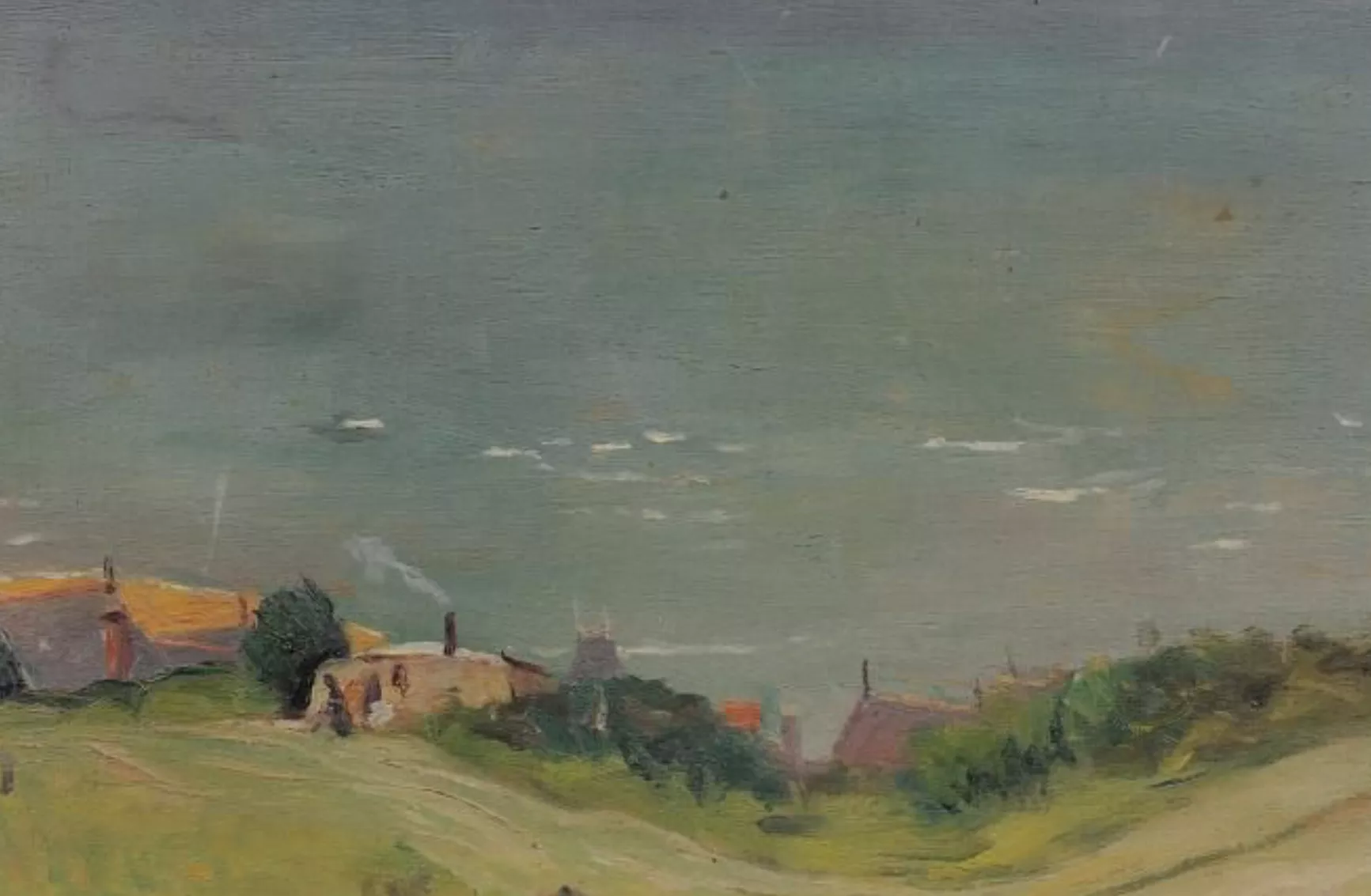
Félix Vallotton was a painter influenced by the Nabis group. Some of his paintings are part of the Impressionist movement, others of the Symbolist movement. He produced drawings, prints, oils on canvas, cardboard and Bristol board.
The life of Félix Vallotton
Félix Vallotton (1865-1925) was a Swiss painter who occupied a singular place in art history, oscillating between tradition and modernity, realism and symbolism.
Born in Lausanne into a relatively well-off family, Vallotton showed a disposition for the visual arts from an early age. This passion led him to enroll at the Académie Julian in Paris, a leading art school that attracted many talented young artists of the time.
There, he became familiar with classical techniques, but above all, he discovered the effervescence of the Parisian art scene and came into contact with the Post-Impressionists, whose influence would profoundly influence his work.
Early on, Vallotton distinguished himself with his mastery of drypoint, an etching technique that demands great precision and a keen sense of detail. However, it was his woodcuts that propelled him to the forefront of the artistic scene.
His style, both spare and expressive, captured the attention of the Nabis, a group of avant-garde artists who sought to renew forms and means of expression by moving away from naturalism.
Impressed by the strength of his line and the depth of his compositions, the Nabis invited him to join them, and he soon became close to Édouard Vuillard, one of the movement's leading figures.
His career took a decisive turn when he married Gabrielle Bernheim, the daughter of an influential art dealer. This marriage, as much a social strategy as a love affair, marked a turning point in his life.
Vallotton, forced to calm his anarchist ardor under the influence of his new milieu, put aside the engraving that had earned him his fame, to devote himself to painting.
He then developed a distinctive pictorial style, characterized by rigorous compositions, a reduced but vibrant color palette, and a subtle irony that shines through in his subjects.
In 1902, however, Vallotton briefly returned to printmaking to collaborate with the famous satirical magazine L'Assiette au beurre.
He produced 23 lithographs for it for an issue entitled Crimes et châtiments, in which his acerbic view of society is forcefully expressed. Parallel to this work, he takes up writing, adding a literary string to his already well-stocked bow.
This foray into literature shows his willingness to express himself beyond the confines of painting and printmaking alone, to explore new forms of narrative and social criticism.
After this period marked by creative intensity, Vallotton turned to more traditional subjects such as landscapes and still lifes.
Yet, even in these seemingly calm works, his critical spirit and sense of irony are never far away, manifesting themselves through subtly placed details and a use of color that prefigures future avant-garde experimentation.
The experience of the First World War left a deep imprint on the artist, who produced a series of paintings inspired by the conflict.
In these works, we perceive an evolution towards a more stripped-down style, where geometric shapes and color contrasts recall the beginnings of Futurism.
This blend of realism and abstraction, social criticism and formal research, characterized Vallotton's work until his death from cancer in Paris in 1925. Vallotton left behind a complex body of work, at the crossroads of the artistic currents of his time, and today remains a key figure in early twentieth-century art.
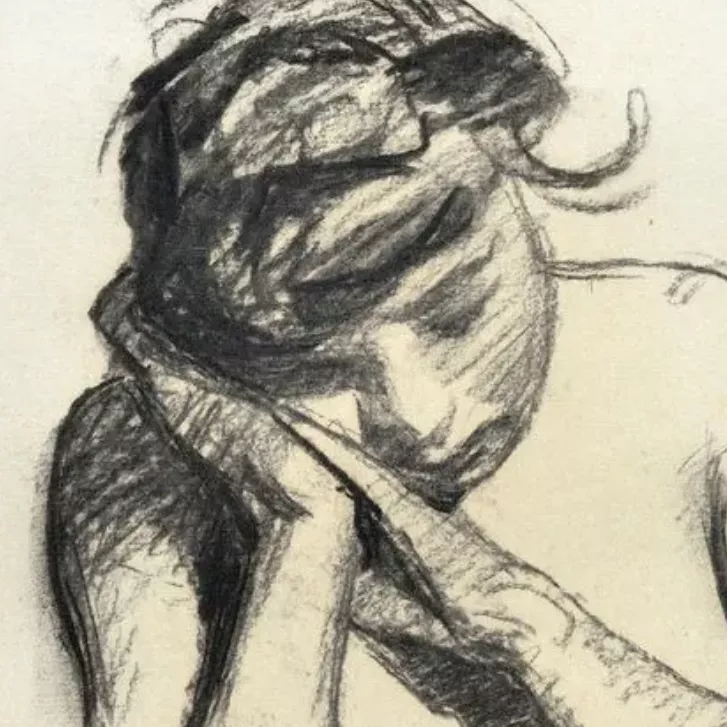
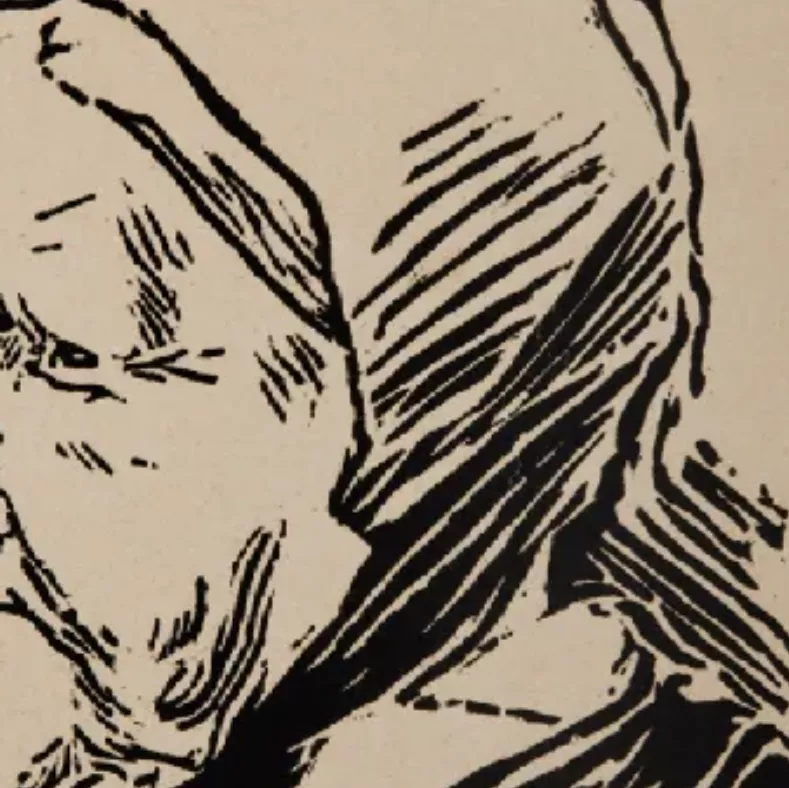
Focus on Le Ballon, Félix Vallotton, 1899
In 1899, Félix Vallotton created Le Ballon, an iconic work that captures a scene of everyday life with remarkable economy of means and a keen sense of detail.
Known for his impact in the nabi movement alongside Édouard Vuillard, Paul Sérusiuer and Maurice Denis, as well as his distinctive contribution to modern painting, Vallotton is distinguished here by an approach that blends compositional rigor and aesthetic sensitivity.
In this composition, Vallotton focuses on the essential: the tension between the immobility of the figures and the vivacity of the balloon.
The flat tones of color, mainly a serene blue for the sky and a bright red for the balloon, are juxtaposed with almost clinical precision.
The contrast between the bright color of the balloon and the duller palette of the figures creates a focusing effect and accentuates the sense of isolation.
Every element of the canvas seems meticulously calculated, reflecting the artist's attention to detail and the structure of the scene.
The figures, static and stripped of all artifice, are depicted with a precision that borders on disquiet, while the balloon, bursting with color and lightness, introduces a note of visual anomaly.
Le Ballon also demonstrates Vallotton's ambition to renew pictorial language by highlighting a composition where movement and stillness coexist paradoxically.
By eliminating superfluous elements, he favors a representation that plays on the juxtaposition of shapes and colors to question social dynamics.
The work is both simple and complex: simple in its depiction of a frozen moment, complex in the subtle interactions between the characters and the ball.
Vallotton thus creates a universe where every detail, every contrast, participates in a deeper reflection on the boredom and superficiality of bourgeois life.
With Le Ballon, Vallotton asserts his unique style, far removed from the conventions of realism, where composition and color become the main vectors of artistic expression. He thus offers a visual reflection on the society of his time, marking a significant step in his artistic evolution.
Understanding the work of Félix Vallotton
Félix Vallotton's imprint on his period
Félix Vallotton made a significant contribution to the development of modern art in France, and his work had a lasting influence on many artists of the time and beyond. His theories on aesthetics and colorimetry contributed to the history of twentieth-century art.
The flat tints of color, deployed with methodical precision, capture the essence of the scenes depicted.
The deep blue of the backgrounds and the vivid touches of red or yellow in the details create a visual dynamic that engages the viewer in deeper reflection.
Each element of the composition seems meticulously calculated, a reflection of Vallotton's rigor in the elaboration of his works.
Vallotton's work also shows his ambition to renew pictorial language by setting aside traditional conventions.
Through his innovative use of color and contrast, he forged a distinctive style that moved away from realism to explore more symbolic and psychological dimensions.
Today, his work continues to captivate enthusiasts and collectors alike, a testament to the lasting impact of his artistic approach.
Vallotton's importance in the history of modern art is confirmed by the enduring value of his works on the art market, underlining his lasting influence on artistic creation and his central role in the evolution of art in the 20th century.
He remains an artist prized at auction by connoisseurs and collectors of early twentieth-century works.
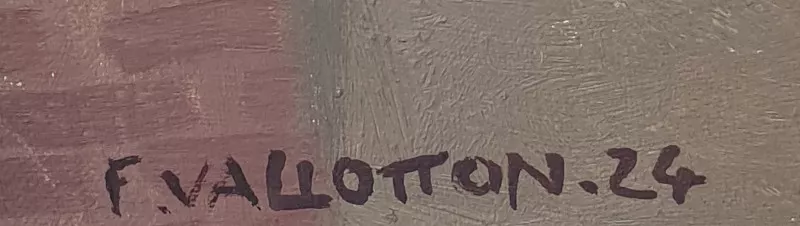
Recognizing the artist's signature
Félix Vallotton's works are not all signed. They may be at the bottom of the painting, but if you think you own one, it's best to have it appraised to be sure of its originality.
Knowing the value of a work
If you happen to own a work by or after Félix Vallotton, don't hesitate to request a free appraisal using our form on our website.
A member of our team of experts and certified auctioneers will contact you promptly to provide you with an estimate of the market value of your work, not forgetting to send you ad hoc information about it.
If you wish to sell your work, you will also be accompanied by our specialists in order to benefit from alternatives for selling it at the best possible price, taking into account market inclinations.
Estimate in less than 24h
Works from the same period sold at auction

Estimated 15.000 - 20.000 €
Jacques MAJORELLE (1886-1962) - Fishermen embarking, Abidjan, Ivory Coast - Oil on canvas.

Estimated 10.000 - 15.000 €
Ebridge Ayer BURBANK(1858-1949), Young African-American boy, Oil on panel.

Estimated 4.000 - 6.000 €
GASTON CHAISSAC (1910-1964) Composition 1947, Gouache and Indian ink on paper.

Estimated 100-200€
Vassiliew Slavik, Oil on canvas
Discover in the same theme

Rating and value of works, drawings, paintings by André Lhot...
André Lhote is a 20th-century painter with Cubist influences who produced drawings, watercolors and paintings listed at auction.
Learn more >

Rating and value of paintings by Bengt Lindstorm
Bengt Lindstorm is a twentieth-century Swedish contemporary artist who has produced highly-rated abstract works of art that are valued at auction.
Learn more >

Rating and value of paintings and laquers by Le Quoc Loc
Le Quoc Loc is a modern Vietnamese artist who has worked mainly in lacquer. His works are highly valued.
Learn more >

Secure site, anonymity preserved

Auctioneer approved by the State

Free and certified estimates
Frequently asked questions
-
Who was Félix Vallotton, and what is his role in art history?Félix Vallotton (1865–1925) was a major Swiss painter of the early 20th century and a central figure of the Nabi movement alongside Édouard Vuillard and Maurice Denis. Trained at the Académie Julian in Paris, he distinguished himself through his mastery of woodcut and drawing before developing a distinctive painterly style characterized by vibrant blocks of color, rigorous composition, and a subtle critique of society. His lasting influence on modern art in France and his innovative approach to color and contrast establish him as a key figure in 20th-century art.
-
What is the price range for Félix Vallotton's works based on the current market?Prices for works by Félix Vallotton range from €20 to €2,700,020, depending on the medium and the work’s prestige. Drawings and watercolors range from €90 to €58,160, prints from €20 to €123,910, and oil paintings from €400 to €2,700,020. This variation reflects the importance of provenance, condition, and quality of the work in the art market.
-
How can you authenticate a work by Félix Vallotton?To authenticate a work by Félix Vallotton, we recommend that you submit a request for a free appraisal to Auctie's via our online form. Our experts and state-certified auctioneers will examine your artwork and provide you with a detailed appraisal, including authentication and an estimate of its market value. This process is non-binding, and you will receive a response within 48 hours.
-
Is this the right time to sell a work by Félix Vallotton?Yes, now is a good time to sell a work by Félix Vallotton. Prices for his paintings are rising steadily on the art market, particularly among Swiss collectors and connoisseurs of early 20th-century art. The sustained demand for his works and their rising value confirm the current market’s interest in this major artist of the Nabi movement.
-
How does the process of selling a work of art at Auctie's work?At Auctie's, the sales process is simple and transparent. You start by requesting a free, no-obligation estimate through our website. Our experts will contact you within 48 hours with an accurate appraisal of your artwork. If you decide to sell, we’ll guide you through the entire process—from the appraisal to the auction—advising you on the best options to get the highest possible price based on current market trends.
