



Rating and value of sculptures and animal bronzes by Gaston Le Bourgeois

Key takeaways
- Gaston Le Bourgeois’s bronze animal sculptures sell for between €100 and €60,000, with record prices exceeding €86,000 in 2016.
- A French artist (1881–1957) recognized as early as 1929 as a master of animal sculpture, Le Bourgeois is distinguished by his refined minimalism and expressive intensity.
- His furniture pieces fetch between €50,000 and €280,000, while his watercolor drawings range from €90 to €100, reflecting significant variation depending on the technique used.
If you own a work by or after Gaston Le Bourgeois, and would like to know its value, our state-approved experts and auctioneers will offer you their appraisal services.
Our specialists will carry out a free appraisal of your work, and provide you with a precise estimate of its value on the current market.
Then, if you wish to sell your work, we will direct you to the best possible arrangement to obtain the optimum price.
.Rating and value of Gaston Le Bourgeois works
Gaston Le Bourgeois produced unique sculptures. Now, prices for his creations can rise considerably under the auctioneer's hammer. His sculptures are particularly prized, by buyers from all over the world.
The price at which they sell on the art market ranges from €100 to €60,000, at the moment, a substantial gap but one that says a lot about the value that can be attributed to Le Bourgeois's works.
In 2016, his bronze sculpture Tête de lama mouton,dating from 1922, sold for €86,000, originally estimated at between €8,000 and €12,000, more than 10 times the low estimate.
The upside potential for Gaston Étienne Le Bourgeois's works on the auction market is therefore enormous. Animal sculpture, particularly in bronze, has been very successful of late, setting auction records.
Order of value from a simple work to the most prestigious
Technique used | Result |
|---|---|
Drawing - watercolor | From €90 to €100 |
Furniture | From €50,000 to €280,000 |
Sculpture - volume | From €150 to €86,000 |
Estimate in less than 24h
Style and technique of artist Georges Le Bourgeois
Georges Le Bourgeois is a multi-talented artist who has explored various media, including wood and drawing, with a marked predilection for bronze.
In addition to his major sculptural works, he therefore produced a few drawings, presumably preparatory sketches for his animal sculptures characterized by a minimalist aesthetic and strong realism.
Parallel to this, he ventured into woodworking, creating rare and exceptional pieces of furniture that testify to his keen sense of design, combining functionality and aestheticism with remarkable precision.
His stylistic vein evokes that of artists such as François Pompon, Paul Landowski or Armand Petersen, creating a link between tradition and innovation.
The influence of medieval sculpture and architecture can be felt in his work, but it remains resolutely contemporary, rooted in its time yet transcending it with a sensibility all his own.
Le Bourgeois succeeds in marrying classical forms with a modern interpretation, capturing the very essence of his subjects while pushing back the boundaries of artistic representation.
Le Bourgeois' aesthetic is distinguished by a refined minimalism: his sculptures are carefully stripped of all superfluous elements, emphasizing the pure representation of the animal in all its majesty.
Every detail, every curve is carefully thought out, revealing a harmony between subject and material. His bold vision and innovative approach make him an artist ahead of his time.
The sculptures of Georges Le Bourgeois retain a striking timeliness that continues to fascinate and inspire, establishing themselves as timeless icons of modern sculpture.
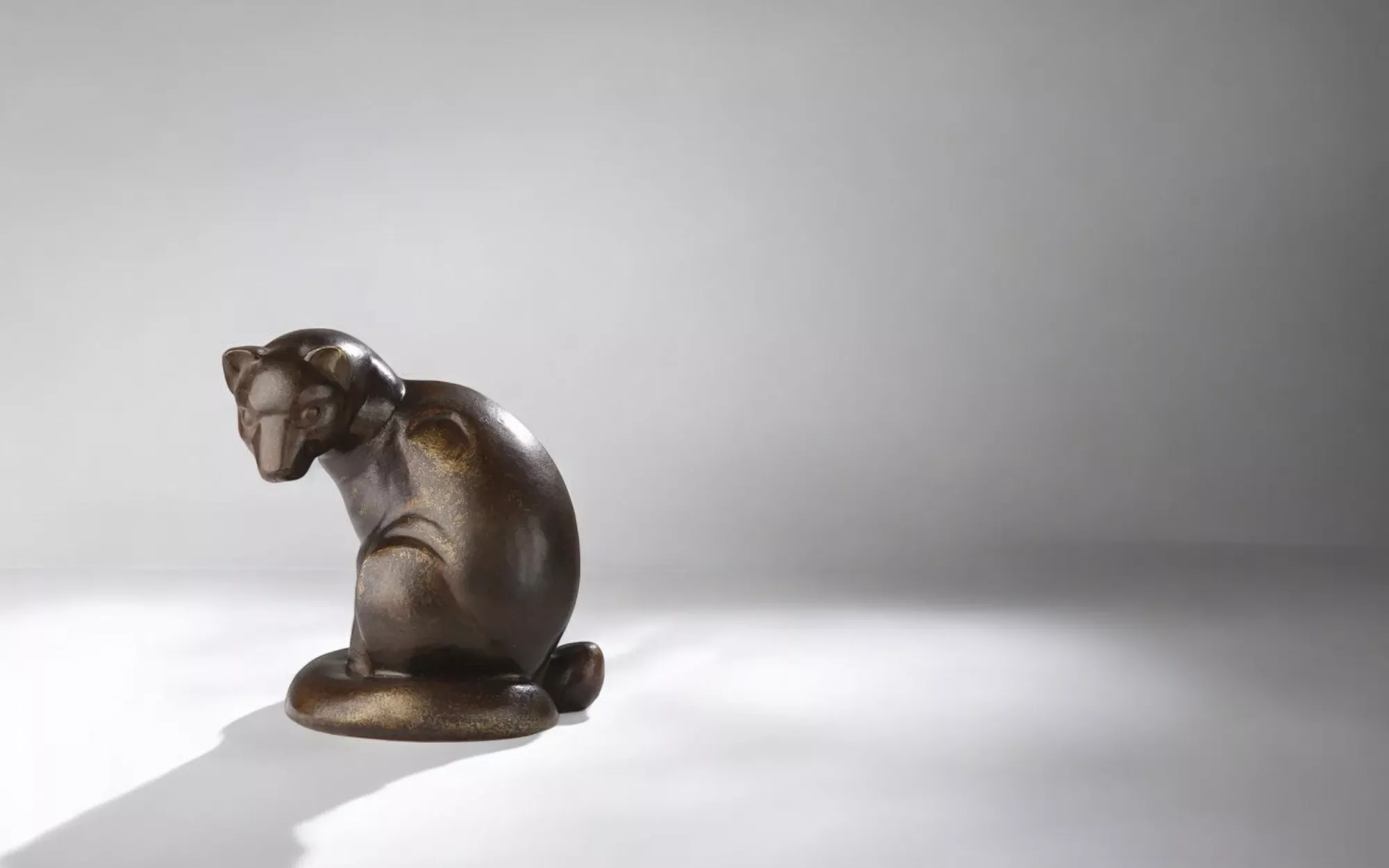
The career of Gaston Étienne Le Bourgeois
Gaston Étienne Le Bourgeois (1881-1957), of French origin, was born in Paris. He started out at the École des Beaux-Arts, where he studied sculpture and traditional ceramic techniques.
In 1905, he moved to the Villa Medici in Rome to further his training, but it was ultimately in the studio of sculptor Jean-Baptiste Auguste Clésinger that he would spend several years familiarizing himself with modeling and the creation of complex forms.
Clésinger, a master of classical sculpture, introduced him to the subtleties of animal art.
In the 1920s, animal art was enjoying a boom. Artists such as François Pompon, known for his Ours Blanc exhibited at the Salon d'Automne in 1922, gathered a new generation of animal artists around them, who drew inspiration from their work.
In 1926, Le Bourgeois also took up animal art, regularly visiting the Jardin des Plantes to study animals in their natural environment, joining Pompon's circle of disciples.
The first group exhibition of the "Animaliers" took place in 1927 at the Brandt gallery, where Le Bourgeois exhibited alongside Sandoz, Bigot, Artus and Pompon. His talent did not go unnoticed.
At the same time, the Manufacture de Sèvres, looking for contemporary works to adapt in colored soft stoneware, chose several sculptures by Le Bourgeois, marking his entry onto the artistic scene.
In contrast to Pompon's creations, which represent an idealized vision of animals, those of Le Bourgeois exude an expressive intensity, an acute sensitivity that distinguishes him as a master of animal sculpture.
As early as 1929, only three years after his debut, he was already recognized as one of the most promising artists of his generation, often cited alongside Pompon.
In 1931, the "Douze Animaliers Français" group was formed, and although French, Le Bourgeois participated enthusiastically.
The economic crisis of 1932 prompted many artists, including himself, to diversify their production, notably by creating ceramic editions to support themselves, collaborating with prestigious manufactures.
After Pompon's death in 1933, the Animaliers group gradually dissolved. However, thanks to Sandoz, who took over the Brandt gallery, they continued to meet until 1939, when the war finally dispersed them.
In 1935, Le Bourgeois obtained French nationality, while continuing to exhibit regularly, thus consolidating his artistic legacy.
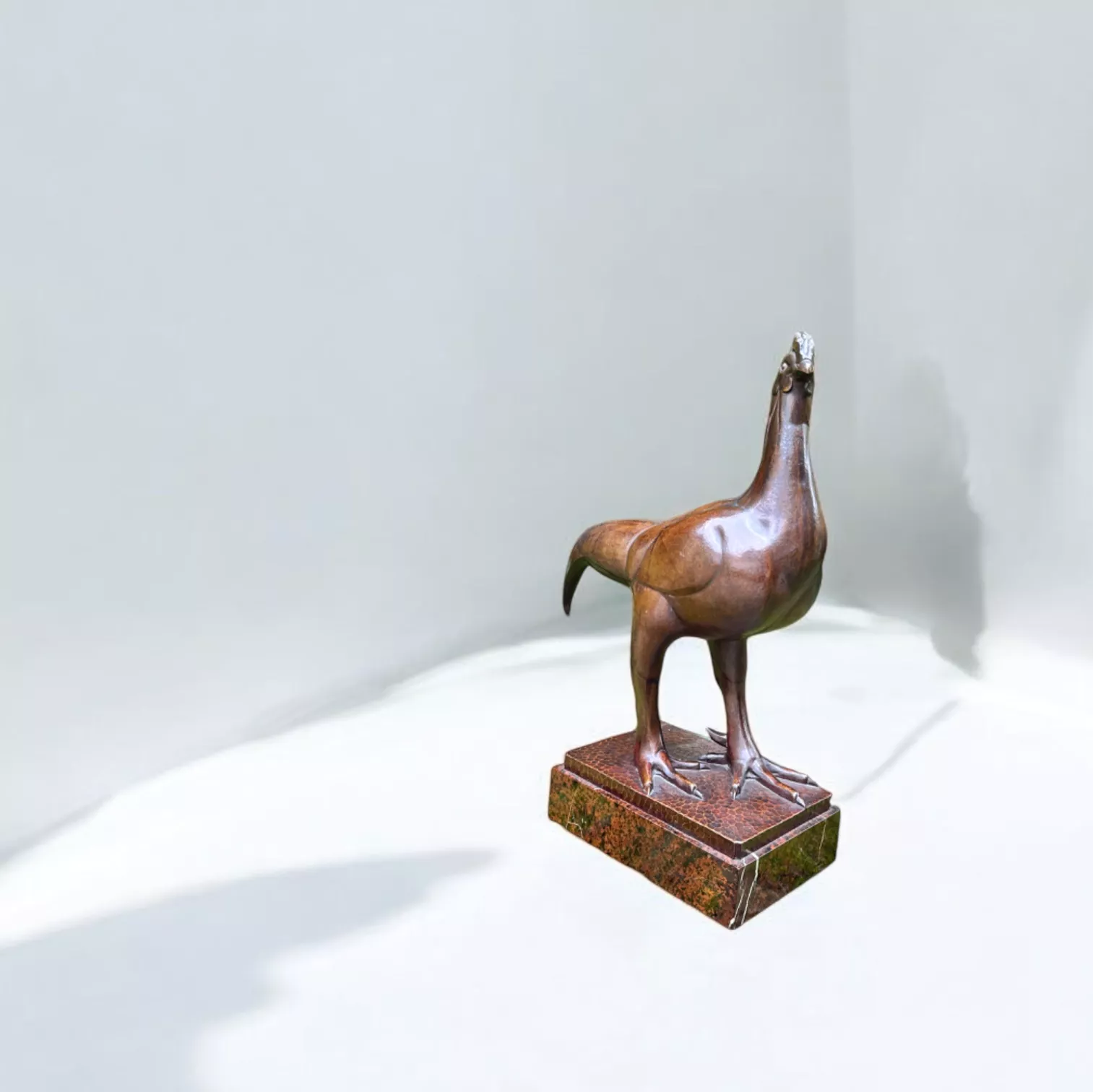
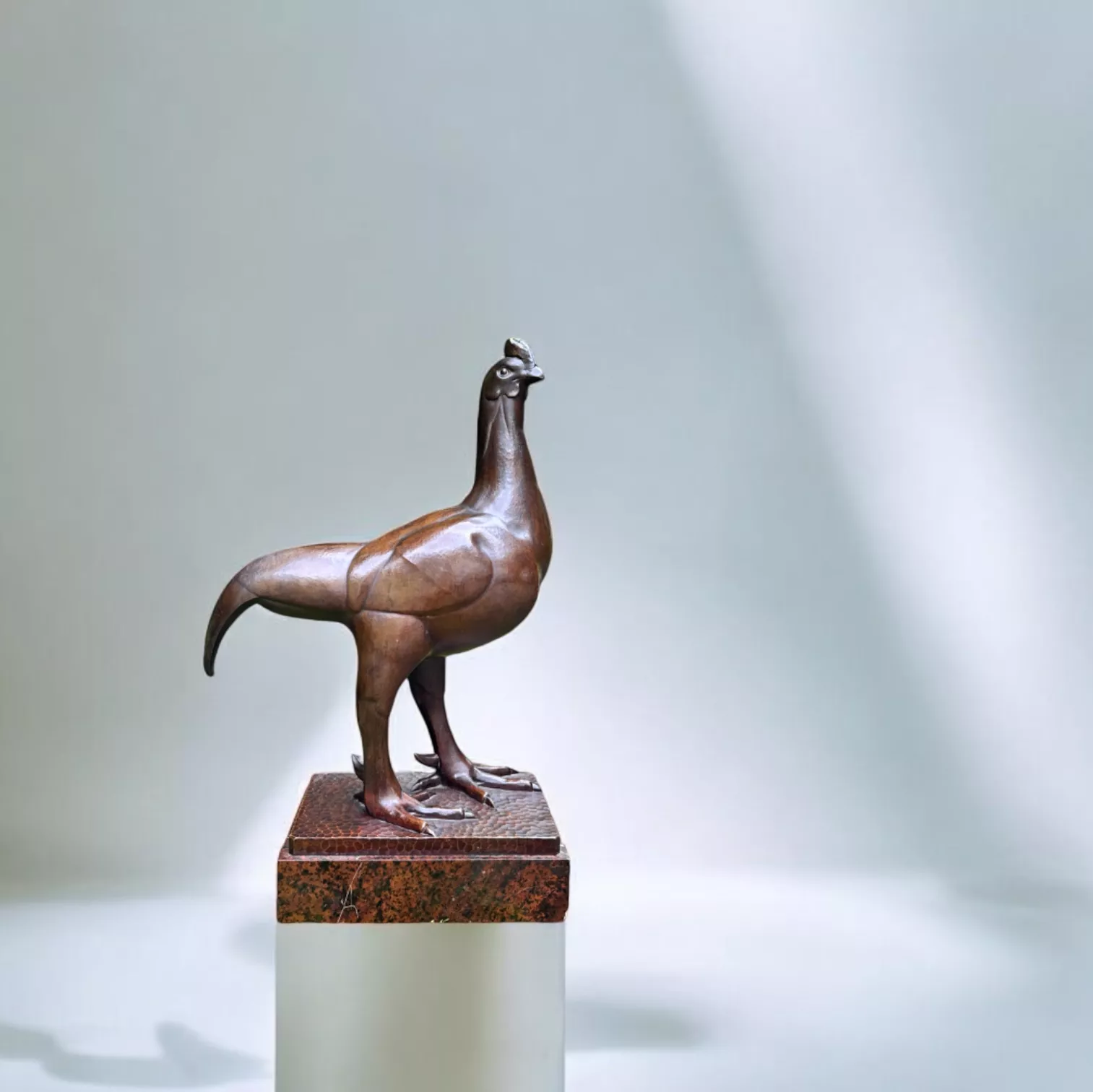
Sculpting animals in the twentieth century with Le Bourgeois
As the industrial age got into full swing and the modern world accelerated, animal artists found an inexhaustible source of inspiration in nature and its creatures, which they sought to represent with a new sensibility.
This artistic genre, often marginalized, is enjoying a resurgence in popularity thanks to visionary sculptors like Gaston Étienne Le Bourgeois, who manage to capture the essence of animals with remarkable depth and expressiveness.
At the beginning of the 20th century, animal sculpture was reinvented by iconic figures such as François Pompon, whose works simplified forms without sacrificing the essence of the animal.
Pompon, a former practitioner of Rodin, turned away from the hyperrealist approach in favor of clean lines and smooth volumes, seeking to capture the essence of the creatures he sculpted.
His Ours Blanc, presented at the Salon d'Automne in 1922, became a symbol of this new style. With its soft contours and almost minimalist appearance, it inspired a whole generation of animal artists, including Le Bourgeois, who sought to express animal life with an economy of formal means, without losing sight of the subject's intrinsic energy.
Le Bourgeois stood out for his original approach, in which he combined elements of realism with a deep emotional sensitivity. His work emphasizes meticulous observation of animal behavior, which he captures in poses that reflect their unique character.
Inspired by his visits to zoos and walks in nature, he succeeds in bringing his sculptures to life, evoking both the power and fragility of the animal world.
In the 1920s and 1930s, animal sculpture enjoyed a veritable golden age in Europe. In France, in addition to Pompon, artists such as Paul Jouve, Édouard-Marcel Sandoz and Armand Petersen stood out for their ability to capture the soul of animals.
Jouve, for example, excelled in depictions of large felines and birds, combining anatomical precision with expressiveness. Sandoz, meanwhile, is interested not only in exotic animals but also in domestic species, which he interprets with particular sensitivity.
Le Bourgeois, as a member of this circle, brings an innovative dimension to animal art by introducing various textures and unexpected materials, such as terracotta and patinated bronzes, thus enhancing the visual and tactile impact of his works.
Parallel to this, the Art Deco movement, which dominated the period between the wars, also influenced animal sculpture. Geometric shapes, clean lines and luxurious materials such as bronze and ivory are favored, giving sculptures a modern yet refined appearance.
Animals become stylized motifs, integrated into architectural or decorative compositions, reinforcing the idea that animal art can also be a decorative art. By exploiting these trends, Le Bourgeois succeeded in creating works that transcended mere representation to become design elements in their own right.
World War II marked a break, but the post-war period saw animal sculpture reinvented once again. The artists of this period, influenced by abstraction and existentialism, explored new ways of representing the animal world.
The forms sometimes became more stylized, the materials more varied, but the interest in wildlife persisted, once again underlining the indefectible link between humanity and nature.
In the twentieth century, animal sculpture has thus evolved to reflect the concerns of its time, from purity of form to expressiveness of volume, while remaining deeply attached to the beauty and diversity of the animal world.
Each artist, and Gaston Étienne Le Bourgeois in particular, contributed his own vision, enriching this artistic genre with a diversity of approaches that continues to inspire and fascinate.
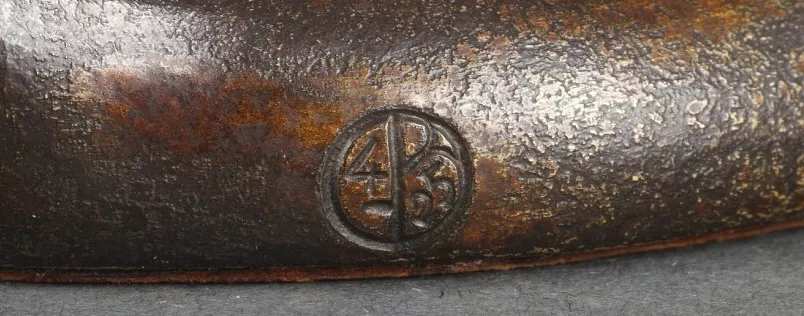
Recognizing Gaston Le Bourgeois's signature
Gaston Le Bourgeois doesn't always sign his works. If you think you own one, it's best to have it appraised.
Knowing the value of a work
If you happen to own a Gaston Le Bourgeois creation, or think you might, don't hesitate to request a free appraisal using our form on our website.
A member of our team of experts and licensed auctioneers will contact you promptly to provide you with an estimate of the market value of your piece, not forgetting to send you ad hoc information about it.
If you wish to sell your property, you will also be accompanied by our specialists to benefit from alternatives for selling it at the best possible price, taking into account the inclinations of the market.
.Estimate in less than 24h
Discover in the same theme

Rating and value of Gio Ponti furniture, tables and armchair...
Gio Ponti is a modern Italian designer who has produced highly-rated works of art that are highly valued on the auction market.
Learn more >

Market Value and Price of Alexandra Exter's Paintings, Drawi...
Alexandra Exter is a Franco-Ukrainian artist of modern art who has produced works that are highly rated and valued at auction.
Learn more >

Rating and value of paintings by Le Tri Dung
Le Tri Dung is a modern Vietnamese painter known for his depictions of horses. His works have a rising reputation.
Learn more >
Bronzes from the same period sold at auction

Estimated Between €2,000 and €4,000
Edouard Marcel SANDOZ (1881-1971) curly stingray, bronze print

Estimated Between €1,500 and €3,000
Renato CARVILLANI (1896-1986), seated woman, gilded bronze print

Estimated Between €800 and €1,500
Claude Victor BOELZ (b. 1937), gilt bronze and quartz centerpiece

Estimated Between €1,500 and €3,000
César BALDACCINI dit CESAR (1921-1998), Poule Cartier, bronze print

Estimated 500 - 1.000
Yves BENOIST-GIRONIERE (1903-1983) Wild boar and its wild boar, bronze print with brown patina

Secure site, anonymity preserved

Auctioneer approved by the State

Free and certified estimates
Frequently asked questions
-
Who was Gaston Le Bourgeois, and what was his contribution to animal sculpture?Gaston Étienne Le Bourgeois (1881–1957) was a French sculptor who trained at the École des Beaux-Arts and in the studio of the sculptor Clésinger. Beginning in 1926, he specialized in animal sculpture, distinguishing himself through an approach that combined meticulous realism with deep emotional sensitivity. Recognized as early as 1929 as one of the most promising artists of his generation, he joined the group “Les Douze Animaliers Français” in 1931 and collaborated with the Manufacture de Sèvres, leaving a lasting mark on the history of 20th-century animal sculpture.
-
What is the current price range for Gaston Le Bourgeois's sculptures?Gaston Le Bourgeois’s sculptures sell for between €150 and €86,000, depending on their size and provenance. A notable example: his sculpture “Head of a Sheep-Lama” (1922) sold for €86,000 in 2016, far exceeding its initial estimate of €8,000 to €12,000. Watercolor drawings range from €90 to €100, while wooden furniture pieces can fetch between €50,000 and €280,000.
-
How do I have a work by Gaston Le Bourgeois authenticated and appraised?We offer a free, no-obligation appraisal of your artwork. Simply fill out our online form or contact us directly. A state-certified expert or auctioneer will examine your piece and provide you with an accurate estimate of its market value within 48 hours, along with detailed information.
-
Is this the right time to sell an animal sculpture by Le Bourgeois?Yes, this is a good time. Bronze animal sculptures are currently enjoying considerable success on the auction market and are setting record prices. The works of Gaston Le Bourgeois, in particular, have enormous upside potential, as demonstrated by the sale of his “Head of a Sheep-Lama,” which exceeded its estimates by more than 10 times.
-
How does the sale of a work by Gaston Le Bourgeois at Auctie's work?After providing a free appraisal of your piece, we’ll help you find the best sales solution for your situation. Our specialists will guide you through the auction process, taking market trends into account, to ensure you get the best possible price for your artwork.
