



Rating and value of paintings, drawings and lithographs by Peter Klasen

Key takeaways
- Prices for Peter Klasen’s works range from €10 to €86,000, with paintings commanding the highest prices, particularly those from the 1960s through the 1980s.
- A leading figure in French narrative figuration since 1964, Klasen employs a critical industrial aesthetic that combines acrylic paint, three-dimensional elements, and serial photography.
- The market is polarized: large canvases from his industrial series sell for between €20,000 and €80,000, while his graphic works remain in the €3,000 to €10,000 range.
If you own a work by or after the artist Peter Klasen, and would like to know its value, our state-approved experts and auctioneers will offer you their appraisal services.
Our specialists will carry out a free appraisal of your work, and provide you with an accurate estimate of its value on the current market.
Then, should you wish to sell your work, we will direct you to the best possible arrangement to obtain the optimum price.
Rating and value of the artist Peter Klasen
Considered an important contemporary artist of the 20th century, Peter Klasen leaves behind an artistic identity of his own. This legacy consists mainly of oils on canvas.
At present, the prices of his works are rising at the auctioneers' gavels, his stock is on the rise. His canvases and other works are particularly prized, especially by French and American buyers, and the price at which they sell on the art market ranges from €10 to €86,000, a considerable delta but one that speaks volumes about the value that can be attributed to Klasen's works.
In 2014, a predominantly black composition entitled Le bon magique sold for €86,000 while it was estimated at between €80,000 and €120,000.
Order of value from a simple work to the most prestigious
Technique used | Result |
|---|---|
Estamp - multiple | From €10 to €6,200 |
Drawing - watercolor | From €30 to €23,000 |
Sculpture - volume | From €150 to €27,000 |
Painting | From €230 to €86,000 |
Estimate in less than 24h
Style and technique of artist Peter Klasen
Peter Klasen (1935 -) is a German artist with an industrial aesthetic and a semiotized visual language. He constructs a pictorial vocabulary inspired by industrial, technological and urban imagery, mobilizing a repertoire of codified signs (arrows, gauges, letters, road signs, metal grids), which evoke signage, danger and the aseptization of bodies.
His practice is part of a logic of deconstruction of systems of representation, borrowing from both the Pop Art through its recourse to the serial image and to mass visual culture, and also to a form of conceptual realism, in which the image becomes the medium of an implicit critique of industrial society and its normative drifts.
Klasen mainly uses the technique of acrylic paint on canvas, which he combines with three-dimensional elements (shutters, metal grids, attached objects), creating plastic assemblages on the borderline between painting and installation.
This dialogue between the pictorial plane and the real object unsettles the traditional reference points of representation. He was also interested in photography and seriality: from the 1960s onwards, he integrated a photographic logic into his approach, both in the treatment of detail and in the serial construction of images.
He practices cropping, fragmentation and the repetition of motifs, in an aesthetic of dehumanization of the real. Klasen's works are structured around rigorous, often compartmentalized devices that evoke industrial or prison spaces.
Pictorial space becomes a functional surface, saturated with signs, in which the gaze is guided, constrained and oriented. His palette is cold and his chromaticism synthetic, favoring saturated, contrasting industrial colors (warning red, signal yellow, electric blue, metallic gray) that refer to visual codes of security, confinement and technicality).
Color thus functions as a vector of psychological tension and emotional distancing. When he introduces bodily elements (mouth, eye, female torso), they are cut out, cropped and neutralized, integrated into a logic of industrial fetishization.
The body is consequently dehumanized, treated as a technical object or a symptom of the control society.
While Klasen's aesthetic relies on the coldness of mechanical systems, it is never neutral for all that, and aims to denounce the mechanisms of standardization, surveillance and dispossession specific to contemporary society.
In this way, painting becomes a critical space, a surface of visual resistance where the viewer is confronted with the symbolic violence of the industrial world.
Although his work is marked by apparent figuration, it is part of the French narrative figuration movement, of which he is a founding player, sharing the desire to reinvest the field of narrative, visible image and political charge.
In this sense, he opposes the formalist abstraction of the 1950s.


The life of Peter Klasen
Peter Klasen was born in 1935 in Lübeck, Germany, into a family marked by the Second World War. This experience of war, violence and industrial reconstruction formed a founding foundation, the critical resonances of which would find their way into his work.
In 1956, he entered Berlin's Hochschule für Bildende Künste, where he studied under expressionist painter Willy Titze. His training was also marked by an internal conflict between academic expressionism and the search for a personal language, which led him to question the limits of traditional figuration at an early stage.
From 1959, he chose to settle in Paris, where he frequented the artistic circles associated with the École de Paris, while maintaining a marginal position in relation to the dominant trends.
From the early 1960s, he developed a singular iconogrpahy, based on industrial objects, signage, bodily fragments and the aesthetics of danger. In 1964, he took part in the seminal exhibition Mythologies quotidiennes at the Musée d'art moderne de la Ville de Paris.
Early on, he positioned himself as a critical observer of industrial society, rejecting gestural painting and lyrical abstraction. Klasen thus denounces mechanisms of control and alienation, reinvesting the visual codes of reality.
From the 1970s onwards, his work was regularly exhibited in France, Germany, Belgium, Italy, the United States and Latin America. The artist has also developed monumental projects and public commissions, notably in connection with architecture and urban space.
His work has gradually found its way into numerous public collections, in France (Centre Pompidou, FNAC, regional funds), Germany and important foreign museums. He has also benefited from several retrospectives and critical studies, consolidating his status as a major player on the European and contemporary art scene.
Still active today, Klasen continues to produce regularly, integrating new image technologies while remaining faithful to his plastic vocabulary. He also reflects on memory, technology and contemporary alienation.
He is also committed to transmission, through lectures, publications, teaching collaborations and critical interviews. He is an intellectual and committed figure in the Franco-German contemporary creative landscape.
Market segmentation and artist rating
Peter Klasen occupies a central place in the figuration narrative movement, a French movement of the 1960s of which he is a major representative alongside Erro, Fromanger, Rancillac or Monory.
His work, which is marked by an industrial, serial but also critical aesthetic, positions him at the frontier of conceptual art, European Pop Art and engaged painting.
The market is consolidated but polarized, insofar as Klasen's quotation is solid but differentiated according to period, technique and format. While the major canvases of the 1960s - 1980s attract the attention of institutional collectors and major galleries, later works and multiple productions are more affordable.
Large-format oils and mixed media on canvas from industrial series (trucks, gauges, hazard symbols) are the most sought-after. Assemblages with metal elements, bas-reliefs or functional shutters also fetch high bids, because they embody the singularity of the artist's plastic language.
Graphic edition works trade in a much lower price bracket. Currently, his major works on canvas sell for between €20,000 and €80,000, with some exceeding this amount depending on iconogrpahy, date, provenance and public visibility.
His works on paper (watercolors, preparatory drawings) generally sell for between €3,000 and €10,000. Printed works (watercolors, preparatory drawings) generally fetch between €400 and €2,000, depending on print run, condition and period.
Peter Klasen's market is mainly active in France, but also in Germany and French-speaking countries. His work is also enjoying growing visibility in Asia and the United States.
Target audiences include collectors of contemporary and post-war European art, enthusiasts of Figuration Narrative and European Pop Art, as well as institutions wishing to integrate works critical of industrial society and its visual excesses.
Klasen thus benefits from a consolidated institutional legitimacy, with works present in several major public collections (Centre Pompidou, Fonds National d'Art Contemporain, regional museums), which guarantees a patrimonial stability of his value over the long term.
Today, artists linked to narrative figuration are experiencing a critical and museum revival, and Peter Klasen's quotation is part of a controlled upward trend, supported by rigorously supervised production.
His iconography is also highly recognizable, and his plastic commitment is in tune with contemporary concerns (technique, surveillance, corporeality).


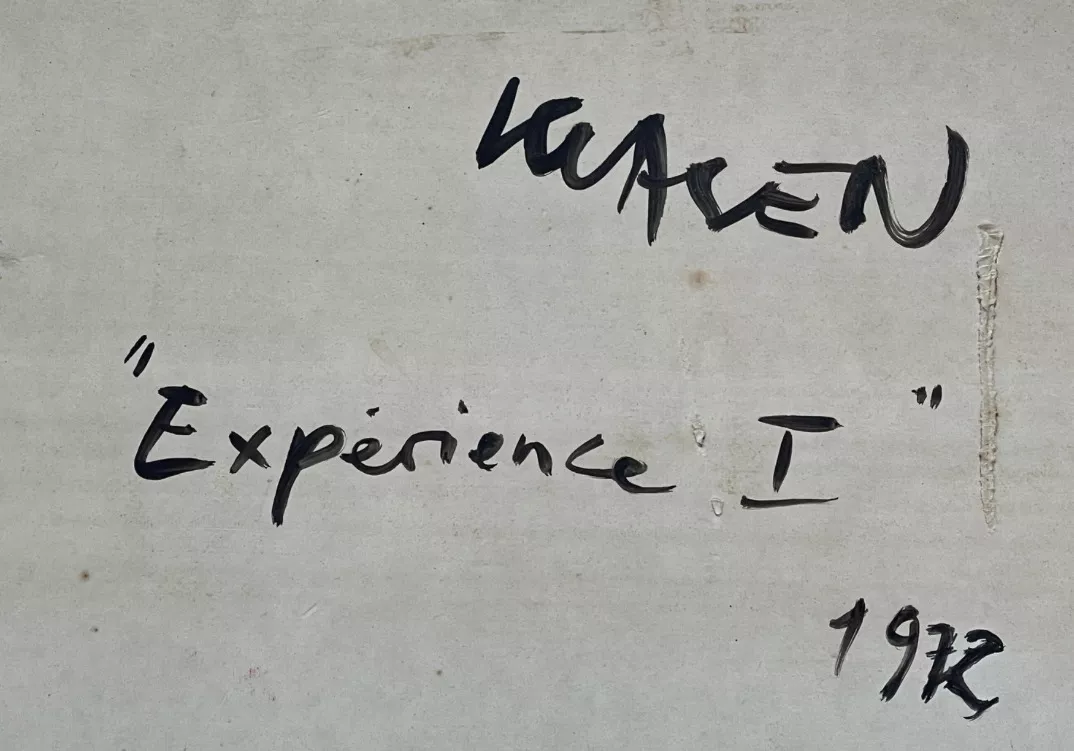
Recognizing the artist's signature
Peter Klasen very occasionally signs his works, most often at the bottom of the painting, in a color that contrasts with the background.
Knowing the value of a work
If you happen to own a work by or after Peter Klasen, don't hesitate to request a free valuation using our form on our website.
A member of our team of experts and certified auctioneers will contact you promptly to provide you with an estimate of the market value of your work, as well as any relevant information about it.
If you're thinking of selling your work, our specialists will also help you find alternatives to sell it at the best possible price, taking into account market trends.
Estimate in less than 24h
Discover in the same theme

Rating and value of paintings by Joseph Inguimberty
Joseph Inguimberty is a twentieth-century French painter who worked in Indochina, producing works that are highly regarded and valued.
Learn more >

Rating and value of drawings and paintings by Jean Peské
Jean Peské is a French-Polish artist who has produced numerous works that command high prices at auction.
Learn more >

Edvard Munch (1863–1944) Market Data – Estimates and Values...
Discover Edvard Munch's market value: prices, auction records, and appraisal criteria. Auctie's will appraise your artwork for free in less than 24 ho...
Learn more >
D'autres tableaux modernes figuratifs vendus aux enchères

Estimated 800 - 1.500
Jean Roger SOURGEN (1883-1978) Trees and dunes Oil on panel

Estimated 3.000 - 5.000
Georges LAPCHINE (1885-1951) The port of St Tropez Oil on canvas

Estimated 18.000 - 30.000
Charles CAMOIN (1879-1965) "Le Port de Marseille, 1928" Oil on canvas.

Estimated 1.500 - 3.000
Jean VANDEN EECKHOUDT (1875-1946), Basket of persimmons, Oil on canvas

Estimated 2.000 - 4.000
Charles LACOSTE (1870-1959) Starry night, Oil on paper mounted on canvas

Secure site, anonymity preserved

Auctioneer approved by the State

Free and certified estimates
Frequently asked questions
-
Who is Peter Klasen, and what is his artistic style?Peter Klasen is a German artist born in 1935 and a leading figure in the French narrative figurative art movement of the 1960s. His work is characterized by an industrial and critical aesthetic, combining serial images inspired by signage, danger symbols, and body parts to denounce the mechanisms of control and standardization in contemporary society. He draws on European Pop Art and conceptual realism, working primarily in acrylic on canvas combined with three-dimensional elements.
-
What is the price range for Peter Klasen's works?The prices of Peter Klasen’s works vary considerably depending on the medium and format. His oil paintings and mixed-media works on canvas generally sell for between €20,000 and €80,000, his works on paper (watercolors, drawings) between €3,000 and €10,000, and his prints and multiples between €400 and €6,200. This variation reflects the market’s differentiation based on periods, formats, and the iconographic nature of the work.
-
How can you authenticate a work by Peter Klasen?To authenticate a work by Peter Klasen, we recommend that you request a free, no-obligation appraisal from Auctie's. A certified expert or auctioneer will examine your artwork and provide you with an estimate within 48 hours, taking into account the signature, provenance, condition, and the artist’s specific stylistic characteristics.
-
Is this a good time to sell a work by Peter Klasen?Yes, now is a good time to sell a work by Peter Klasen. The artist’s market value is following a steady upward trend, supported by well-established institutional recognition (Centre Pompidou, FNAC, regional museums) and a renewed critical interest in artists of narrative figuration. His critical iconography remains in tune with contemporary concerns about technology and surveillance.
-
How does the appraisal process work at Auctie's?Appraisals at Auctie's are free and non-binding. Simply fill out a form on our website with information about your artwork and photos of it. A member of our team—composed of experts and licensed auctioneers—will contact you shortly to provide an estimate of the market value and share all relevant information with you. If you’d like to sell, we’ll guide you toward the best options to get the best possible price.
