



Rating and value of paintings by Jacques Monory

Key takeaways
- Jacques Monory (1924–2018), a leading figure in narrative figuration, creates works that remain highly valued and in demand internationally.
- His paintings from the 1960s are the most sought-after, with works fetching up to €100,000 at auction, such as “Meurtre n°V,” which sold in 2012.
- The artist developed a distinctive aesthetic based on blue monochromes and mixed media incorporating photography and film, creating a cold and dramatic atmosphere.
If you own a work by or after the artist Jacques Monory, and would like to know its value, our state-approved experts and auctioneers will offer you their appraisal services.
Our specialists will carry out a free appraisal of your work, and provide you with a precise estimate of its value on the current market.
Then, should you wish to sell your work, we will guide you towards the best possible arrangement to obtain the optimum price.
Artist's rating and value
An important artistic figure of his time, Jacques Monory has established himself as a sure bet on the art market. Constantly evolving, his quotation remains high and his works are sold internationally.
In the auction room, his canvases, part of the narrative figuration movement, painted in the 1960s, are the most sought-after and therefore prized. Watercolors are also popular with collectors.
A work by Monory, for example, can fetch around a hundred thousand euros at auction, as demonstrated by his mixed-media composition, Meurtre n°v,dating from 1968 and adjudged €100,000 in 2012, whereas it was estimated at between €80,000 and €90,000.
Order of value from the most basic to the most prestigious
Technique used | Result |
|---|---|
Estamp - multiple | From €10 to €3,500 |
Drawing - watercolor | From €120 to €24,400 |
Painting | From €120 to €100,000 |
Sculpture - volume | From €400 to €105,000 |
Estimate in less than 24h
Artist's style and technique
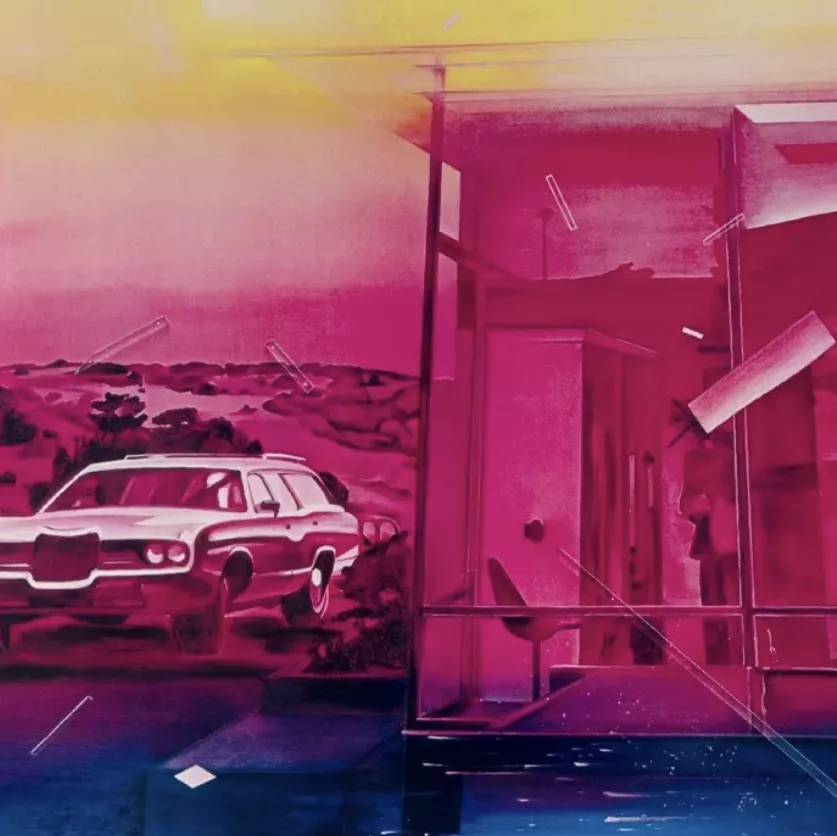
Jacques Monory develops a painting style in which the image, always fragmented, seems captured in a suspended moment, like a film scene stopped dead.
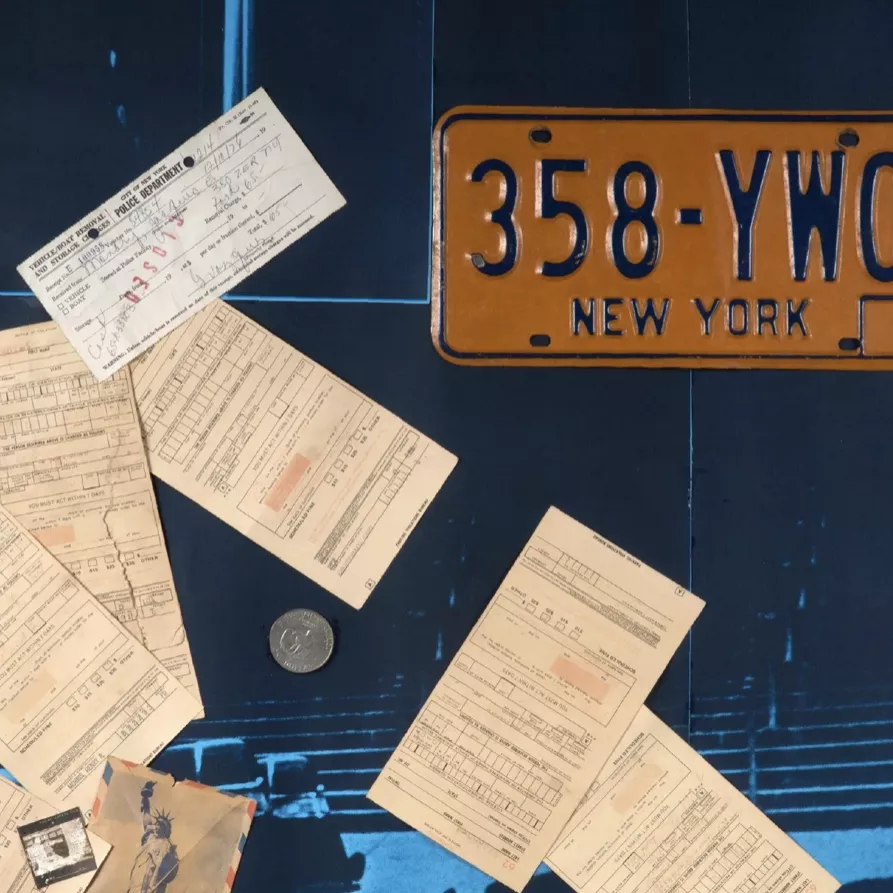
He works mainly in oils, but also incorporates mixed techniques, notably photography, which he reworks on canvas, playing on the contrasts between reality and fiction.
His systematic use of monochrome, particularly blue, gives his works a cinematic coldness, an almost spectral detachment.
This blue, often declined in multiple shades, acts as a filter, establishing a distance from the subject while intensifying the dramatic atmosphere of the scene.
The image is often split into several planes, creating superimposed effects that confuse the viewer's perception. The framing is precise, sometimes tightened like a zoom, sometimes fragmented like a montage, reinforcing this impression of a fragmented world, between reality and fiction.
Far from limiting himself to a simple transcription of reality, Monory manipulates his images, reconstructing and deconstructing them, introducing effects of blur or duplication that reinforce the strangeness of the composition.
He borrows from the codes of detective fiction and the photo-novel, drawing on an iconography where threat is latent, where the moment seems frozen before or after a drama. The influence of cinema is omnipresent: his framing is reminiscent of film noir shots, and his play with light accentuates the enigmatic nature of the scenes he depicts.
Mirrors, broken glass and multiplying reflections often reinforce this mise en abyme of the gaze, where one image always seems to refer to another. Through this cold, methodical aesthetic, Monory constructs a work that captures the eye as much as it confuses it, oscillating between fascination and disquiet.
The life of Jacques Monory
Jacques Monory (1924-2018) was a French artist, painter and sculptor, whose work was part of narrative figuration, in opposition to the abstract research that still marked his era.
Trained as a painter-decorator at the École des Arts appliqués in Paris, he honed his eye and technique for ten years with art publisher Robert Delpire, where he helped design illustrated encyclopedias.
He exhibited for the first time in 1955 at the Galerie Kléber. From then on, he focused on depicting a world dominated by violence and contemporary anxieties. The Les Meurtres series is one of the most striking examples.
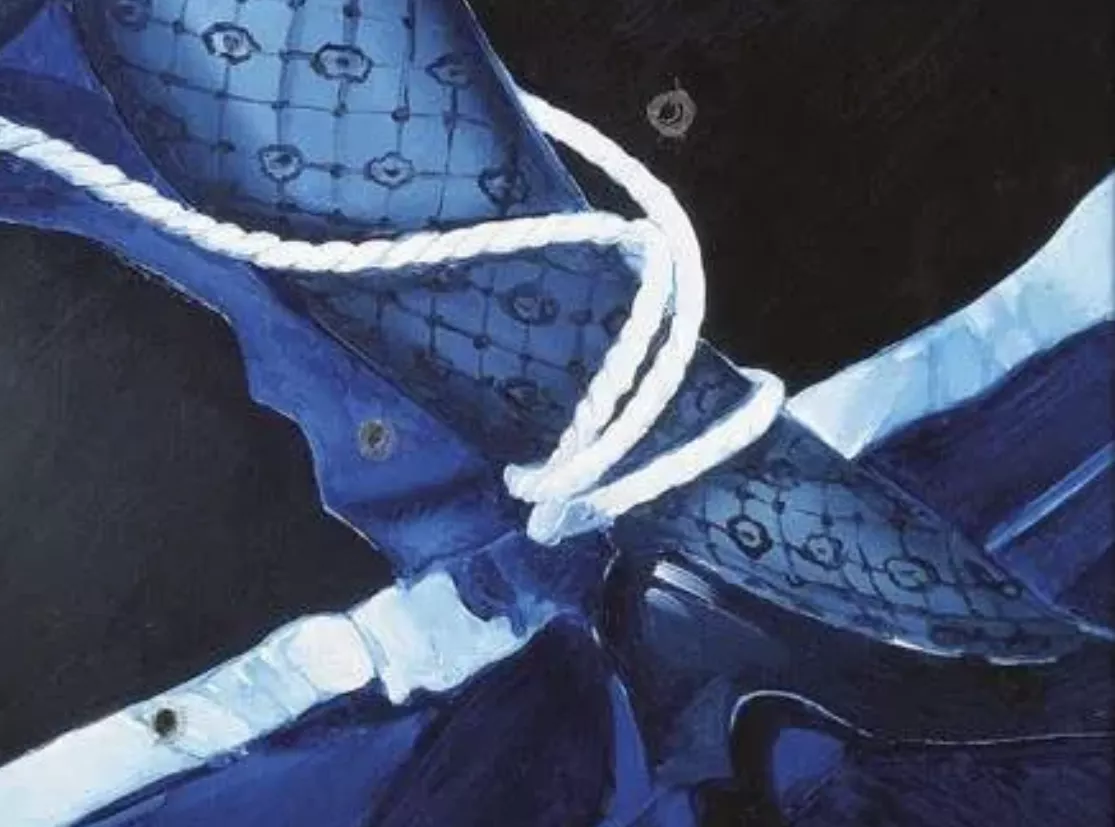
Monory doesn't just paint violence, he physically integrates it into his works by incorporating bullet holes shot right into the support.
In Meurtre n°V, a broken mirror reflects the scene, multiplying the image of the viewer, who becomes an integral part of the painting. The work oscillates between reality and fiction, between image and matter, plunging the viewer into an uncertain space.
His systematic use of monochrome accentuates this oppressive atmosphere. He favors blue, declining its nuances to create an unreal, icy world, where the distance between image and emotion is gradually erased.
His works don't seek to provoke a simple shock, but to question our relationship with images and their hold on the collective consciousness.
Focus on Murder n°5, Jacques Monory
In Murder n°5, an emblematic work by Jacques Monory, the artist once again questions the blurred boundaries between everyday life and violence, drawing on visual codes from film noir.
The scene, bathed in an icy blue, is constructed like a fragment of a film suspended in time, a moment freezing the tension of an aggression in progress. The man, shot in a hail of bullets, is depicted in a tight frame, as if we were witnessing the projection of a broken image.
Here, the bullet holes, scattered throughout the composition, echo crime scenes and sordid tales from detective films, while inscribing this violence in an abstraction where emotion is perceived not in the figure, but in the composition itself.
The choice of monochrome is essential: the artificial, almost electric blue eliminates any human warmth and plunges the viewer into a cold, clinical atmosphere.
Far from simply illustrating a violent scene, Monory makes the image a sensory experience, a reflection of a world whose dramatic intensity is accentuated by contrasts of light and shadow.
The violence here is not just visualized, it's experienced through the staging, which directly questions the viewer's relationship with the image: how does this image transform our perception of reality?
By manipulating the codes of cinema, Monory goes beyond simple narration to create a space where interpretation becomes an active process, leaving it up to each individual to decipher the painting's enigma.
Jacques Monory's imprint on his period
Jacques Monory's imprint on his period is distinguished by his novel way of transposing modern images, often marked by popular culture, into a singular pictorial form.
Early in the 1960s, he introduced a new approach, in which photography, cinema and advertising became essential starting points for his compositions.
As William S. Rubin points out, "Monory was able to assimilate the power of the popular image, while injecting it with a sense of drama specific to his time", notably through the exclusive use of blue, a color that became the keystone of his work.
In his paintings, light and shadow are played out through meticulous treatment of the pictorial surface, marking violent contrasts that accentuate the dramatic intensity of his scenes.
This way of diverting the visual elements of everyday life into representations that are both frozen and mysterious testifies to his exploration of solitude and the passage of time.
Their cold tones and taut compositions, featuring isolated figures in urban or interior settings, echo a personal vision of the world, where visual distancing becomes a means of questioning man's relationship to his environment.
With this approach, Monory, while part of the Pop Art movement, opens up a new, more introspective and distanced path, without however detaching himself from the aesthetic concerns of his time.
The stylistic influences of Jacques Monory
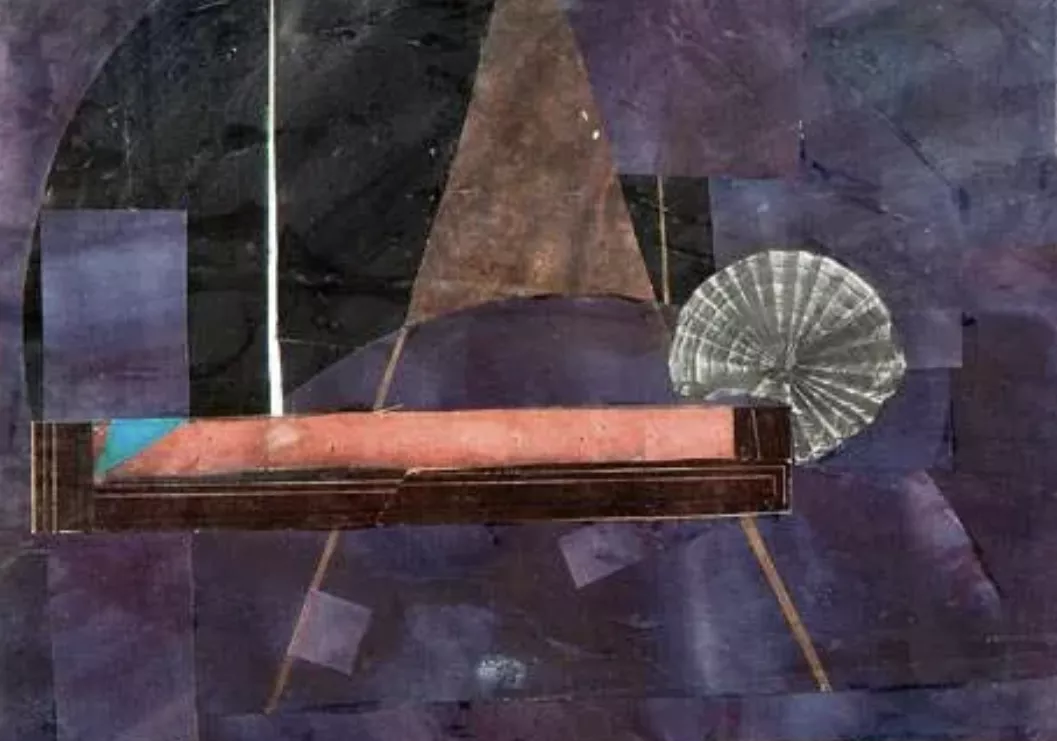
The stylistic influences of Jacques Monory are rooted in a dual tradition, at the crossroads of narrative figuration and imagery borrowed from cinema and photography.
From his earliest works, he explored an aesthetic that owes as much to the incisive framing of film noir as to the fragmented compositions of photoreportage, transposing into painting the staging effects characteristic of twentieth-century visual media.
As Germain Viatte has pointed out, "Monory manipulates the image like a film editor, cutting, cropping, superimposing elements to extract a latent dramatic tension."
This approach brings him closer to vernacular photography and the American noir novel, where the human figure, often solitary, stands out in an urban environment saturated with signs.
He also draws on the monochrome tradition, reducing his chromatic spectrum to ranges dominated by blue, a hue he exploits as a vector of strangeness and distancing, like cinematic filter effects.
In this research, his work dialogues with the works of Frantisek Kupka, Rémi Blanchard or Vladimir Velickovic, while at the same time belonging to an older filiation, where history painting reinvents itself through a fragmented, subjective narrative.
By playing on fragmentary memory and the recomposition of images, Monory thus hijacks the codes of figuration to create a vision suspended between reality and fiction.
Recognizing the artist's signature
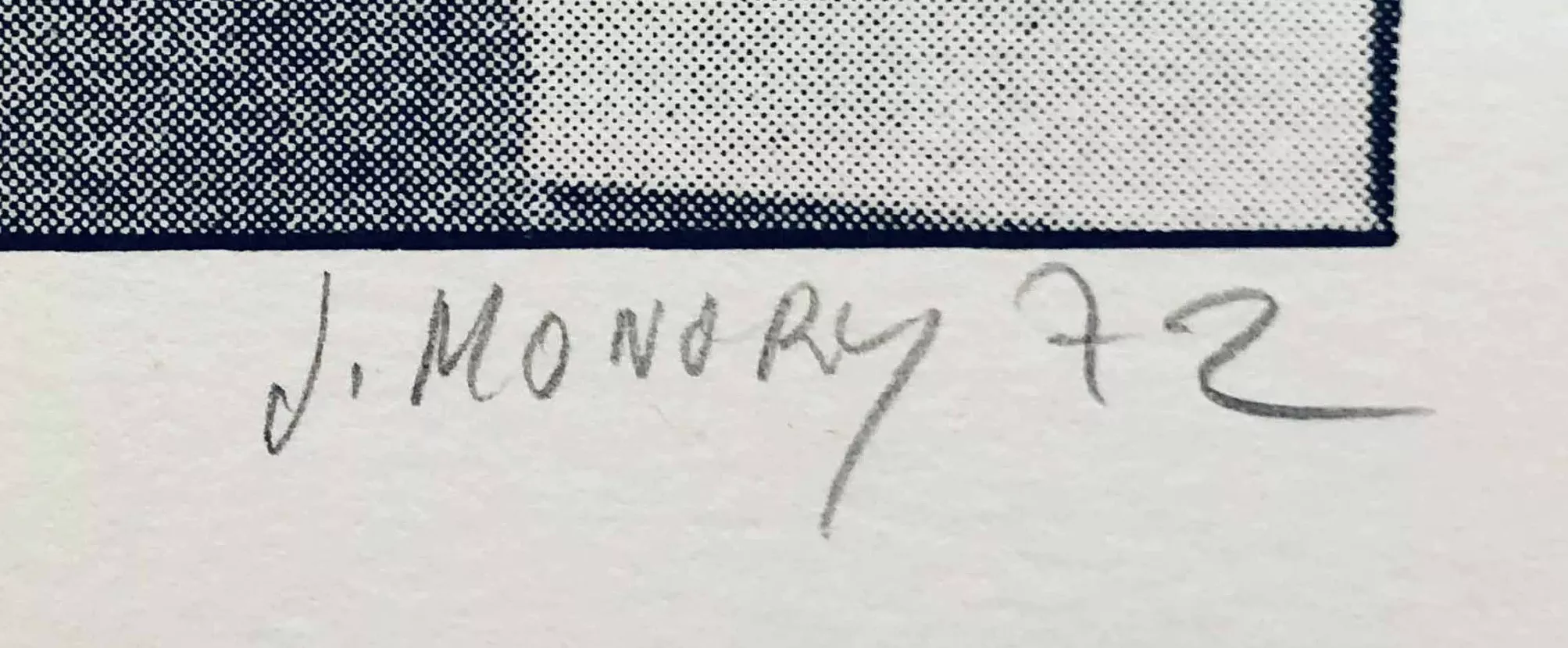
Not all of Jacques Monory's works are signed, and copies may exist. Here's an example of his signature.
Expertise your property
If you happen to own a work by Jacques Monory, request a free appraisal without further delay via our form on our website.
A member of our team will contact you promptly to provide you with an estimate of the value of your work, as well as any relevant information about it.
If you are considering selling your work, our specialists will also be on hand to help you find alternative ways of selling it at the best possible price.
.Estimate in less than 24h
Discover in the same theme

Rating and value of works, paintings by Zoran Music
Zoran Music is a 20th-century painter who depicted the horror of the concentration camps. His works are valued and quoted at auction.
Learn more >

Rating and value of Takaseda Matsutani's paintings, drawings...
Takaseda Matsutani is a Japanese surrealist artist who has produced paintings and works that are highly rated and valued at auction.
Learn more >

Rating and value of vases by Lucien Levy Dhurmer and Clément...
Clément Massier and Lucien-Lévy Dhurmer collaborated on Art Nouveau vases, which command high prices and are highly valued at auction.
Learn more >
Other paintings from the same period sold at auction

Estimated 2.000 - 4.000
Charles LACOSTE (1870-1959) Starry night, Oil on paper mounted on canvas

Estimated 4.000 - 6.000
Pierre HODÉ (1889-1942) Vue de Port, Oil on canvas

Estimated 1.000 - 2.000
Raymond GUERRIER (1920-2002), Composition I, Oil on canvas

Estimated 1.500 - 3.000
Jean VANDEN EECKHOUDT (1875-1946), Basket of persimmons, Oil on canvas

Estimated 5.000 - 8.000
Claude VENARD (1913-1994), Landscape with the Eiffel Tower, Oil on canvas.

Estimated 12.000 - 15.000
Paul AIZPIRI (1919-2016), Still life of flowers, Oil on canvas

Secure site, anonymity preserved

Auctioneer approved by the State

Free and certified estimates
Frequently asked questions
-
Who is Jacques Monory, and what is his artistic movement?Jacques Monory (1924–2018) was a leading French painter and sculptor of the narrative figuration movement. Trained at the École des Arts appliqués in Paris, he rejected the abstract trends of his time by developing a unique aesthetic that combined cinema, photography, and popular imagery. His work is distinguished by the systematic use of monochrome—particularly blue—and by fragmented compositions inspired by film noir and photo novels.
-
What is the price range for works by Jacques Monory?The value of Jacques Monory’s works varies depending on the medium: prints range from €10 to €3,500, drawings and watercolors from €120 to €24,400, paintings from €120 to €100,000, and sculptures from €400 to €105,000. His narrative figurative paintings from the 1960s are particularly sought after and prized by international collectors.
-
How can you authenticate a work by Jacques Monory?To authenticate a work by Jacques Monory, we recommend that you request a free, no-obligation appraisal from Auctie's. Our state-certified auctioneers and experts will examine your artwork and provide you with an accurate estimate of its value within 48 hours. This process will allow you to verify its authenticity and obtain a reliable professional opinion.
-
Is this the right time to sell a work by Jacques Monory?Yes, now is a good time to sell a work by Jacques Monory. The artist remains a safe bet on the art market, with a steadily rising value and enduring popularity among international collectors, particularly for his narrative figurative paintings from the 1960s and his watercolors. Sustained demand ensures favorable selling conditions.
-
How does the appraisal and sales process work at Auctie's?At Auctie's, the process begins with a free, no-obligation appraisal: simply fill out a form on our website, and an expert will contact you shortly. You’ll receive an accurate estimate of your artwork within 48 hours. If you decide to sell, our specialists will guide you through the entire process—from the appraisal to the auction—offering you the best options to achieve the highest possible price.
