



Rating and value of paintings, drawings and engravings by Arthur-Luiz Piza

Key takeaways
- Arthur-Luiz Piza (1928–2017), a Brazilian abstract printmaker, has seen his works sell for between €10 and €113,550 at auction.
- Paintings fetch the highest prices (up to €113,550), while signed prints range from €300 to €1,500, and reliefs from €15,000 to €20,000.
- A master engraver trained in Paris beginning in 1951, the artist combines geometric abstraction with material experimentation, and his market value remains stable, supported by collectors specializing in modern engraving.
If you own a work by artist Arthur Luiz-Piza or based on his work and would like to know its value, our state-approved experts and auctioneers will guide you.
Our specialists will carry out a free appraisal of your work, and provide you with a precise estimate of its value on the current market.
Then, if you wish to sell your work, we will direct you to the best possible arrangement to obtain the optimum price.
Artist's rating and value
A Brazilian abstract painter and printmaker who is fairly well known in Europe, Arthur-Luiz Piza achieved great fame during his lifetime. Today, his works are highly prized on the market, particularly by collectors of his school.
The artist thus maintains a stable and lively quotation, with his creations being sold for between €10 and €113,550 on the auction market.
A work by Piza can sell for more than half a hundred thousand euros, as demonstrated by his oil on canvas Reliefs, dating from 1982, sold for €70,000 in 2012, whereas it was estimated at between €10,000 and €15,000, i.e. 700% its low estimate.
Order of value from the most basic to the most prestigious
Technique used | Result |
|---|---|
Sculpture - volume | From €320 to €2,300 |
Estamp - multiple | From €10 to €6,700 |
Drawing - watercolor | From €65 to €66,000 |
Painting | From €200 to €113,550 |
Estimate in less than 24h
The artist's work and style
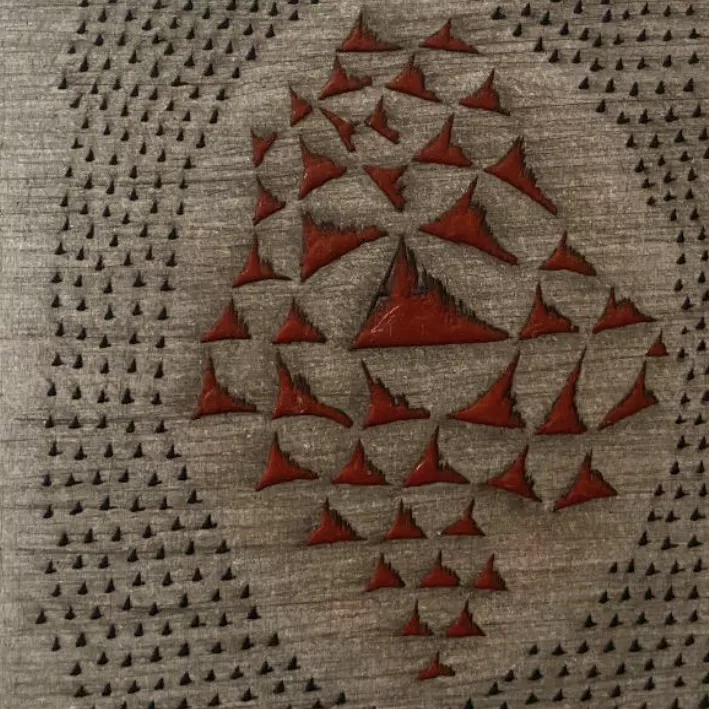
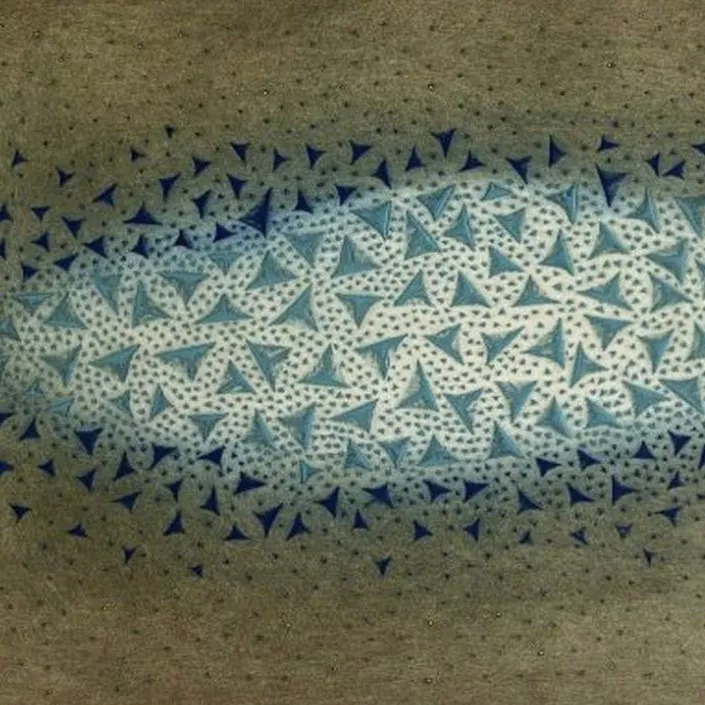
Arthur-Luiz Piza proposes through his work a constructed abstraction and a certain sense of matter. His production is characterized by a sensitive geometric abstraction, structured around simple shapes (triangles, circles, ellipses, quadrilaterals) whose repetition, variation and modulation create an almost musical visual rhythm.
He elaborates a refined plastic language, based on the tension between formal rigor and surface vibration.
His practice is distinguished by a particular attention to the tactile, textured dimension of the medium. Both through etching and painting, Piza introduces a third dimension, through processes of incision, embossing, collage or assemblage, which give his works an almost sculptural presence.
He engraves with burin and conducts other technical experiments. Piza was trained in traditional engraving, and established himself as a master of the burin from the 1950s. He developed a personal technique that blends intaglio, deep burin, embossing and selective inking, making his production of etchings one of the most complete in terms of technical processes within abstraction.
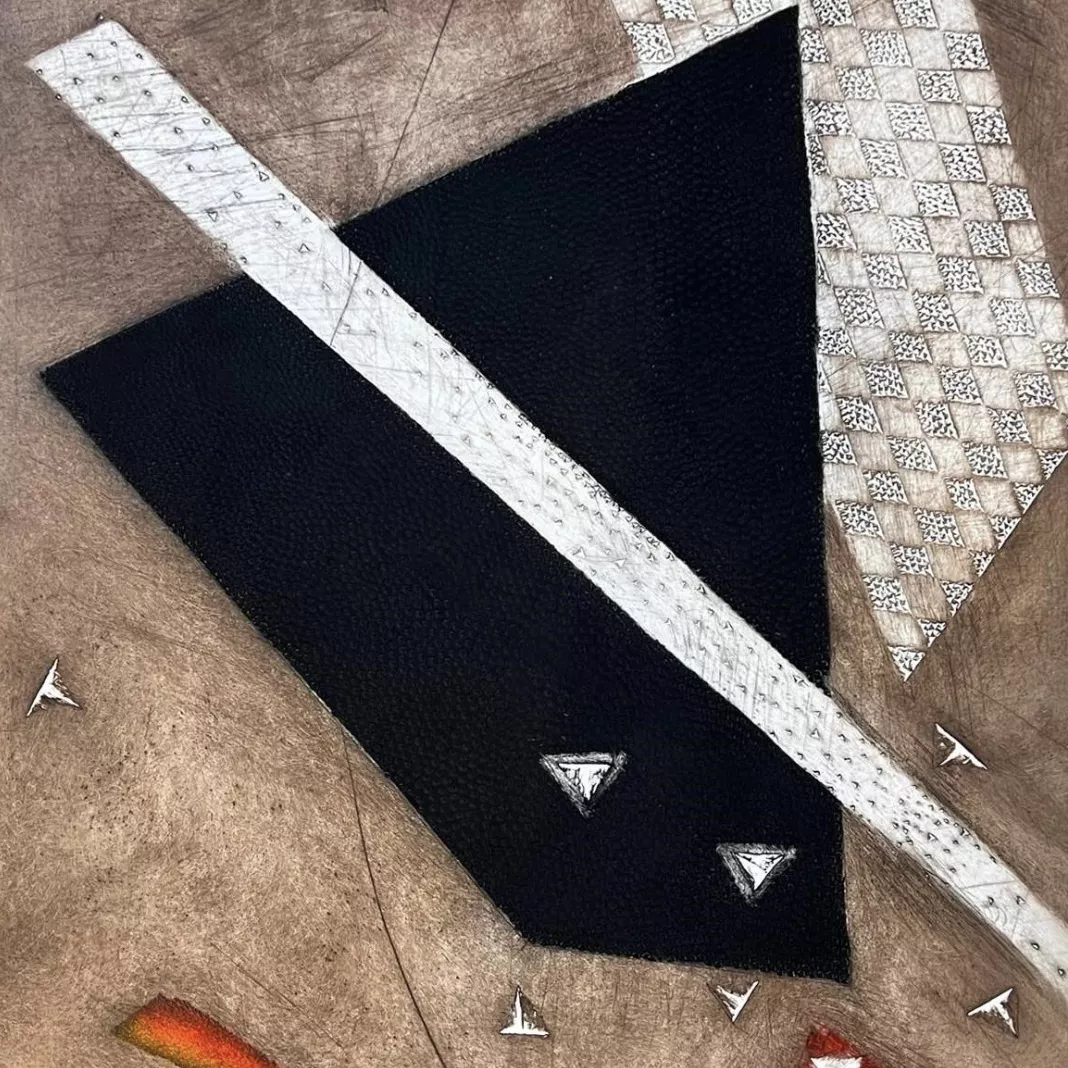
His approach to etching pushes the boundaries of the medium, to the point of making some prints almost unique. His palette outside etching is restricted: in graphic works such as collages and paintings, he favors a restrained palette, often reduced to a few muted tones (ochre, earth, deep red, slate grey, black) worked in superimpositions, shifts and transparencies.
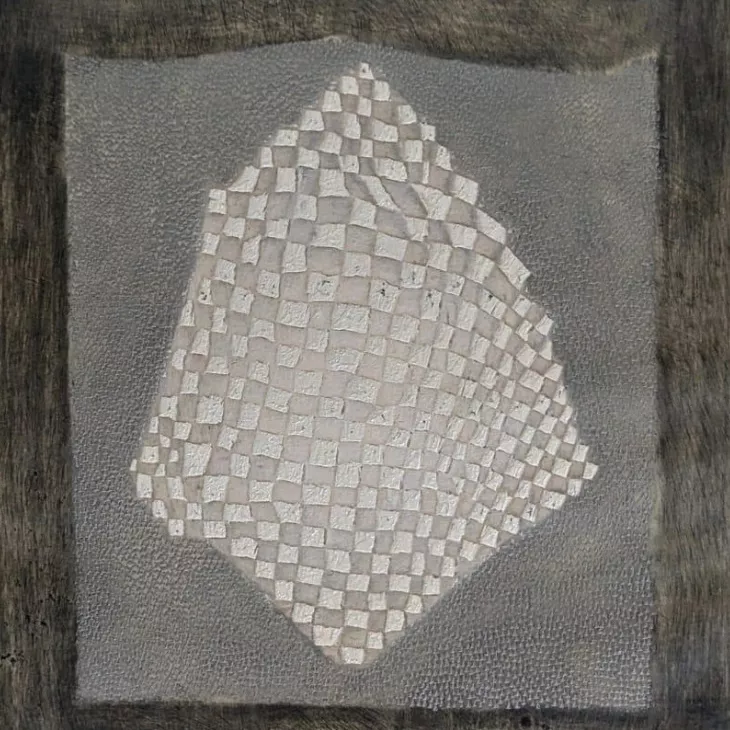
Color is at the service of form, never decorative and always structural. He builds by accumulation. In his collages and painted reliefs, Piza composes by modular arrangement, accumulating elements cut out, superimposed, sometimes sewn or fixed by tension, according to an additive logic close to weaving or architecture.
Each work thus functions as a living structure, balanced between order and imbalance. Piza places crucial importance on interstitial space, emptiness and breathing between forms. This meditative treatment of the medium gives her compositions a contemplative force, where the unspoken matters as much as the material present.
Whether engraving or assembling, the artist's work is part of a meticulous, internalized temporality of making, where each incision, each added element proceeds from a quasi-ritual act.
The artist does not belong to any established group, but is implicitly in dialogue with the research of Gustave Singier, Jean Degottex, Vieira da Silva or Günter Fruhtrunk. He retains his own plastic identity, based on engraving and material, at the crossroads of lyrical abstraction and concrete art.
The life of Arthur-Luiz Piza
Arthur-Luiz Piza (1928 - 2017) is a Brazilian artist born in Sao Paulo, during the emergence of Latin American modern art. He grew up in an environment open to the arts, at a time when artistic exchanges between Europe and South America were particularly active.
In the late 1940s, he studied with painter Antonio Gomide, an important figure in Brazilian modernism. This training introduced him to the rigor of composition, the structure of drawing and the dialogue between forms and materials, concerns he would maintain throughout his career.
In 1951, he moved to Paris, where he took classes in the studio of Johnny Friedlaender, a German-born engraver and influential teacher. This encounter marked a turning point for the artist, who discovered the expressive power of the burin and the possibility of constructing a non-figurative language through the mere action of line and material.
Although he maintained close ties with Brazil, Piza chose to settle permanently in Paris, where he gradually integrated the networks of contemporary printmaking, abstract art galleries and European collecting circles.
From the 1950s onwards, he participated in numerous international biennales (Tokyo, Venice...). In the 1960s-70s, Piza won awards at several international printmaking salons, and his work was acquired by prestigious institutions. This institutional recognition established him as one of the great abstract printmakers of the 20th century.
From the 1970s onwards, he expanded his vocabulary to include other media (collages, wall reliefs, small-format sculptures) without ever turning his back on printmaking. He developed a protean body of work, based on material experimentation and the poetic construction of form.
His career illustrates a fertile hybridization between Brazilian culture and European tradition, where we find both the constructivist rigor of concrete art and a sensibility peculiar to South American baroque, discreetly present in the tensions between form, rhythm and space.
Arthur Luiz-Piza today pursues his career between Paris and Zurich, while regularly exhibiting in Brazil. He died in 2017, leaving behind a dense, rigorously constructed body of work that continues to be rediscovered by institutions and collectors.
Market segmentation and artist's rating
Arthur Luiz-Piza occupies a discreet place in the post-war abstraction market. As a major artist-engraver, recognized for his technical mastery and the coherence of his plastic language. He is valued within the market of geometric and matierist abstract artists, along with others such as Soulages in its etched dimension or Degottex.
A clear medium segmentation operates with Piza. His burin etchings (mixed techniques in intaglio, embossing, aquatint) constitute the main segment of his market, with lots that are highly prized by collectors. His collages and reliefs on paper or canvas constitute an expanding segment, at the intersection of concrete art and textile art, appreciated for its poetic and tactile dimension.
His paintings and one-off works are rarer on the market and are increasingly in demand, particularly at design and contemporary art fairs, where sensitive abstraction finds a wider audience.
His signed engravings, printed in small numbers, fetch between €300 and €1,500, depending on the technique, date and complexity of the print. Works with embossing or mixed techniques can exceed €2,500. One-off reliefs and collages, meanwhile, can fetch between €15,000 and €20,000, depending on provenance and state of preservation.

Works from museum exhibitions or documented private collections (notably Swiss, Brazilian or French) benefit from a premium valuation that is reinforced by the scarcity of pieces available on the secondary market.
The target clientele remains collectors specializing in modern and contemporary etching, lovers of sensitive abstraction and material research, as well as museum institutions and libraries specializing in prints.
The Latin American market is also attentive to its Brazilian roots, with renewed interest in expatriate artists. The artist's quotation is stable, supported by a coherent body of work with little speculation and controlled distribution.
The potential for revaluation is revised upwards in the context of renewed interest in paper art, non-figurative mixed techniques and transatlantic figures of abstraction. Its growing institutional visibility also supports an ongoing heritage rereading, favorable to a repositioning on the upper graphics market.
His signature
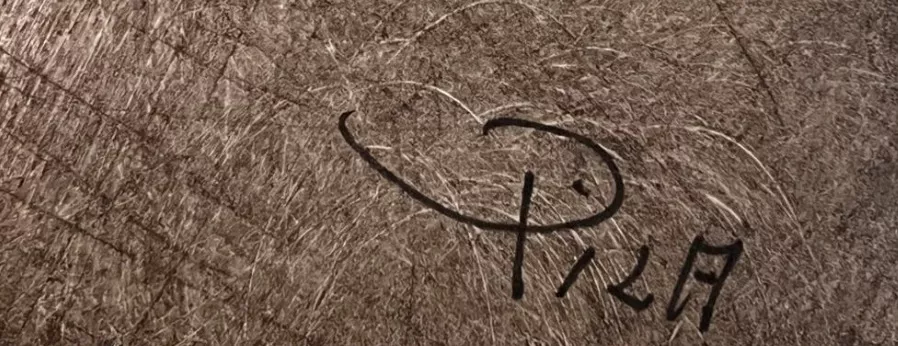
Not all of Arthur-Luiz Piza's works are signed.
Although there are variations, here's a first example of his signature:
Expertise your property
If you own a work by Arthur-Luiz Piza, don't hesitate to request a free appraisal by filling in our online form.
A member of our team of experts and certified auctioneers will contact you to provide an estimate of the market value of your work.
If you are considering selling your work, our specialists will also guide you through the various alternatives available to obtain the best possible price, taking into account market trends and the specific features of each work.
Estimate in less than 24h
Discover in the same theme

Rating and value of works, drawings, paintings by Jacob Hend...
Jacob Hendrik Pierneef is a South African Impressionist painter whose drawings and oil paintings are sought-after at auction.
Learn more >

Rating and value of works, drawings, paintings by Ladislas K...
Ladislas Kijno was a 20th-century French visual artist who produced drawings and oils on canvas, experimenting with papier marouflé.
Learn more >

Rating and value of Gio Ponti furniture, tables and armchair...
Gio Ponti is a modern Italian designer who has produced highly-rated works of art that are highly valued on the auction market.
Learn more >
D'autres tableaux abstraits vendus aux enchères

Estimated 2.000 - 4.000
Serge POLIAKOFF (1900-1969), Composition en rouge et bleu. 1965, Lithograph

Estimated Between €5,000 and €8,000
Jean MIOTTE (1926-2016), acrylic on canvas

Estimated 3.000 - 5.000
Roberto MATTA (1911-2002), Composition, Gouache on canvas

Secure site, anonymity preserved

Auctioneer approved by the State

Free and certified estimates
Frequently asked questions
-
Who is Arthur-Luiz Piza, and what is his artistic background?Arthur-Luiz Piza (1928–2017) was a leading Brazilian abstract painter and printmaker, recognized as one of the great masters of the engraving needle of the 20th century. Trained in São Paulo and later in Paris under Johnny Friedlaender beginning in 1951, he developed a personal artistic language based on sensitive geometric abstraction, blending Constructivist rigor with a sensitivity to materials. His hybrid body of work blends European tradition with Brazilian culture, placing him at the crossroads of concrete art and lyrical abstraction.
-
What is the price range for Piza's works on the market?Piza's prices vary depending on the technique: his signed prints range from €300 to €2,500, his unique reliefs and collages from €15,000 to €20,000, and his paintings can fetch over €100,000. Overall, his works sell for between €10 and €113,550, with a stable average that reflects consistent institutional recognition among collectors of abstract art.
-
How can you authenticate a work by Piza and determine its exact value?Auctie's offers a free, no-obligation appraisal of your artwork. Simply fill out the online form: a state-certified expert or auctioneer will contact you to appraise your item and provide you with an accurate estimate of its market value within 48 hours, taking into account the technique, provenance, and condition.
-
Is this the right time to sell a work by Piza?Yes, the market for Piza is experiencing favorable momentum. His market value remains stable and strong, with growing interest among collectors in sensitive abstraction, mixed media, and transatlantic figures. The renewed interest in paper-based art and non-figurative abstraction, combined with growing institutional visibility, is creating a context for long-term appreciation.
-
How does the process of selling a work of art at Auctie's work?Auctie's supports you every step of the way: after a free appraisal by an expert, our specialists will advise you on the best sales options based on market trends and the characteristics of your artwork. We then guide you through the auction process to maximize the final price.
