



Rating and value of paintings by Sydney Thompson

Key takeaways
- Sydney Lough Thompson’s works sell for between €200 and €35,200, with paintings commanding higher prices than drawings and watercolors (€300 to €11,700).
- A Post-Impressionist artist trained in New Zealand and Brittany, Thompson (1877–1973) is known for his mastery of light and his rigorous compositional structure.
- His paintings depicting rural scenes from Brittany and New Zealand are popular with collectors thanks to their serene and luminous atmosphere.
If you own a work by or based on the work of artist Sydney Lough Thompson and would like to know its value, our state-approved experts and auctioneers will guide you.
Our specialists will carry out a free appraisal of your work, and provide you with an accurate estimate of its value on the current market.
Then, should you wish to sell your work, we will direct you to the best possible arrangement to obtain the optimum price.
Artist's rating and value
Thanks to their serene, luminous atmosphere, Sydney Lough Thompson's works meet with some success with collectors.
On the market, his various postimpressionist compositions are successful at auction. His works sell for between €200 and €35,200, a significant delta but one that says a lot about the value that can be attributed to these canvases.
Some of the artist's works, for example, have fetched unheard-of amounts, as evidenced by his painting L'enfant de l'artiste, Grasse,dating from 1930, which sold for €35,200 whereas it was estimated at between €22,500 and €33,800.
Order of value from the most basic to the most prestigious
Technique used | Result |
|---|---|
Drawing - watercolor | From €300 to €11,700 |
Painting | From €200 to €35,200 |
Estimate in less than 24h
The artist's work and style
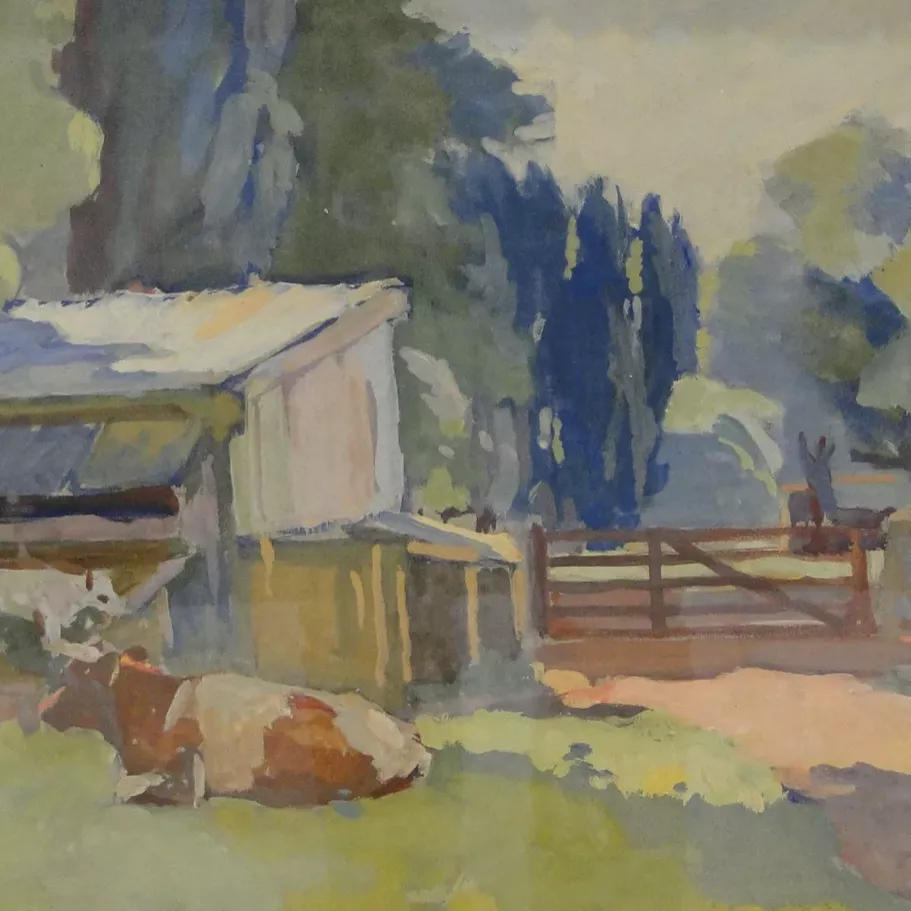
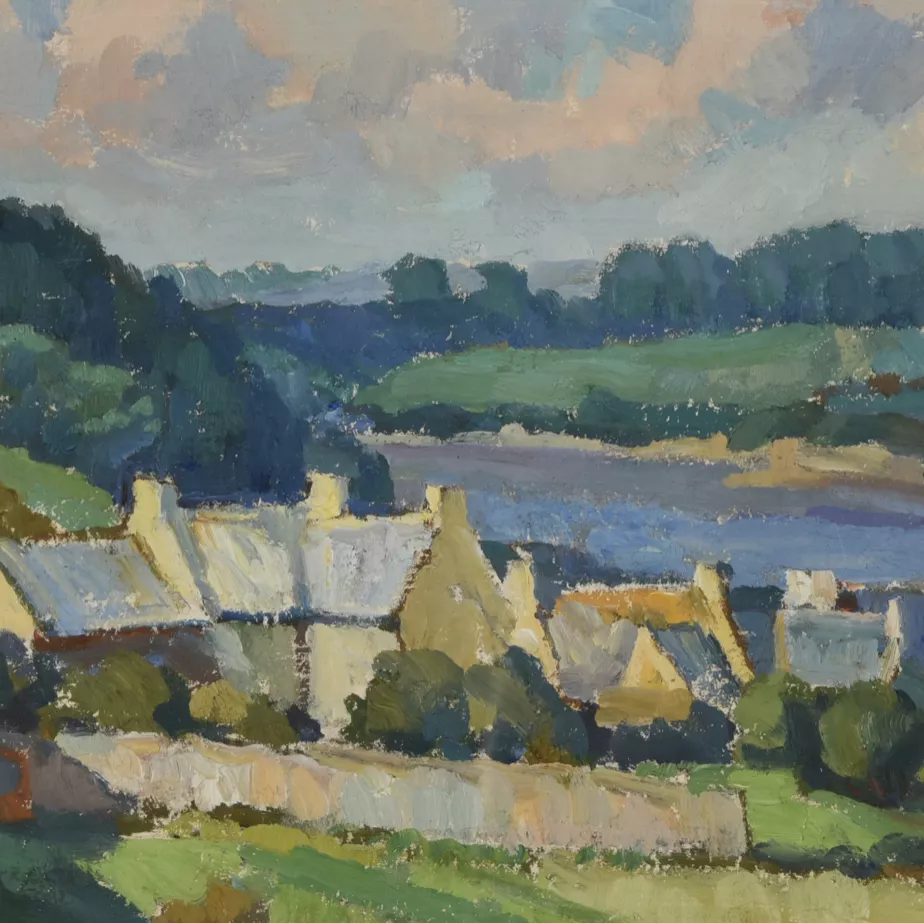
Sydney Lough Thompson is part of the Post-Impressionist tradition, exploring light and color with great sensitivity. Trained in New Zealand before continuing his apprenticeship in Europe, he assimilated the influence of the Pont-Aven school, where he stayed on several occasions.
His vibrant palette and fluid brushstrokes reflect a marked interest in atmospheric effects and the spontaneity of gesture.
Working as much on the motif as in the intimacy of his studio, he favors scenes of Breton and New Zealand rural life, which he renders with chromatic intensity and an expressive touch.
His approach combines a rigorous structuring of forms and a free facture, enabling him to breathe a particular rhythm into his compositions.
He plays on light contrasts and color density to animate his landscapes and figures, creating an impression of movement and vitality.
His work, marked by a constant search for harmony between nature and humanity, asserts itself as a synthesis between impressionism and post-impressionism, rooted in modernity while remaining faithful to a sensitive observation of reality.
Sydney Lough Thompson's life
Sydney Lough Thompson was born in 1877 in New Zealand, where he trained at the Canterbury College School of Art before moving to Europe to further his apprenticeship.
Attracted by the artistic effervescence of the Old Continent, he spent long periods in France, particularly in Brittany, where he immersed himself in the atmosphere of Pont-Aven.
Fascinated by the light and rurality of the Breton landscape, he found it a major source of inspiration and returned there regularly. He also explored other regions, notably Normandy and the Loire Valley, always in search of new motifs and light effects.
In between trips, he returned to New Zealand, where he played an essential role in the evolution of local painting by exposing European trends and encouraging an opening towards modernist movements.
His commitment to teaching and his influence on the younger generation of New Zealand artists contributed to the transformation of the national artistic landscape. After settling permanently in France in the 1920s, he continued to exhibit on both sides of the globe, establishing an international career.
Recognized for his talent as a colorist and his ability to capture the soul of a landscape, he won several awards and saw his work acquired by public and private collections.
He died in 1973, leaving behind him a body of work imbued with light, color and a deep sensitivity to nature and rural life, a true link between Europe and his native country.
At the time, his work was a source of inspiration and inspiration.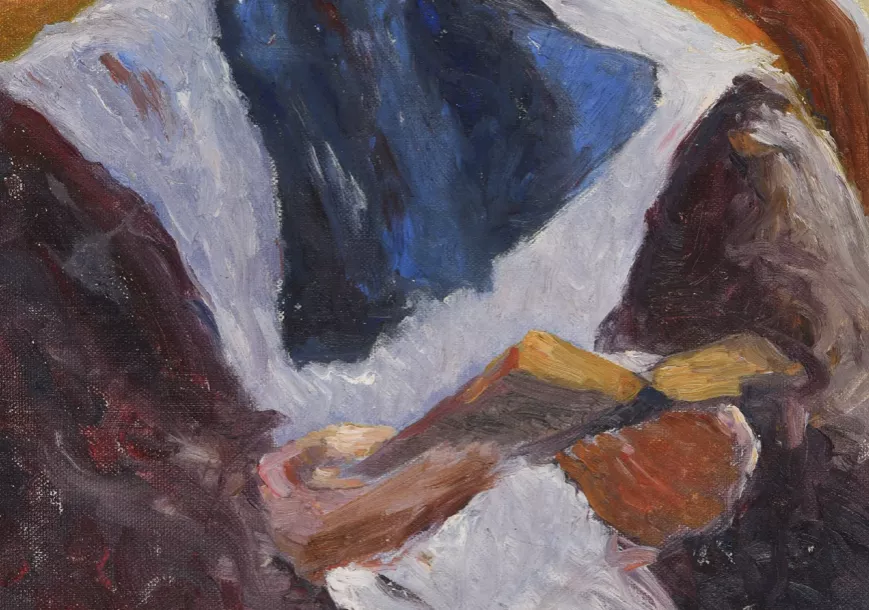
Focus on Marché en Bretagne, Syndney Thompson
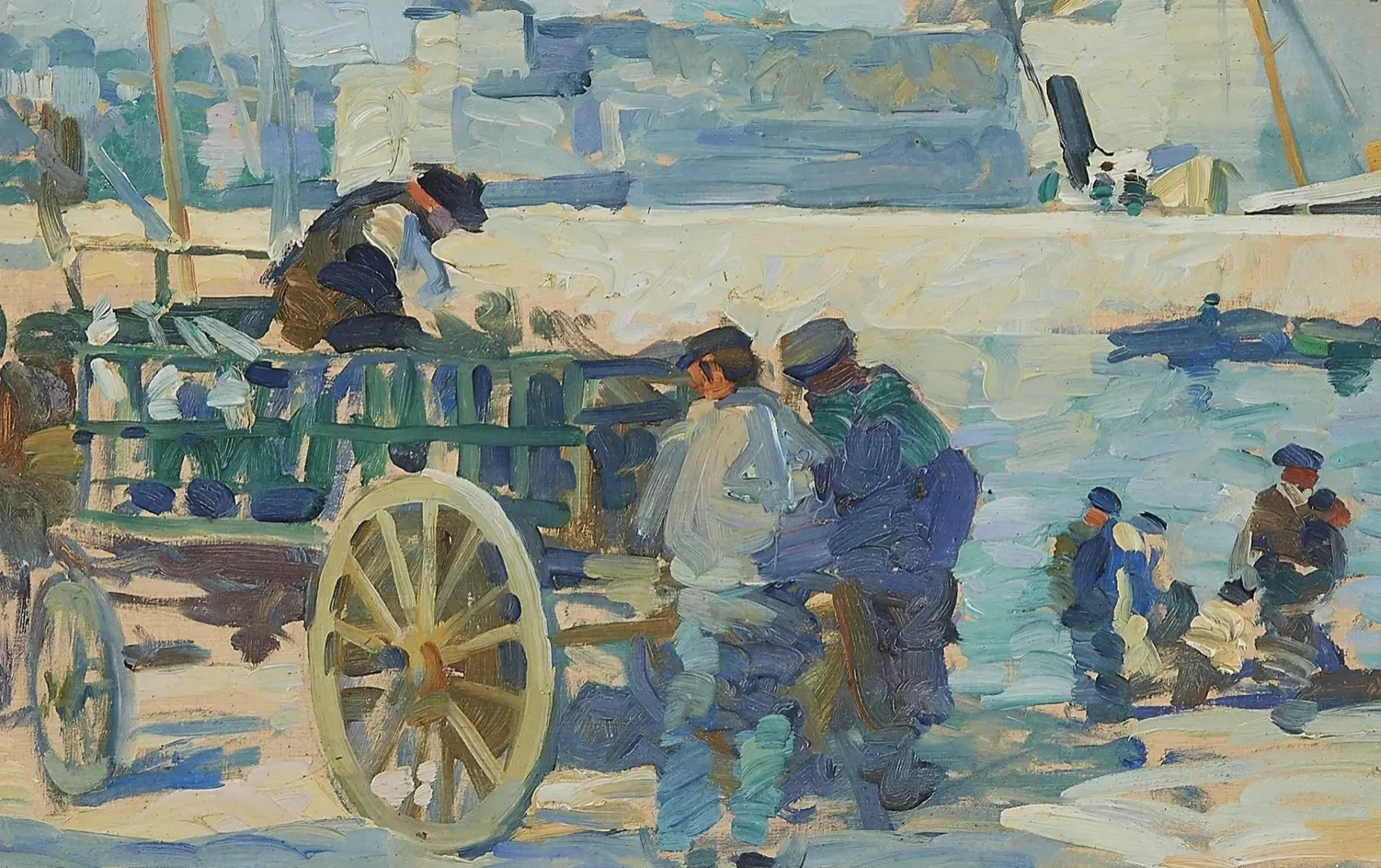
Marché en Bretagne, among Sydney Lough Thompson's most emblematic works, reveals a conception of space concerned with balance and rigor, where light modulates forms with subtlety.
The painter, true to his approach, favors a palette dominated by muted tones, which he enhances with brighter touches, thus organizing the composition according to a skilfully mastered play of contrasts.
The scene, enlivened by the presence of peasant figures in traditional costumes, is in a naturalistic vein, without abandoning a stylization of volumes and a precise structuring of planes.
At the time, artists who frequented Brittany oscillated between a synthetic transcription of the motif, inherited from the Pont-Aven School, and an approach more attentive to the materiality of the visible.
Thompson, on the other hand, favors a rigorous drawing, perceptible beneath the pictorial material, and a methodical plastic organization, reminiscent of the teaching of the masters of the European tradition.
His fluid yet precise brushwork meticulously restores the texture of fabrics and the density of shadows, translating a desire for formal analysis that yields neither to gratuitous ornamentation nor to facile picturesqueness.
Far from an instantaneous capture of reality, Marché en Bretagne is part of a search in which the motif, far from being a simple subject, becomes a pretext for reflection on the balance of masses and the structuring of space.
From this perspective, the artist moves away from the subjective expression of gesture to embrace a tradition of rigorous construction, where the brushstroke itself, measured and controlled, participates in a desire for an ordered transcription of the visible.
Sydney Thompson's imprint on his period
Sydney Lough Thompson's imprint, in the context of the painting of his time, is distinguished by his ability to inscribe light and form within a rigorously structured framework.
At a time when stylistic evolutions were multiplying and Fauvism and Cubism were shaking up codes, Thompson anchored himself in a more classical tradition, while demonstrating an unprecedented mastery of light and shadow, capable of restoring the very essence of figures and landscapes.
His works, initially influenced by the 19th-century masters, are characterized by a sense of geometry and composition that reflects a constant search for volume and depth.
In his work, light becomes not only an element of the scene, but also a true actor in the composition. Thompson, faithful to the realist tradition, is interested in natural light, which he renders with great fidelity, while constructing space in a rational, sometimes even calculated manner.
This approach, far from the excesses and visual revolutions proposed by his contemporaries, allows him to leave his mark on the evolution of painting at the beginning of the 20th century, offering a stable anchor point in a pictorial universe where the externalization of emotion sometimes takes precedence over structure.
His influence, though more discreet, is to be found in this ability to capture the world in its most minute detail, away from currents of thought that seek above all rupture.
Sydney Thompson's artistic influences
Sydney Lough Thompson's artistic influences, throughout his career, are part of a figurative tradition that is nevertheless open to the major changes of his time.
Trained in the shadow of the great masters of the 19th century, notably at the Julian Academy, he initially drew his inspiration from realism and academicism, while drawing on the heritage of neoclassical painting, embodied by figures such as Ingres or David.
However, if his early works seem marked by this academic foundation, his vision is distinguished by a particularly precise eye for light and color, often likened to that of the Impressionists.
But where his contemporaries sought to capture the ephemeral and the immediate, Thompson lingers on the thickness and substance of the world.
Through his travels and his frequentation of the great European artistic centers, notably Paris, he encountered the beginnings of the modern movements, notably Fauvism and Cubism, from which he retained certain approaches to volume and light.
However, unlike his peers, he did not fully embrace these currents, preferring a more introspective approach, more inclined to a meticulous analysis of reality.
Thus, although his influences are varied, ranging from academic painting to Impressionism (including Pierre de Clausade, André Lagrange or Émile Boggio), his work seems to testify to a desire to reconcile the heritage of the past with the artistic experimentations of his time, without getting carried away by the emphatic stylistic ruptures of modernity.
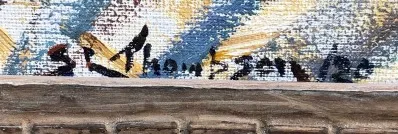
His signature
Not all of Sydney Thompson's works are signed.
Although there are variations, here is a first example of his signature:
Expertise your property
If you own a work by Sydney Thompson, don't hesitate to request a free appraisal by filling in our online form.
A member of our team of experts and licensed auctioneers will contact you to provide an estimate of the market value of your work.
If you are considering selling your work, our specialists will also guide you through the various alternatives available to obtain the best possible price, taking into account market trends and the specific features of each work.
Estimate in less than 24h
D'autres tableaux modernes figuratifs vendus aux enchères

Estimated 800 - 1.500
Jean Roger SOURGEN (1883-1978) Trees and dunes Oil on panel

Estimated 3.000 - 5.000
Georges LAPCHINE (1885-1951) The port of St Tropez Oil on canvas

Estimated 18.000 - 30.000
Charles CAMOIN (1879-1965) "Le Port de Marseille, 1928" Oil on canvas.

Estimated 1.500 - 3.000
Jean VANDEN EECKHOUDT (1875-1946), Basket of persimmons, Oil on canvas

Estimated 2.000 - 4.000
Charles LACOSTE (1870-1959) Starry night, Oil on paper mounted on canvas
Discover in the same theme

Rating and value of works, drawings, paintings by Léopold Su...
Léopold Survage is an artist of the Paris School who produced drawings, watercolors and oil paintings that are quoted on the auction market.
Learn more >

Rating and value of works, drawings, paintings by Jean Royèr...
Jean Royère is a 20th-century decorator who produced furniture such as pedestal tables and sofas that are appreciated and quoted at auction.
Learn more >

Rating and value of paintings by Sayed Haider Raza
Sayed Haider Raza is a twentieth-century Indian abstract painter who has produced works whose value is exploding on the auction market.
Learn more >

Secure site, anonymity preserved

Auctioneer approved by the State

Free and certified estimates
Frequently asked questions
-
Who is Sydney Lough Thompson, and what is her artistic style?Sydney Lough Thompson (1877–1973) was a New Zealand painter who worked within the Post-Impressionist tradition. Trained at the Canterbury College School of Art in New Zealand, he continued his studies in Europe, notably in Pont-Aven, Brittany, where he was influenced by the Pont-Aven School. His work combines a rigorous structuring of forms with a free and expressive style, focusing on scenes of rural life in Brittany and New Zealand, rendered with a vibrant palette and a keen sensitivity to light.
-
What are the prices and values of Sydney Thompson's works?Sydney Lough Thompson’s works sell for between €200 and €35,200, depending on the medium and quality. Drawings and watercolors range from €300 to €11,700, while paintings range from €200 to €35,200. This significant range reflects variations in size, date, subject matter, and condition. For example, his painting “The Artist’s Child, Grasse” (1930) sold for €35,200, exceeding its initial estimate.
-
How can you authenticate a work by Sydney Thompson?To authenticate a work by Sydney Thompson, we recommend that you request a free, no-obligation appraisal from Auctie's. Our state-certified experts and auctioneers will examine your artwork and provide you with an accurate estimate within 48 hours. This process will allow you to verify the authenticity and current market value of your item.
-
Is this a good time to sell a work by Sydney Thompson?Yes, now is a good time to sell a work by Sydney Thompson. His Post-Impressionist compositions are becoming increasingly popular among collectors, particularly his Breton landscapes and scenes of rural life. Demand for this type of artwork remains steady, and auction results confirm that the market is active and favorable.
-
How does the sales process work at Auctie's?At Auctie's, the process is simple and guided: we start by providing a free appraisal of your artwork by our experts. If you’d like to sell, our specialists will guide you through the various options available, taking into account market trends and the unique characteristics of your artwork—from consignment through to the auction—to help you achieve the best possible price.
