



Rating and value of paintings by Martiros Saryan

Key takeaways
- Martiros Saryan’s paintings, particularly his landscapes, fetch several hundred thousand euros, such as “The Poet,” which sold for €642,700 in 2024.
- His style blends French Fauvism, Eastern art, and Armenian traditions, characterized by vivid, pure colors that create intense, expressive contrasts.
- Prints sell for between €300 and €400, watercolors for €130 to €50,000, while paintings currently offer the strongest potential for market appreciation.
If you own a work by or based on the work of artist Martiros Saryan and would like to know its value, our state-approved experts and auctioneers will guide you.
Our specialists will carry out a free appraisal of your work, and provide you with an accurate estimate of its value on the current market.
Then, should you wish to sell your work, we will direct you to the best possible arrangement to obtain the optimum price.
Artist's rating and value
Martiros Saryan's work is common and highly rated on the auction market. His works arouse interest among collectors and art lovers, particularly those who appreciate painting associated with the École de Paris.
The most sought-after pieces are landscape paintings. Thus, a work signed by Saryan can fetch hundreds of thousands of euros at auction, such as his painting The Poet (On the Foothills a Aragats), adjudged for €642,700, whereas it was estimated at between €618,000 and €860,000.
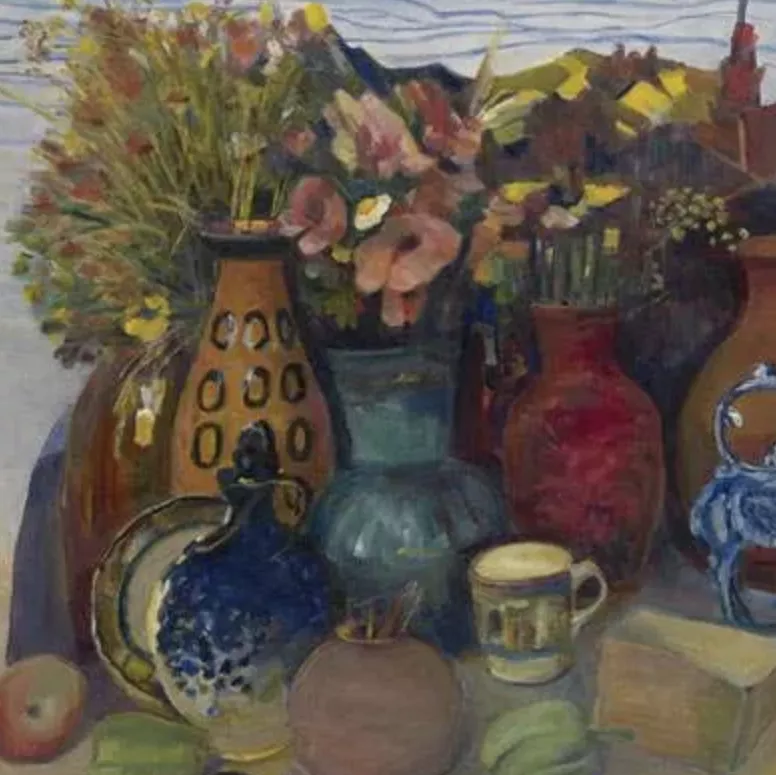
High upside potential is evident in his works, particularly his colorful tempera-painted landscapes and still lifes.
Order of value from the most basic to the most prestigious
Technique used | Result |
|---|---|
Estamp - multiple | From 300 to 400€ |
Drawing - watercolor | From €130 to €50,000 |
Painting | From €890 to €642,720 |
Estimate in less than 24h
Artist's style and technique
Martiros Saryan's style and technique is characterized by several influences and processes. His painting is a blend of French Fauvism, Oriental art and Armenian traditions. The result is a unique approach to color.
The shades applied to the canvas are calculated from pure colors, reinforcing the intensity of the chromatic treatment and its impact on the viewer's eye. In his painting, Saryan puts into practice the scandal of Room VII, notably " the orgy of pure tones " described by Louis de Vauxcelles when he spoke of the 1905 Salon d'Automne.
He is also influenced by Paul Gauguin in his use of intense colors - but also by European Expressionism in his treatment of forms.
His palette is therefore characterized by pure, vivid colors, often non-naturalistic, which enable him to create strong contrasts between warm and cool tones to accentuate the expressiveness of his works. He creates powerful lighting effects to give his canvases an impression of warmth and energy.
His treatment of light is quite original and elaborate, mixing several techniques and inspirations - he thus achieves a bright, sunny light that floods his painting, and bathes the landscapes and figures he depicts.
He places more emphasis on the inner luminosity of the colors than on the shadows, which enables him to apply an " orientalist " treatment of light, so that his compositions correspond as closely as possible to the atmosphere of Armenia, where the painter hails from.
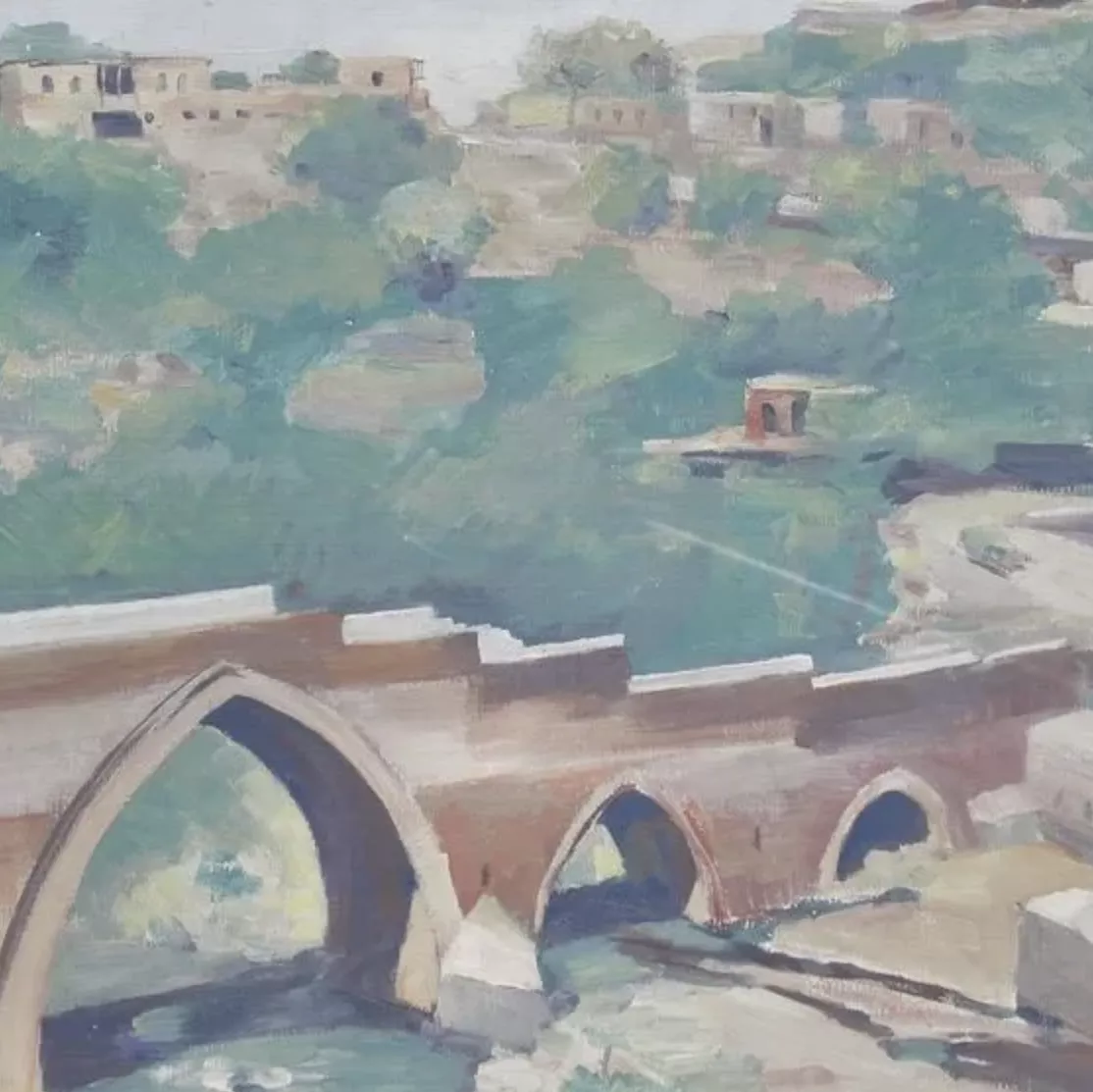
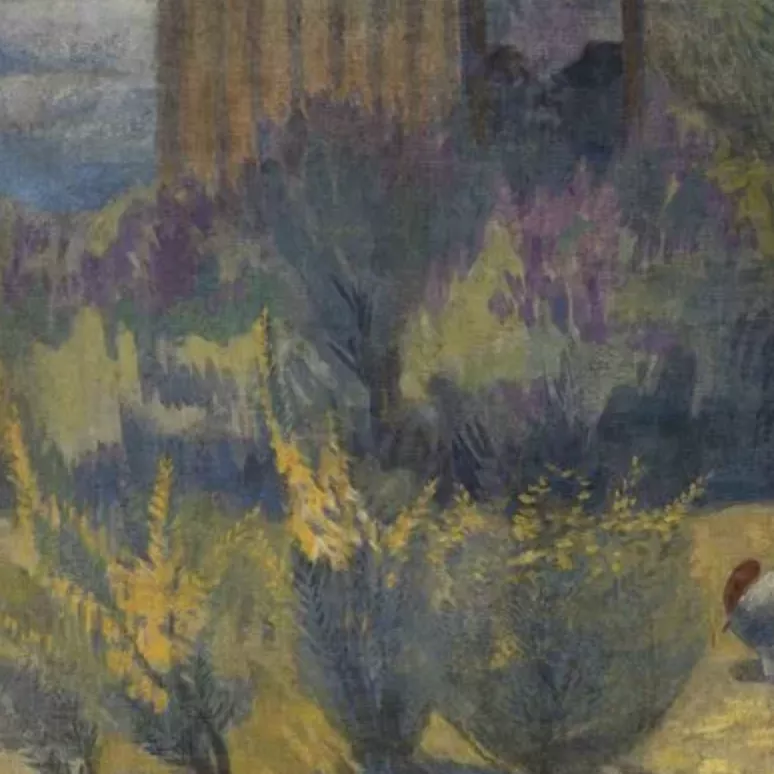
His pictorial technique is materialized by a free-flowing brush, whose strokes are visible and dynamic. The superimposition of colors creates an impression of depth and movement, creating a slight relief of textures on the surface of the canvas.
The treatment of forms is not always very precise, the shapes are simplified, sometimes stylized, in order to get to the essentials and not drown the viewer in too much technical information.
The subjects he works with are often luminous Armenian landscapes, expressive portraits, and scenes from everyday life. The influence of Persian miniatures can be felt in the composition of the scenes.
The latter are therefore balanced, very often with a dynamic of diagonal lines that provide more structure, important for the retinal aspect and the arrangement of colors.
Through the implementation of all his techniques, Martiros Saryan seeks a harmony between the retranscription of the real Armenian world and a certain poetic vision of it.
The life of Martiros Saryan
Martiros Saryan, or Sarian (1880-1972), Armenian painter, was born in Russia, into an Armenian family from the diaspora. He began training in painting in 1997 at the Moscow School of Painting, Sculpture and Architecture, where he studied with Valentin Serov and Constantin Korovine.
He was successively a member of the Scarlet Rose and Blue Rose groups, with whom he exhibited his work in Russia. In 1901, he visited Russian Armenia, then traveled to the Ottoman Empire. In 1915, concerned about the fate of his people, he spent time in Etchmiadzin, where he cared for and helped survivors of the Armenian genocide. He also helped organize the Society of Armenian Artists. He produced his first series during this trip, influenced by Symbolism.
After the October Revolution, the artist returned to Russia, then settled in 1922 in the Soviet Socialist Republic of Armenia, for which he designed the coat of arms and the first flag, and took up the post of artistic director of the State Museum.
From 1926 to 1928, Martiros Sarian moved to Paris, producing numerous paintings, some of which are now lost. He had the opportunity to show them at a private exhibition. On his return, he was the victim of a rather dramatic accident for his work: two years of work, or 35 paintings, were burnt in a fire on a ship in Constantinople.
In the 30s, back in Armenia, he worked mainly on landscapes and portraits. However, the government didn't like the tawny aspect of his painting, the overly bright colors and the overly decorative nature of his canvases. This was a complicated period for the artist, who refused to paint Stalin's portrait.
However, Khrushchev's arrival in power gave him back his freedom to paint and exhibit as he saw fit. He was decorated three times with the Order of Lenin and other orders.
He died in 1972 in Yerevan, and his house was turned into a museum.
.
Focus on Paysage d'Arménie, Martiros Saryan
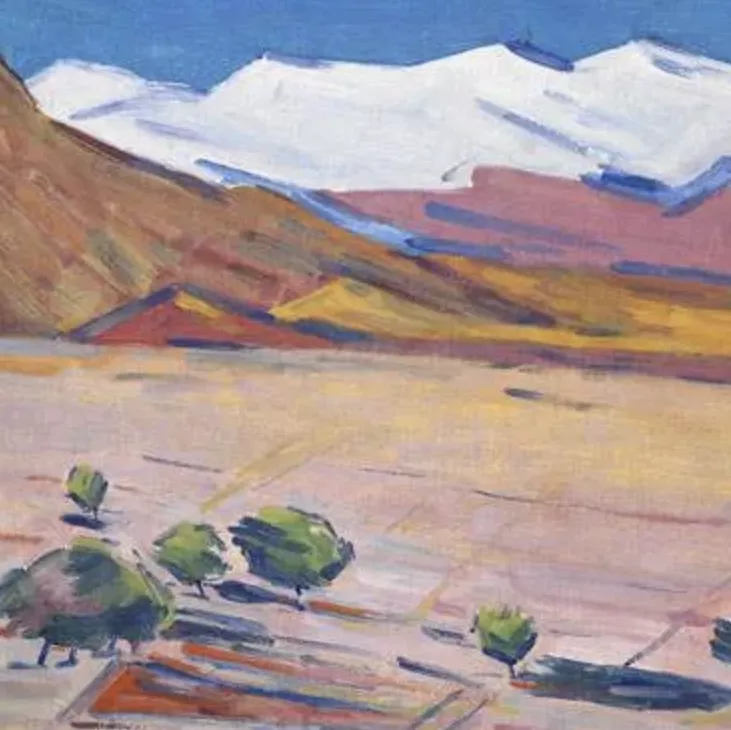
In Paysage d'Arménie, Saryan depicts a landscape bathed in light, imprinting an Armenian valley with rather flamboyant hues. Mountains can be seen in the background, often stylized with bold gradations of color.
He depicts trees and hills in simplified forms, elements on which he works mainly through color. The atmosphere of the painting is peaceful and warm, the artist's aim seems to be to give as much life as possible to this landscape.
The colors chosen are bright and pure, dominated by the shades of red, orange and yellow used for the grounds and hills.
The brilliant blue used for the sky contrasts with the warm hues of the landscape, while the play of light and saturated hues accentuates the vitality of the scene.
As for technique, Saryan uses a fluid, dynamic brushwork, discarding concern for hyper-realistic detail. Shapes are simplified and stylized, to bring out a vision that is more poetic than naturalistic.
Colors are applied in broad flat tints, with few gentle transitions. Composition and perspective are arranged through balanced composition and dynamic staging of nature. Perspective is simplified, sometimes verging on a decorative vision, as it was criticized under Stalin.
The central element is highlighted by an opposition of bright colors, which create in the atmosphere and expressiveness a sense of warmth and fullness, which is accentuated by the bright light. The landscape thus celebrates the beauty of Armenia by being almost idealized.
Martiros Saryan's approach here is once again close to symbolism, enabling him to depict nature as a reflection of the country's soul, his aim being to convey emotion and intensity first and foremost through color.
Martiros Saryan's imprint on his period
Saryan established himself as a pioneer of modern Armenian art, and played a major role in the transformation of Armenian painting in the 20th century.
He introduces vivid colors, in an often symbolist approach that renews the representation of landscape, also to be found in Jean Carzou.
He adapts the Fauvist heritage to Armenian culture, mixing the orgy of pure tones with orientalism, he develops a unique style where color becomes an expressive element in its own right.
Thus, he transcended Western influence by integrating typically Armenian motifs and sensibility. Deeply rooted in his culture and country, he became a key figure in Armenian cultural identity.
He also played an institutional role, gaining official recognition by becoming director of the National Museum of Fine Arts of Armenia - also establishing himself as a key figure in the promotion of art in his country.
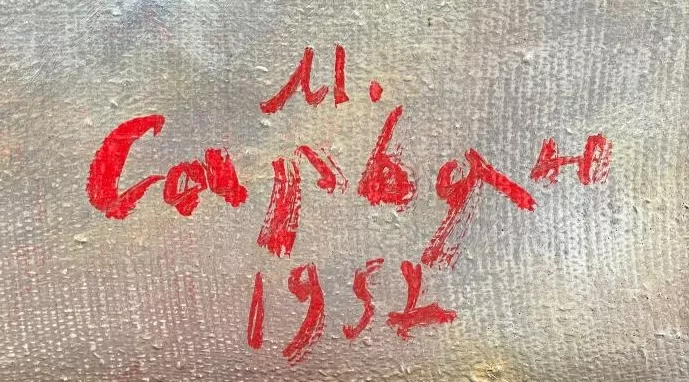
His signature
Not all of Martiros Saryan's works are signed. It is also possible that it is a copy or that the mention has faded over time, which is why expertise is paramount.
Expertise your property
If you own a work by Martiros Saryan, don't hesitate to request a free appraisal by filling in our online form.
A member of our team of experts and certified auctioneers will contact you to provide an estimate of the market value of your work.
If you are considering selling your work, our specialists will also guide you through the various alternatives available to obtain the best possible price, taking into account market trends and the specific features of each work.
Estimate in less than 24h
Discover in the same theme

Rating and value of Daum crystal works, Nancy school
After 1945, the Daum glassworks produced a number of crystal works that are highly prized on the auction market. They have a stable, fairly high marke...
Learn more >

Rating and value of works, fashion drawings by René Gruau
René Gruau is a twentieth-century artist and draughtsman who worked for Dior, among others, and whose work is highly valued and quoted.
Learn more >

Rating and value of watercolors, drawings and paintings by L...
Le Pho is a 20th-century French-Vietnamese artist who produced drawings, watercolors and oil on canvas that are listed at auction.
Learn more >
D'autres tableaux modernes figuratifs vendus aux enchères

Estimated 800 - 1.500
Jean Roger SOURGEN (1883-1978) Trees and dunes Oil on panel

Estimated 3.000 - 5.000
Georges LAPCHINE (1885-1951) The port of St Tropez Oil on canvas

Estimated 18.000 - 30.000
Charles CAMOIN (1879-1965) "Le Port de Marseille, 1928" Oil on canvas.

Estimated 1.500 - 3.000
Jean VANDEN EECKHOUDT (1875-1946), Basket of persimmons, Oil on canvas

Estimated 2.000 - 4.000
Charles LACOSTE (1870-1959) Starry night, Oil on paper mounted on canvas

Secure site, anonymity preserved

Auctioneer approved by the State

Free and certified estimates
Frequently asked questions
-
Who is Martiros Saryan, and what is his artistic background?Martiros Saryan (1880–1972) was an Armenian painter who trained in Moscow under renowned Russian masters. A pioneer of modern Armenian art, he fused French Fauvism with Orientalism and Armenian traditions, creating a unique style characterized by vivid, pure colors. He played a major institutional role as director of the State Museum of Armenia and was a key figure in Armenian artistic and cultural identity.
-
What is the price range for Martiros Saryan's works?Martiros Saryan's works command high prices on the auction market. Estimates vary depending on the medium: multiple prints range from €300 to €400, drawings and watercolors from €130 to €50,000, and paintings from €890 to €642,720. His landscapes, his most sought-after works, show strong potential for appreciation and can fetch hundreds of thousands of euros.
-
How can you authenticate a work by Martiros Saryan?To authenticate a work by Martiros Saryan, we recommend that you request a free appraisal from Auctie's. Our auctioneers and certified experts will examine your item with no obligation and provide you with a detailed appraisal within 48 hours. This step is essential because not all of the artist’s works are signed, and some signatures may have faded over time.
-
Is this a good time to sell a work by Martiros Saryan?Yes, now is a good time to sell a work by Martiros Saryan. His paintings—particularly his tempera landscapes and still lifes—are attracting growing interest among collectors of the École de Paris. The market shows strong upside potential for his works, making them an attractive investment for sellers right now.
-
How does the appraisal and sale process work at Auctie's?Appraisals at Auctie's are free and non-binding: fill out our online form, and an expert will contact you within 48 hours with an accurate appraisal. If you decide to sell, our specialists will guide you every step of the way—from selecting the best sales channels to the final auction—taking market trends into account to maximize your selling price.
