



Rating and value of paintings by Jean Carzou

Key takeaways
- Jean Carzou's works sell for between €10 and €30,490 at auction, with his paintings fetching the highest prices compared to his prints and drawings.
- The artist developed a distinctive style characterized by intersecting architectural lines, subtle flat areas of color, and a dreamlike atmosphere dominated by deep blues and ochres.
- Born in 1907 in Aleppo, Carzou moved to Paris in 1924, where he became a major figure in the French art scene, blending Eastern influences with European modernism until his death in 2000.
If you own a work by or based on the artist Jean Carzou and would like to know its value, our state-approved experts and auctioneers will guide you.
Our specialists will carry out a free appraisal of your work, and provide you with a precise estimate of its value on the current market.
Then, should you wish to sell your work, we'll direct you to the best possible arrangement to obtain the optimum price.
Rating and value of the artist
More well-known in France than in his native country, Jean Carzou achieved great renown during his lifetime. Today, his works are prized on the market, particularly by collectors of his school.
As a result, the artist continues to enjoy a stable and lively market, with his creations selling for between €10 and €30,490 on the auction market.
A work by Carzou can sell for tens of thousands of euros, as demonstrated by his oil on canvas La plage, sold for €30,090, whereas it was estimated at between €15,245 and €22,870.
Order of value from the most basic to the most prestigious
Technique used | Result |
|---|---|
Estamp - multiple | From €10 to €2,500 |
Drawing - watercolor | From €10 to €22,770 |
Painting | From €20 to €30,490 |
Estimate in less than 24h
The artist's works and style
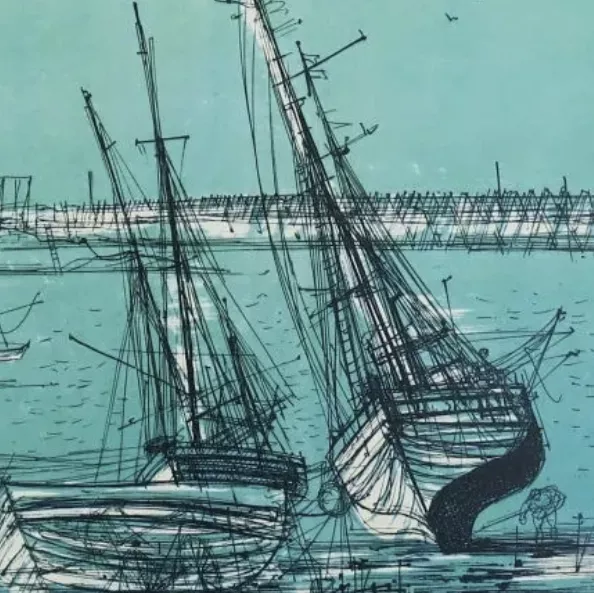
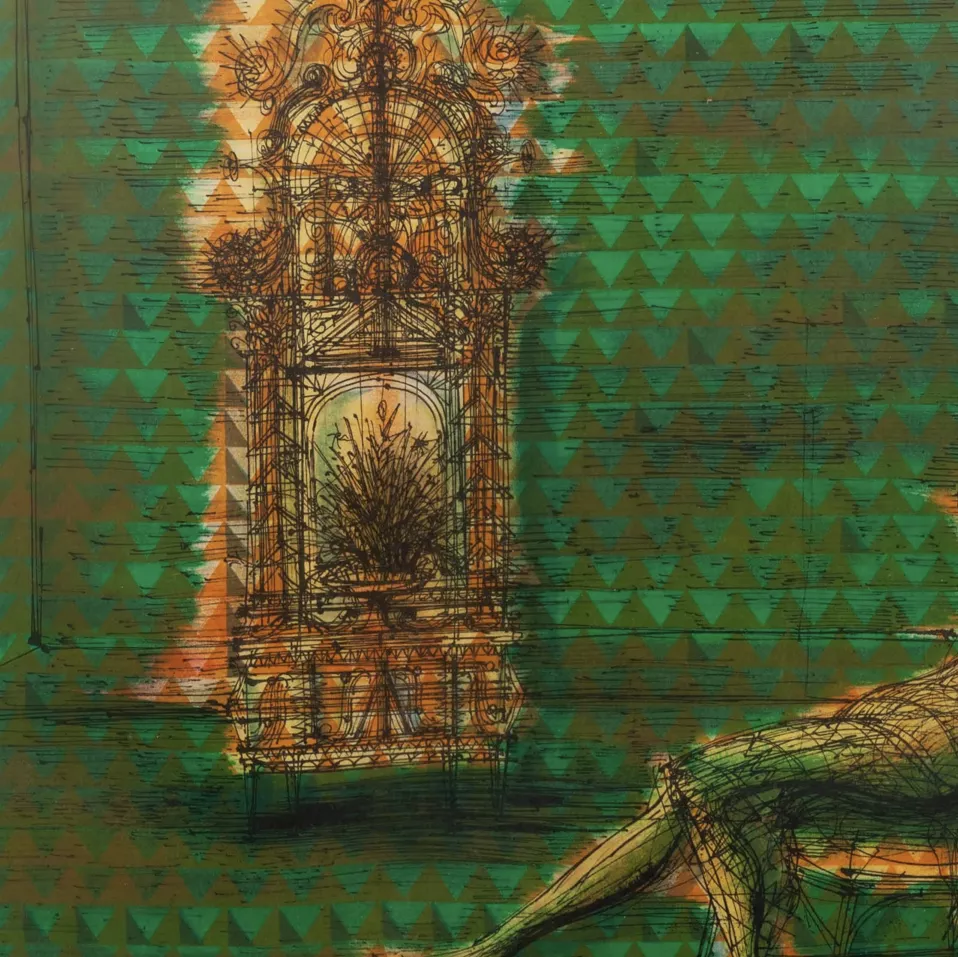
Jean Carzou develops an immediately recognizable pictorial language, where the rigor of the drawing structures space and imposes a network of interwoven, almost architectural lines.
His incisive, precise strokes evoke an etching in perpetual construction, a filigree world where reality seems to emerge from a graphic labyrinth.
Color intervenes in dabs, often in subtle flat tints or diffuse halos, reinforcing the dreamlike aspect of his compositions. His urban landscapes, imaginary architectures or almost spectral figures are bathed in subdued light, dominated by deep blues, ochres and muted reds.
His approach to the medium is equally characteristic: on canvas as on paper, he superimposes fine hatching and nervous curves, giving his works an almost tactile vibration.
Somewhat reminiscent of engraving and illustration, his technique also recalls the visions of a De Chirico in the strangeness of its moods and the solitude that emanates from them.
But with Carzou, the world does not freeze in metaphysical expectation: it seems in perpetual mutation, as if woven from a multitude of lines that sculpt space and capture light with a rare sensitivity.
The life of Jean Carzou
Jean Carzou, whose real name was Karnik Zouloumian, was born into an Armenian family in Aleppo in 1907. From an early age, he showed a marked interest in drawing, a means for him to capture a world in motion.
As a teenager, he moved to Cairo, where he continued his studies before settling in Paris in 1924.
Enrolling at the École spéciale d'architecture, he perfected his sense of composition and perspective, elements that would profoundly influence his work. He soon abandoned architecture for painting, developing a singular style where line dominates color, where line imposes its rhythm.
He began exhibiting in the 1930s, and found a public receptive to his universe of suspended spaces, imaginary cities and enigmatic figures.
His work as an illustrator also opened up new avenues, notably with lithographs created for works by Balzac and Rimbaud. After the war, his success grew, and he became a key figure on the French art scene.
Exhibitions in France and abroad consecrated his work, while he tried his hand at other media, from stained glass to tapestry.
Carzou thus explored different forms of expression, always with the same graphic precision that was his signature. He died in 2000, leaving behind a world of architectural visions, somewhere between reality and dream.
Focus on Les Tourments, Jean Carzou
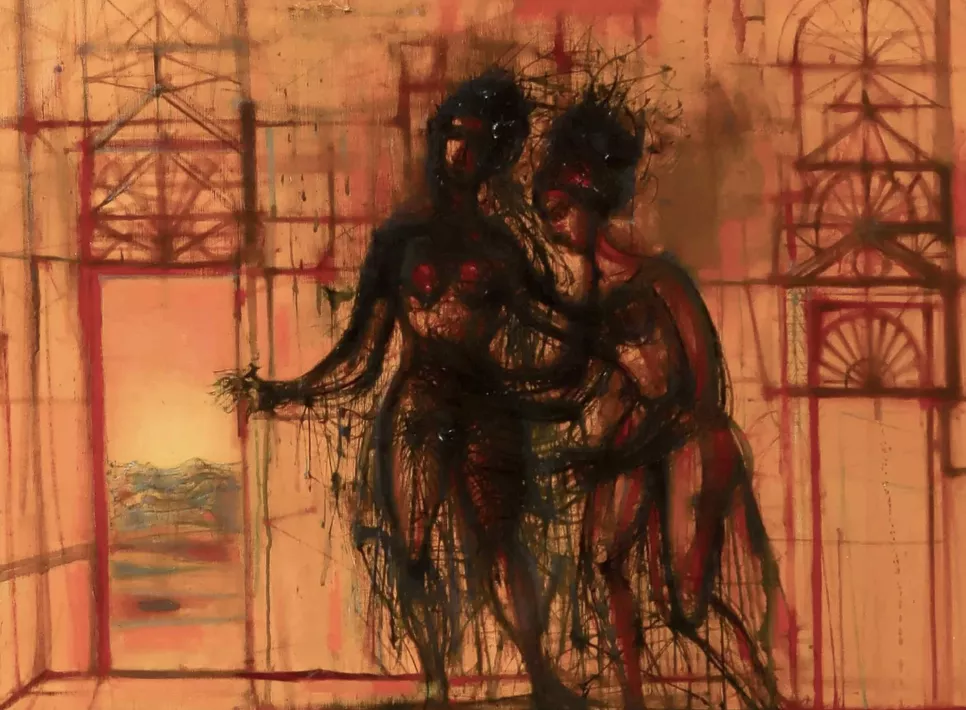
Les Tourments by Jean Carzou is a work in which anxiety seems inscribed in the very fabric of the painting. True to his graphic language, the artist constructs here a scene where space is dislocated under a network of nervous lines, interwoven like a spider's web.
The architecture is omnipresent here, but it is not reassuring: it fragments, cracks, becomes a prison. The lighting, often icy in Carzou's work, bathes the composition in a spectral glow, reinforcing the impression of a world suspended between reality and nightmare.
In the center, silhouettes appear, frail and almost spectral, as if imprisoned in this maze of sharp lines. Here, the artist pushes to the limit his work on the tension between line and color, structure and emotion.
The metallic blue that dominates the canvas in no way soothes the scene; on the contrary, it lends it an almost dramatic intensity.
Carzou, always fascinated by ruin and collapse, here offers a vision where man seems lost in a world that has become unreadable, where the very geometry of the setting becomes distressing.
The work thus illustrates all the visionary force of the artist, a painter of vertigo and instability, whose every stroke, with implacable precision, seems to shear the canvas with a dull anxiety.
Jean Carzou's legacy on his period
Jean Carzou stands out as a singular figure in twentieth-century painting, marking his era with an immediately recognizable graphic universe.
At a time when abstraction dominated the art scene, he chose a personal path, blending figuration and linear construction in an almost architectural approach to composition.
His style, dominated by a complex network of sharp lines, evokes both the fragility of the modern world and its imminent collapse.
Through this tension between rigorous drawing and intense color, Carzou influenced a generation of artists fascinated by the idea of structured pictorial space, yet haunted by emptiness and instability.
His work, which crosses painting, illustration and scenography, earned him recognition beyond the circle of visual artists, finding echoes in literature and theater.
Inscribed in an era marked by reconstruction and doubt, he leaves a lasting imprint, testifying to an anxious look at a world in perpetual mutation, where man always seems on the verge of disappearance.
The stylistic influence of Jean Carzou
Jean Carzou's work is part of a subtle dialogue between classical influences and the modern currents that run through the 20th century.
Trained in a context where drawing still structures the act of painting, he inherits the graphic rigor of the Renaissance masters, but also the linear expression peculiar to 19th-century engravers.
His attachment to the architectural construction of the painting brings him closer to the visions of Piranesi and the structured compositions of Cézanne, where space unfolds in ordered strata.
However, his universe marked by a dreamlike, melancholy atmosphere finds echoes in Symbolists like Odilon Redon or Alexandre Séon, who, like him, build worlds between reality and dream.
The influence of surrealism can also be seen in his deserted urban landscapes, where man seems erased by a relentless mechanics of lines and structures, reminiscent of certain visions by Yves Tanguy.
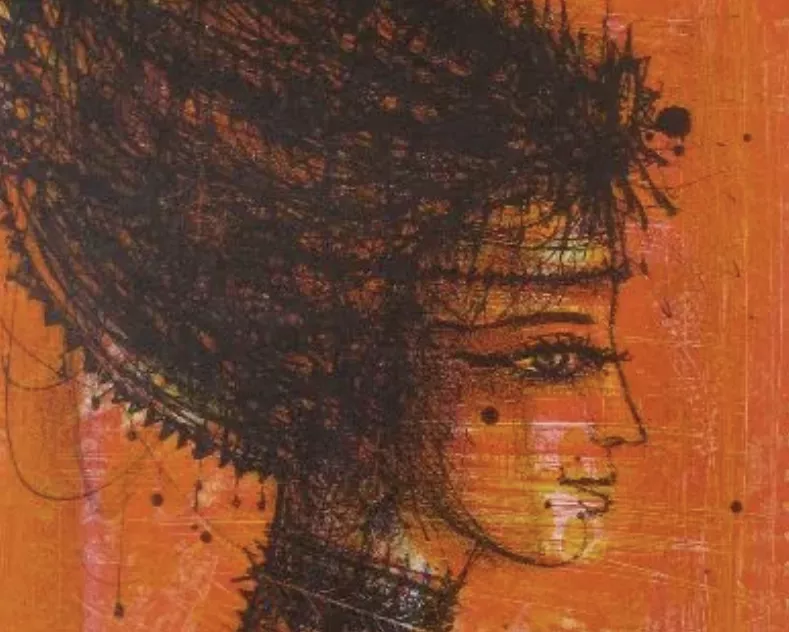
This graphic sensibility is complemented by a vivid palette that evokes post-impressionism and Byzantine art, where color, applied in flat tints or vivid highlights, seems to illuminate his compositions like stained-glass windows.
Through this fusion of heritages, Carzou forges an immediately identifiable style, where the precision of the line dialogues with the poetry of mystery.
Jean Carzou's place in Syrian painting
Although Jean Carzou built most of his career in France, his work maintains a deep link with his Syrian roots, inscribing his name among the leading figures of twentieth-century Oriental-inspired art.
While Syrian painting is rooted in figurative and calligraphic traditions, Carzou brings a singular approach to it, where Eastern heritage merges with a modernity nourished by European influences.
His taste for labyrinthine architecture and desert landscapes joins Syrian artists' fascination with the memory of place and the evocation of the sacred.
Like Mahmoud Hammad or Fateh Moudarres, he explores an aesthetic where abstraction and figuration interpenetrate, but he distinguishes himself from them by a sharp line and a rigorous structuring of space.
While his name often remains associated with the Parisian school, his work extends a reinvented Orientalist imaginary, where light and intense colors echo the pictorial traditions of the Levant.
Through this dual affiliation, Carzou inscribes his work in a dialogue between East and West, contributing to the recognition of a Syrian modernity with universal resonances.
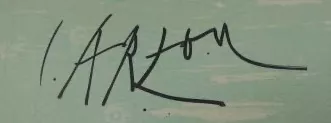
His signature
Not all of Jean Carzou's works are signed.
Although there are variations, here is a first example of his signature:
Expertise your property
If you own a work by Jean Carzou, don't hesitate to request a free appraisal by filling in our online form. A member of our team of experts and licensed auctioneers will contact you to provide an estimate of the market value of your work.
If you are considering selling your work, our specialists will also guide you through the various alternatives available to obtain the best possible price, taking into account market trends and the specific features of each work.
.Estimate in less than 24h
Discover in the same theme

Rating and value of works, drawings, paintings by Keith Hari...
Keith Haring is a twentieth-century painter, draughtsman and graphic artist who produced drawings and paintings in a variety of media that are listed.
Learn more >

Rating and value of paintings by Arnold Borisovich Lakhovsky
Arnold Lakhovsky is a Russian painter who produced many paintings that are highly valued at auction. 100% free estimate
Learn more >

Rating and value of sculptures and drawings by Emile Gilioli
Emile Gilioli was a 20th-century abstract sculptor who created numerous works that command high prices at auction.
Learn more >
Similar works sold at auction

Estimated 1.500 - 3.000
Henri MEGE (1904-1984), oil on canvas

Estimated 5.000 - 10.000
Jean Roger SOURGEN (1883-1978), Lake and pine forest, oil on canvas

Estimated 2.000 - 3.000
Raymond THIBÉSART (1874-1968) Apple trees in blossom, oil on canvas

Estimated 1.000 - 2.000
Lucien GOUBERT (1887-1964), Rochers à Fermanville, oil on canvas

Estimated 1.000 - 2.000
TRAN DUY (1920-2014). École des beaux-arts de l'Indochine, preparatory class 1945, ink and color painting on silk

Estimated 3.000 - 5.000
Alphonse OSBERT (1857-1939) "Le soir" Oil on canvas

Secure site, anonymity preserved

Auctioneer approved by the State

Free and certified estimates
Frequently asked questions
-
Who was Jean Carzou, and what was his artistic style?Jean Carzou (1907–2000), born Karnik Zouloumian in Aleppo, was a Franco-Syrian painter, draftsman, and illustrator. His unique style blends figurative art with rigorous linear composition, characterized by a network of sharp, intersecting lines that structure space in an almost architectural manner. His dreamlike and melancholic compositions, dominated by deep blues, ochres, and muted reds, evoke imaginary cities and spaces suspended between reality and dreams.
-
What is the current market value of Jean Carzou's works?Jean Carzou’s works sell for between €10 and €30,490 at auction. Estimates vary by medium: prints range from €10 to €2,500, drawings and watercolors from €10 to €22,770, and paintings from €20 to €30,490. The artist enjoys a stable and strong reputation among collectors, particularly those interested in his style and distinctive graphic universe.
-
How can you authenticate and appraise a work by Jean Carzou?To authenticate and appraise a work by Jean Carzou, we recommend that you request a free, no-obligation appraisal from Auctie's. Our auctioneers and certified experts will examine your artwork and provide you with an accurate estimate of its market value within 48 hours. This process will give you a reliable appraisal before you make any decision to sell.
-
Is this the right time to sell a work by Jean Carzou?Yes, now is a good time to sell a work by Jean Carzou. The artist enjoys a stable and strong market valuation, with high demand from collectors drawn to his unique visual style and his significant influence on 20th-century painting. His status as a major figure in the French art scene ensures a steady following and enduring interest in his works.
-
How does the sale of a work of art work at Auctie's?Auctie's guides you from appraisal to auction. After receiving a free appraisal of your artwork from our auctioneers and experts, we will recommend the best sales approach to achieve the highest possible price, taking into account market trends and the unique characteristics of each piece. We’ll manage the entire process to maximize the value of your item.
