



Rating and value of paintings by Lynne Drexler

Key takeaways
- Prices for Lynne Drexler’s works range from €130 to €1,239,500, with strong demand from French buyers for her oil-on-canvas paintings.
- Her oil on canvas "Airlee" (1960/62) sold for €1,239,000 in 2024, confirming the stability of her market value.
- An American artist (1928–1999) associated with Abstract Expressionism, she has been rediscovered since 2010 for her personal style blending visual rhythm, structural color, and musical influences.
If you own a work by artist Lynne Mapp Drexler or after, and would like to know its value, our state-approved experts and auctioneers will offer you their appraisal services.
Our specialists will work to carry out a free appraisal of your work, and will provide you with an accurate estimate of its value on the current market.
Then, if you wish to sell your work, we will direct you to the best possible arrangement to obtain the optimum price.
Rating and value of the artist Lynne Mapp Drexler
Lynne Mapp Drexler is a little-known American artist of the 19th century. Now, prices for her works are rising at the auctioneers' gavel.
Her oil paintings are particularly prized, especially by French buyers, and the price at which they sell on the art market ranges from €130 to €1,239,500, a considerable delta but one that speaks volumes about the value that can be attributed to the artist's works.
In 2024, his oil on canvas entitled Airlee, dating from 1960/62 was sold for €1,239,000, while it was estimated at between €763,000 and €1,144,000. Its value is stable.
Order of value from a simple work to the most prestigious
Technique used | Result |
|---|---|
Drawing - watercolor | From €130 to €338,000 |
Painting | From €60 to €1,239,500 |
Estimate in less than 24h
Style and technique by artist Lynne Mapp Drexler
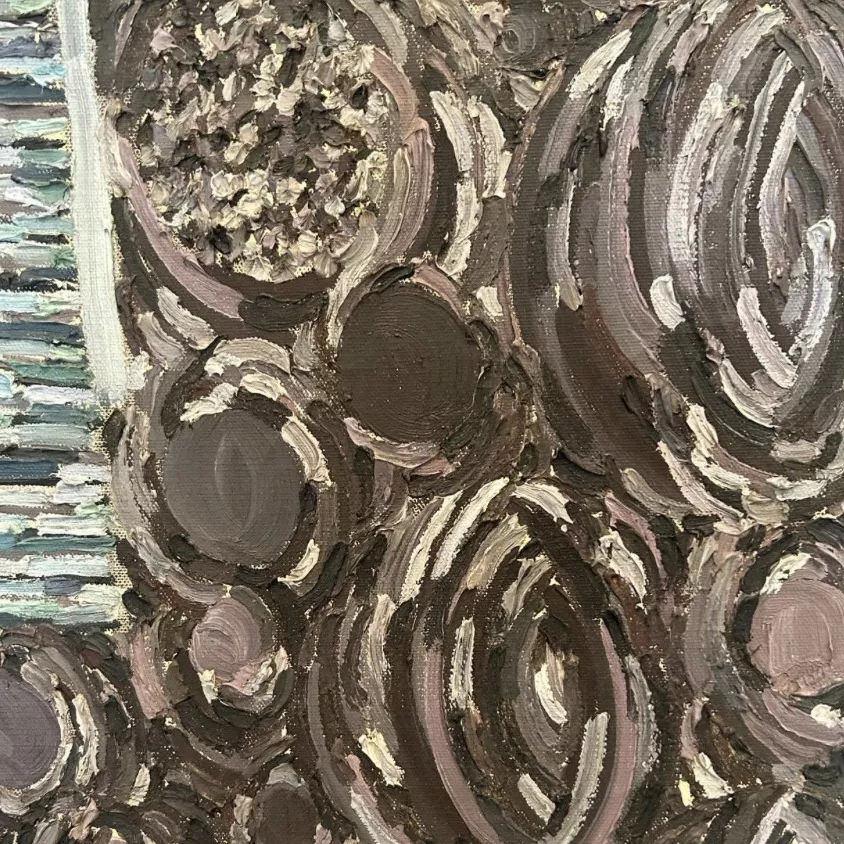
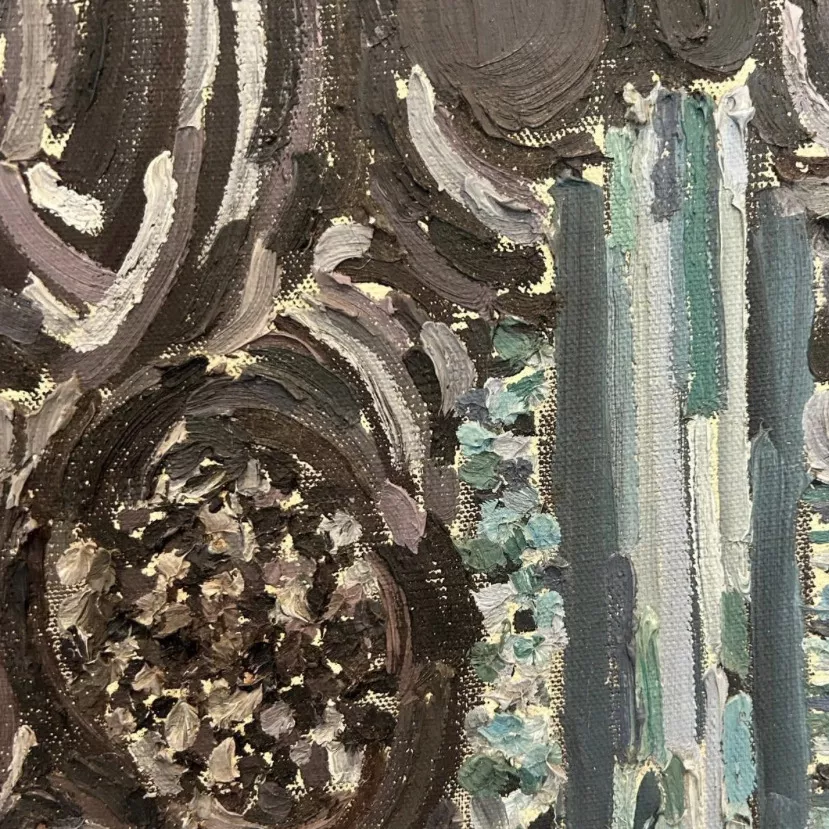
Lynne Mapp Drexler (1928 - 1999) is an American painter associated with abstract expressionism and the Maine art scene. The artist developed a distinctive style that blends abstract expressionism, ornamental motifs and musical influences.
Her works often consist of small, repeated forms such as rectangles, dots or patches of color, juxtaposed in a rhythmic structure.
This repetition gives her painting a musical dimension, evoking counterpoint or the visual figure. She uses oil on canvas or acrylic on paper, with a dense, layered application : the layers of color interpret each other without merging.
The brushstroke is often rapid, repetitive and laid down in tight units, creating a vibrant texture. She works in all-over (i.e., the surface is entirely invested), with no hierarchy between center and edges.
Her painting is marked by a vivid, contrasting palette (bright pinks, oranges, acid greens, deep blues and luminous yellows). She juxtaposes complementary or dissonant colors, in an intuitive rather than theoretical logic.
Color is never decorative but structural, expressive and emotional, guided by intuition. Her painting is directly influenced by music. The artist, who trained on the piano in her youth, has transferred her musical sensibility into her painting, particularly in the visual rhythm and chromatic resonances.
She herself speaks of her painting as a score, where every touch of color is a note and every canvas a sound construction.
The influence of classical music (Bach and Mozart, among others) can be read in the repetitive, balanced structure of her compositions. After settling on Monhegan Island, Maine, she developed an abstraction nourished by the observation of natural textures: foliage, rocks, vegetation and light.
Her abstraction always remains linked to the sensitive world, even if it is never descriptive. She captures the organic rhythm of the landscape more than its form. Unlike her male Abstract Expressionist contemporaries, Drexler cultivates a more intimate, meditative painting style, less gestural and more constructed.
She also resists the dominant trends of her time, pursuing a personal language of repetition, listening and colorful intuition. Now rediscovered, her work is recognized for its plastic rigor.
The life of Lynne Mapp Drexler
Lynne Mapp Drexler (1928 - 1999) is an American painter who was long marginalized and was recently rediscovered. Born in 1928 in Newport, Virginia (USA), her childhood was marked by a dual passion for classical music and drawing, which she pursued in parallel throughout her life.
She studied art at the Richmond Professional Institute, then at Hunter College in New York, where she was a student of Robert Motherwell and Hans Hofmann, two key figures in Abstract Expressionism. In the 50s/60s, she moved to New York, a city in the midst of post-war artistic effervescence.
She frequented the Abstract Expressionist scene, but remained aloof from its most prominent circles (Pollock, de Kooning ...) to the image of Janet Sobel or Judit Reigl. Her highly personal approach (structure, color and influence of music) didn't match the masculine canons of the time.
She married painter John Hultberg in 1962. The couple traveled extensively, living in California, Mexico and New York. At the end of the 1960s, she discovered Monhegan Island, off the coast of Maine, a fisherman's island with a wild landscape, where she settled permanently in 1963.
The voluntary isolation she chose allowed the development of an autonomous pictorial language, nourished by the natural environment and the rhythm of solitude. She continued to paint intensely throughout the 1980s and 1990s, despite virtually no exhibitions or public recognition.
Lynne Dexler lives in modest conditions, in a studio house overrun with her canvases, sketches and musical scores. Her work remained largely unknown to the art market until her death in 1999 at the age of 71.
From the 2010s, her work was rediscovered at studio sales and retrospectives. She is now recognized as one of the great singular voices of American abstraction, at the crossroads of music, nature and color.
Her life and work illustrate the destiny of a visionary artist who remained on the bangs, but whose formal and sensory power is now fully acclaimed.
Focus on Composition, Lynne Mapp Drexler, 1962
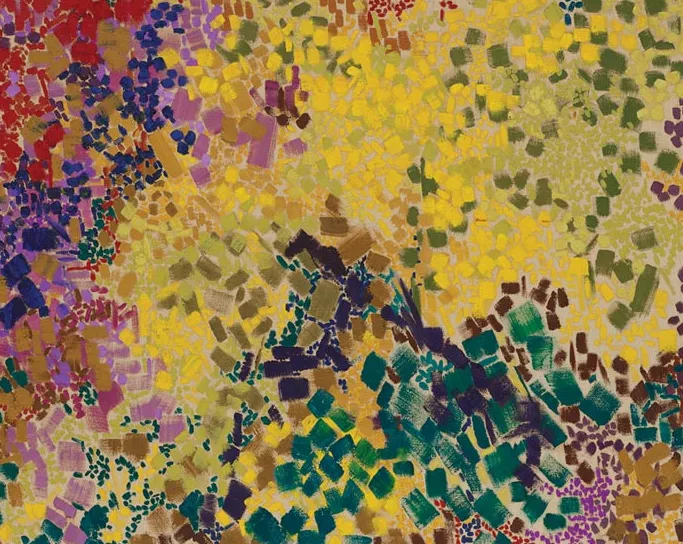
Composition is a 1962 oil-on-canvas painting by Lynne Drexler. It is held in a private collection and is entirely representative of her New York period. Measuring 76 x 102 cm, the work illustrates the transition between lyrical abstract expressionism and rigorous color construction.
The canvas is constructed by superimposing small rectangular or square strokes, juxtaposed evenly but without geometric rigidity. The whole evokes a moving mosaic, a weaving of light and matter.
There is no spatial hierarchy, the eye moves freely. The colors are bright and saturated (lemon yellows, cherry reds, cobalt blues, emerald greens), laid down in blocks.
Drexler plays with temperature contrasts and vibrant chromatic chords, creating a continuous luminous tension. The rhythm of the repeated but varied strokes gives the surface a visual pulsation, like an expanding pattern.
The artist applies paint with a brush, in visible layers, with a lively but controlled material. The texture remains flat, but the slight irregularity of the strokes creates subtle optical effects.
This work perfectly embodies the way Drexler transposes his musical experience (particularly Baroque and Classical) into visual rhythm. Each key is designed to become a note and each chromatic variation to become a modulation.
The image therefore reads like a fugue or a repeated variation. The canvas represents nothing but evokes a continuous sensation and a listening to time through color.
This work thus marks a moment when Drexler emancipates himself from the dominant codes of abstract expressionism in order to construct a personal language based on repetition, vibration and sensation.
This is a pivotal work, still marked by the New York of the 1950s, but already turned towards the rhythmic and chromatic structures she would develop at Monhegan Island.
Recognizing the artist's signature
Lynne Drexler does not necessarily sign her works. Copies may exist, which is why expertise remains important.
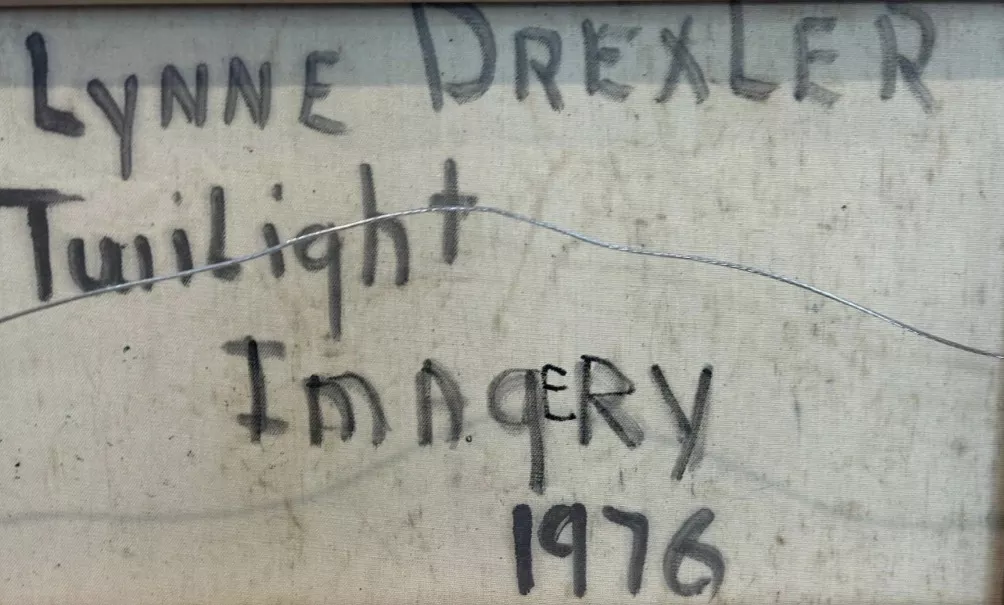
Knowing the value of a work
If you happen to own a work by or after Lynne Drexler, don't hesitate to request a free appraisal using our form on our website.
A member of our team of experts and chartered auctioneers will contact you promptly to provide you with an estimate of the market value of your work, as well as ad hoc information about it.
If you are considering selling your work, you will also be accompanied by our specialists in order to benefit from alternatives for selling it at the best possible price, taking into account market inclinations.
Estimate in less than 24h
Discover in the same theme

Rating and value of paintings by Lin Fengmian
Lin Fengmian is an avant-garde Chinese painter who has produced numerous paintings that are highly valued on the art market.
Learn more >

Rating and value of paintings by Pierre de Clausade
Pierre de Clausade is a twentieth-century French landscape painter who produced paintings of fairly high value.
Learn more >

Rating and value of paintings and drawings by Le Van De
Van De is a painter from Vietnam's early modern period whose works command high prices and are highly valued at auction.
Learn more >
D'autres tableaux abstraits vendus aux enchères

Estimated 2.000 - 4.000
Serge POLIAKOFF (1900-1969), Composition en rouge et bleu. 1965, Lithograph

Estimated Between €5,000 and €8,000
Jean MIOTTE (1926-2016), acrylic on canvas

Estimated 3.000 - 5.000
Roberto MATTA (1911-2002), Composition, Gouache on canvas

Secure site, anonymity preserved

Auctioneer approved by the State

Free and certified estimates
Frequently asked questions
-
Who is Lynne Mapp Drexler, and what is her artistic background?Lynne Mapp Drexler (1928–1999) was an American painter associated with Abstract Expressionism who was long marginalized but has recently been rediscovered. Trained under Robert Motherwell and Hans Hofmann, she developed a personal style blending abstraction, repetitive forms, and musical influences, while remaining outside the dominant male-led artistic norms of her time. Her work is now recognized as one of the great, distinctive voices of American abstraction.
-
What is the price range for Lynne Drexler's works?Prices for Lynne Drexler’s works vary considerably depending on the medium and period: drawings and watercolors range from €130 to €338,000, while paintings range from €60 to €1,239,500. In 2024, her oil on canvas “Airlee” (1960/62) sold for €1,239,500, slightly exceeding its estimate of €763,000 to €1,144,000. His market value remains stable.
-
How can you authenticate a work by Lynne Drexler and determine its value?To authenticate a work of art and determine its value, we recommend that you request a free appraisal from Auctie's using our online form. A certified expert or auctioneer will contact you within 48 hours to evaluate your piece and provide you with an accurate estimate based on current market conditions, with no obligation on your part.
-
Is this a good time to sell a work by Lynne Drexler?Yes, this is a good time to sell a work by Lynne Drexler. The artist has been experiencing a significant resurgence in popularity since the 2010s; her market is expanding, particularly among French collectors, and her market value is currently stable and on the rise. The growing interest in the forgotten figures of American abstraction is driving demand for her work.
-
How does the sales process work at Auctie's?At Auctie's, the process is simple and transparent: you start by requesting a free, no-obligation estimate. After our certified auctioneers have appraised your piece, we’ll present you with the best sales options and guide you through the entire process—from the appraisal to the auction—to help you achieve the best possible price based on current market trends.
