



Rating and value of paintings by Jean Dubuffet

Key takeaways
- Works by Jean Dubuffet, the 20th-century French painter and founder of Art Brut, sell for between €10 and €19.6 million, depending on the medium and rarity.
- Oil paintings fetch the highest prices (up to €19.6 million), while prints and drawings range from €10 to €3.65 million.
- Dubuffet rejected academic art, used raw materials (sand, tar, plaster), and drew inspiration from the works of children and people with mental illness to create a spontaneous and instinctive style.
If you own a work by or after the artist Jean Dubuffet, and would like to know its value, our state-approved experts and auctioneers will offer you their appraisal services.
Our specialists will carry out a free appraisal of your work, and provide you with a precise estimate of its value on the current market.
Then, if you wish to sell your work, we will direct you to the best possible arrangement to obtain the optimum price.
Rating and value of the artist Jean Dubuffet
Jean Dubuffet is a French painter of the 20th century. He leaves behind a unique artistic repertoire characteristic of art brut. This legacy consists of paintings that are predominantly oils on canvas.
At present, the prices of his works are flying off the auctioneers' hammers. His paintings and other works are particularly prized, especially by French buyers, and the price at which they sell on the art market ranges between €10 and €19,646,000, a considerable delta but one that speaks volumes about the value that can be attributed to Dubuffet's works.
In 2015, a purple-dominated polychrome composition entitled Paris Polka sold for €19,646,00 while it was estimated at €22,325,000.
Order of value from a simple work to the most prestigious
Technique used | Result |
|---|---|
Estamp | From €10 to €146,900 |
Sculpture - volume | From €500 to €2,522,230 |
Drawing - watercolor | From €60 to €3,650,000 |
Oil painting | From €110 to €19,646,000 |
Estimate in less than 24h
Style and technique of artist Jean Dubuffet
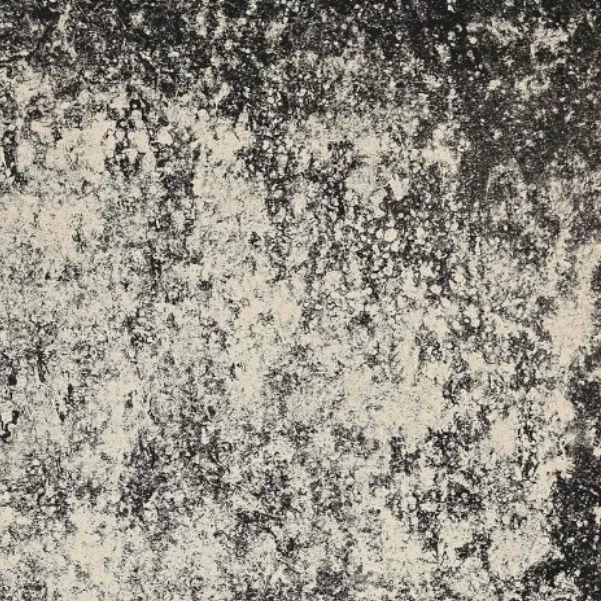
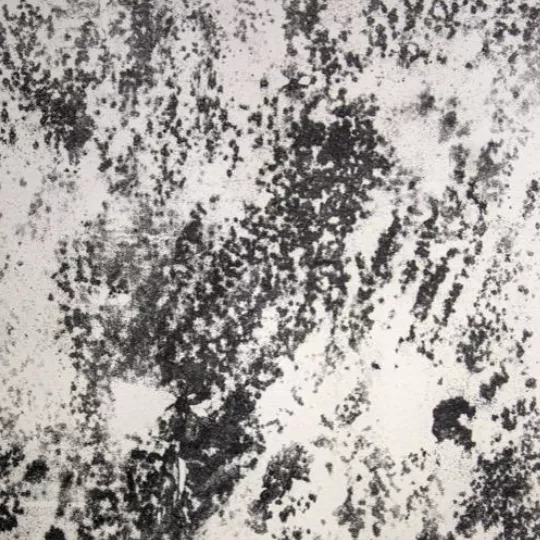
Jean Dubuffet doesn't try to please. He rejects the codes of traditional art and paints with raw materials, sand, tar and thick paint. He scratches, scrapes and superimposes. His colors are frank, often raw.
He loves awkward shapes, simplified silhouettes reminiscent of children's drawings. He draws his inspiration from the art of the marginalized, inventing "art brut". He finds his models among self-taught artists, outcasts and mental hospital patients.
He rejects the idea of beauty and focuses on spontaneous, instinctive creation, far removed from academic refinement. He experiments constantly, incorporating plaster, pebbles, papier-mâché. His canvases are dense, almost sculpted, like surfaces in motion.
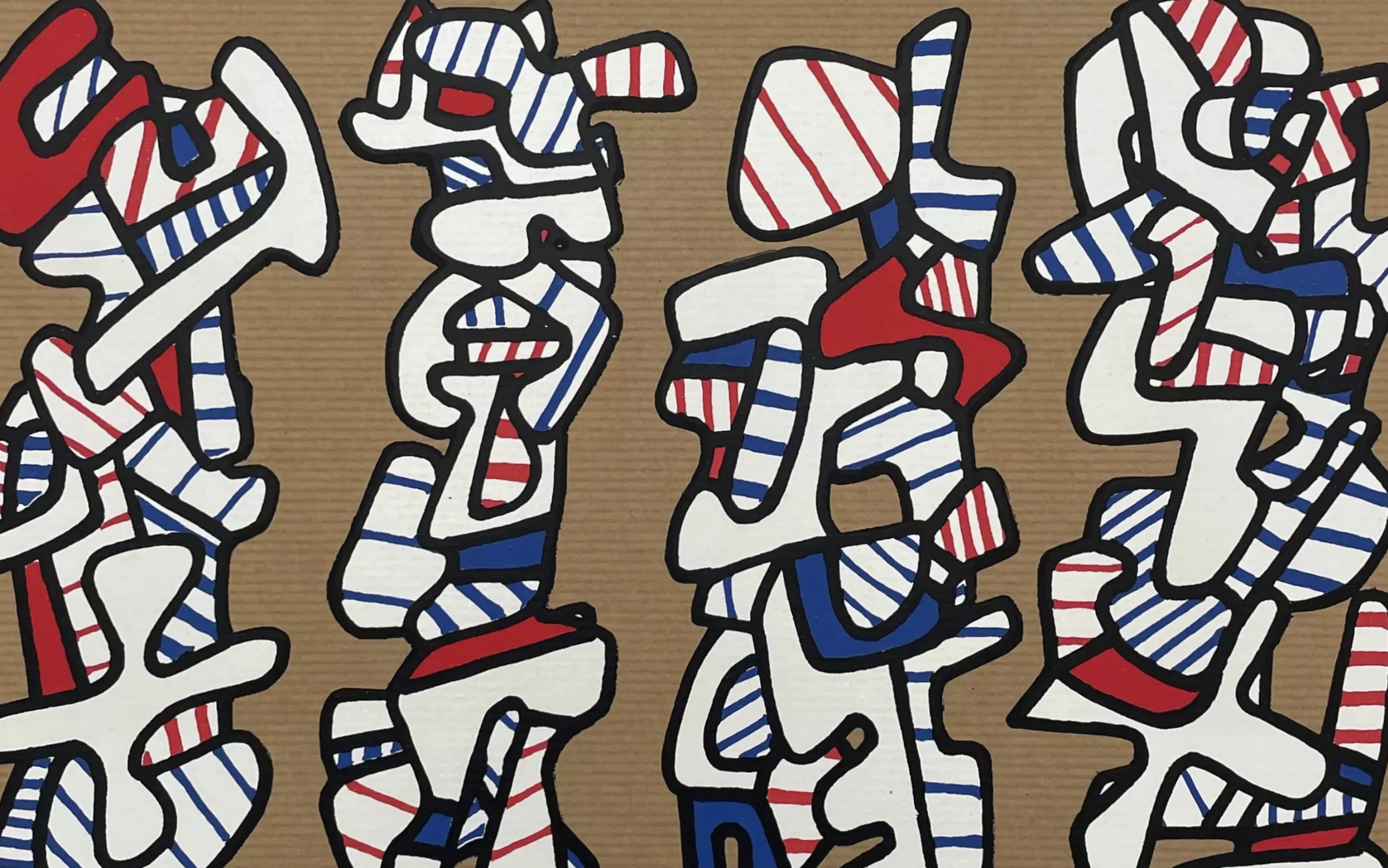
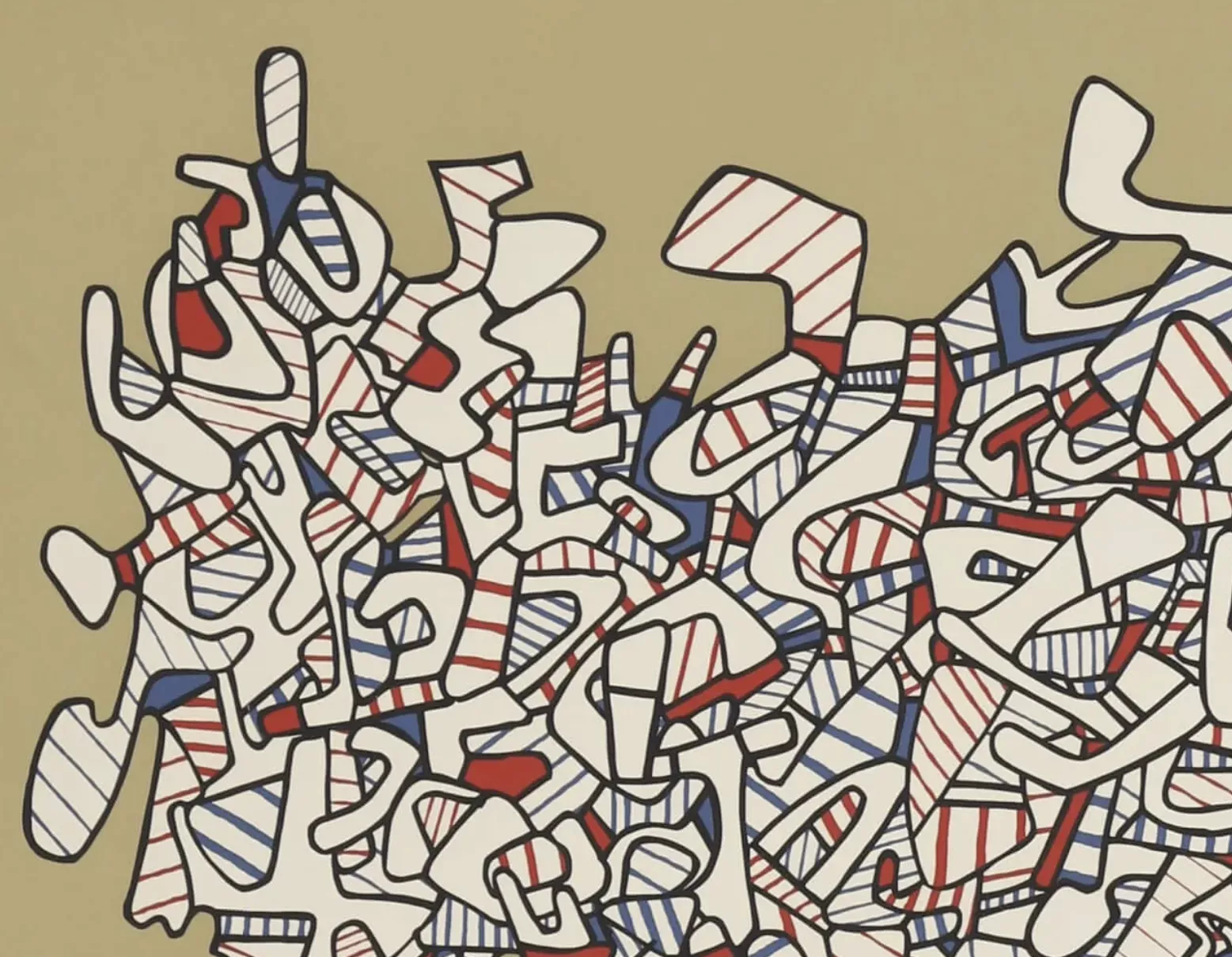
He seeks not illusion but matter. In the 1960s, he created the "Hourloupe" series, compositions in which black lines enclose red, blue and white solids, like a visual labyrinth. He applied this style to monumental sculptures, architectures with strange, shifting forms.
He covered entire facades, building spaces where everything seemed to float. He also creates sets, costumes, posters, always in this nervous graphic writing.
He explores lithography, drawing, ink, each technique becoming a playground. His work retains a raw energy, a spontaneity that marks twentieth-century art.
Jean Dubuffet, a prized painter
Jean Dubuffet (1901-1985), a French artist, has become a sought-after figure among collectors.
He was born into a bourgeois family of wine merchants in Le Havre. He didn't like high school, and from the second year onwards attended the Ecole des Beaux-Arts in Le Havre. Gaston Chaissac, painter of the art brut movement, also took his classes.
Frustrated by his environment, he attended the Académie Julian for a while and tried his hand at literature and music. He met Max Jacob, Fernand Léger and André Masson. He searches for himself for a long time and writes that he is " not adapted to his human condition ".
He trades in wine and travels for a while, then starts painting again in a crusade against museum art, preferring to draw inspiration from the art of madmen.
He continues his commercial activities at the same time, but is labeled a quasi-underground painter. He is mobilized by the French Air Force, then reassigned to Rochefort for indiscipline.
After the Second World War, he is exhibited by Galerie René Drouin, which brings him further notoriety. The exhibition was moderately well received by the public, with many calling it provocative and some calling it a sham, and the same was true of subsequent exhibitions.
There is talk of deliberate clumsiness. After these events, he travels to Africa to find new inspiration.
He also travels to the United States, where he exhibits and where some of his works are still preserved, before opening the Fondation Dubuffet at the end of his life, which will then hold his Art Brut collection.
Jean Dubuffet dies in 1985 in Paris, aged 83.
Focus on Jardin d'Hiver, Jean Dubuffet, 1974
Jean Dubuffet built Le Jardin d'Hiver in 1974. It's not a painting, it's a space, a white labyrinth streaked with black. He didn't want a simple painting hung on the wall, he wanted the viewer to enter the work, to walk through it.
The shapes are rounded, the surfaces irregular, as if everything had been sculpted freehand. There's no top or bottom, no perspective, just a tangle of lines and volumes.
He plays with material, using painted polyester to create a universe that seems to move. Nothing is fixed, everything is organic, almost alive.
He wants to break the codes of the museum, transforming art into an experience. We no longer look at a work, we enter it. He wants art to be an environment. He imagines a world that escapes the rules, a landscape where we walk without landmarks.
White dominates, enhanced by edgy black lines that trace abstract patterns. Everything seems to have come out of a child's drawing, a doodle turned into architecture. There are alcoves, nooks and crannies, meandering curves. You never know where it begins or ends.
He wants to create a playful space, a free territory where the imagination takes over. You walk through Le Jardin d'Hiver as if in a dream, lost between abstraction and childhood.
You can sit in it, hide in it, get lost in it. The work imposes nothing, leaving room for play and wandering. Dubuffet speaks of a world without weight, without constraint, a parenthesis out of time. The work is both disconcerting and fascinating, a condensation of his universe, between chaos and freedom.
Jean Dubuffet's imprint on his period
Jean Dubuffet shook up the art of his time. He rejects norms, rejects tradition, seeks a new path. He defended art brut, that spontaneous, instinctive, untutored art. He opposes conventions, academies and museums. He uses sand, tar, raw materials.
He scratches, he scrapes, he pastes. His canvases seem to have emerged from another world. People talk about wild art, crazy painting. Some see it as a sham, others as a revolution.
He's criticized, mocked, but he forges ahead. He exhibits without seeking approval, he writes, he builds a body of work that resembles him. He doesn't compromise. He disturbs, but he asserts himself. He influences a generation of artists who in turn explore new forms.
He is followed by the New Realists, watched by Americans, sought after by galleries. He doesn't like frames, so he makes them disappear.
He wants art without constraints, without hierarchy, where anything is possible. He invests the city, imagining environments where art becomes a space. He created Le Jardin d'Hiver, his Hourloupe, transforming the landscape.
His works are exhibited in the greatest museums. He leaves a powerful legacy, a new language, a freedom he wrested.
Jean Dubuffet's role in Art Brut and his stylistic influences
Jean Dubuffet, always steering clear of the influences of the great schools, finds his inspiration in children's drawings, graffiti, but above all in works created by the mentally ill. For him, art must be pure, uninfluenced, unconstrained, springing from intuition, from madness.
Dubuffet explored this path, surrounding himself with little-known artists such as Augustin Lesage and Adolf Wölfli, and developing a radical vision. He seeks an instinctive, raw, untutored art, where expression takes precedence over technique.
He meets Augustin Lesage, Adolf Wölfli and other creators of art brut, their rule-free approach inspiring him. He also discovers the works of Van Gogh and Paul Klee, whose simplicity and expressive power appeal to him. But it's not in tradition that he seeks his art.
He looks elsewhere, in what is often considered marginal, in what escapes convention. He wants free art, without hierarchy or technique. Art that springs from intuition, from madness, without learning or constraint.
He exerted a considerable influence on twentieth-century art, ranging from world-famous artists such as Keith Haring to lesser-known artists such as Gaston Chaissac.
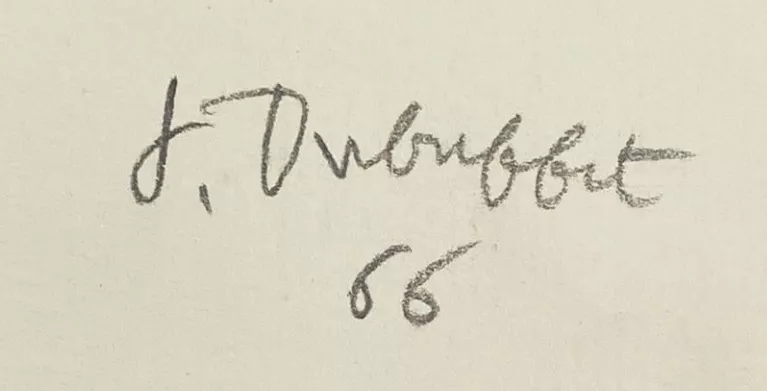
His signature
Not all of Jean Dubuffet's works are signed.
Although there are variations, here is a first example of his signature :
Knowing the value of a work
If you happen to own a work by or after Jean Dubuffet, don't hesitate to request a free appraisal using our form on our website.
A member of our team of experts and licensed auctioneers will contact you promptly to provide you with an estimate of the market value of your work, not forgetting to pass on ad hoc information about it.
If you are considering selling your work, you will also be accompanied by our specialists in order to benefit from alternatives to sell it at the best possible price, taking into account market inclinations.
Estimate in less than 24h
Discover in the same theme

Rating and value of World War II and Holocaust paintings
Paintings related to the Second World War are highly prized on the auction market. Their value is often very high.
Learn more >

Rating and value of paintings by Odette Pauvert
Odette Pauvert is a French artist who produced mainly landscape paintings but also religious subjects.
Learn more >

Rating and value of drawings and paintings by Jean Peské
Jean Peské is a French-Polish artist who has produced numerous works that command high prices at auction.
Learn more >
Works from the same period sold at auction

Estimated 30 € - 50 €
In the spirit of Keith HARING (1958-1990), Pregnant woman and "radiant baby".

Estimated 4.000 - 6.000 €
GASTON CHAISSAC (1910-1964) Composition 1947, Gouache and Indian ink on paper.

Estimated 3.000 - 5.000
After Keith HARING (1958-1990), Radiant baby, Color lithograph

Secure site, anonymity preserved

Auctioneer approved by the State

Free and certified estimates
Frequently asked questions
-
Who is Jean Dubuffet, and what is his role in art history?Jean Dubuffet (1901–1985) was a 20th-century French painter and the founder of the Art Brut movement. He revolutionized art by rejecting traditional academic conventions and drawing inspiration from marginal sources such as children’s drawings, graffiti, and the works of self-taught artists. His spontaneous and instinctive approach, using raw materials such as sand and tar, profoundly influenced subsequent generations of artists.
-
What are the prices and price ranges for works by Jean Dubuffet?Jean Dubuffet’s works vary widely in price depending on their medium and significance. Prints range from €10 to €146,900, drawings and watercolors between €60 and €3,650,000, while oil paintings—his major works—range from €110 to €19,646,000. Sculptures and three-dimensional works fetch prices ranging from €500 to €2,522,230, reflecting the diversity and growing value of his body of work.
-
How do I have a work by Jean Dubuffet authenticated and appraised?To have a work by Jean Dubuffet authenticated and appraised, we recommend that you submit a request for a free, no-obligation estimate with Auctie's. A state-certified expert or auctioneer will examine your artwork and provide you with an accurate estimate of its market value within 48 hours. This appraisal is an essential prerequisite before proceeding with any sale.
-
Is this the right time to sell a work by Jean Dubuffet?Yes, now is a good time to sell a work by Jean Dubuffet. His paintings and other works are particularly sought after by French and international collectors, and prices regularly reach record highs at auction. Demand for this major 20th-century artist remains strong, offering good sales opportunities for owners.
-
How does an art sale work at Auctie's?At Auctie's, we guide you from the initial appraisal through to the auction. Following a free initial appraisal by our certified experts, we offer you the best options for selling your artwork at the best possible price, taking market trends into account. Our team of auctioneers manages the entire sales process through to its completion, guaranteeing professionalism and transparency.
