



Rating and value of paintings by Camille Hilaire

Key takeaways
- Camille Hilaire (1916–2004), a leading figure in Post-Cubism, has paintings that fetch prices ranging from €5 to €30,720 on the current market.
- Oil paintings dominate his body of work and are his most highly valued pieces, while prints range in price from €5 to €1,100.
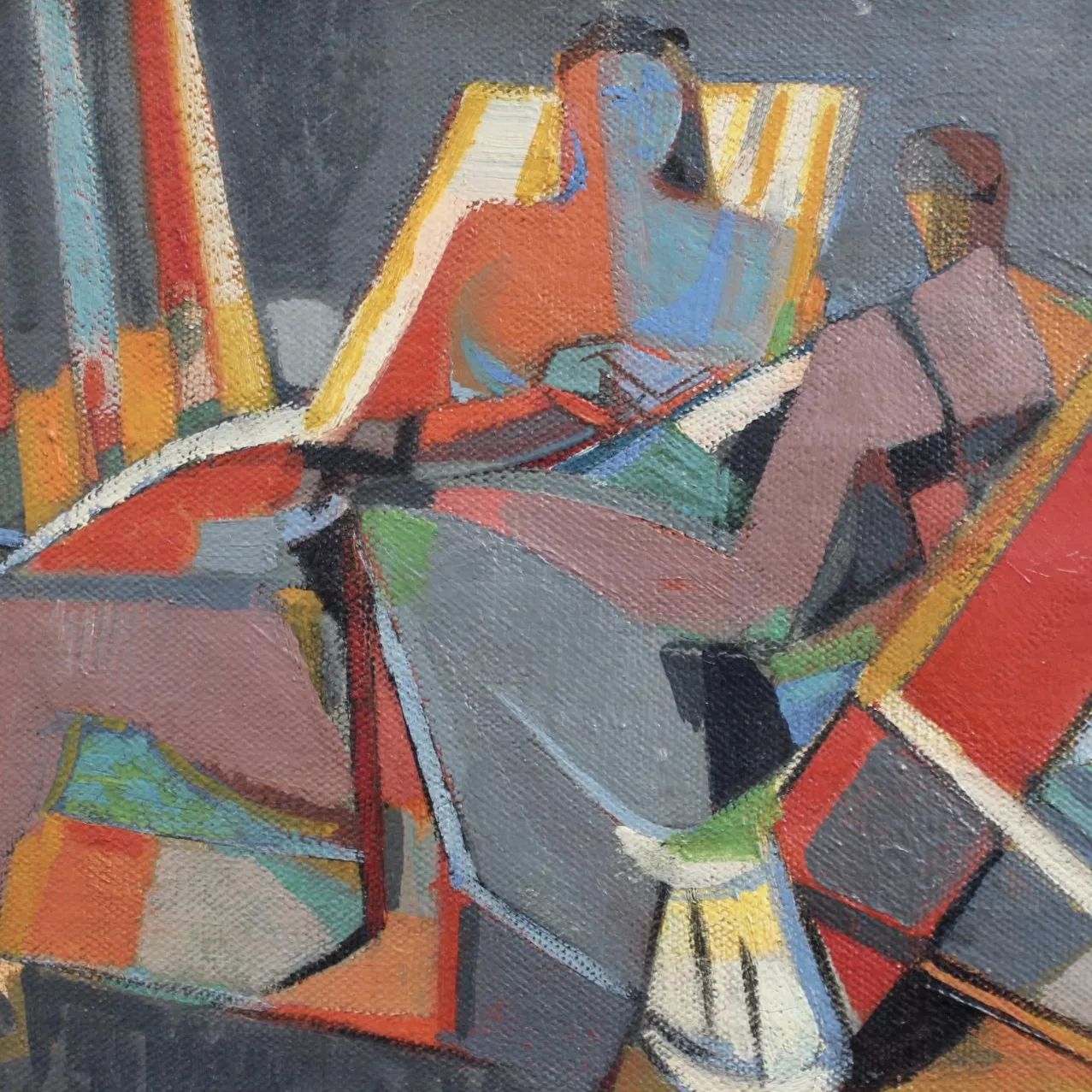
- His style blends figurative art and Post-Cubism, featuring luminous color palettes (greens, blues, yellows) applied to geometrically structured landscapes, nudes, and equestrian scenes.
If you own a work by or after the artist Camille Hilaire, and would like to know its value, our state-approved experts and auctioneers will offer you their appraisal services.
Our specialists will carry out a free appraisal of your work, and provide you with a precise estimate of its value on the current market.
Then, if you wish to sell your work, we will direct you to the best possible arrangement to obtain the optimum price.
Rating and value of the artist Camille Hilaire
Considered one of the leaders of post-cubism, Camille Hilaire participated in the artistic revolution of the 20th century. This legacy consists of paintings, watercolor drawings and prints.
At present, the prices of his works are rising under the auctioneers' gavels. His paintings are particularly prized, and the price at which they sell on the art market ranges from €5 to €30,720, a considerable delta but one that speaks volumes about the value that can be attributed to Hilaire's works.
In 2000, a polychrome composition depicting a woman seated in nature sold for €30,720, while it was estimated at between €16,450 and €21,940.
Order of value from a simple work to the most prestigious
Technique used | Result |
|---|---|
Estamp - multiple | From €5 to €1,100 |
Drawing - watercolor | From €40 to €7,000 |
Upholstery | From 760 to 11 000€ |
Oil painting | From 200 to 30 720€ |
Estimate in less than 24h
Style and technique by artist Camille Hilaire
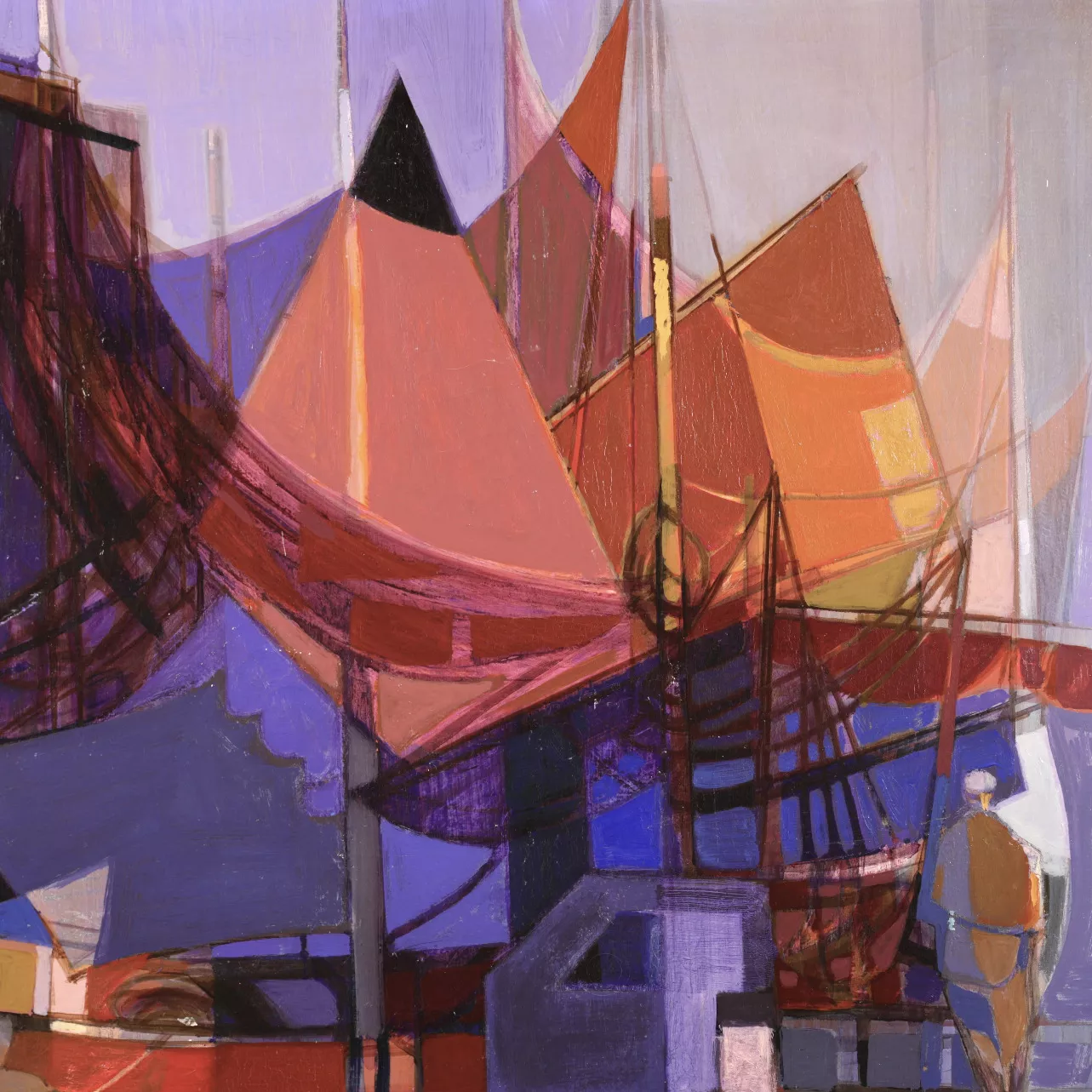
Camille Hilaire is a 20th-century French painter whose style blends figuration and post-cubism. His compositions show a balance between geometric structuring, due to the influence of Cubism, and a colorful, luminous palette, which avoids any radical rigidity of classical Cubism.
His most frequent pictorial motifs are landscapes (interiors, exteriors), horses and riders, female nudes and Mediterranean or forest atmospheres. His characteristic palette contains fresh greens, soft blues and luminous yellows, often combined with more moderate tones.
Color is used both to describe and to sense space. When drawing, Hilaire maintains a precise line, sometimes supported by the use of line and contour, which gives his forms a definite presence.
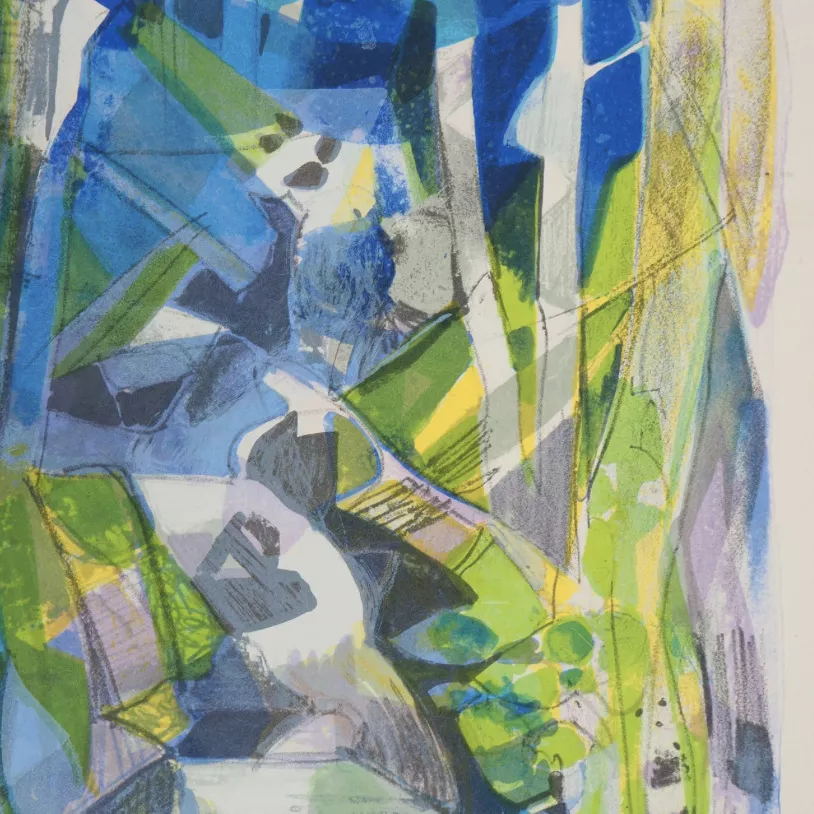
The mediums he uses are varied, with oils on canvas dominating. He also works with watercolors, lithography and tapestry, and has also created a few stained-glass windows. His canvases often feature flat tints of color interspersed with more structured strokes or touches, reflecting a search between spontaneity and formal control.
Camille Hilaire uses superimposed planes and geometric shapes (rectangles, trapezoids, obliques) to organize pictorial space while preserving a certain visual fluidity. In tapestries and stained-glass windows, Hilaire adapts his motifs to textiles or through-light, requiring simplification of design and harmonization of colors.
The artist's style lies between the tradition of figuration (landscape, figure) and the heritage of cubism : he therefore doesn't reject recognizable form, but restructures it.
The life of Camille Hilaire
Camille Hilaire (1916-2004), a French artist, became an important figure in the 20th-century art world. He was born in Metz, a city that was then in German territory during the annexation.
Hilaire initially trained as a painter for buildings, so he was a craftsman before becoming an artist, but soon began to paint on motif in the practice of his profession. He takes a close interest in the work of Dürer, whom he copies.
Jean Giono and Nicolas Untersteller then notice his artistic productions. He does his military service in Paris immediately afterwards, before being taken prisoner during the French campaign. He is a pupil of André Lhote, with whom he shares an interest in the golden ratio, as does Jean Metzinger and Jacques Villon.
He is taken prisoner and does not return to the front, preferring to study at the Beaux-Arts in Paris under a false identity.
He is then appointed Professor at the Ecole Supérieure de Peinture et de Dessin in Nancy. At the same time, he took part in various Salons where he exhibited his work, winning the second Grand Prix de Rome in 1950.
He also produced tapestries towards the end of his life, when he also taught at the Ecole des Beaux-Arts in Paris. He also produced a number of models for the Manufacture de Sèvres.
Camille Hilaire died on his estate in 2004.
.
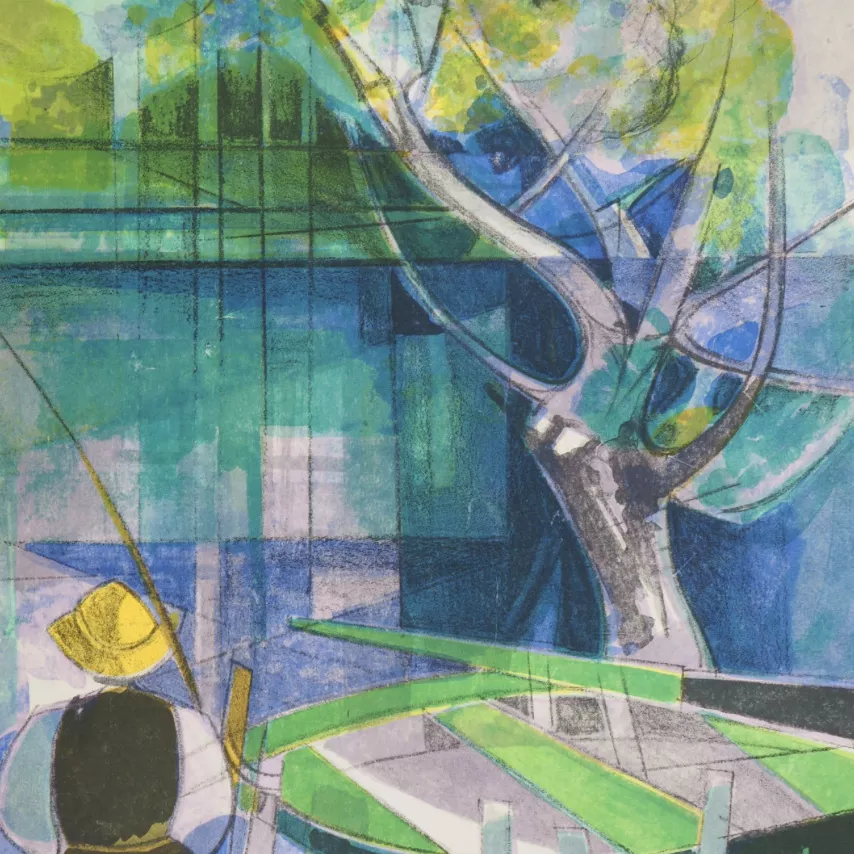
Focus on l'Étang bleu, Camille Hilaire, 1980
L'Étang bleu is an oil on canvas by Camille Hilaire produced around 1980. It depicts a landscape of water surrounded by vegetation, with dominant shades of blue, green and yellow, with the presence of gray trunks or plant structures represented from a stylized angle.
The artist opts for a strong graphic structure, with horizontal (the pond), vertical and oblique planes (trunks, branches) that criss-cross the visual space. The pond occupies the central part, and the vegetation dominates the periphery. The frame is therefore both structured and fluid.
The chromatic range emphasizes intense blue-greens, bright yellows for the light and pale gray for the trunks. This chromatic contrast creates a certain visual strength. The pictorial application seems to favor broad flat tints mixed with more suggestive touches of texture.
Although the landscape remains recognizable, the facture is resolutely modernized with simplified forms, sometimes sharp contours, flat surfaces and implicit plays of reflections and symmetries. This is in keeping with Hilaire's post-Cubist approach, where nature is structured.
The pond functions as a visual mirror that amplifies depth, the artist playing on reflections and natural frames to give an impression of immersion. The yellow light seems to filter through the foliage and reflect on the water.
The choice of motif is typical of Hilaire's more domestic formats (moderate size, luminous color) and shows the diversity of his landscape themes. This work is a good benchmark for understanding how Hilaire adapts Cubist structure to a peaceful natural subject.
The legacy of Camille Hilaire
Camille Hilaire marked his time with his contribution to post-Cubist painting. He produced not only oils on canvas, but also lithographs and other drawings. His early thinking on the use of color and form in painting is reflected in his work.
He constantly exploits the contrast between warm and cold colors, as well as the use of fine, blurred lines. Today, most of his works are held by private collectors.
Recognizing Camille Hilaire's signature
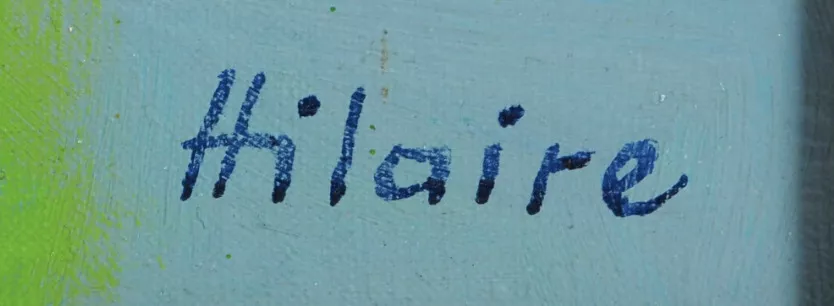
The artist's works are often signed. If he does, the signature appears at the bottom of the painting, in a color that contrasts with the background. He signs " Hilaire " at the bottom right, sometimes with the date and title on the reverse for oils.
Knowing the value of a work
If you happen to own a work by or after Camille Hilaire, don't hesitate to request a free valuation using our form on our website.
A member of our team of experts and licensed auctioneers will contact you promptly to provide you with an estimate of the market value of your work, not forgetting to send you ad hoc information about it.
If you are considering selling your work, you will also be accompanied by our specialists in order to benefit from alternatives to sell it at the best possible price, taking into account market inclinations.
Estimate in less than 24h
Discover in the same theme

Rating and value of furniture, table, bench Claude Lalanne
Claude Lalanne is a 20th-century artist who has created and produced a great deal of furniture that is highly valued at auction.
Learn more >

Rating and value of paintings by Marie Hiester Reid
Mary Hiester Reid is a Canadian artist who produced mainly still lifes. Her works are highly valued at auction.
Learn more >

Rating and value of boxes, inkwells and vases by Eugène Feui...
Eugène Feuillâtre is an Art Nouveau silversmith who produced few objects that have a significant value at auction. 24h estimate.
Learn more >

Secure site, anonymity preserved

Auctioneer approved by the State

Free and certified estimates
Frequently asked questions
-
Who was Camille Hilaire, and what was her artistic background?Camille Hilaire (1916–2004) was a French painter considered one of the leading figures of 20th-century Post-Cubism. Trained at the École des Beaux-Arts in Paris under André Lhote, he developed a distinctive style that blended figurative elements with Cubist geometric structures, while maintaining a colorful and luminous palette. He taught in Nancy and Paris, and his favorite subjects included landscapes, horses, female nudes, and Mediterranean scenes.
-
What is the price range for Camille Hilaire's works on the market?Prices vary considerably depending on the technique and quality of the work. Prints range from €5 to €1,100, watercolor drawings between €40 and €7,000, tapestries between €760 and €11,000, and oil paintings—the most sought-after—between €200 and €30,720. A polychrome painting thus fetched €30,720 in 2000, exceeding its initial estimate.
-
How can you authenticate a work by Camille Hilaire?To authenticate and appraise a work by Camille Hilaire, we recommend that you request a free, no-obligation estimate from Auctie's using our online form. A certified expert or auctioneer will examine the work and provide you with an accurate assessment of its market value within 48 hours, verifying, in particular, the artist’s distinctive signature.
-
Is this a good time to sell a work by Camille Hilaire?Yes, now is a good time to sell. Prices for Camille Hilaire’s works are rising steadily on the art market, particularly for his paintings, which are highly sought after by collectors. Demand for this master of Post-Cubism remains steady, and auction results confirm an upward trend.
-
How does the free appraisal of a work of art work at Auctie's?Appraisals at Auctie's are completely free and non-binding. You fill out a form on our website, a certified expert or auctioneer will contact you to examine the piece, and you’ll receive a detailed assessment of its market value within 48 hours. If you decide to sell, we’ll guide you through the process—from choosing the best sales method to the final auction.
