



Rating and value of paintings by Anne Redpath

Key takeaways
- The works of Anne Redpath (1895–1965), a Scottish artist who specialized in still lifes, sell for between €10 and €264,380, depending on the technique used.
- Her oil-on-canvas paintings are the most sought-after, particularly by Scottish and English buyers, and their market value remains stable.
- As the first woman elected as a full member of the Royal Scottish Academy in 1952, she is recognized as a key figure in 20th-century Scottish painting.
If you own a work by or after the artist Anne Redpath, and would like to know its value, our state-approved experts and auctioneers will offer you their appraisal services.
Our specialists will work to carry out a free appraisal of your work, and provide you with an accurate estimate of its value on the current market.
Then, if you wish to sell your work, we will direct you to the best possible arrangement to obtain the optimum price.
Rating and value of artist Anne Redpath
Anne Redpath is an artist known to still life enthusiasts. Now, prices for her works are rising at the auctioneers' gavel.
Her oils on canvas are particularly prized, especially by Scottish and English buyers, and the price at which they sell on the art market ranges from €10 to €264,380, a large delta but one that speaks volumes about the value that can be attributed to the artist's works.
In 2007, his oil on canvas Still life with white tulips,was sold for €264,380, while it was estimated at between €117,500 and €176,250. Its value is stable.
Order of value from a simple work to the most prestigious
Technique used | Result |
|---|---|
Estamp - multiple | From 10 to 1 040€ |
Drawing | From 360 to €23,630 |
Oil on canvas | From €40 to €264,380 |
Estimate in less than 24h
The style and technique of Anne Redpath
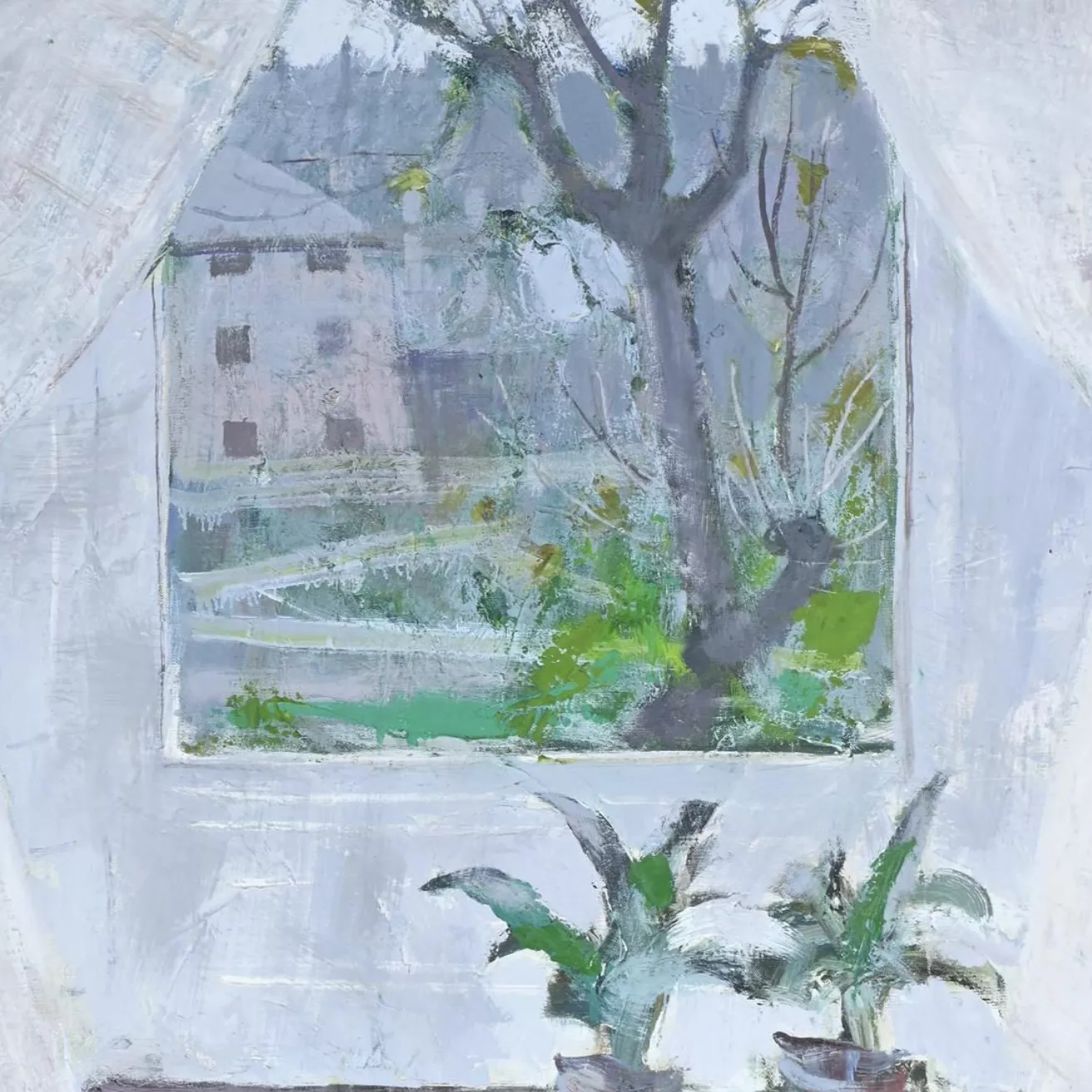
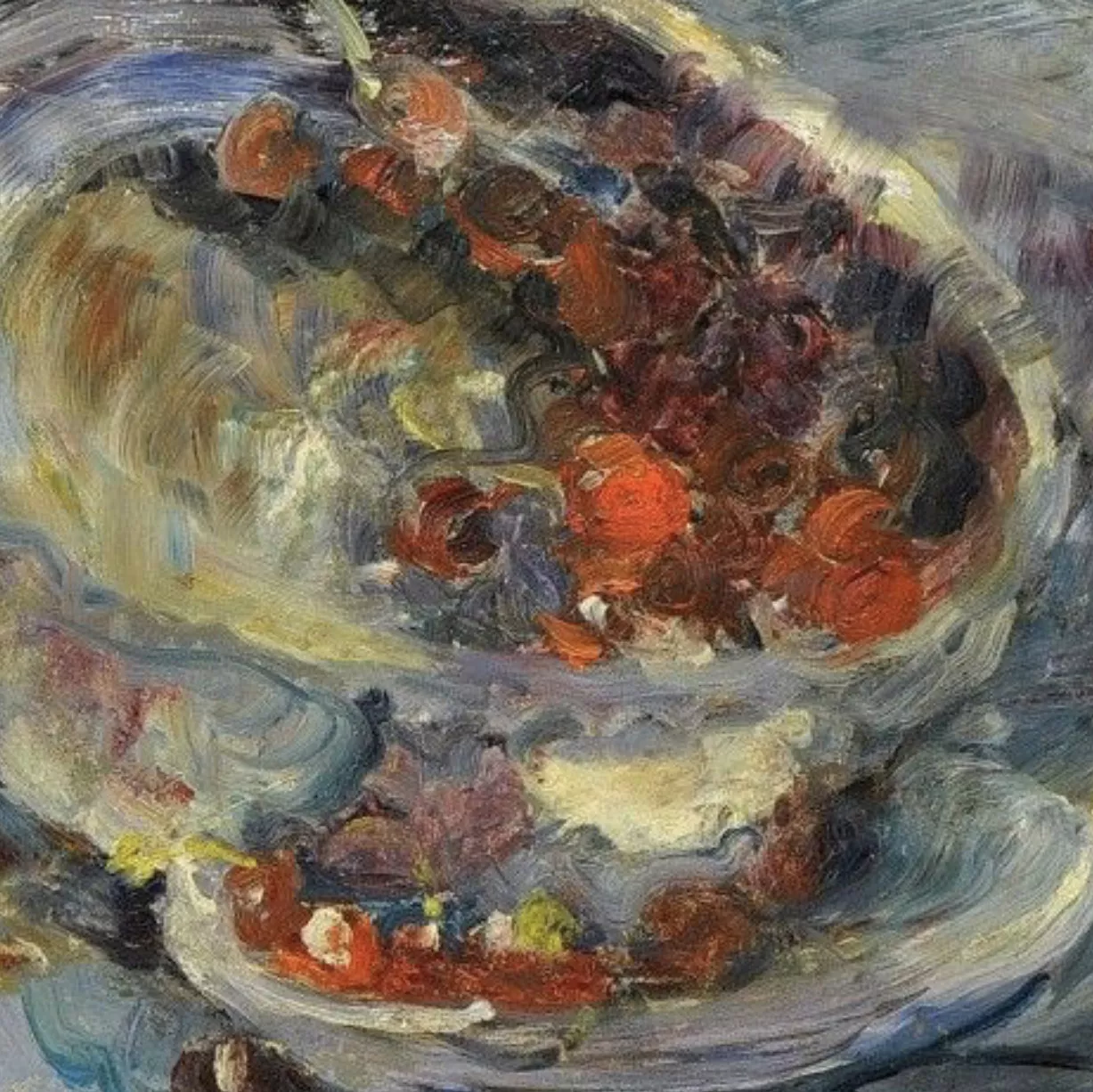
Anne Redpath (1895 - 1965) was a Scottish artist known for her interiors, still lifes and landscapes. Redpath developed a pictorial style inspired by the post-impressionist tradition, in which color takes precedence over drawing.
She was strongly influenced by the Fauves, including Matisse and Bonnard, but adapted their research to a more restrained British sensibility. Her style thus blends solid structure and chromatic freedom, with constant attention to overall harmony.
Redpath uses a rather pasty paint, applied with a brush or sometimes a knife, with a visible, nervous and lively touch. In some of her works, she introduces sands or powders into the paint, to reinforce the texture and opacity of the material.
She often plays with matte and gloss effects, depending on the areas of the painting. Her palette is characterized by light, warm, powdery tones, often with off-whites, silvery grays, faded pinks, brick reds and golden ochres.
She employs color not as an imitation of reality, but as a structuring and emotional element, seeking visual balance more than optical exactitude. She has said herself that her painting comes " from the inside, not the outside ". Emotional perception guides her chromatic choices.
She mainly creates still lifes, interiors and landscapes, often linked to her domestic environment or trips to Europe. Her interiors are mostly inhabited by everyday objects (flowers, fabrics, porcelain), which she transforms into rhythmic, colorful forms.
The subject is often secondary to the arrangement of shapes and tones, which is the real plastic issue.
Her style remains narrative and legible, but pushes decorative abstraction within the figurative framework. She is distinguished by an expressive sobriety (no dramatic effect, but a delicate balance between formal tension and visual softness).
She bridges the gap between generations of classical Scottish painters and the opening up to continental modernity.
The life of Anne Redpath
Born in 1895 in Galashiels, in the Scottish Borders, into a modest family, her father was a decorator of religious buildings, which was to influence her early taste for color and texture.
She studied at the Edinburgh College of Art, where she received a classical training, but was also exposed to European post-impressionist trends. She won a scholarship that enabled her to travel to France, Italy and Belgium, absorbing the influences of continental art.
In 1920, she married James Beattie, an architect, and subsequently lived in France, mainly in Antibes. During this period (1920-1930) she devoted herself mainly to her family life and almost completely interrupted her artistic practice.
Returning to Scotland in the mid-1930s, following the death of her husband, she resumed painting with intensity to provide for her children.
From the 1940s, her work enjoyed a revival, with regular exhibitions in Edinburgh, London and other British galleries.
An active member of the Royal Scottish Academy and the Society of Scottish Artists, she became a leading figure on the Scottish art scene. She was also the first woman to be elected a full member of the Royal Scottish Academy in 1952, a historic recognition.
She continued to travel throughout her life, among other places to Spain, Italy and Morocco, countries whose lights and colors nourished her work. These sojourns influenced her clear, warm palette, as well as her themes (Mediterranean landscapes, interiors bathed in light).
She died in 1965 in Edinburgh, leaving behind an abundant body of work, centered on still lifes, interiors and intimate landscapes. Today, she is recognized as one of the greatest Scottish artists of the 20th century, and paved the way for other female painters in a still very masculine milieu.
Many British museums preserve her work, including the Scottish National Gallery of Modern Art. Today, her work is enjoying renewed interest on the auction market, as is that of Mary Casatt, Mary Hiester Reid or Barbara Hepworth.
Focus on The Indian Rug (Red Slippers), Anne Redpath, circa 1942
The Indian Rug is probably one of Redpath's best-known paintings, held at the Scottish National Gallery of Modern Art in Edinburgh. It depicts a domestic interior, with an oriental rug, a pair of red slippers, a table and a few everyday objects in the foreground.
The painting illustrates a familiar corner of the interior, but treated with great plastic attention the rug, table, bowl, chair and floor all become rhythmic elements. The absence of a human figure reinforces the presence of the objects, which are invested with an almost symbolic dimension.
The composition suggests suspended movement, in a silent yet vibrant space. The Indian rug is the central element : its geometric patterns and texture are treated with great formal freedom, more decorative than descriptive.
The red shoes in the foreground act as a signature, introducing an almost narrative element of life. The pictorial material is thick and vibrant, especially in the treatment of the carpet, which catches the light and animates the surface.
The artist's palette is warm and muted (browns, reds, bluish-greys, ochres), evoking a gentle but not passive domestic atmosphere. The light does not come from an identifiable direct source but illuminates the scene diffusely, creating a restrained atmosphere.
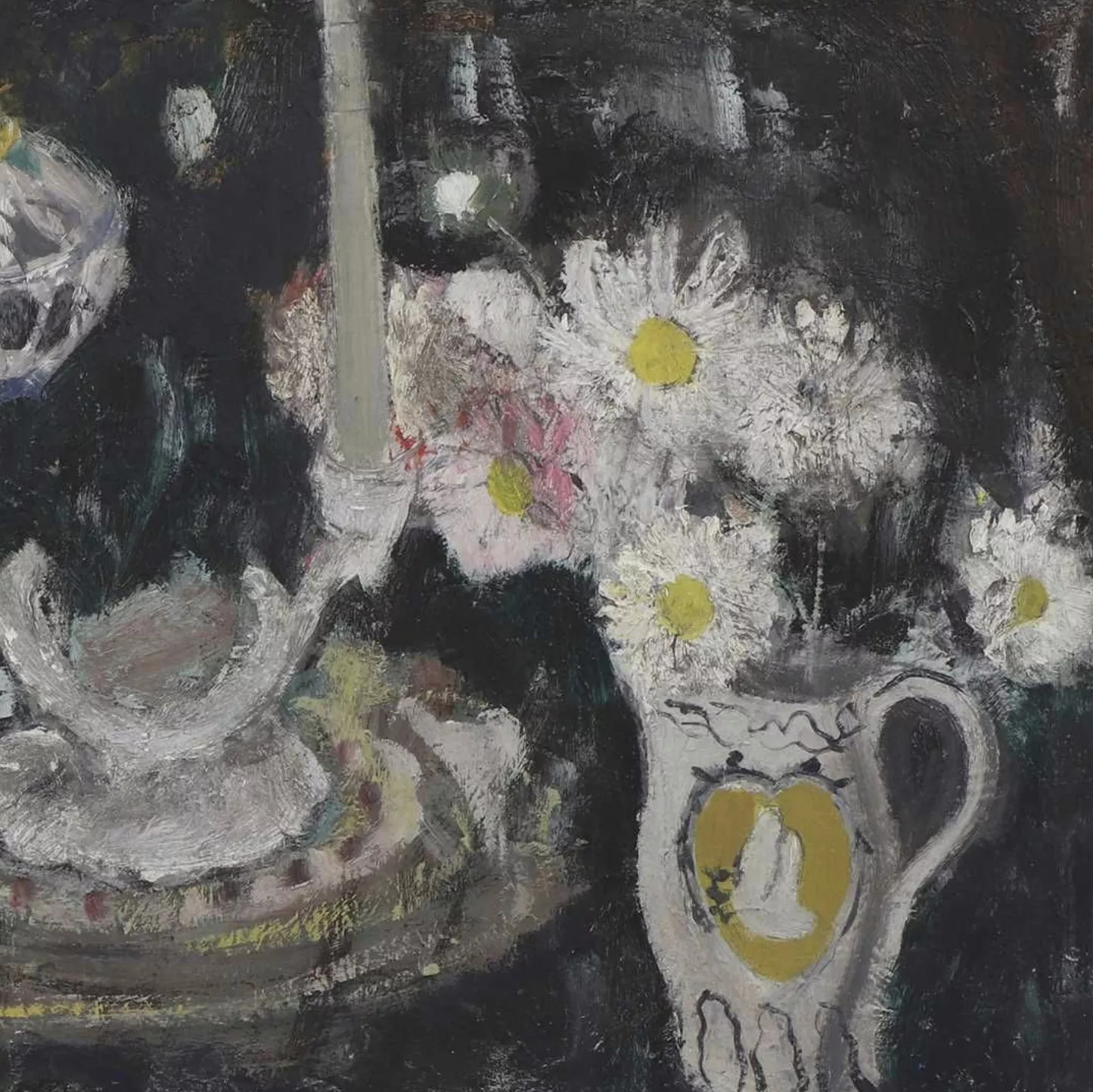
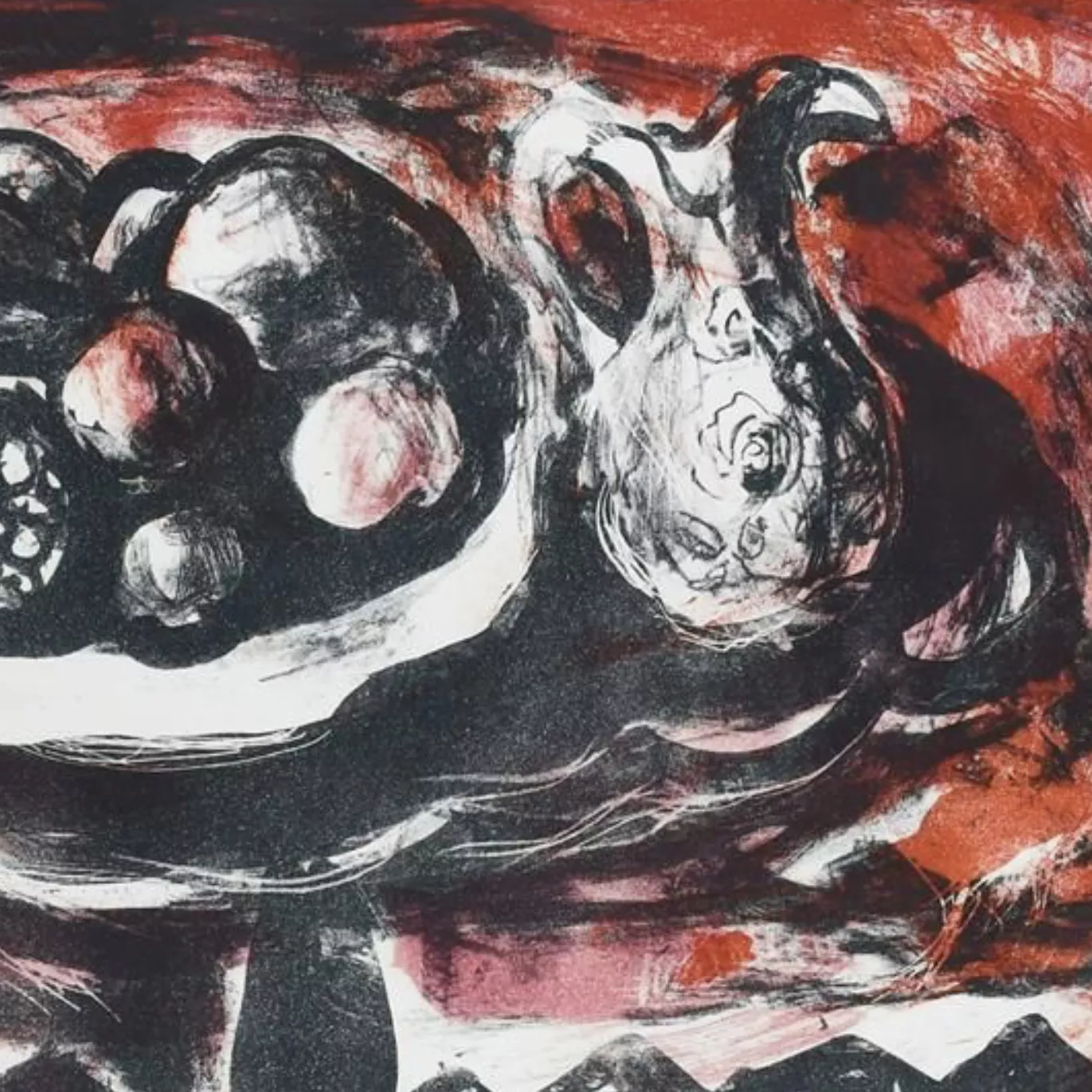
The strokes are visible, laid energetically but smoothly, reinforcing the intimate, lively character of the scene. The painting seems to describe the space of the artist herself, or that of a woman at work, through her everyday objects.
The carpet acts as a visual metaphor for painting itself (a flat, decorative and rhythmic surface that absorbs and organizes the gaze. The work embodies a moment of contemplation in which the simplicity of the subject is charged with a certain emotional force.
This work marks a stylistic turning point for Redpath insofar as it affirms a painting of intimacy, which blends formal modernity with a grounding in domestic reality.
It illustrates his ability to link private space and plastic language, and to elevate ordinary objects to the dignity of the artistic subject. The Indian Rug is therefore often considered emblematic of her personal style, halfway between Matisse and the Scottish tradition of colorism.
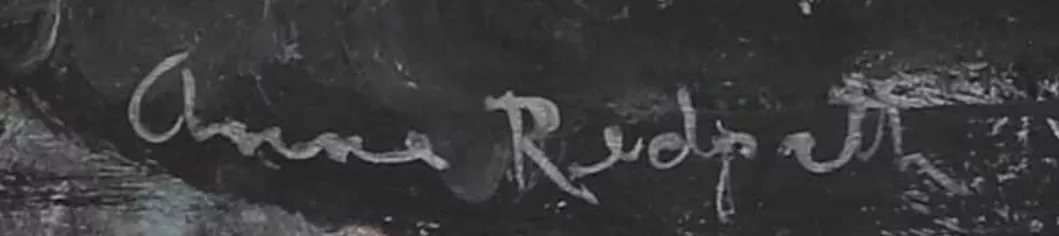
Recognizing the artist's signature
Anne Redpath doesn't necessarily sign her works. Copies may exist, which is why expertise remains important.
Knowing the value of a work
If you happen to own a work by or after Anne Redpath, don't hesitate to request a free valuation using our form on our website.
A member of our team of experts and certified auctioneers will contact you promptly to provide you with an estimate of the market value of your work, as well as ad hoc information about it.
If you are considering selling your work, you will also be accompanied by our specialists in order to benefit from alternatives for selling it at the best possible price, taking into account market inclinations.
Estimate in less than 24h
Discover in the same theme

Value and quotation of works, paintings by Bengt Lindstrom
Bengt Lindstrom, a 20th-century Swedish painter, breathed new life into Nordic painting. His works are listed. Estimated in 24 hours.
Learn more >

Rating and value of works, drawings, paintings by Keith Hari...
Keith Haring is a twentieth-century painter, draughtsman and graphic artist who produced drawings and paintings in a variety of media that are listed.
Learn more >

Quote and value of paintings, drawings and sculptures by Wif...
Wifredo Lam is a Cuban surrealist artist whose works are highly valued on the auction market. Estimated in 24h.
Learn more >
D'autres natures mortes vendues aux enchères

Estimated 15.000 - 20.000
Anthony II CLAESZ (1616-1642), Still life of flowers, oil on canvas

Estimated 8.000 - 12.000
Guillaume FOUACE (1837 - 1895), Still life with lobster, oil on canvas

Estimated 8.000 - 15.000
Maurice de VLAMINCK (1876-1958), Still life with jugs and leeks, oil on canvas

Estimated 4.000 - 6.000
Guillaume FOUACE (1837-1895), Still life with Roquefort cheese, Oil on canvas

Estimated 12.000 - 15.000
Paul AIZPIRI (1919-2016), Still life of flowers, Oil on canvas

Estimated 800 - 1.500
Pascal DAGNAN-BOUVERET (Paris 1852-1929 Quincey) Still life with apple and books, Oil on cardboard

Secure site, anonymity preserved

Auctioneer approved by the State

Free and certified estimates
Frequently asked questions
-
Who is Anne Redpath, and what is her artistic background?Anne Redpath (1895–1965) was a major Scottish artist of the 20th century, known for her still lifes, interiors, and landscapes. Her style draws on the Post-Impressionist tradition and the influence of the Fauves (Matisse, Bonnard), which she adapted to a restrained British sensibility. She was the first woman elected as a full member of the Royal Scottish Academy in 1952, marking a historic milestone in a male-dominated field.
-
What are the market prices for Anne Redpath's works?The prices of Anne Redpath's works vary significantly depending on the medium and quality. Prints sell for between €10 and €1,040, drawings for between €360 and €23,630, while oil paintings on canvas—which are particularly sought after—range from €40 to €264,380. Her market value remains stable, and her work is seeing renewed interest on the auction market.
-
How can I authenticate a work by Anne Redpath and determine its value?To authenticate a work of art and determine its exact value, we recommend that you request a free appraisal using our form. A certified expert or auctioneer from our team will contact you promptly and provide you with a detailed assessment of your artwork’s market value, with no obligation on your part.
-
Is this a good time to sell a work by Anne Redpath?Yes, now is a good time to sell a work by Anne Redpath. Her work is currently experiencing a significant resurgence of interest in the auction market, particularly among Scottish and English collectors, and her market value remains stable. Oil-on-canvas paintings, in particular, are in steady demand.
-
How does the sales process work with Auctie's?Auctie's supports you every step of the way. You start with a free, no-obligation appraisal from our certified experts (response within 48 hours). If you decide to sell, our specialists will guide you toward the best options for selling your artwork at the highest possible price, taking market trends into account.
