



Rating and value of paintings by Marie Hiester Reid

Key takeaways
- Mary Hiester Reid (1854–1921), an American and Canadian artist who specialized in floral still lifes and intimate interiors, has seen her auction prices rise steadily.
- Oil paintings on canvas sell for between €160 and €15,260, while drawings range from €230 to €400, with prices currently stable.
- Her style, characterized by a light touch and muted, nuanced tones, conveys a poetic vision of women’s daily lives, drawing parallels to Whistler and Fantin-Latour.
If you own a work by or after the artist Mary Hiester Reid, and would like to know its value, our state-approved experts and auctioneers will offer you their appraisal services.
Our specialists will work to carry out a free appraisal of your work, and provide you with an accurate estimate of its value on the current market.
Then, should you wish to sell your work, we will direct you to the best possible arrangement to obtain the optimum price.
Rating and value of the artist Mary Hiester Reid
Mary Hiester Reid is an artist known to lovers of Impressionist canvases. Now, prices for her works are rising at the auctioneers' gavel.
Her oils on canvas are particularly prized, especially by French and Canadian buyers, and the price at which they sell on the art market ranges from €230 to €15,260, a large delta but one that speaks volumes about the value that can be attributed to the artist's works.
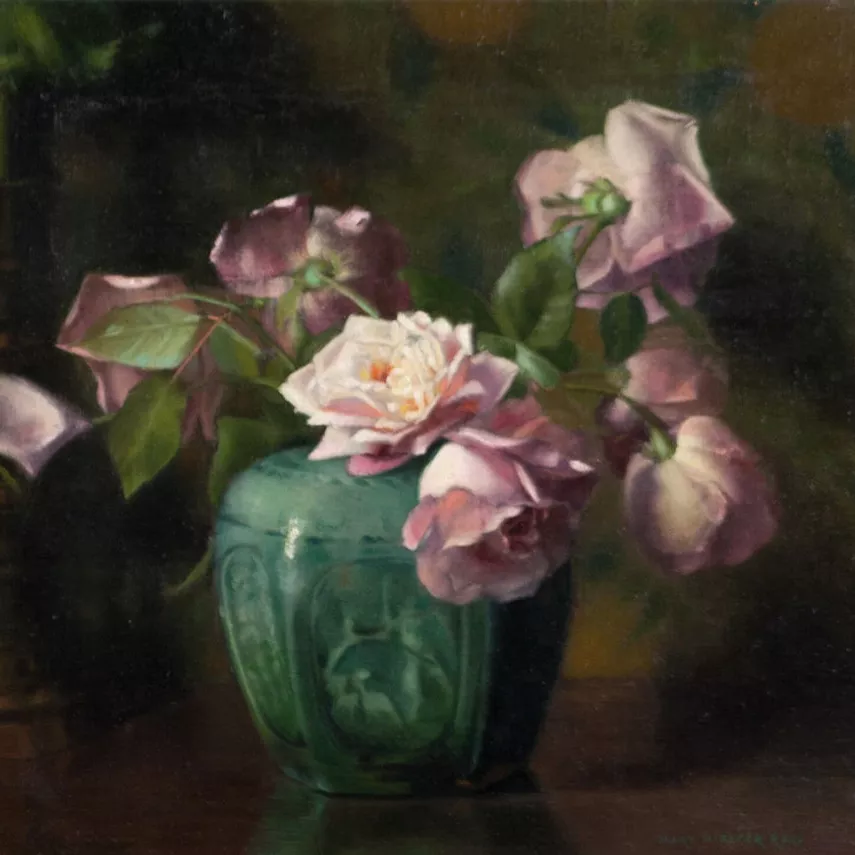
In 2021, his oil on canvas Roses in a green and turquoise vase, sold for €15,260, while it was estimated at €1,700 to €2,100. Its value is stable.
Order of value from a simple work to the most prestigious
Technique used | Result |
|---|---|
Drawing | From 230 to 400€ |
Oil on canvas | From 160 to 15 260€ |
Estimate in less than 24h
The style and technique of Mary Hiester Reid
Mary Hiester Reid (1854 - 1921) was an American and Canadian artist renowned for her still lifes and intimate interiors. She developed a pictorial language marked by great delicacy of touch and strong chromatic sensitivity, halfway between late Impressionism and a form of poetic intimism.
She favors modest, restrained compositions that invite contemplation rather than demonstration. Her style is characterized by a meditative, often melancholy mood, reinforced by the choice of quiet subjects (flowers, fabrics, silent rooms).
Hiester Reid uses a light touch, visible but never jarring, with subtle fading work between forms. Contours are often blurred, giving her objects a soft yet floating presence, without any plastic brutality. She manages to modulate textures (petals, silks, foliage, lacquered surfaces) without overloading the pictorial material.
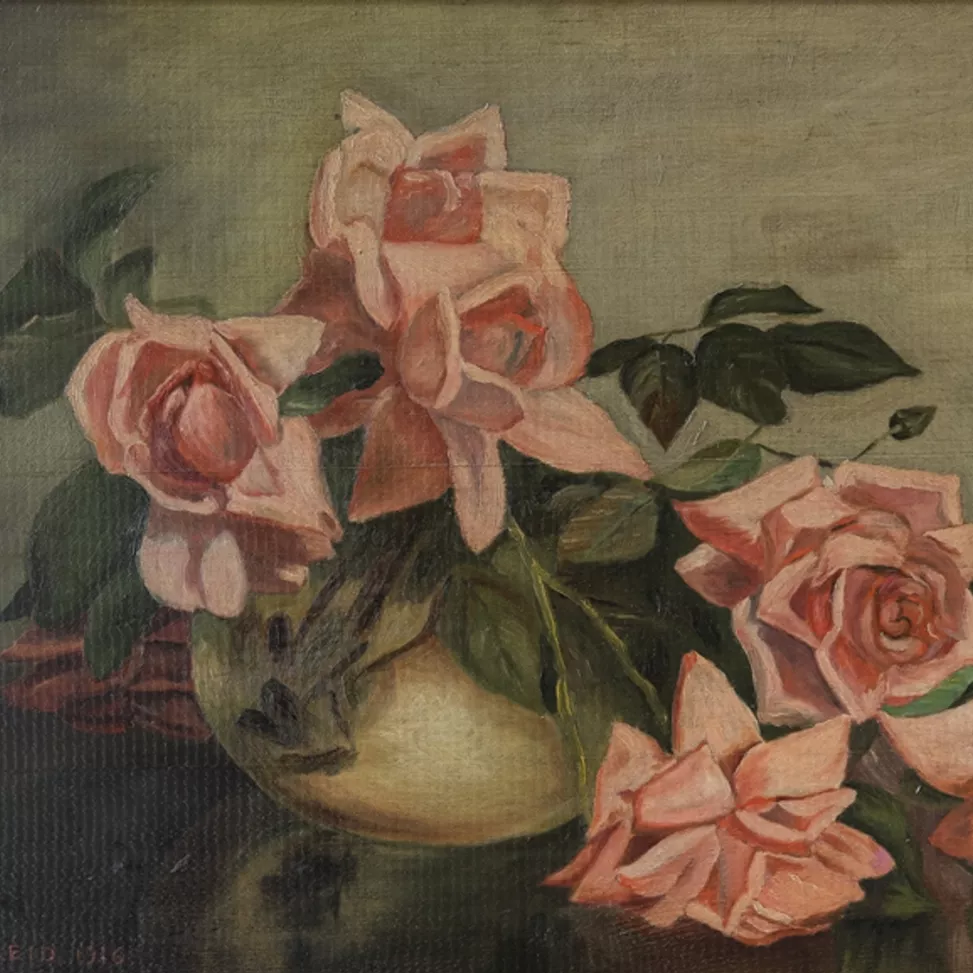
She shows a predilection for muted, nuanced tones (mauves, old pinks, warm browns, faded greens, ivory whites). Her sense of color is distinguished by a modal harmony, like a restrained but just musical scale.
Mary Hister Reid favors soft transitions, tonal chords, without violent contrasting effects. She specializes in bouquets of cut flowers, set tables, vases and curtains, objects that are discreet but invested with great emotional density.
Her interiors are mostly depopulated, but imbued with implied human presence, as if one or more individuals have just left the room. She paints personal space and the private world of women with great restraint and elegance.
Far from the avant-garde or radical formal research, Reid is part of a painting of silence, which values time, sensory memory and chosen solitude. His painting affirms an unspectacular vision of the everyday, but one that is inhabited.
Thanks to its discreet refinement, it joins the research of a Whistler or even Victoria and Henri Fantin-Latour, while asserting a strong yet peaceful feminine subjectivity.
The life of Mary Hiester Reid
Mary Hiester Reid (1854 - 1921), was an important figure in Canadian art and a pioneer in the recognition of women artists. She was born in Reading, Pennsylvania, into a cultured family.
She studied at the Pennsylvania Academy of the Fine Arts in Philadelphia, where she was a pupil of Thomas Eakins, renowned for his rigorous teaching of drawing and anatomy. In 1881, she married Canadian painter George Agnew Reid, whom she had met at the academy, with whom she formed an influential artistic couple.
Reid moved with him to Toronto in the early 1880s. She began exhibiting in 1883 at the Ontario Society of Artists, then at the Royal Canadian Academy of Arts, becoming one of the first women to be an associate member.
At the same time, she continued her studies in Paris at the Académie Colarossi, one of the few schools to welcome both women and men in the late 19th century. She then specialized in floral still lifes and domestic interiors, at a time when these genres were often associated with the female sphere.
Reid thus succeeded in making her mark despite social restrictions, and became a major figure on the Toronto art scene. In fact, she was often the only woman exhibited at the official Canadian Salons of her time.
She claimed the status of a professional artist in her own right, asserting a determined yet discreet feminine presence in both her life and her work. Her role is not limited to that of an artist's wife : she leads an independent career, exhibiting in Canada, the United States and Europe.
She also plays an active role in Toronto's artistic circles, participating in teaching and animating cultural life.
The artist died in Toronto in 1921, widely recognized during her lifetime, but subsequently eclipsed by the emergence of male modern art (on a Canadian scale, this would be the Group of Seven).
Mary Hiester Reid has been rediscovered since the 2000s as part of studies on women-artists and is today considered the major figure of North American intimism and turn-of-the-century flower painting.
In 2000, the Art Gallery of Ontario dedicated a posthumous retrospective to her, hailing the breadth of her work.
Focus on Chrysanthemums, Mary Hiester Reid, circa 1902
Chrysanthemums is a medium-format oil on canvas (60 x 80 cm) by Mary Hiester Reid circa 1902, depicting a vast bouquet of white, yellow and pink crysanthemums, arranged in a sober vase on a table covered with dark fabric.
The chrysanthemum, flower of autumn and the cycle of life, is immortalized here in all its textured fragility and diaphanous luminosity. The composition avoids decorative effect the flowers are not stylized, but represented with respect, care and gravity.
The choice of this complex flower allows Reid to deploy his mastery of textures and tonal values. The touch is supple, almost powdery, with an application in fine molten strata and without marked contours.
The petals are slightly ruffled and irregular, never set, creating a sense of vibration. The vase is treated with realistic sobriety, without unnecessary shine, anchored in an understated material world.
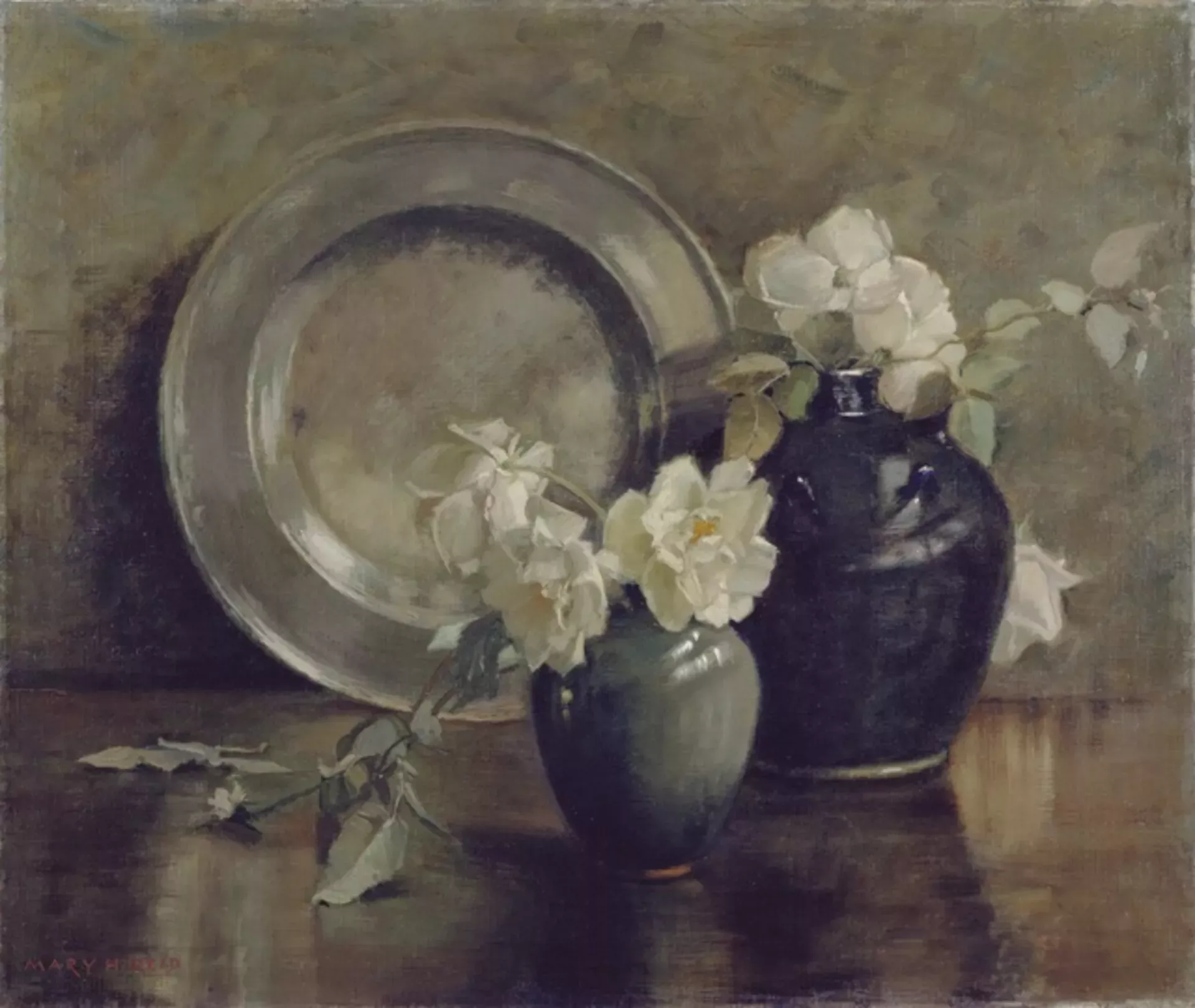
The palette is deliberately restrained but subtly nuanced (off-whites, pale yellows, soft pinks, on a deep brown background). The light is lateral and subdued, as if filtered through a window, enhancing the velvety material of the flowers and the grain of the fabric.
The whole is thus bathed in a meditative, suspended atmosphere, almost funereal but without being sad. Beyond the floral representation, the work evokes the transience of beauty, silent contemplation and the intimacy of an unspectacular feminine space.
The painting can be read as a meditation on time, the season or even light, where the act of painting becomes an act of attention and memory. Through its balance and simplicity, the work here embodies a form of modern classicism, anchored in the moment and the repetition of the motif.
Chrysanthemus is thus emblematic of the artist's practice a minor subject treated with grandeur, revealing the intensity of a look at the familiar. This painting synthesizes his approach : technical mastery, hushed palette, sense of floral rhythm and poetic density.
It quietly but authoritatively affirms Reid's place in the tradition of flower painting as a place of complexity, style and restrained emotion.
Recognizing the artist's signature
Mary Hiester Reid doesn't necessarily sign her works. Copies may exist, which is why expertise remains important.
Knowing the value of a work
If you happen to own a work by Mary Hiester Reid or after the artist, don't hesitate to request a free appraisal using our form on our website.
A member of our team of experts and chartered auctioneers will contact you promptly to provide you with an estimate of the market value of your work, as well as ad hoc information about it.
If you are considering selling your work, you will also be accompanied by our specialists in order to benefit from alternatives for selling it at the best possible price, taking into account the inclinations of the market.
.Estimate in less than 24h
Discover in the same theme

Rating and value of paintings by Pierre Ambrogiani
Pierre Ambrogiani is a painter who has produced modern paintings whose price and value may surprise you at auction. 24h estimate.
Learn more >

Rating and value of Joan Miro lithographs, paintings and scu...
Joan Miro is a twentieth-century abstract and surrealist painter whose works are highly valued at auction.
Learn more >

Rating and value of paintings and laquers by Hoang Tich Chu
Hoang Tich Chu is a painter of Vietnamese modernity who has produced paintings and lacquers that are highly valued at auction.
Learn more >
D'autres natures mortes vendues aux enchères

Estimated 15.000 - 20.000
Anthony II CLAESZ (1616-1642), Still life of flowers, oil on canvas

Estimated 8.000 - 12.000
Guillaume FOUACE (1837 - 1895), Still life with lobster, oil on canvas

Estimated 8.000 - 15.000
Maurice de VLAMINCK (1876-1958), Still life with jugs and leeks, oil on canvas

Estimated 4.000 - 6.000
Guillaume FOUACE (1837-1895), Still life with Roquefort cheese, Oil on canvas

Estimated 12.000 - 15.000
Paul AIZPIRI (1919-2016), Still life of flowers, Oil on canvas

Estimated 800 - 1.500
Pascal DAGNAN-BOUVERET (Paris 1852-1929 Quincey) Still life with apple and books, Oil on cardboard

Secure site, anonymity preserved

Auctioneer approved by the State

Free and certified estimates
Frequently asked questions
-
Who is Mary Hiester Reid, and what is her artistic style?Mary Hiester Reid (1854–1921) was a pioneering American and Canadian artist, known for her floral still lifes and intimate interiors. Her style is characterized by a light and delicate touch, a palette of muted and nuanced tones, and a meditative atmosphere that lies between late Impressionism and poetic intimism. She is part of a tradition of “painting silence” that celebrates time, sensory memory, and the understated elegance of everyday life.
-
What are the prices and current market value of Mary Hiester Reid's works?Mary Hiester Reid’s oil-on-canvas paintings sell for between €160 and €15,260 on the current market, while her drawings range from €230 to €400. Her market value is stable, with growing interest, particularly among French and Canadian buyers. In 2021, the painting “Roses in a Green and Turquoise Vase” sold for €15,260, far exceeding its initial estimate.
-
How do I have a work by Mary Hiester Reid authenticated?To authenticate a work by Mary Hiester Reid, we recommend that you submit a request for a free appraisal using our online form. An expert or certified auctioneer from our team will examine your piece and provide you with an accurate estimate of its market value, with no obligation, within 48 hours.
-
Is this a good time to sell a work by Mary Hiester Reid?Yes, now is a good time to sell a work by Mary Hiester Reid. The artist has been experiencing a significant resurgence in popularity since the 2000s, thanks in part to scholarship on women artists and the growing interest in North American Intimism. Demand is on the rise, particularly among French and Canadian collectors, which is supporting market prices.
-
How does the sales process work at Auctie's?At Auctie's, we guide you through the entire process, from a free appraisal to the sale of your artwork. After receiving a no-obligation evaluation from our experts and licensed auctioneers, you’ll benefit from advice tailored to current market trends to help you sell your artwork at the best possible price. Our specialists will guide you toward the best solutions based on the type and value of your painting.
