



Rating and value of Jane Poupelet's sculptures and drawings

Key takeaways
- Sculptures by Jane Poupelet, a 20th-century animal artist, sell for between €50 and €8,400, with prices on the rise since 2022.
- Her works in bronze, terracotta, and plaster are characterized by simplified forms and a refined modern classicism, influenced by François Pompon.
- Her watercolor drawings range from €65 to €3,400, while her three-dimensional sculptures fetch up to €8,400 at auction.
If you own a work by artist Jane Poupelet or after, and would like to know its value, our state-approved experts and auctioneers will offer you their appraisal services.
Our specialists will work to carry out a free appraisal of your work, and will provide you with an accurate estimate of its value on the current market.
Then, should you wish to sell your work, we will direct you to the best possible arrangement to obtain the optimum price.
Rating and value of artist Jane Poupelet
Jane Poupelet is an artist appreciated by collectors of animal sculptures. Now, prices for her creations are rising under the auctioneers' gavel.
Her creations are particularly prized, especially by French buyers, and the price at which they sell on the art market ranges from €50 to €8,400, a significant delta but one that speaks volumes about the value that can be attributed to the artist's works.
In 2022, bronze sculpture, Bbit crouching, was sold for €8,400, whereas it was estimated at between €300 and €500, more than 16 times the high estimate. Its value is on the rise.
Order of value from a simple work to the most prestigious
Technique used | Result |
|---|---|
Drawing - watercolor | From €65 to €3,400 |
Sculpture - volume | From €50 to €8,400 |
Estimate in less than 24h
Style and technique of artist Jane Poupelet
Jane Poupelet works in bronze, terracotta, plaster and occasionally stone, and collaborates with well-known founders, notably Valsuani. She was active in the first decades of the 20th century.
She favored small and medium-sized formats, with a marked taste for intimacy and purity, and a preference for the ronde-bosse, with supple modeling, often left deliberately visible in the material.
Her style is characterized by a simplification of volumes, a search for plastic balance, and a taste for closed forms. She quickly moves away from the excesses of academic naturalism, without falling into abstraction, and cultivates a modern, sober and expressive classicism.
The treatment of surfaces, which are often carefully sanded or patinated, contributes to a rendering that is both tactile and silent. She creates a large body of animal sculptures, notably of cats, dogs and small wildfowl, in a rather observant and stylized vein.
She follows in the footsteps of avant-garde animal sculptors such as François Pompon, with whom she shares a synthetic vision of the living. She seeks a restrained energy: the animals are often frozen in a calm, almost meditative pose.
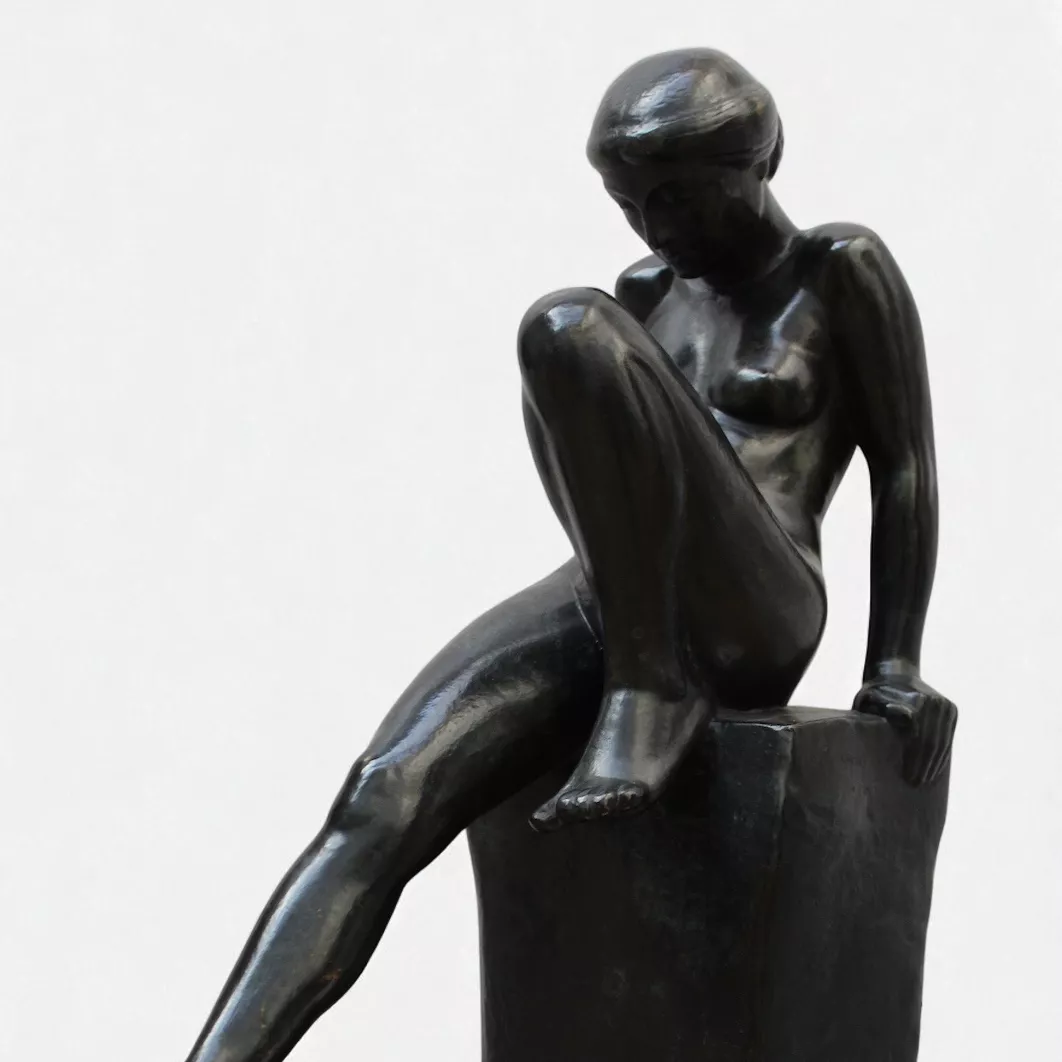
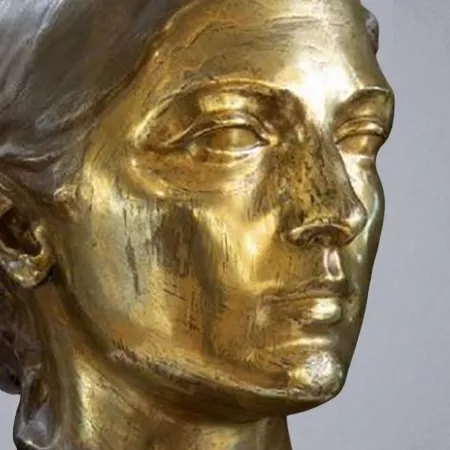
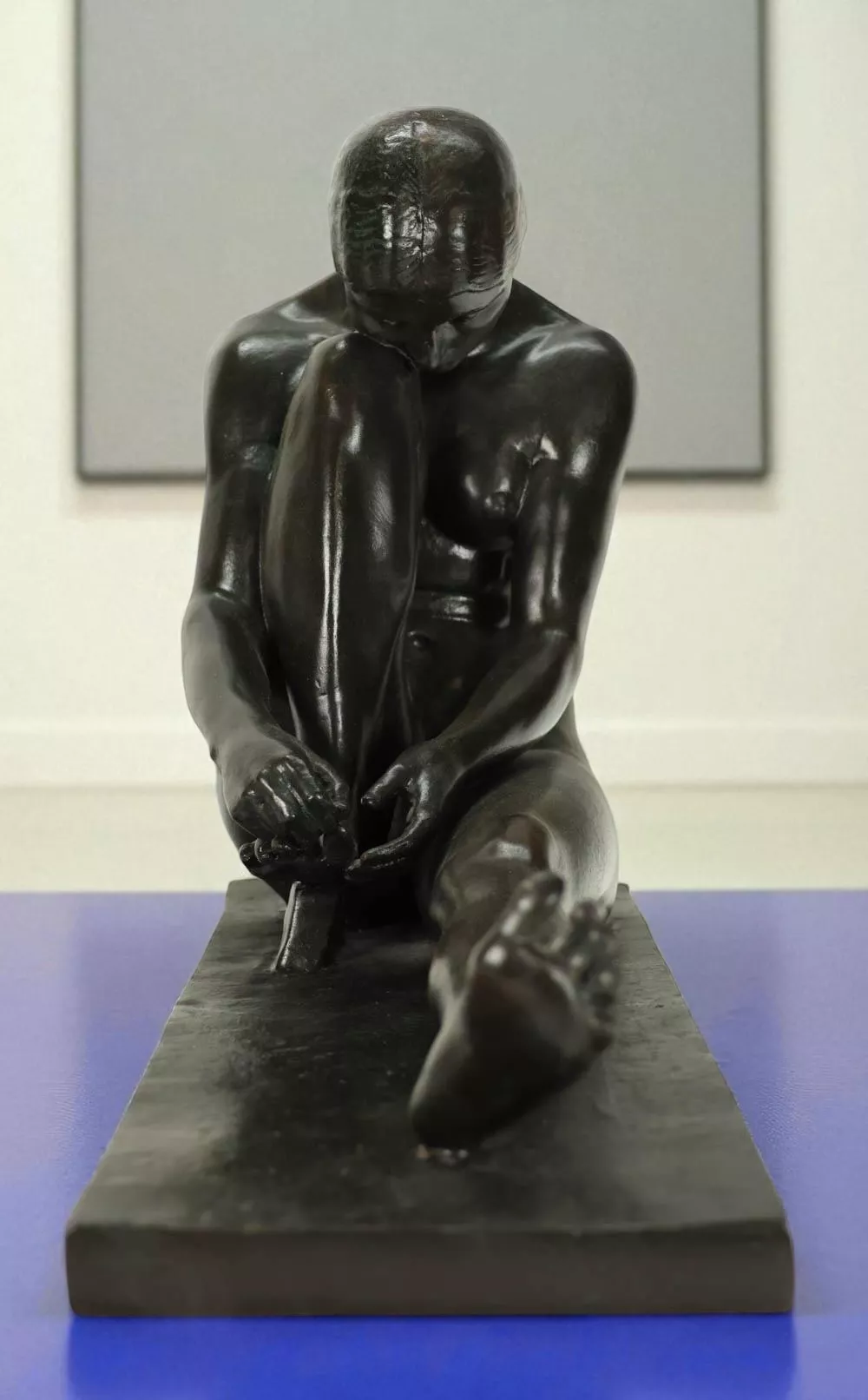
Jane Poupelet also produces several female heads, portraits and nudes that are treated with a formal gentleness close to that of Maillot. Shapes are simplified, faces have reduced features, without pathos or anecdote priority is given to the internal balance of the composition.
Her sculpture is placed in a constant search for the right relationship between empty and full, and between axis and curve. The modelling is never demonstrative, serving a sensitive and restrained vision of the subject, without unnecessary effects.
His technique, refined yet rigorous, anticipates certain orientations of modern sculpture, while remaining deeply embodied.
The life of Jane Poupelet
Jane Poupelet, born Marie Marcelle Poupelet in 1874 in Saint-Léonard-de-Noblat in Haute-Vienne, came from a bourgeois background, and turned to the arts despite the social expectations of the time.
She moved to Paris to train as an artist, including at the École des Beaux-Arts, which was still rare for a woman in the late 19th century.
She became a pupil of the sculptor Jean-Antoine Injalbert, and then frequented Parisian artistic circles turned towards modernity.
She began exhibiting at the Salon des Artistes Français in the 1900s, and frequented innovative sculptors such as Pompon, whose pared-down approach to animality would have a lasting influence on her own work.
She also developed a practice of portraiture, particularly of women, in a sober, structured style. During the First World War, she put her artistic practice at the service of medicine, working in the maxillofacial prosthesis workshops for broken heads.
This experience would mark her work, as she returned to sculpture with a heightened sense of the dignity of the body, and a purified vision of the human form. In the 1920s, she established herself as an important figure in modern animal sculpture, with a repertoire focused on simplifying forms.
She exhibited regularly at the Salons d'Automne, the Indépendants and in Parisian galleries. She was esteemed for her intimate, rigorous and quiet approach, remaining discreet in a male-dominated milieu.
She died prematurely in 1932 in Paris. Her career was relatively short but dense, stylistically marked but remarkable. Her name remains associated with a modernized classicism, halfway between observation of reality and formal reduction ; that would influence other twentieth-century animal sculptors.
Her works today feature in several public collections in France.
.
Focus on Sitting Cat, Jane Poupelet
Sitting Cat is a brown patina bronze by Poupelet, sometimes produced in terracotta and sometimes in plaster. Dimensions vary according to the cast, generally around 20 to 30 cm.
The work is often signed " J. Poupelet " on the terrace, with the founder's stamp (notably Valsuani). It is held in a number of public collections, including the Musée d'Orsay and the Musée de Limoges.
The subject represents a seated domestic cat, with its body tucked up, legs bent and head turned slightly. The animal's attitude is calm, almost meditative, with no apparent muscular tension.
The sculpture renounces all anectdote, there is no staging or props. The animal is treated as a closed, autonomous form, focused on itself. Volumes are roundly modeled and contours are pared down, each form seemingly contained within a perfect oval.
The modeling remains present on the surface, with slight finger or spatula marks in some fonts. No naturalistic description is made of the hair or fur, formal abstraction takes precedence over descriptive realism.
Light also glides over the curves, underlining the link between sculpture and tactile sensation. There is in this work a direct heritage of François Pompon's sculpture, but with a more intimate, interior touch.
The work expresses a form of contemplation, in phase with the research of a " art pur " of the 1920s. This cat is part of a logic of simplified modern sculpture, with no break but with a real poetic density.
It participates fully in the renewal of French animal sculpture of the interwar period, between stylization and presence.
This work is in the stylistic vein of artists such as Paul Jouve or laterArmand Petersen, who helped to bring animal sculpture to the fore in France.
Recognizing the artist's signature
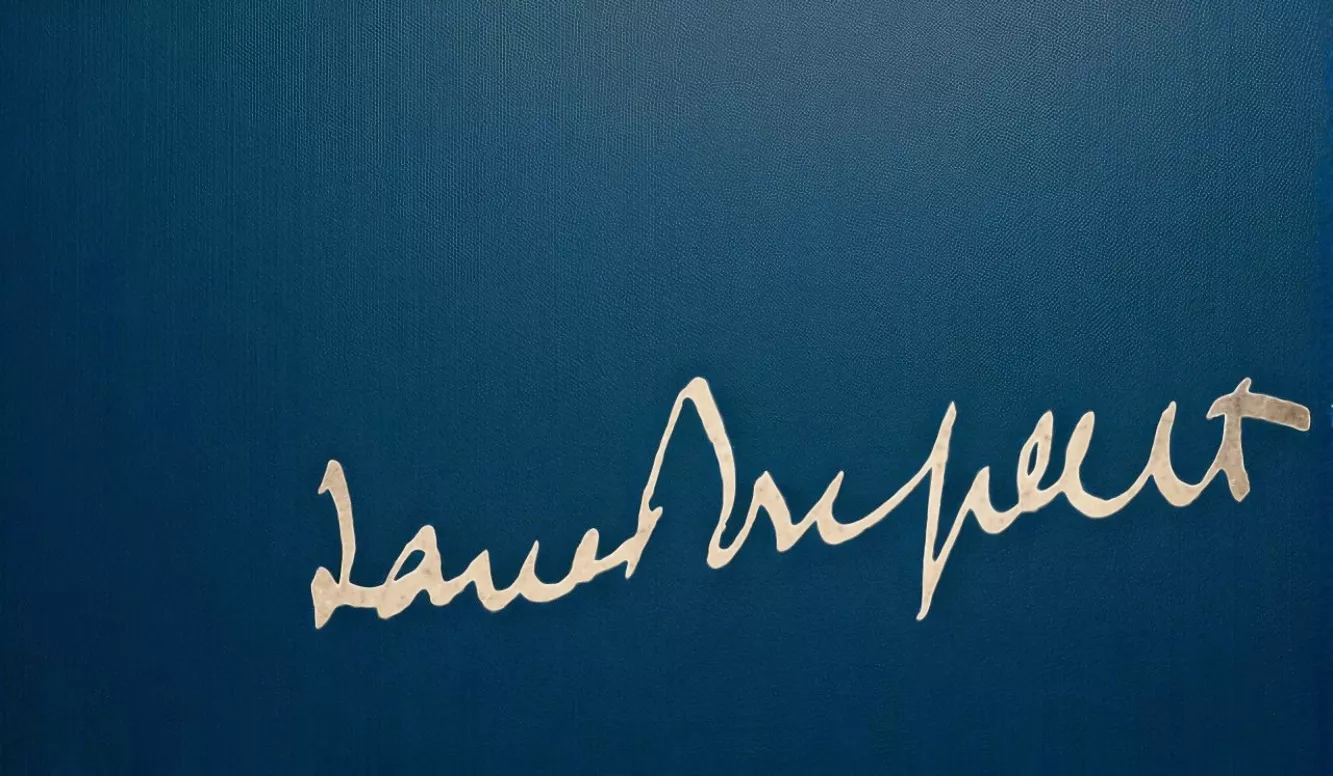
Jane Poupelet doesn't necessarily sign her works. Copies may exist, which is why expertise remains important.
Knowing the value of a work
If you happen to own a work by or after Jane Poupelet, don't hesitate to request a free valuation using our form on our website.
A member of our team of experts and certified auctioneers will contact you promptly to provide you with an estimate of the market value of your work, as well as ad hoc information about it.
If you are considering selling your work, you will also be accompanied by our specialists in order to benefit from alternatives for selling it at the best possible price, taking into account market inclinations.
Estimate in less than 24h
Discover in the same theme

Rating and value of paintings by Adolf Weber
Adolf Weber is a twentieth-century Swiss Impressionist painter who produced works that are quite highly rated and have value at auction.
Learn more >

Rating and value of paintings by Michel Larionov
Michel Larionov is a Russian painter of the Rayon period who has produced works that are quoted and valued at auction. Estimated in 24h.
Learn more >

Rating and value of paintings by Gabriele Münter
Gabriele Münter is an Expressionist artist who has produced many works that are highly valued at auction. 24h estimate
Learn more >
D'autres bronzes modernes vendus aux enchères

Estimated Between €2,000 and €4,000
Edouard Marcel SANDOZ (1881-1971) curly stingray, bronze print

Estimated Between €1,500 and €3,000
Renato CARVILLANI (1896-1986), seated woman, gilded bronze print

Estimated Between €1,500 and €3,000
César BALDACCINI dit CESAR (1921-1998), Poule Cartier, bronze print

Estimated Between €10,000 and €20,000
Baltasar LOBO (1910-1993), female nude in bronze

Estimated 5.000 - 8.000
Igor MITORAJ (1944-2014), Bust of Asclepius, Green patina bronze sculpture

Secure site, anonymity preserved

Auctioneer approved by the State

Free and certified estimates
Frequently asked questions
-
Who is Jane Poupelet, and what is her artistic style?Jane Poupelet (1874–1932) was a French sculptor and a pioneer of modern animal sculpture. Her work is characterized by a refined and expressive classicism; she worked primarily in bronze, terracotta, and plaster, with a preference for small and medium-sized works. Her style emphasizes the simplification of forms, sculptural balance, and a synthetic vision of living creatures, particularly evident in her extensive body of work featuring cats, dogs, and small wild animals.
-
What is the price range for Jane Poupelet's works on the market?The prices of Jane Poupelet’s sculptures and drawings range from €50 to €8,400. Drawings and watercolors range from €65 to €3,400, while three-dimensional sculptures range from €50 to €8,400. Her market value is on the rise, as illustrated by the 2022 sale of a bronze sculpture, *Bbit Crouching*, which sold for 8,400€ despite an estimate of between 300 and 500€.
-
How do I have a work by Jane Poupelet authenticated?To authenticate a work by Jane Poupelet, we recommend that you request a free, no-obligation appraisal using the form on the Auctie's website. A state-certified expert or auctioneer will examine your artwork and contact you within 48 hours to provide you with an accurate estimate of its market value, as well as all necessary information regarding its authenticity.
-
Is this the right time to sell a work by Jane Poupelet?Yes, now is a good time to sell a work by Jane Poupelet, as her value is on an upward trend in the art market. The prices of her works are rising steadily at auction, and her animal sculptures are particularly sought after by collectors, especially in France. A free appraisal by our experts will help you determine the best time and the optimal approach to achieve the highest possible price.
-
How does the sale of a work of art work at Auctie's?The selling process at Auctie's begins with a free, no-obligation appraisal conducted by our experts and licensed auctioneers, with a response within 48 hours. After the appraisal, if you decide to sell, we’ll guide you through the entire process, offering the best options for selling your artwork at the best price, taking into account current market trends and preferences.
