



Rating and value of Hans Hartung lithographs

Key takeaways
- Hans Hartung (1904–1989), a pioneer of abstract art and a member of the School of Paris, began working in lithography in the 1950s to broaden the reach of his art.
- His works command exceptional prices: an oil on canvas sold for over 2 million euros in 2017, while prints and lithographs range from 5 to 11,000 euros.
- Hartung mastered lithography by combining spontaneous gestures with technical precision, creating powerful black-and-white contrasts with dynamic lines characteristic of his lyrical abstract style.
German painter, photographer and architect Hans Hartung (1904-1989) is one of the most important exponents of abstraction and a precursor of spontaneous experimental techniques.
Also a member of the École de Paris, Hans Hartung employed a technique that encouraged spontaneity of gesture.
If you own a work by or based on the artist Hans Hartung and would like to know its value, our state-approved experts and auctioneers will guide you.
Our specialists will carry out a free appraisal of your work, and provide you with a precise estimate of its value on the current market.
Then, should you wish to sell your work, we will direct you to the best possible arrangement to obtain the optimum price.
Artist's rating and value
Throughout his career, Hans Hartung produced a great deal. Nevertheless, his most prized period began in the 1950s.
His international renown opened the doors of numerous museums in Paris and New York. Today, Hans Hartung retains his high standing and establishes himself as a safe bet on the art market.
As such, a work signed by the artist's hand can fetch millions of euros at auction, as evidenced by his oil on canvas T1956-13, adjudged over 2 million euros at Sotheby's in 2017.
Order of value from the most basic to the most prestigious
Technique used | Result |
|---|---|
Photography | From € 155 to € 5,700 |
Estamp | From €5 to €11,000 |
Drawing | From €350 to €179,891 € |
Oil on canvas | From €250 to €2,250,000 |
Estimate in less than 24h
Hans Hartung's lithography
Hans Hartung, a German-born painter who became a leading figure in abstraction, took up lithography in the 1950s, enabling wider distribution of his works and his work.
Enthralled by the possibility of reproducing his spontaneous gestures while retaining technical rigor, he saw it as a means of renewing his artistic language.
Lithography then became a privileged field of exploration, enabling him to play with the strong contrasts between black and white that often dominate his works.
In this technique, Hartung manages to capture the immediate energy of his gesture while introducing a precision that he doesn't always find on his larger canvases.
Here he reproduces his characteristic motifs - dynamic, taut lines, exploded shapes - which appear with even more striking clarity.
Working with a wide variety of tools, such as broad brushes, scrapers or dry points, he explores the textures and variations in density that lithography enables him to achieve.
While remaining true to his abstract style, he injects a certain graphic discipline into his prints, where mastery of gesture mingles with free, improvised gestures.
Through lithography, Hartung doesn't just transpose his art onto another medium: he pushes experimentation further and enriches his work with new depth.
His lithographs, at once powerful and delicate, bear witness to his ceaseless quest for renewal and technical perfection.
Many artists of lyrical abstraction, including Hans Hartung, used lithography as a medium of expression. These include Olivier Debré, Georges Mathieu, or from André Lanskoy.
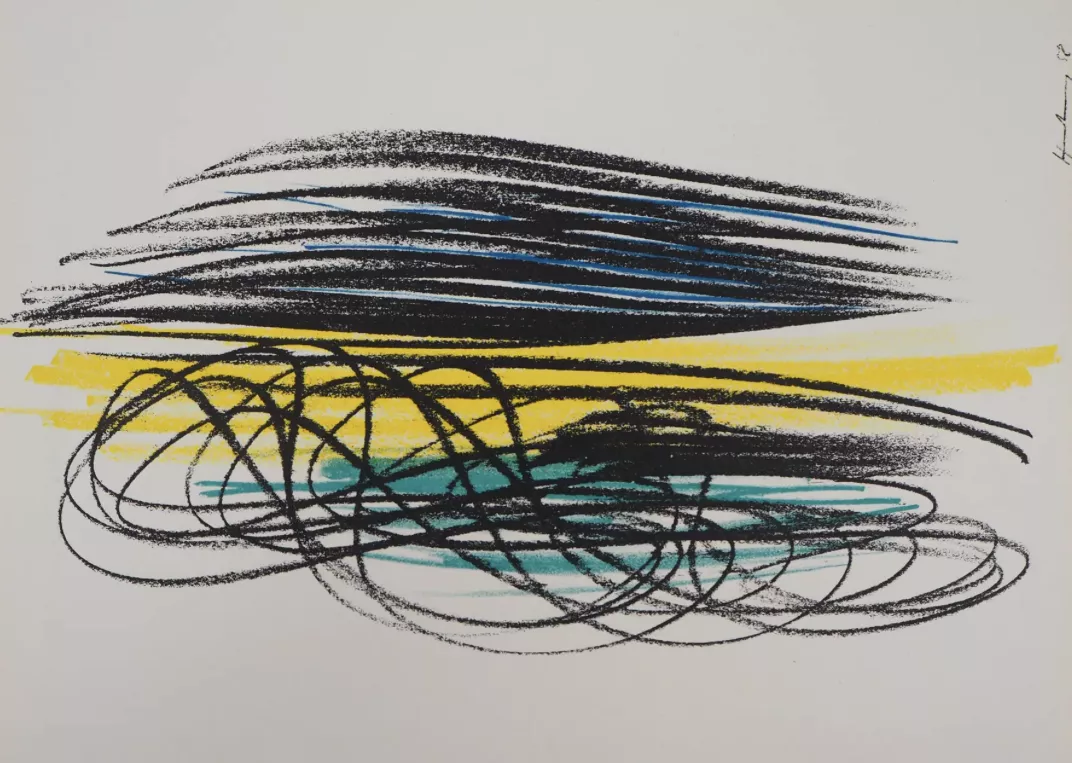
Hans Hartung's career
Hans Hartung, a German-born French painter born in Leipzig on September 21, 1904, also ventured into lithography.
After studying at the Beaux-Arts in Munich, Hartung traveled throughout Europe with his wife, the Norwegian artist Anna-Eva Bergman, before settling permanently in Paris. This journey reflects the rich European artistic exchanges of his time.
Rootedly opposed to Nazism, Hartung volunteered to fight in 1939. Arrested like many Germans present in France, he experienced detention.
His release enabled him to join the Foreign Legion, where he suffered a serious wound in combat, losing his right leg, an ordeal that consolidated his artistic commitment.
Throughout his career, Hans Hartung received numerous prestigious distinctions, including the Légion d'honneur, emphasizing his major contribution to abstract art.
From an early age, he nurtured a fascination for photography and astronomy, passions that influenced his work and manifested themselves in the play of light and celestial compositions of his lithographs.
Autodidact, Hartung was introduced to painting by reproducing classical works, before turning to a bold approach centered on color.
Inspired by masters such as Rembrandt, Goya and the German Expressionists, he quickly developed a unique visual language through his lithographs, where the fluidity of forms and intensity of colors intertwine.
In a constant quest for innovation, Hartung explored lithography with a variety of techniques, incorporating unusual tools and impulsive gestures, giving his works a distinct gestural quality.
In 1968, he and his wife settled in Antibes in a house-studio he had designed, a space conducive to creation and experimentation.
This is where he continued his artistic exploration until his death in 1989, leaving a considerable legacy in abstract art, marked by an unceasing quest for freedom and expression through ever more daring forms and techniques, particularly in lithography.
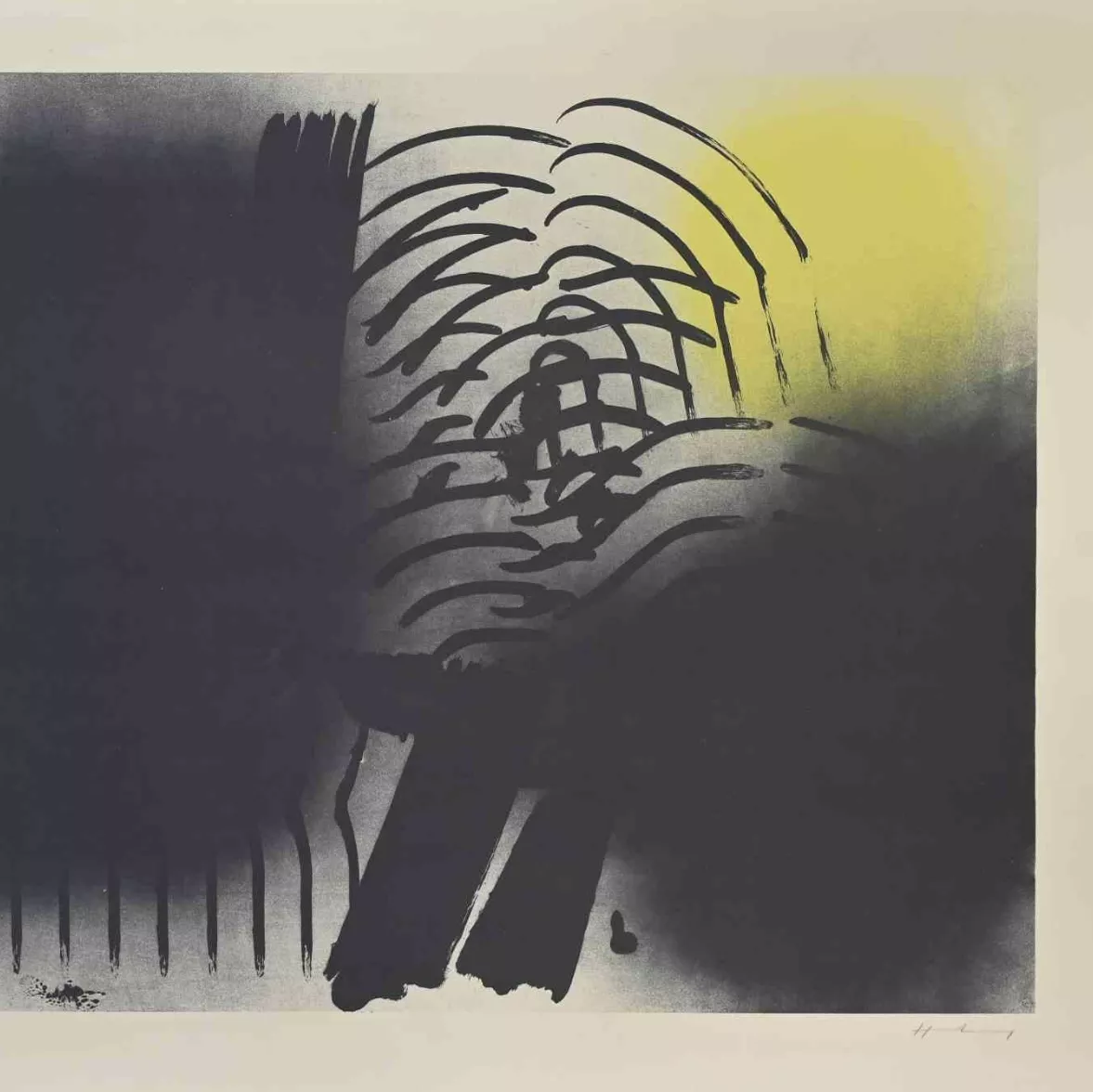
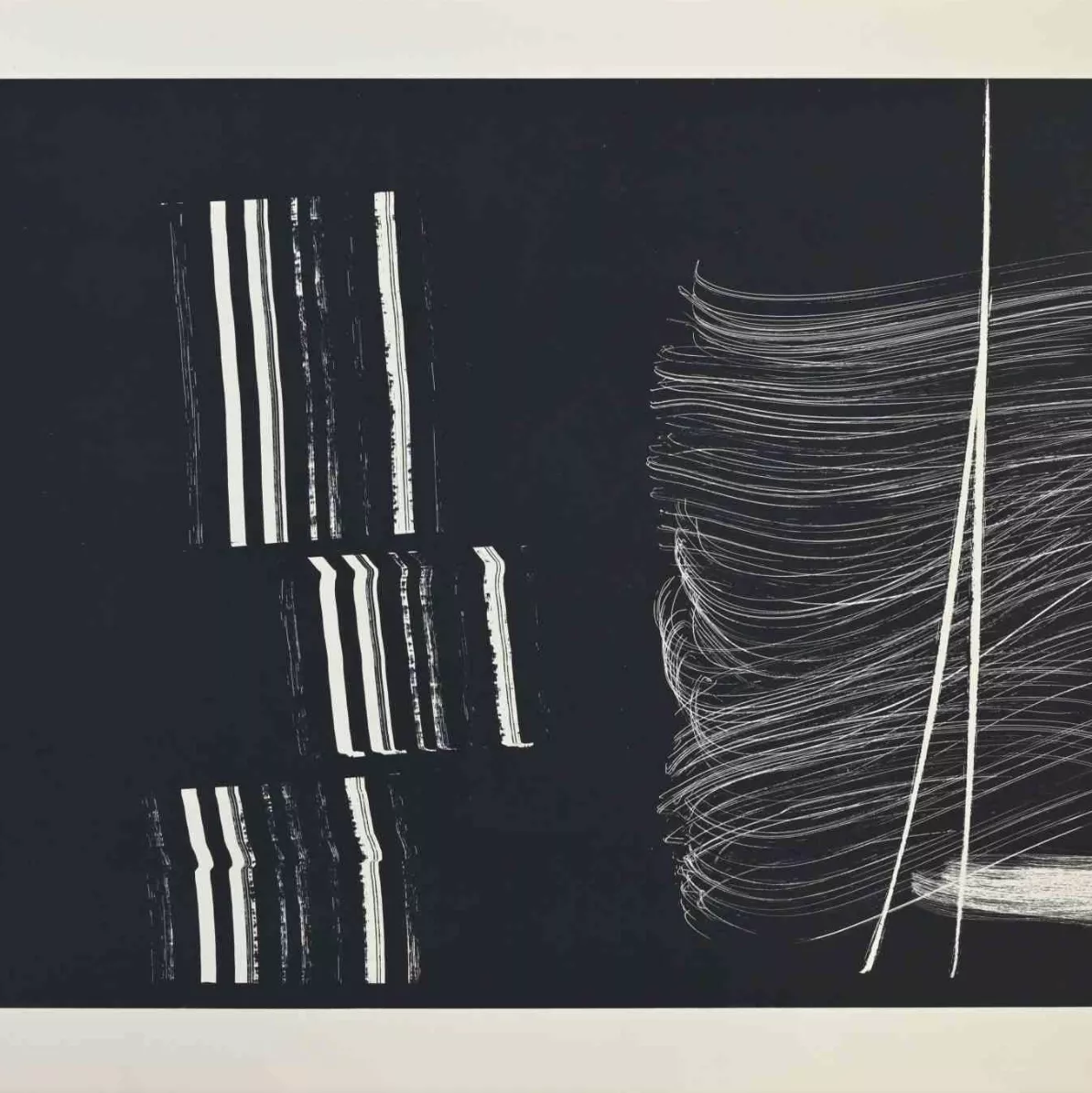
Focus on Rayonnement, Hans Hartung, 1963
This vibrant, luminous work by Hans Hartung perfectly conveys the apogee of his artistic research. Rayonnement embodies the interaction between color and light, revealing a poetic dimension at the heart of his creative process.
The palpably energetic brushstrokes intertwine and soar in a play of vibrant colors, blending shades of yellow, orange and red.
These warm hues, which seem to vibrate from within, evoke an atmosphere of warmth and dynamism. Here, Hartung captures the very essence of movement, as if the work were a reflection of a dance, of a life in constant evolution.
The subtly shaded background acts as a resonant space. It supports the agitation of the colors, creating a depth that invites the viewer to immerse themselves.
This harmony of hues lends the whole a lightness, as if the forms were suspended in an infinite universe, where time and space dilate.
The colors, bright and lively, seem to float on the canvas. Their swirling, fluid movement evokes an organic dynamic, like a breath of life flowing through the work.
Hartung succeeds in freezing the intensity of a moment in matter, offering the viewer an immersive visual experience.
The contrasts between warm areas and darker spaces intensify this sense of movement.
This interplay between light and shadow lends the work an emotional dimension, where each color becomes a note in a visual symphony.
Hartung, in this way, invites us to feel raw emotion, a deep connection with his inner world.
The composition as a whole is skilfully orchestrated, each touch of color coming to form part of an overall rhythm.
We sense an unshakeable mastery on the part of the artist, able to bring elements into dialogue with one another with disconcerting ease.
This search for harmony and rhythm is central to Hartung's work, who envisaged painting as a melody, a visual song that resonates beyond the canvas.
In conclusion, Rayonnement is an emblematic work that testifies to Hans Hartung's artistic commitment to the exploration of color and light.
It captures the very essence of his art, oscillating between raw energy and delicacy, revealing a vision of the world where pictorial expression becomes a true reflection of existence.
Hartung manages, through the simplicity of his means, to evoke complex emotions, to create a universe where each color, each movement, resonates in harmony with the other.
Hans Hartung and Abstraction: a human language
Hans Hartung's imprint on his time
Hans Hartung's imprint on abstract art is considerable and lasting. His bold exploration of color and form left its mark on a generation of artists.
Hartung, by integrating innovative techniques and varied tools into his practice, created a unique gesturality that shines through in his works.
His famous Ink stains testify to his ability to transform emotions into visual forms, establishing a dialogue between artist and viewer.
The artist also played a key role in promoting lyrical abstraction, a movement that values personal expression through color and gesture.
His influence is felt beyond his own creations, as many contemporary artists draw inspiration from his quest for freedom and his commitment to breaking conventions.
Hartung was able to establish links between his personal experience, marked by hardship, and his artistic vision, leaving behind a rich legacy that continues to nourish reflections on abstract art today.
His studio house in Antibes, where he created until his death in 1989, remains a symbol of his dedication to creation and experimentation.
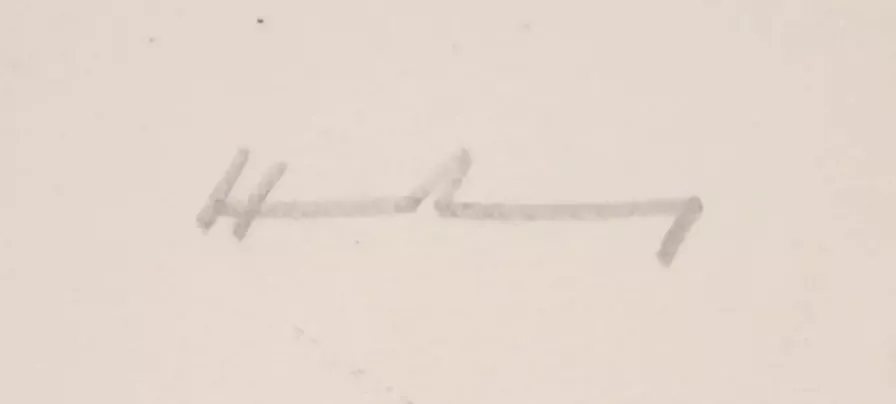
His signature
Not all of Hans Hartung's works are signed.
Although there are variations, here is a first example of his signature:
Expertise your property
If you own a Hans Hartung work, don't hesitate to request a free valuation by filling in our online form.
A member of our team of experts and licensed auctioneers will contact you to provide an estimate of the market value of your work.
If you are considering selling your work, our specialists will also guide you through the various alternatives available to obtain the best possible price, taking into account market trends and the specific features of each work.
Estimate in less than 24h
Discover in the same theme

Rating and value of works, paintings, drawings, by Jean-Loui...
Jean-Louis Forain was an Impressionist painter of the Belle Époque, who produced paintings and drawings that were appreciated and quoted at auction.
Learn more >

Rating and value of sculptures, paintings and drawings by Er...
Ernst Iossipovich Neizvestny is a Russian Expressionist artist who produced works that are highly valued at auction.
Learn more >

Rating and value of paintings by Anna Boch
Anna Boch is an Impressionist artist who produced paintings that are highly rated and valued at auction. 100% free estimate
Learn more >
Works from the same period sold at auction

Estimated 2.000 - 4.000 €
PABLO PICASSO (1881-1973) ATELIER MADOURA " Profil de femme n° 67 " Round plate.

Estimated 100-200€
Vassiliew Slavik, Oil on canvas

Estimated Between €5,000 and €8,000
Jean MIOTTE (1926-2016), acrylic on canvas

Estimated 2.000 - 4.000
Serge POLIAKOFF (1900-1969), Composition en rouge et bleu. 1965, Lithograph

Estimated 1.000 - 2.000
Raymond GUERRIER (1920-2002), Composition I, Oil on canvas

Secure site, anonymity preserved

Auctioneer approved by the State

Free and certified estimates
Frequently asked questions
-
Who is Hans Hartung, and what is his artistic background?Hans Hartung (1904–1989) was a German painter, photographer, and architect, a leading figure in abstract art and a pioneer of spontaneous experimental techniques. A member of the École de Paris, he settled in Paris after studying in Munich and remained artistically active throughout his life, becoming a staple of the modern art market with works characterized by free brushstrokes and a bold exploration of color.
-
How much is a Hans Hartung lithograph worth?The value of Hans Hartung’s lithographs varies widely depending on their quality and the period in which they were created. Overall, Hartung’s prints range in price from €5 to €11,000, while his most significant works can fetch millions of euros at auction (such as his oil on canvas T1956-13, which sold for over €2 million in 2017). An accurate estimate depends on the work’s period, condition, and provenance.
-
How can you authenticate a lithograph by Hans Hartung?To authenticate a lithograph by Hans Hartung, we recommend that you submit your artwork for a free appraisal through Auctie's. Our experts and state-certified auctioneers will examine your lithograph and provide you with an accurate, no-obligation appraisal. This free appraisal will allow you to verify the authenticity and market value of your artwork.
-
Why is now the right time to sell a Hans Hartung lithograph?Hans Hartung continues to command high prices and has established himself as a safe bet in the contemporary art market, particularly since the 1950s. Demand for lithographs by artists associated with lyrical abstraction remains steady, and his works continue to attract interest from collectors and museums. Now is therefore an opportune time to sell your piece, capitalizing on the artist’s enduring reputation.
-
How does the sales process work at Auctie's?At Auctie's, we guide you through the process from appraisal to auction. After you submit your lithograph via our online form, an expert will contact you within 48 hours to provide a free, no-obligation estimate. If you’d like to sell, our specialists will guide you toward the best approach to achieve the highest possible price, taking into account market trends and the characteristics of your artwork.
