



Rating and value of drawings and painting by Sadamasa Motonaga

Key takeaways
- Sadamasa Motonaga’s works fetch up to €1,026,240 at auction, with paintings estimated between €550 and €1,026,240.
- A leading Japanese artist of the Gutai movement (1950–1960), he practiced a form of performance painting using fluid and unstable materials.
- Condition and authenticity are key factors in determining an estimate, particularly for works that employ experimental techniques.
Sadamasa Motonaga’s paintings and drawings fetch up to €1,026,240 at auction. An appraisal allows us to accurately determine the current market value of your Sadamasa Motonaga artwork and, if applicable, optimize the sale of the piece.
If you own a work by Sadamasa Motonaga and would like to know its value, our state-certified auctioneers will provide a free appraisal based on authenticity, market rating, and recent market results.
Artist’s Market Value and
Reputation
Practicing what is known as “performative painting,” Sadamasa Motonaga is a Japanese artist known for his participation in the avant-garde Gutai art movement.
He creates paintings, watercolor drawings, prints, and a few sculptures, of which we have only a limited number of examples. The prices at which his works are sold range from €80 to €1,026,240.
In 2017, an abstract painting titled “Work,” dating from 1963, sold for €1,026,200, while it had been estimated at between €482,000 and €723,000.
Rang of values from a simple work to the most prestigious
Estimate | |
Painting | From €550 to €1,026,240 |
Drawing - Watercolor | From €120 to €26,000 |
From €80 to €43,000 | |
SV | From €360 to €8,500 |
Ceramics | From €770 to €3,400 |
Estimate in less than 24h

Placing the Artist in Context
Period
Sadamasa Motonaga (1922–2011) worked within the context of the post-World War II Japanese avant-garde. His work was particularly influential beginning in the 1950s, a period of radical renewal in artistic practices in Japan.
He was part of a phase in which Japanese art opened up to the international scene and engaged in dialogue with Western avant-garde movements.
Artistic Movements
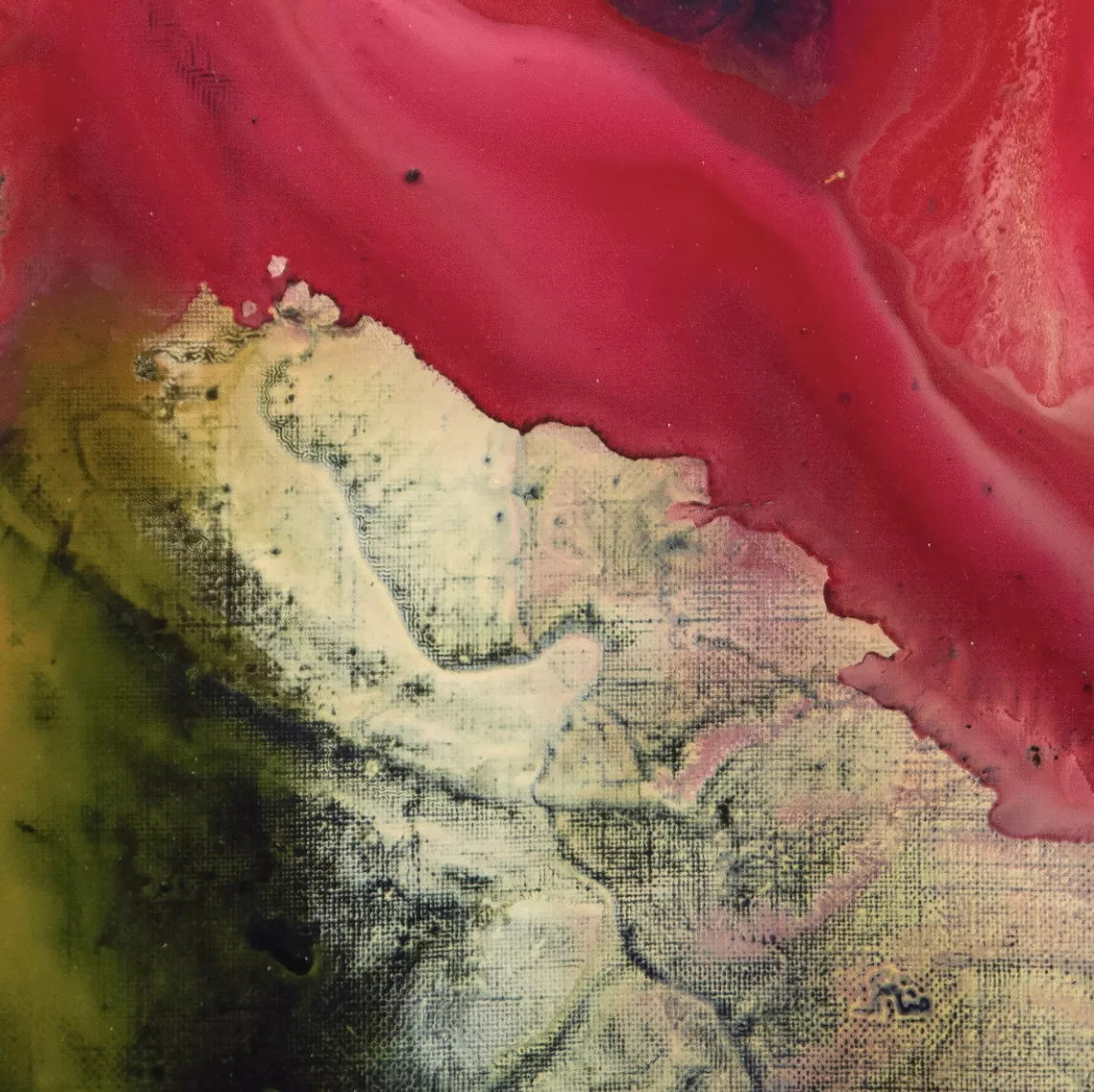
The artist was an active member of the Gutai movement, which was based on experimentation with materials, processes, and the relationship between gesture and matter. In his own way, he embraced lyrical abstraction by using fluid colors, supple forms, and unstructured composition, prioritizing spontaneity and intuition.
He uses liquid, transparent, or unstable materials, highlighting the physical properties of the medium. Motonaga places great importance on the creative process itself rather than the final result, as part of a philosophy of continuous experimentation.
His compositions are characterized by drips, transparencies, and chromatic interactions, creating dynamic and ever-changing visual effects.
He engages with the international abstract movement and maintains a close connection to certain strands of gestural abstraction and abstract expressionism, while retaining a distinctiveness linked to the Japanese avant-garde.

The Life of Sadamasa Motonaga
Cultural Context
Sadamasa Motonaga was born in 1922 and developed his body of work within the context of the postwar Japanese avant-garde, a period marked by a reevaluation of traditional media and an openness to experimentation.
He was a member of the Gutai movement, which emphasized the direct interaction between material, gesture, and environment, as well as the integration of natural phenomena into the artwork. His practice is distinguished by the use of unconventional materials (colored water, smoke, fabric, vinyl) as well as ephemeral installations and outdoor installations.
He also creates abstract paintings characterized by fluid forms, vivid colors, and free composition, evoking natural and organic processes. His work is part of a reflection on transformation, instability, and temporality, in which the artwork is conceived as an event rather than a fixed object.
Artistic and Intellectual Circle
Sadamasa Motonaga actively participated in the activities of the Gutai group under the leadership of Jiro Yoshihira, who encouraged experimentation and radical innovation. He worked alongside artists such as Kazuo Shiraga and Atsuko Tanaka, sharing a performative and material approach to creation.
His work engages in a dialogue with international avant-garde movements, particularly practices related to abstraction and environmental art, while retaining a distinctiveness rooted in the Japanese context.

The Artist's Techniques
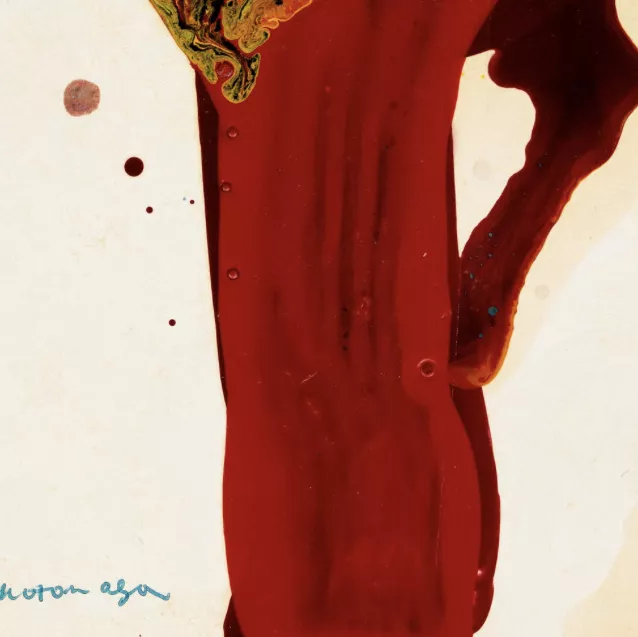
As part of the Gutai movement, Sadamasa Motonaga is engaged in an experimental redefinition of painting and the medium itself. His work focuses on the physical properties of materials (liquids, pigments, supports), which he views as active agents in the creative process.
He uses organic and fluid forms, often achieved through drips, suspensions, or the natural interactions of materials. His palette is vivid and luminous, characterized by translucent colors and subtle gradations.
He places great importance on controlled chance, where physical phenomena contribute to the final composition. His body of work shows a tendency toward lyrical abstraction, a far cry from the gestural intensity of certain members of the Gutai group.
Focus on a Key Work
*Work*, 1956
This is an installation composed of plastic bags filled with colored water suspended in space. The artist sought to highlight fluidity and transparency as constitutive elements of the work.
The material is transformed into an autonomous visual phenomenon, independent of any figurative representation. The goal is to create an interaction between light and liquid, producing shifting chromatic effects.
There is no fixed composition; the work evolves according to environmental conditions. This piece is emblematic of the Gutai movement, illustrating an experimental approach in which material and process become the very subject of art.
FAQ – How do you appraise a work by Sadamasa Motonaga?
1) What stylistic criteria specific to Sadamasa Motonaga are key?
For this artist, the analysis focuses on the use of fluid forms, vivid colors, and abstract compositions evoking natural phenomena—characteristics of his visual language within the Gutai movement.
2) How important is the Gutai period in determining value?
Works from the 1950s and 1960s—a period of radical experimentation by the Gutai group—are particularly sought after due to their historical significance in Japanese contemporary art.
3) How does the condition of a work influence its valuation?
The condition of the support and materials—particularly for works using experimental techniques or unstable mediums—is a key factor in determining value.
His Signature
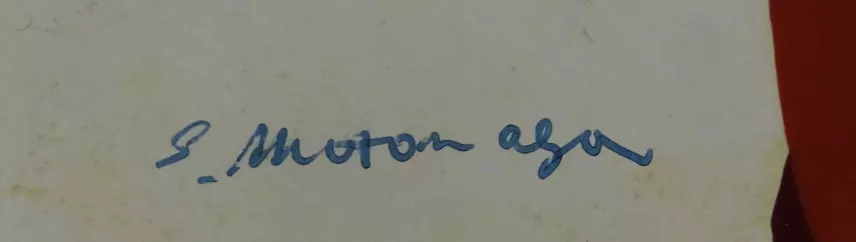
Not all of Motonaga’s works are signed. It is also possible that a work is a copy or that the signature has faded over time, which is why expert appraisal is essential.
Get Your Sadamasa Motonaga Artwork Appraised
If you own a work by Sadamasa Motonaga, an appraisal will help you determine its current market value.
Using our online form, our experts and certified auctioneers will conduct a free appraisal and provide you with a reliable estimate of your artwork’s market value.
If you’re considering selling it, we’ll guide you through the process to ensure you get the best possible price.
Estimate in less than 24h
Discover in the same theme

Rating and value of Yves Klein's paintings, sculptures and d...
Yves Klein is a 20th-century artist who founded Contemporary Art. His value is extremely high and he is much sought-after at auction.
Learn more >

Rating and value of sculptures and furniture by Odile Noll
Odile Noll was an active artist from the 1950s to the 70s, producing works in fine wood. Her works are valued and quoted.
Learn more >

Rating and value of drawings and paintings by Vladimir Baran...
Vladimir Baranoff Rossiné is a painter associated with Cubism whose works command high prices and are highly valued at auction.
Learn more >
Nos records d'enchères à l'hôtel Drouot

Estimated 10.000 - 15.000 €
Ebridge Ayer BURBANK(1858-1949), Young African-American boy, Oil on panel.

Estimated 20.000 - 30.000
EXCEPTIONAL LARGE OVAL DISH IN VINCENNES SOFT PASTE PORCELAIN FROM THE "BLEU CÉLESTE" SERVICE OF KING LOUIS XV AT THE CHÂTEAU DE VERSAILLES

Estimated 20.000 - 30.000
MANUFACTURE ROYALE DE SÈVRES, 18th century "L'Empereur de la Chine" - Portrait of the Emperor Qianlong, Hard porcelain bisque, 1775

Estimated 1.500 - 3.000
HERMÈS, "Kelly" 32 saddle bag in black box calf

Estimated Between €5,000 and €8,000
KRACHKOWSKY (1854-1914), Before the storm, oil on canvas

Estimated 40.000 - 80.000
Alexandre ROUBTZOFF (1884-1949), Portrait of Arbia, oil on canvas

Secure site, anonymity preserved

Auctioneer approved by the State

Free and certified estimates
Frequently asked questions
-
Who was Sadamasa Motonaga, and what was his role in contemporary art?Sadamasa Motonaga (1922–2011) was a Japanese avant-garde artist and an active member of the Gutai movement. He is known for his so-called “performative” painting, which was based on experimentation with materials and featured fluid forms, vivid colors, and abstract compositions evoking natural phenomena. His work is part of the radical renewal of artistic practices in postwar Japan and his engagement with Western avant-garde movements.
-
What is the price range for Sadamasa Motonaga's works at auction?Sadamasa Motonaga’s paintings and drawings sell for between €80 and €1,026,240. Paintings range from €550 to €1,026,240, watercolor drawings between €120 and €26,000, prints between €80 and €43,000, while sculptures and ceramics command more moderate prices. Prices depend heavily on the period (the Gutai works from the 1950s and 1960s are particularly sought after), the condition, and the authenticity of the work.
-
How can I have a work by Sadamasa Motonaga authenticated and appraised?Auctie's offers a free, no-obligation appraisal conducted by our state-certified auctioneers and experts. Simply fill out our online form with photos and information about your artwork. We’ll provide you with a reliable appraisal based on authenticity, market value, and recent market results within 48 hours.
-
Why is now the right time to sell a work by Sadamasa Motonaga?The market for pre-war Japanese art—and particularly works from the Gutai movement—is attracting growing interest from collectors around the world. Motonaga’s works, particularly those from the 1950s and 1960s, enjoy historical recognition and sustained demand, creating favorable conditions for a sale.
-
How does the sale of a work of art work at Auctie's?Auctie's guides you from the free appraisal to the auction. After the initial appraisal, we discuss the optimal sales strategy with you, prepare the artwork for auction, and leverage our international network of collectors and institutions to ensure your artwork fetches the highest possible price.
