



Rating and value of paintings by Yvonne Canu

Key takeaways
- The oil-on-canvas paintings by Yvonne Canu, a Neo-Pointillist artist born in 1921, sell for between 150 and 67,250 euros, with auction prices often exceeding estimates.
- Her masterpiece, “Crépuscule sur Paris,” fetched 67,250 euros in 2008, well above the initial estimate of 8,000 to 11,000 euros, demonstrating a stable and rising market value.
- Canu consistently applies the Pointillist technique to landscapes of ports and villages, using a light palette of blues, whites, and ochres without impasto, creating a constant luminous vibrancy.
If you own a work by or after the artist Yvonne Canu, and would like to know its value, our state-approved experts and auctioneers will offer you their appraisal services.
Our specialists will work to carry out a free appraisal of your work, and provide you with an accurate estimate of its value on the current market.
Then, should you wish to sell your work, we will direct you to the best possible arrangement to obtain the optimum price.
Rating and value of the artist Yvonne Canu
Yvonne Canu is an artist known to lovers of neo-pointillist canvases. Now, prices for her works are rising at the auctioneers' gavel.
Her oils on canvas are particularly prized, especially by French buyers, and the price at which they sell on the art market ranges from €60 to €67,250, a significant delta but one that speaks volumes about the value that can be attributed to the artist's works.
In 2008, his oil on canvas Crépuscule sur Paris, was sold for €67,250, while it was estimated at between €8,000 and €11,000. Its value is stable.
Order of value from a simple work to the most prestigious
Technique used | Result |
|---|---|
Estamp - multiple | From €60 to €95 |
Drawing - watercolor | From €60 to €1,700 |
Oil on canvas | From €150 to €67,250 |
Estimate in less than 24h
Yvonne Canu's style and technique
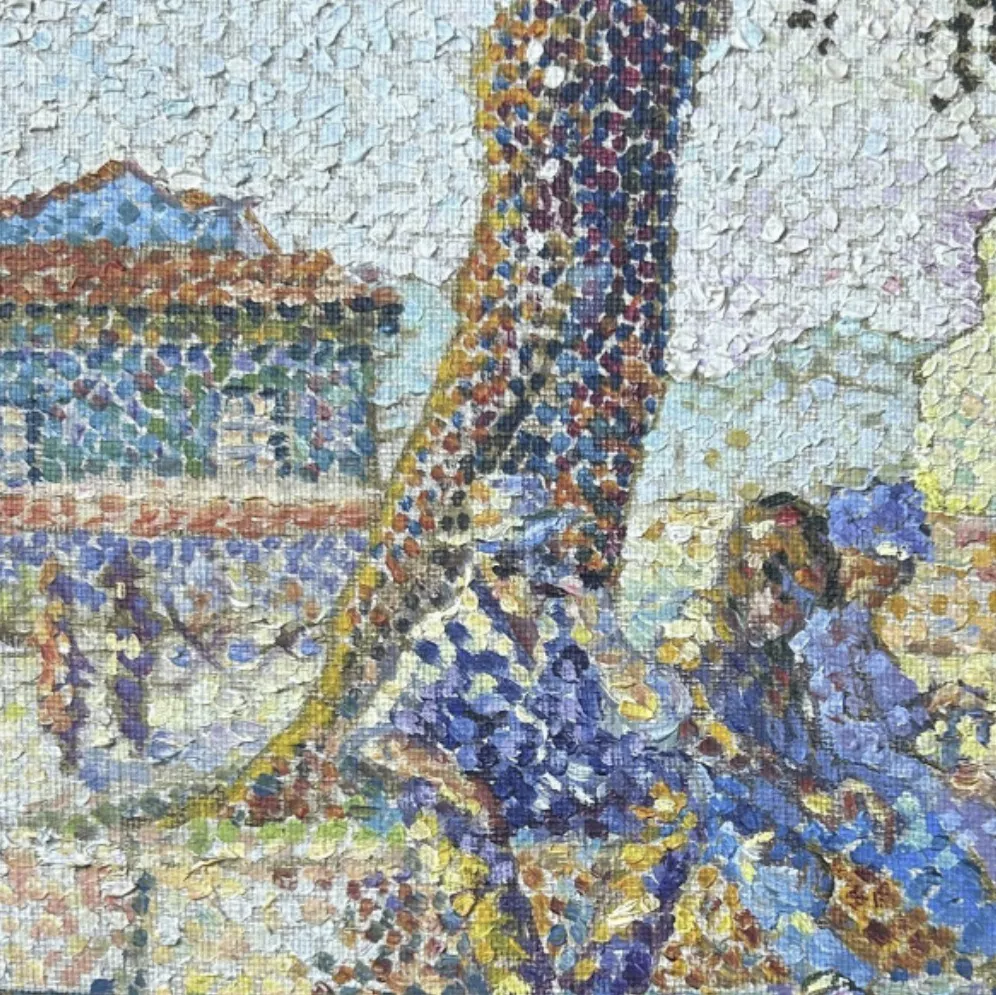
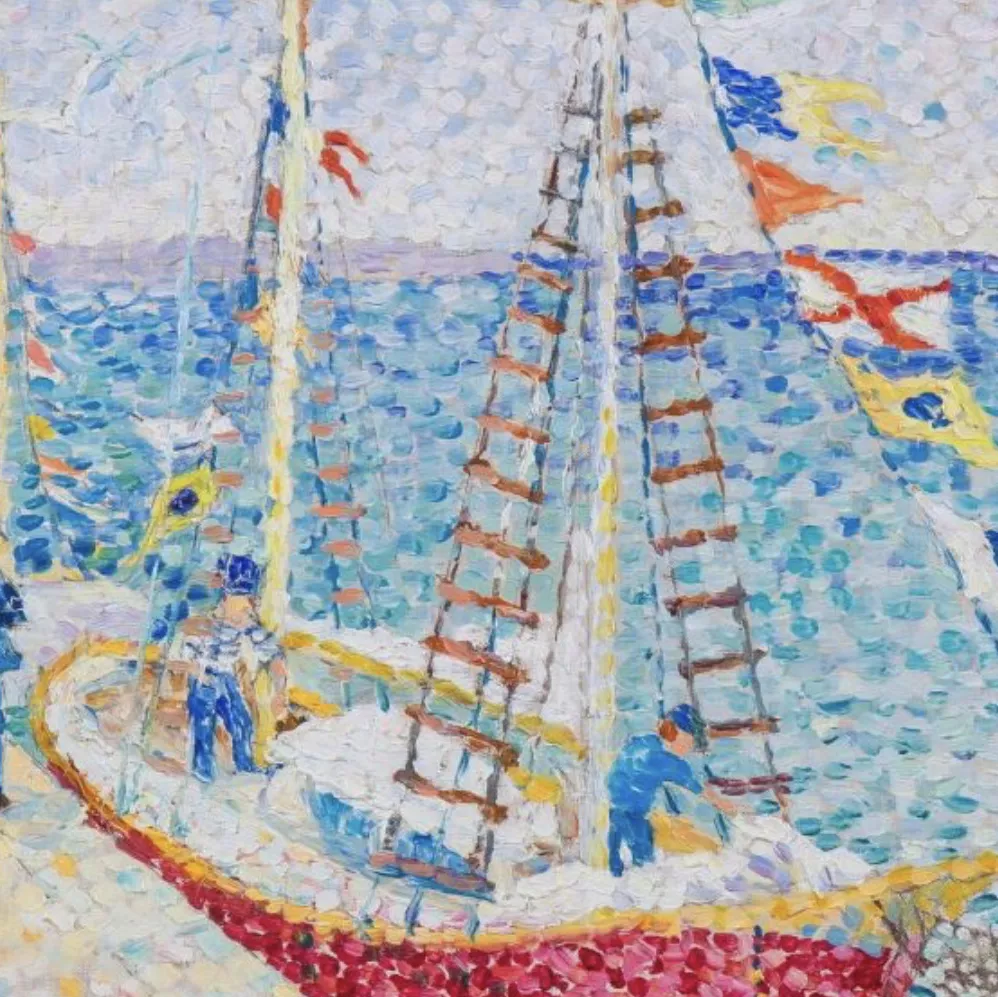
Yvonne Canu develops a painting style structured around the divided brushstroke, applied regularly in a method akin to pointillism. She uses this process, inherited from the Neo-Impressionists, to build her landscapes with precision, superimposing small touches of pure color. Each canvas gives an impression of controlled calm, as if frozen in a moment of clarity.
Her compositions are simple, often centered on a port, a boat or a village, with a very clear horizon line. The elements are arranged in a balanced way, without overloading, in a rigorous ordering of the motif. The image always retains a direct legibility, despite the use of fragmented brushstrokes.
She employs a light palette, composed of blues, whites, yellows or ochres, with no material effects. The colors are applied without impasto, the surface remains smooth, matte, almost textile. The sky, water and houses are painted with the same small, regularly applied strokes, giving the whole a constant luminous vibration.
The atmosphere that emanates from his works is silent and stable. No sudden movements, no breaks: everything is contained, poised, suspended. This painting strives to capture a simple moment, often in broad daylight, when light seems to stop on things.
Yvonne Canu's life
Yvonne Canu was born in 1921 in Meknes, Morocco. She spent her childhood in North Africa, then moved to France in the early 1930s. She studied at the École des Beaux-Arts in Paris, where she received a classical training. During the Second World War, she interrupted her studies, but resumed her artistic practice after the Liberation.
She began by painting landscapes in a realistic vein, before gradually moving towards a simplification of form and color. From the 1950s, she discovered the work of Seurat and Signac (which artists such as Mendjinsky would take up), marking a decisive turning point in her approach. She then adopted a pointillist technique, which she applied consistently until the end of her career.
She exhibited in several Parisian salons and took part in group shows in France and abroad. Her work attracts the attention of galleries, notably for its formal rigor and luminosity. She remains faithful to a solitary practice, far from the mainstream, and builds a coherent and identifiable body of work.
Yvonne Canu died in 2008. Her work continues to circulate in galleries and modern art fairs, where it is recognized for its technical mastery and fidelity to the language of neo-impressionism.
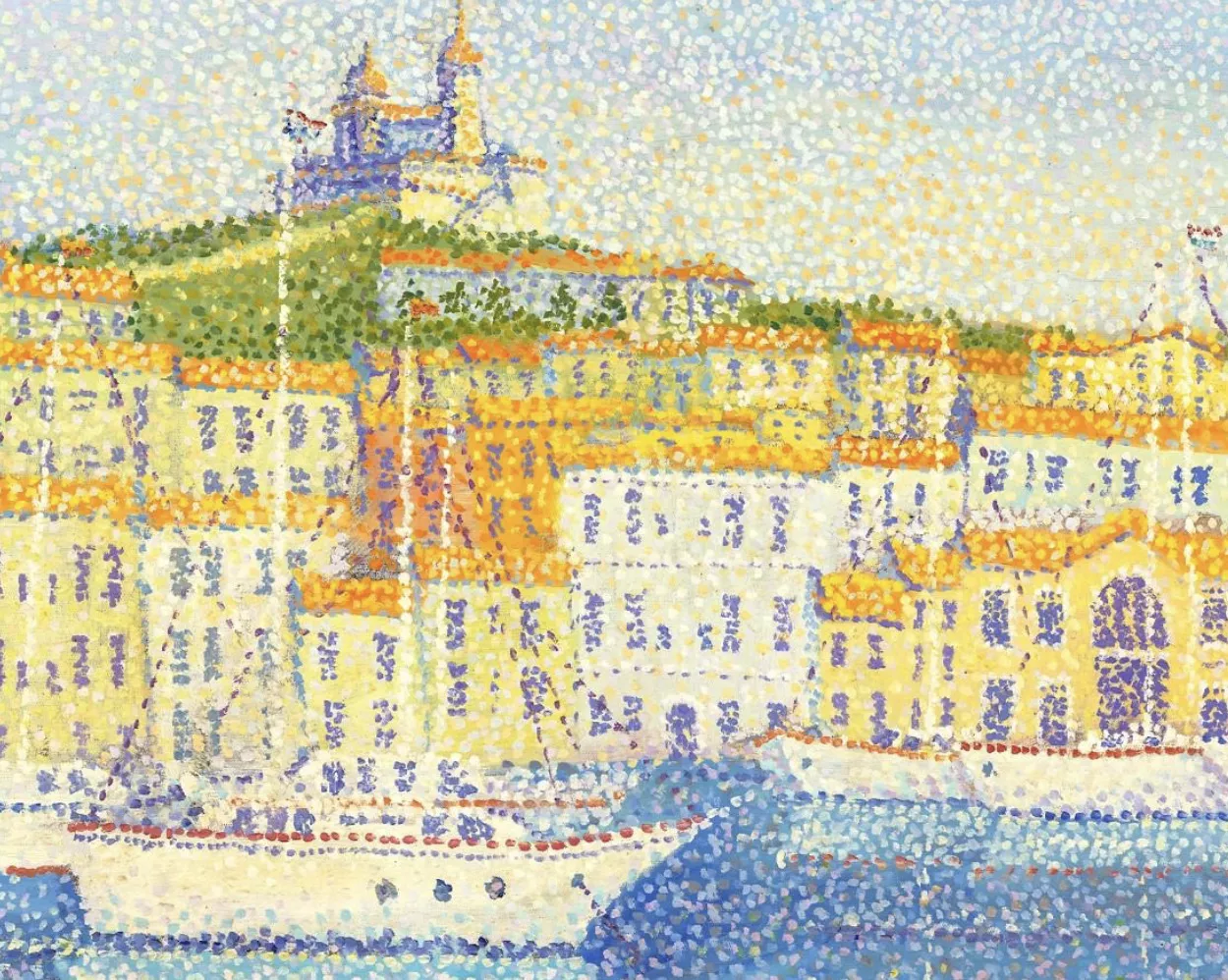
Focus on Le Port de Saint-Tropez, Yvonne Canu
This work depicts a calm harbor, lined with light-fronted houses. Several boats are moored alongside. Their hulls can be seen from the front or at an angle. The masts stand vertically. The water occupies the foreground. It reflects the shapes in a regular manner.
The composition is stable. Elements are centered. Horizontal lines dominate. The verticals of the masts punctuate the scene. The houses are arranged side by side. Openings are schematic. The shapes are geometric and solid.
The touch is divided. It is methodically applied. Stitches are tight, dense, juxtaposed. No contours are drawn. The surface is completely covered. The whole is homogeneous.
The palette is light. Blues, beiges, ochres and pinks are distributed without harsh contrast. The light is soft. There are no marked shadows.
The scene is empty. No characters are depicted. No movement is suggested. The boats are motionless. The water is flat. The whole is silent.
Yvonne Canu's imprint on her period
Yvonne Canu belongs to the generation of artists active after the Second World War. She chose a path apart. She did not follow the dominant abstract trends. She took up the technique of pointillism. She applies it to calm, luminous landscapes.
Her work follows in the footsteps of the Neo-Impressionists. It is distinguished by its regularity and clarity. She developed a coherent body of work. She paints harbors, villages and seashores. She always uses the same method. She applies color in small strokes. She constructs her images by juxtaposition.
Her paintings meet with discreet success. They are shown in galleries and salons. They appeal for their balance and precision. They attract lovers of figurative painting.
She marks her era by her fidelity to an ancient technique. She renews it without modifying it. She contributes to keeping alive a pictorial tradition. Her work remains identifiable. It is distinguished by its simplicity, its light and its constancy.
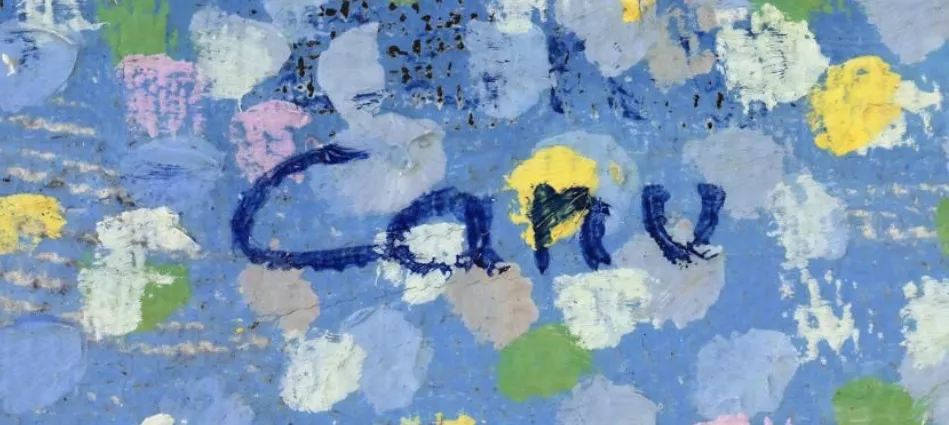
Recognizing the artist's signature
Yvonne Canu does not necessarily sign her works. Copies may exist, which is why expertise remains important.
Knowing the value of a work
If you happen to own a work by or after Yvonne Canu, don't hesitate to request a free valuation using our form on our website.
A member of our team of experts and chartered auctioneers will contact you promptly to provide you with an estimate of the market value of your work, as well as ad hoc information about it.
If you are considering selling your work, you will also be accompanied by our specialists in order to benefit from alternatives for selling it at the best possible price, taking into account market inclinations.
Estimate in less than 24h
Discover in the same theme

Rating and value of paintings, sculptures and drawings by Ha...
Hans Bellmer is a twentieth-century surrealist painter who produced paintings and sculptures that are valued at auction.
Learn more >

Rating and value of Robert Picault's ceramics, services and...
Robert Picualt is a 20th-century ceramist who worked in Vallauris. He is the author of an important and valuable production.
Learn more >

Rating and value of paintings by Lynne Drexler
Lynne Drexler is an American Expressionist artist who has produced numerous paintings that are highly rated and valued at auction.
Learn more >
D'autres tableaux modernes figuratifs vendus aux enchères

Estimated 800 - 1.500
Jean Roger SOURGEN (1883-1978) Trees and dunes Oil on panel

Estimated 3.000 - 5.000
Georges LAPCHINE (1885-1951) The port of St Tropez Oil on canvas

Estimated 18.000 - 30.000
Charles CAMOIN (1879-1965) "Le Port de Marseille, 1928" Oil on canvas.

Estimated 1.500 - 3.000
Jean VANDEN EECKHOUDT (1875-1946), Basket of persimmons, Oil on canvas

Estimated 2.000 - 4.000
Charles LACOSTE (1870-1959) Starry night, Oil on paper mounted on canvas

Secure site, anonymity preserved

Auctioneer approved by the State

Free and certified estimates
Frequently asked questions
-
Who is Yvonne Canu, and what is her artistic style?Yvonne Canu (1921–2008) was a French painter known for her Neo-Pointillist approach. She developed a style of painting structured around the “divided brushstroke,” drawing on the Pointillist technique inherited from Seurat and Signac to create precise landscapes of ports and villages. Her style is characterized by a light color palette (blues, whites, yellows, ochres), a smooth surface without impasto, and a calm, luminous atmosphere.
-
What is the price range for Yvonne Canu's works?The prices of Yvonne Canu’s works vary considerably depending on the medium: prints range from €60 to €95, drawings and watercolors from €60 to €1,700, and oil paintings on canvas from €150 to €67,250. This wide range reflects the varying value assigned to pieces based on their significance, provenance, and condition.
-
How can you authenticate a work by Yvonne Canu and determine its exact value?To authenticate a piece and determine its current value, we recommend that you request a free appraisal using the form on the Auctie's website. A certified expert or auctioneer will contact you within 48 hours to provide you with an accurate estimate, with no obligation on your part.
-
Is this the right time to sell a work by Yvonne Canu?Yes, now is a good time to sell. Yvonne Canu’s market value is stable, and her oil-on-canvas paintings continue to attract steady interest from collectors of figurative art and Neo-Impressionism, particularly in the French market. The growing recognition of her work ensures consistent demand.
-
How does the sales process work at Auctie's?At Auctie's, we support you every step of the way: a free, no-obligation appraisal by our experts, followed by guidance on the best sales options to achieve the best possible price. Our state-certified auctioneers manage the entire process, from appraisal to auction, taking current market conditions into account.
