



Rating and value of paintings by Georges Seurat

Key takeaways
- Seurat remains a sure bet on the art market, with his oil-on-canvas paintings fetching up to 129.6 million euros at auction in 2022.
- His Divisionist technique, based on scientific principles of optics, juxtaposes dots of pure color to create harmonious visual blends.
- Drawings and watercolors sell for between 1,300 and 9 million euros, while prints range from 10 to 32,700 euros.
If you own a work by or after the artist Georges Seurat, and would like to know its value, our state-approved experts and auctioneers will offer you their appraisal services.
Our specialists will carry out a free appraisal of your work, and provide you with an accurate estimate of its value on the current market.
Then, if you wish to sell your work, we will direct you to the best possible arrangement to obtain the optimum price.
Artist's rating and value
An important artistic figure of his time, Georges Seurat has established himself as a sure bet on the art market. Constantly evolving, his value remains high and his works are sold internationally.
In the auction room, canvases depicting landscapes or portraits, painted in the late 1800s, are the most sought-after and therefore prized. Drawings are also very popular with collectors.
A work by Seurat, for example, can fetch a hundred million euros at auction, as evidenced by his 1892 oil on canvas, Les poseuses, Ensemble (petite version), fetched €129,642,000 in 2022.
Order of value from the most basic to the most prestigious
Technique used | Result |
|---|---|
Estamp - multiple | From €10 to €32,700 |
Drawing - watercolor | From €1,300 to €9,042,600 |
Oil on canvas | From €128,000 to €129,642,000 |
Estimate in less than 24h
Georges Seurat's style and technique
Georges Seurat, in search of an almost scientific precision in the pictorial act, revolutionized the art of his time through the rigorous application of divisionism.
In contrast to his Impressionist contemporaries, such as Monet or Renoir, who favored the spontaneity of the brushstroke, Seurat adopted a calculated method in which each point of color obeyed precise optical principles derived from the work of Chevreul and Rood.
Far from a mere technique, this approach reflected a broader ambition: to order light and forms according to a harmonious logic.
In Un Dimanche après-midi à l'Île de la Grande Jatte (Art Institute of Chicago), the human figures, reduced to hieratic silhouettes, stand out in a composition orchestrated with an almost architectural rigor, reminiscent of classical friezes.
Where Pissarro was still exploring the freedom of gesture, Seurat attached himself to a discipline where color, broken down into dots, becomes a tool of visual synthesis in the viewer's eye.
This methodical work gives his canvases a unique luminous density, while imposing a form of emotional distance, making his art a subtle balance between scientific modernity and timeless classicism.
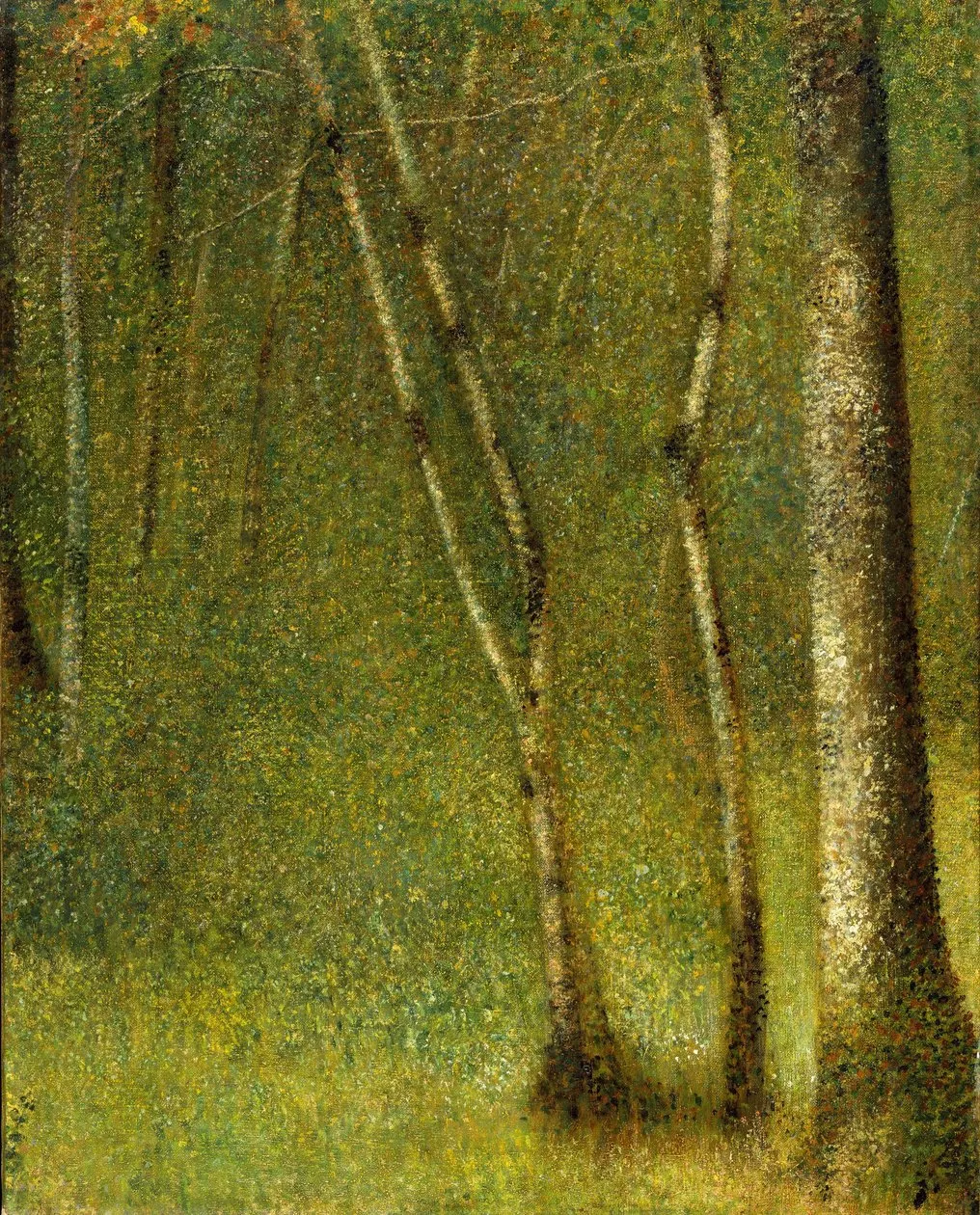
Paul Signac, his life, his work
Georges Seurat, born in 1859 in Paris, embodies an atypical figure in late 19th-century art, at the crossroads of academic tradition and scientific avant-garde.
A student at the École des Beaux-Arts, he received rigorous training under the influence of classical masters such as Ingres, whose purity of line he admired.
But from his earliest works, Seurat stood out for his analytical approach, nourished by contemporary theories on light and color, notably those of Michel-Eugène Chevreul and Ogden Rood.
In 1884, he became one of the founders of the Société des Artistes Indépendants, rejecting the conventions imposed by official salons and offering a space for expression to the bold research of his generation.
Working with an almost scientific method, he devoted much of his life to the development of pointillism, a technique that combines rigor and sensitivity, with each touch of color thought out to interact harmoniously with the whole.
Solitary, often distant from social circles, he nevertheless frequented a few figures on the art scene, such as Paul Signac, with whom he shared the ambition to go beyond Impressionism by giving it a more rational foundation.
His private life, just as enigmatic as his work, is marked by extreme discretion: it's only after his premature death at the age of 31, in 1891, that we discover his partner and their young son.
Seurat left behind a concise yet innovative body of work, in which each painting becomes an aesthetic manifesto, reaffirming the place of art in a quest for scientific and emotional truth.
His influence, though discreet during his lifetime, would extend beyond neo-impressionism, heralding the great formal upheavals of the twentieth century.
Focus on Un dimanche après-midi à l'île de la Grande Jatte, 1886
Un dimanche après-midi à l'Île de la Grande Jatte, created between 1884 and 1886, is one of the most significant masterpieces by Georges Seurat, and perhaps of Neo-Impressionism as a whole.
With this vast canvas, measuring 2 by 3 meters, Seurat wasn't just offering a scene of outdoor leisure: he was erecting an artistic manifesto.
Each element, from the motionless figures to the stretched shadows, is skilfully ordered in a quasi-architectural composition, reminiscent of ancient friezes and the rational balance of a Poussin.
But what sets this work apart is its technique: pointillism, or divisionism, where juxtaposed dots of pure color create optical mixtures.
Inspired by the scientific theories of Chevreul and Rood, Seurat applies an almost mathematical method here.
Light contrasts, chromatic vibrations, everything responds to an implacable logic. In this way, light and color are no longer merely perceived: they are constructed, in a meticulous process that demands both precision and global vision.
The figures, static and almost sculptural, seem disconnected from one another, reinforcing an impression of strangeness. What could have been a simple bucolic scene becomes a meditation on modernity and isolation.
The work, exhibited at the Salon des Indépendants in 1886, was disconcerting: some saw it as a scientific feat, others criticized its coldness.
Today, it is recognized as a fundamental piece, heralding the formal questioning of the XXᵉ century, where painting explores the furthest reaches of human perception.
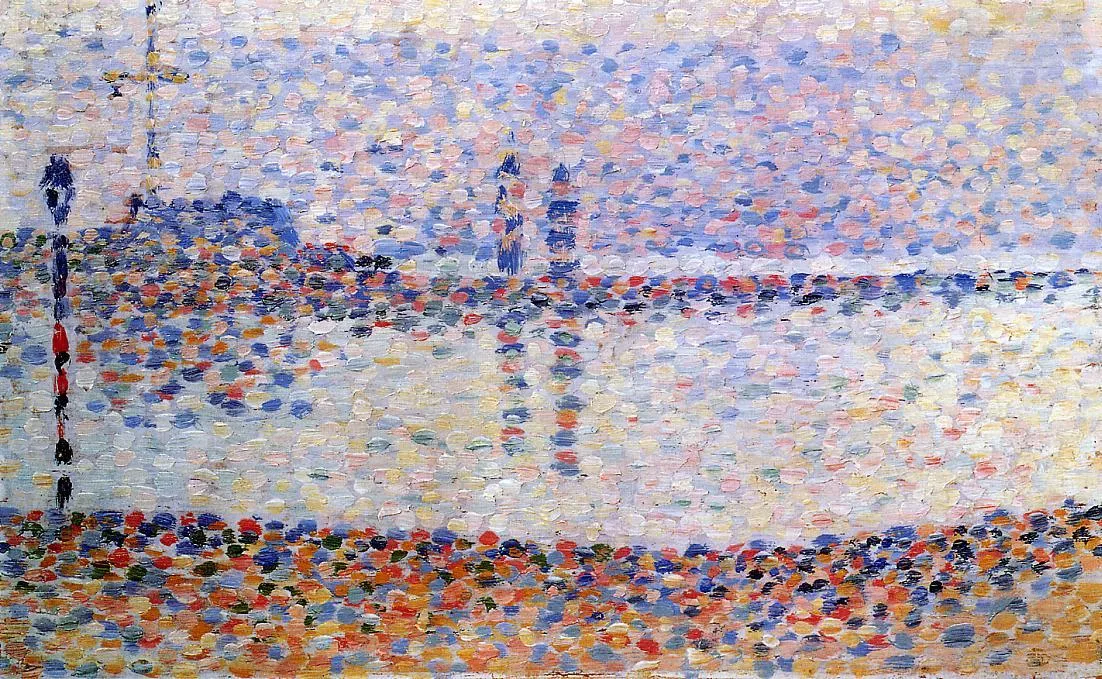
Georges Seurat's imprint on his period
Georges Seurat, in developing pointillism, marked a decisive break with Impressionism, while opening a new chapter for modern painting.
Influenced by Chevreul's theories on color contrast and chromatic division, he makes each brushstroke an autonomous unit, participating in a methodical orchestration of light and space.
With A Sunday Afternoon on the Île de la Grande Jatte (Art Institute of Chicago), he created not only a social fresco of his time, but also a work in which every detail, calculated with scientific precision, blends into an almost classical monumentality.
This quest for order and harmony, supported by a technique of rare rigor, both impressed and baffled his contemporaries.
Signac and Pissarro continued his legacy, enriching Neo-Impressionism, while movements such as Cubism found inspiration in his structuring of space.
Seurat's visionary, analytical approach redefined the possibilities of the pictorial medium, consolidating its place as a pillar in the evolution of Western art.
.
Seurat and divisionism
Divisionism, a technique based on the systematic separation of colors into small juxtaposed touches, is based on scientific principles borrowed from optics and color theory, notably Chevreul's work on simultaneous contrasts and Rood's on light perception.
Georges Seurat was the pioneer, transforming the canvas into a vibrant surface where each colored point participates in a chromatic recomposition by the viewer's eye.
This process, visible in Un dimanche après-midi à l'Île de la Grande Jatte (Art Institute of Chicago), achieves a mathematical precision where the arrangement of primary and secondary colors maximizes the luminous effect.
Paul Signac, Seurat's faithful companion, perfected this technique by endowing it with a freer touch, as witnessed by Le port de Saint-Tropez (Musée d'Orsay). More distant Seurat influences can also be found in Serge Mendjisky.
Camille Pissarro, initially an Impressionist, also incorporated elements of Divisionism, although his approach remained more intuitive. In Italy, Giovanni Segantini and Gaetano Previati adapt these principles to Symbolist compositions, giving the movement international scope.
Divisionism is not just about technical prowess: it illustrates a methodical, quasi-scientific vision of painting, transforming the creative act into an experiment with light and space.
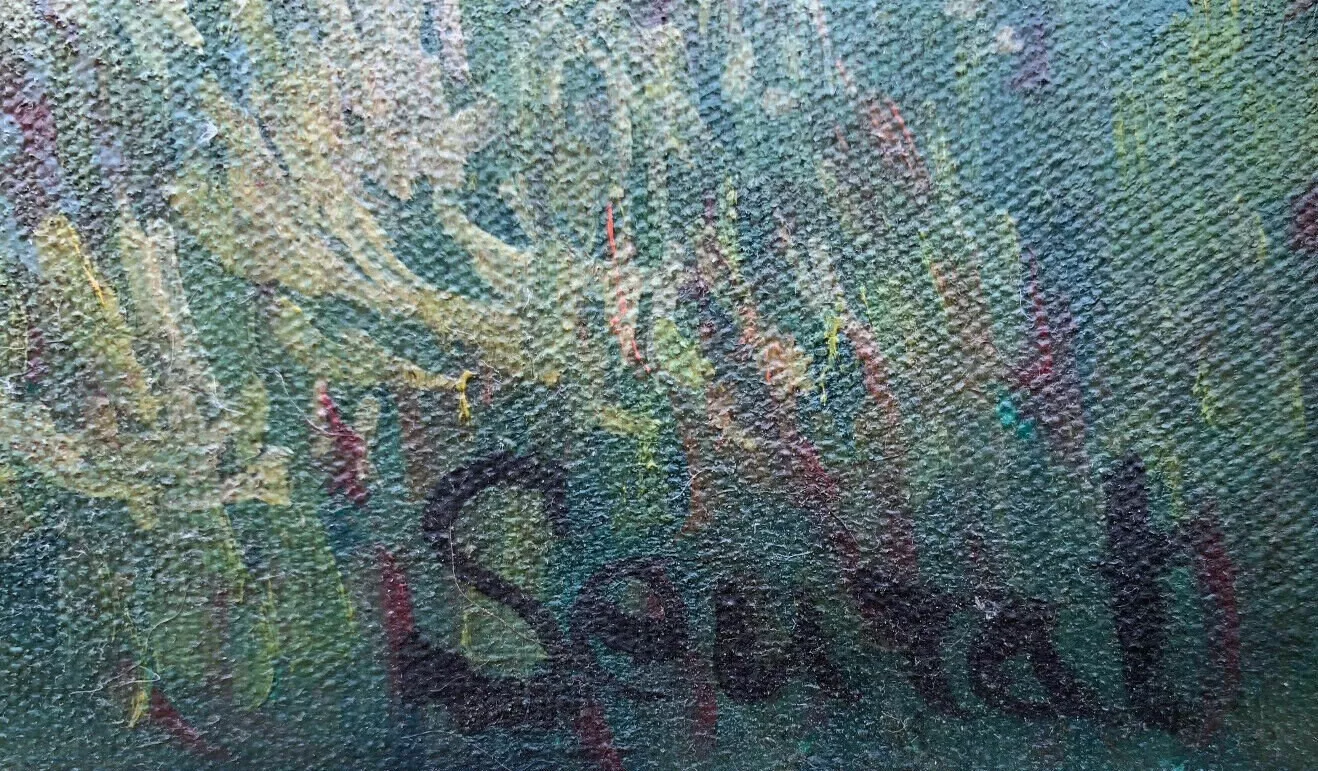
Recognizing the artist's signature
Not all of Georges Seurat's works are signed, and copies may exist. The production of fake paintings is very important for this artist. Here's an example of his signature.
Expertise your property
If you happen to own a work by Georges Seurat, request a free appraisal without further delay via our form on our website.
A member of our team will contact you promptly to provide you with an estimate of the value of your work, not forgetting to send you ad hoc information about it.
If you are considering selling your work, you will also be accompanied by our specialists in order to benefit from alternatives for selling it at the best possible price.
.Estimate in less than 24h
Discover in the same theme

Rating and value of works, paintings, drawings by Étienne Pr...
Berne Bellecour is a successful 19th-century painter of military art. His quotation is stable and the value of his paintings high.
Learn more >

Rating and value of works, drawings, paintings by Guillaume...
Guillaume Fouace was a 19th-century realist painter, best known for his still lifes. His paintings are successful at auction.
Learn more >

Rating and value of Pascal Dagnan Bouveret's paintings and d...
Pascal Dagnan Bouveret is a 19th-century naturalist artist whose works are highly valued at auction.
Learn more >
D'autres tableaux impressionnistes vendus aux enchères

Estimated 6.000 - 8.000
Mikhail Markianovich GUERMACHEFF (1867 - 1930) House under the snow, oil on canvas

Estimated 2.000 - 4.000
Jean DUFY (1888-1964) Vase of anemones, Watercolor

Estimated 600 € - 800 €
Henri ZUBER (1844-1909), Bridge at Artemare. Oil on canvas.

Secure site, anonymity preserved

Auctioneer approved by the State

Free and certified estimates
Frequently asked questions
-
Who is Georges Seurat, and what is his contribution to art history?Georges Seurat (1859–1891) was a Parisian painter who revolutionized late 19th-century art by developing Divisionism (or Pointillism), a technique based on scientific principles of optics and color theory. Trained at the École des Beaux-Arts but breaking with academic conventions, he founded the Société des Artistes Indépendants and created major works such as “A Sunday Afternoon on the Island of La Grande Jatte,” which foreshadowed the formal upheavals of the 20th century. His analytical and methodical approach influenced Neo-Impressionism and Cubism.
-
What are the price ranges for works by Georges Seurat?Estimates vary considerably depending on the medium and provenance: prints range from €10 to €32,700, drawings and watercolors between €1,300 and €9,042,600, while oil-on-canvas paintings range from €128,000 to €129,642,000 (its record set by “Les poseuses, Ensemble” in 2022). Paintings depicting landscapes or portraits from the late 1880s are the most sought-after by international collectors.
-
How can I have a work by Georges Seurat appraised and verify its authenticity?Auctie's offers a free, no-obligation appraisal by state-certified auctioneers and experts through a form on our website. A member of our team will contact you shortly to evaluate your artwork and provide you with an accurate estimate of its value. This step is particularly important for Seurat, as there are a large number of forgeries of his works: verifying authenticity is essential before any transaction.
-
Is this the right time to sell a work by Georges Seurat?Yes, now is a good time to sell: Georges Seurat has established himself as a safe bet in the art market, with prices that are steadily rising and works that regularly sell on the international market. Collector demand for his paintings, drawings, and watercolors remains strong, particularly for works from the late 1880s. Auctie’s will guide you from the appraisal to the auction to help you achieve the best possible price.
-
How does the sale of a work of art work at Auctie's?The process begins with a free appraisal of your artwork by our state-certified experts, with no obligation on your part. You’ll receive a response within 48 hours. If you decide to sell, our specialists will guide you through the entire process: they’ll advise you on the best way to list your piece and help you choose the optimal approach to achieve the best possible price at auction.
