



Rating and value of paintings by Paul Signac

Key takeaways
- Paul Signac, a leading figure of Neo-Impressionism, has seen his works fetch up to 33.9 million euros at auction, particularly his Parisian landscapes from the 1900s.
- Prints sell for between €10 and €33,330, watercolor drawings for between €240 and €251,770, and paintings for between €270 and over 33 million euros.
- As a co-founder of Pointillism alongside Georges Seurat, Signac theorized this scientific movement based on the juxtaposition of dots of pure color applied directly to the canvas.
If you own a work by or after the artist Paul Signac, and would like to know its value, our state-approved experts and auctioneers will offer you their appraisal services.
Our specialists will work to carry out a free appraisal of your work, and provide you with an accurate estimate of its value on the current market.
Then, if you wish to sell your work, we will guide you towards the best possible arrangement to obtain the optimum price.
Artist's rating and value
An important artistic figure of his time, Paul Signac has established himself as a sure bet on the art market. Constantly evolving, his quotation remains high and his works sell internationally.
In the auction room, canvases depicting Parisian landscapes or topographies, painted in the early 1900s, are the most sought-after and therefore prized. Drawings are also popular with collectors.
A work by Signac, for example, can fetch a hundred million euros at auction, as demonstrated by his 1892 oil on canvas, Concarneau, calme du matin, which fetched €33,906,330 in 2022, whereas it was estimated at between €27,923,000 and €34,903,200.
Order of value from the most basic to the most prestigious
Technique used | Result |
|---|---|
Estamp - multiple | From €10 to €33,330 |
Drawing - watercolor | From €240 to €251,770 |
Painting | From €270 to €33,906,330 |
Estimate in less than 24h
Style and technique of Paul Signac
The central subject of his paintings, cities, ports, and seascapes are Signac's favorite theme, marking a strong connection between the artist and the marine world.
His work is deeply rooted in the changing atmosphere of the Mediterranean and northern European coasts, which he endeavors to capture with luminous meticulousness.
The artist is close to the work of Georges Seurat, with whom he co-founded neo-impressionism, of which pointillism is one of the most emblematic expressions. This movement, derived from Impressionism, is based on a scientific method of juxtaposing small touches of pure color.
In contrast to mixing colors on a palette, these are applied directly to the canvas in tightly-packed dots. These touches, often in pastel or luminous hues, visually blend together when the work is observed from a distance, creating vibratory and luminous effects.
This pictorial technique gives greater relief to the composition, accentuating the luminosity of the works and offering a new perception of light and contrasts. It gives each canvas an almost musical dimension, where colors play like notes, reinforcing the harmony and serenity of the landscapes.
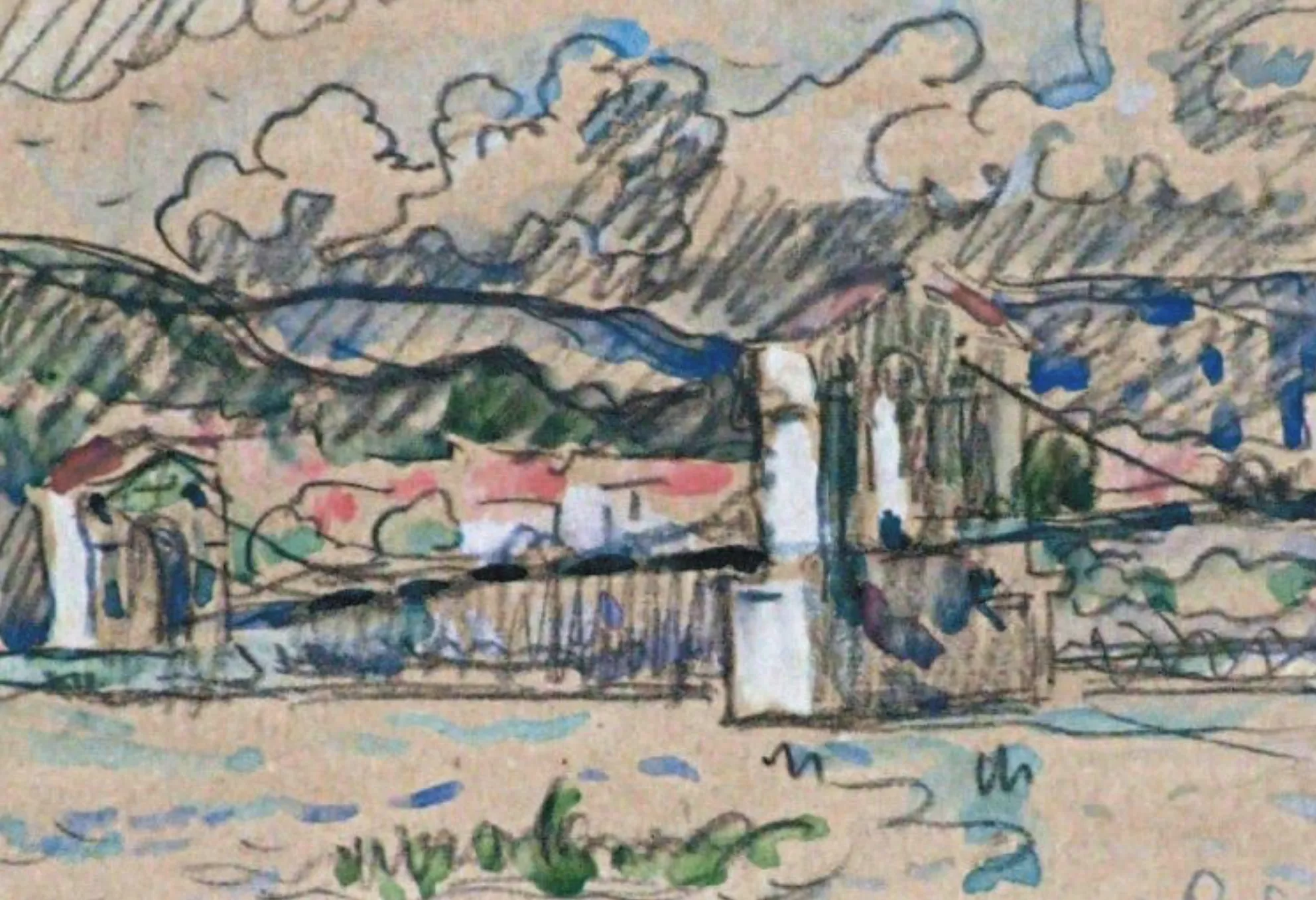
Paul Signac, his life, his work
Paul Signac (1863-1935) was a French pointillist painter born in Paris, whose work profoundly influenced the history of modern art. Born into an affluent and cultured family, he grew up in an environment conducive to the discovery of the arts.
At the age of 16, his encounter with Impressionism at an exhibition was an aesthetic shock that determined his artistic career. Fascinated by the works of this new avant-garde, he tried to copy them, but was quickly rebuked by Paul Gauguin, who urged him to develop his own vision.
Autodidact, Signac had no formal academic training. His passion for painting led him to abandon his secondary studies to devote himself entirely to his art.
Inspired by Édouard Manet, he moved to Montmartre, renting a studio in the heart of this bohemian district, where he rubbed shoulders with many Symbolist artists and writers, whose influence would mark his evolving style. It was also during this period that he befriended Claude Monet, whose approach to light and color would be decisive for his own work.
His career took a decisive turn when he began exhibiting at the Salon des Indépendants, a key venue for artists breaking away from academic institutions.
Aware of the need to free himself from the constraints imposed by official art, he helped found the Société des Artistes Indépendants, thus affirming his desire to see art evolve freely. It was also here that he met Georges Seurat, with whom he forged a fruitful collaboration.
Together, they founded Neo-Impressionism, a form of "scientific impressionism" based on the theory of tonal division. Their technique, pointillism, relies on the application of small dabs of pure color that, seen from a distance, optically blend in the viewer's eye, creating a new, more vibrant luminosity.
Camille Pissarro joins them, further enriching this nascent movement.
The untimely death of Seurat in 1891 called into question the foundations of this new movement.
In order to preserve and formalize neo-Impressionist theory, Signac took up his pen and wrote a key essay, D'Eugène Delacroix au néo-impressionnisme, in which he defended the principles of color division and legitimized their approach. This seminal text consolidates his position as an intellectual and theorist of the movement.
Parallel to his artistic career, Signac drew closer to anarchist circles, sharing with them a utopian vision of society and individual freedom. This political commitment is echoed in some of his works, notably in his famous portrait of Félix Fénéon, art critic and anarchist activist.
Towards the end of his life, Signac settled in Saint-Tropez, where he continued his exploration of seascapes, ever faithful to his pointillist technique. In 1915, he was appointed official painter of the Navy, an honorary title that crowned a career marked by a constant quest for light, harmony and artistic innovation.
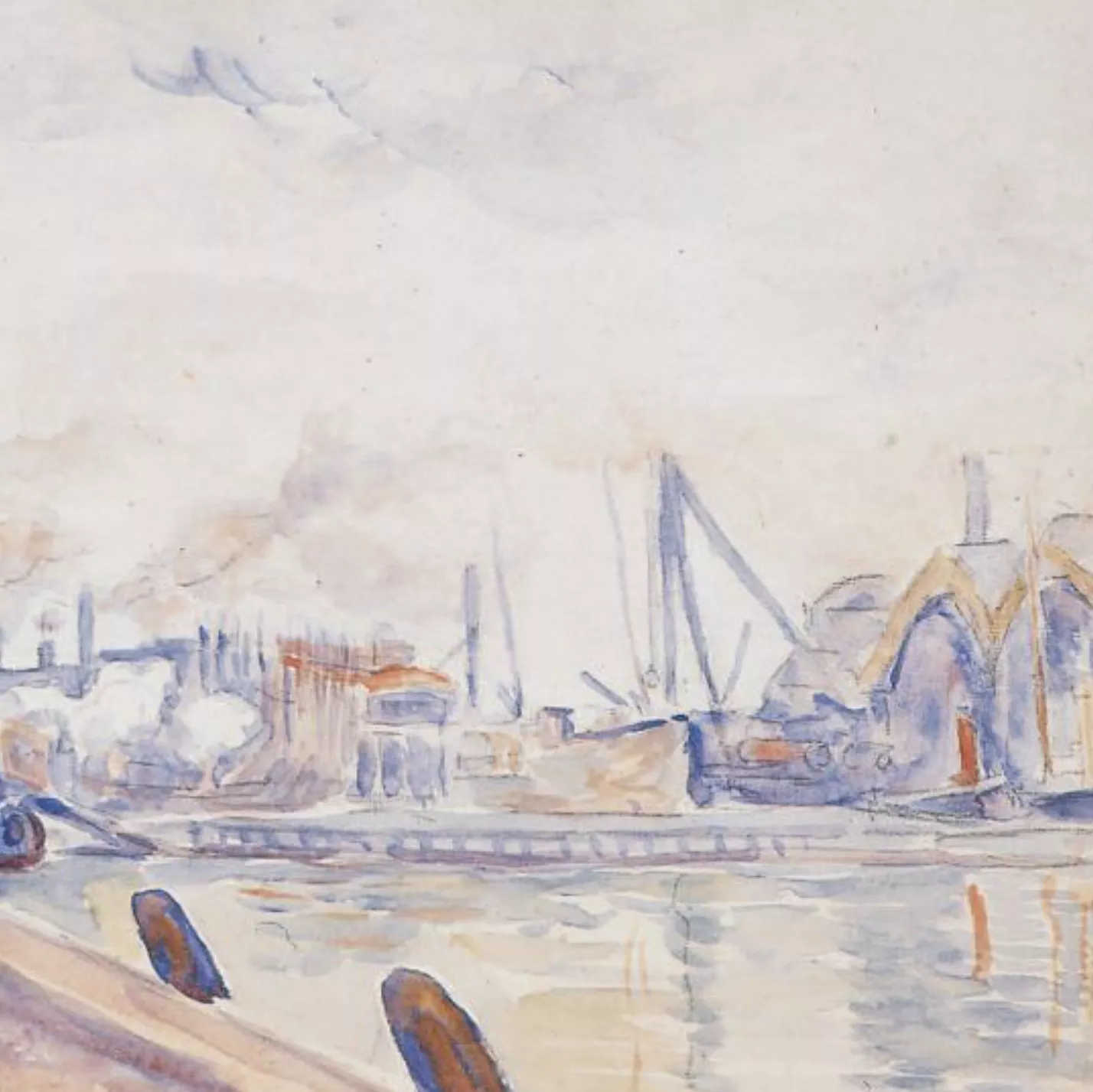
Focus on Signac's lithograph on the cover
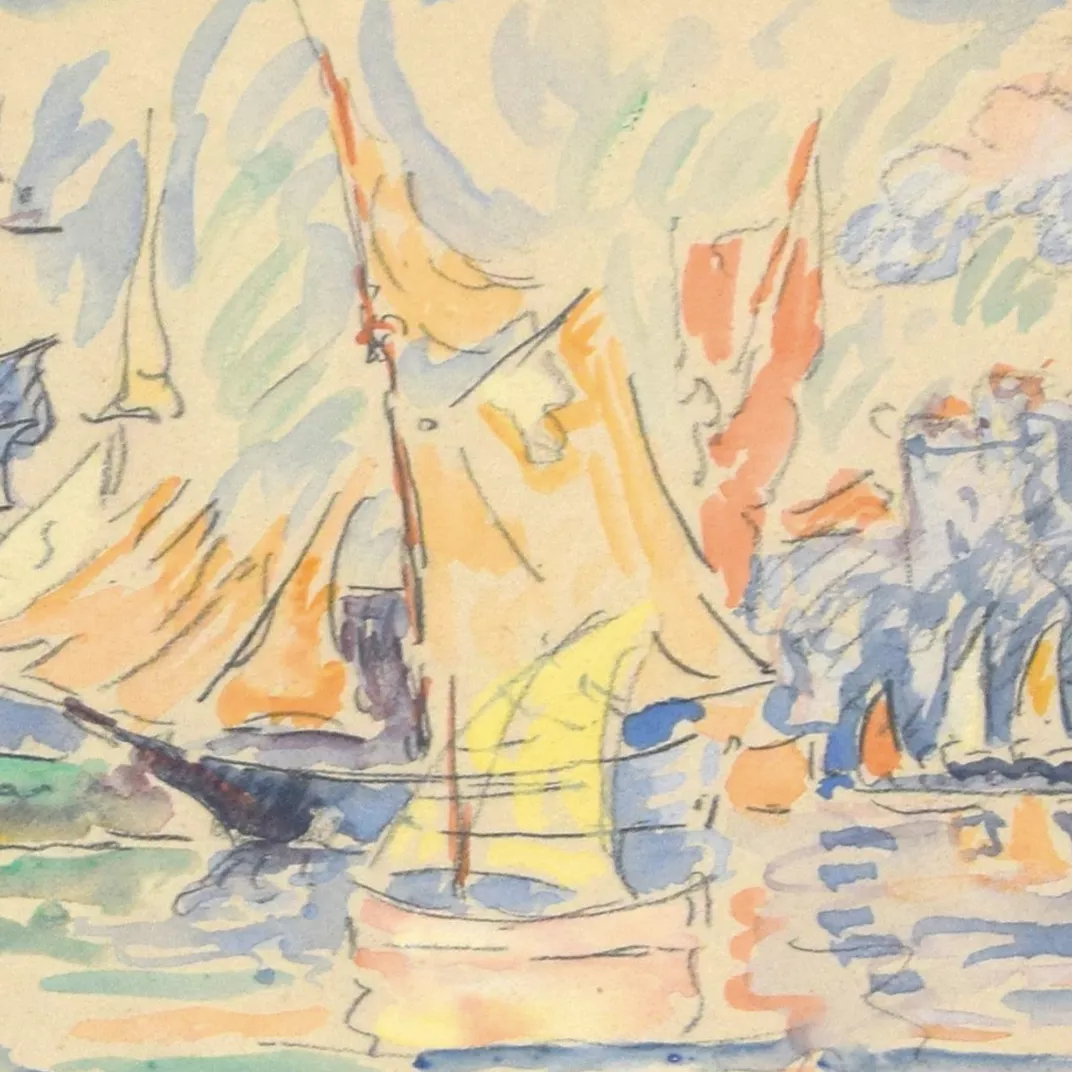
This lithograph by Paul Signac, entitled Le Port de La Rochelle, embodies the very essence of his artistic approach, where light and color intertwine harmoniously.
Done in 1898, this work reveals a vibrant maritime scene, typical of Signac's interest in ports and seascapes, which are recurring motifs in his work.
The composition is characterized by fluid lines and simplified forms, typical of pointillism, but also by a subtle arrangement of colors.
Shades of blue, violet and ochre blend to evoke the reflections of sky on water, while the white sails of the boats rise lightly, capturing the movement and softness of the sea air.
The soothing pastel color palette conveys an impression of serenity and escapism, inviting the viewer to immerse themselves in this tranquil atmosphere.
The choice of lithography as a medium also underscores Signac's desire to make his art accessible and spread the ideas of Neo-Impressionism to a wider audience.
By combining the technique of lithography with his artistic vision, he succeeds in creating a work that is both refined and popular, true to his commitment to art as a vehicle for emotion and reflection.
Through this lithograph, Signac doesn't just depict a landscape: he succeeds in capturing the essence of a moment, conveying a mood and arousing emotions.
His keen eye for nature and talent for interpreting it make this work a precious testament to his artistic legacy, while illustrating his pivotal role in the development of Pointillism and Neo-Impressionism.
Signac and the politics of pointillism
Paul Signac's imprint on his period
Considered the major theorist of Pointillism and Neo-Impressionism, Paul Signac left an indelible mark on his era, both through his technical innovation and his role as an intellectual.
Refusing to conform to academic practices, he developed a style deeply rooted in scientific reflection on light and color.
As a co-founder of Neo-Impressionism alongside Seurat, he went further than classical Impressionism in seeking to structure the principles of visual perception. Other theorists such as Jacques Villon and Olivier Debré would pursue similar lines of thought in their currents.
Pointillism, with its small touches of juxtaposed color, became for him not only a means of retranscribing reality, but also a method of giving his works a vibrant, almost palpable dimension.
His influence went far beyond painting. Signac, as a true theorist, published writings that not only explained his approach, but also guided a generation of artists in search of novelty and rigor.
He encouraged young painters to explore the relationship between science and art, urging them to see creation as a field where research and experimentation were essential.
His ability to theorize the principles of Neo-Impressionism helped solidify this movement, which would have a lasting influence on the European art scene at the turn of the century.
If Signac made a mark during his lifetime, it was also due to the singularity of his work. His seascapes, harbors bathed in light, urban scenes flooded with brilliant colors, testify to an exceptional mastery of pointillist technique, but also to a rare sensitivity to nature and urbanity.
Far from being a mere craftsman of color, he infuses his canvases with a poetic vision of the world, where light becomes almost musical, vibrant with life.
Today, Paul Signac enjoys increasing recognition, both in the world of art historians and among collectors. His works, present in the world's greatest collections and museums, continue to fascinate with their modernity and boldness.
An innovative artist and rigorous theorist, Signac remains a key figure in art history, whose influence is still felt far beyond his own era.
Recognizing the artist's signature
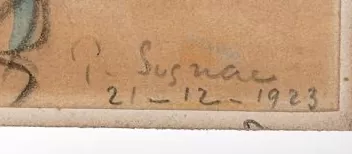
Not all of Paul Signac's works are signed, and copies may exist. The production of fake paintings is very important for this artist. Here's an example of his signature.
Expertise your property
If you happen to own a work by Paul Signac, request a free appraisal without further delay via our form on our website.
A member of our team will contact you promptly to provide you with an estimate of the value of your work, not forgetting to send you ad hoc information about it.
If you're considering selling your work, our specialists will also help you find alternatives to sell it at the best possible price.
Estimate in less than 24h
Discover in the same theme

Rating and value of Gino Sarfatti's furniture, lighting and...
Gino Sarfatti is a twentieth-century Italian designer who produced lighting fixtures, wall lamps and ceiling pendants that are quoted on the auction m...
Learn more >

Rating and value of works, paintings and prints by Max Papar...
Max Papart is a twentieth-century post-Cubist artist who produced paintings and prints that are valued on the art market.
Learn more >

Rating and value of paintings by Otto Manigk
Otto Manigk was a Polish and German Expressionist painter who produced paintings that are highly valued at auction.
Learn more >
Similar works sold at auction

Estimated 5.000 - 8.000
Alexandre ROUBTZOFF (1884-1949), The Sidi Makhlouf Mosque, oil on canvas

Estimated 2.000 - 3.000
Raymond THIBÉSART (1874-1968) Apple trees in blossom, oil on canvas

Estimated 5.000 - 10.000
Victor Gabriel GILBERT (1847-1935), Le marché aux fleurs, oil on canvas

Estimated 800 - 1.500
Georges MASSON (1875-1948) La cour fleurie du couvent des Récollets à Ciboure, oil on panel

Secure site, anonymity preserved

Auctioneer approved by the State

Free and certified estimates
Frequently asked questions
-
Who is Paul Signac, and what is his role in art history?Paul Signac (1863–1935) was a French Pointillist painter and co-founder of Neo-Impressionism alongside Georges Seurat. A leading theorist of this movement, he developed Pointillism, a technique based on the juxtaposition of small dots of pure color that blend optically from a distance. His seminal essay, “From Eugène Delacroix to Neo-Impressionism,” solidified the movement’s principles, and his influence endures in the history of modern art.
-
What is the price range for Paul Signac's works?Paul Signac's market value varies considerably depending on the technique and quality of the work. Prints range from €10 to €33,330, drawings and watercolors from €240 to €251,770, while paintings range from €270 to several million euros. His most sought-after paintings—particularly his Parisian landscapes and seascapes from the early 1900s—command the highest prices on the international market.
-
How can you authenticate a work by Paul Signac?To authenticate a work by Paul Signac, we recommend that you request a free, no-obligation appraisal from Auctie's. Our state-certified auctioneers and experts will examine your artwork and provide you with an accurate estimate. Please note: there are many forgeries of this artist’s work, so a professional appraisal is essential to verify authenticity.
-
Is this the right time to sell a work by Paul Signac?Yes, now is a good time to sell a work by Paul Signac. His market value remains high, and his works sell regularly on the international market. As a leading figure of Neo-Impressionism and a renowned theorist, his paintings, drawings, and lithographs are in constant demand among collectors and institutions. The market remains favorable for this type of artwork.
-
How does the appraisal and sale of a work of art take place at Auctie's?Appraisals at Auctie's are free and non-binding: simply submit information about your artwork via our online form, and an expert will contact you within 48 hours with a detailed estimate. If you decide to sell, our specialists will guide you every step of the way, helping you choose the best sales strategy to achieve the highest possible price at auction.
