



Rating and value of mannerists works of art

Key takeaways
- Mannerist paintings by the masters (Pontormo, Bronzino, Parmigianino) fetch between €500,000 and €30 million, while drawings represent the most active and accessible segment of the market.
- Attribution is the primary determinant of value: the shift from “workshop” to “autograph” status multiplies the price by a factor of 10 to 100, depending on the criteria for authentication.
- Condition, religious iconography (Madonna and Child, Christological scenes), and documented provenance (the Medici, Farnese, and Borghese collections) are the three essential secondary factors influencing value.
Mannerism (1520–1600) is a niche European artistic movement whose works command high prices on the art market. Panel or canvas paintings by the great masters (Pontormo, Parmigianino, Bronzino, Spranger) can fetch over 30 million euros at international auctions, while drawings remain the most accessible and active segment of the market.
A work’s value depends on three major criteria: attribution (with a multiplier of 10 to 100× between “workshop” and “autograph”), iconography, and condition.
Some Key Figures
Key Element | Statistical Data |
Historical period of Mannerism | 1520–1600 |
Upper range (painting, top tier) | €500,000 – over €30 million |
Low range (engravings) | €500 – €30,000 |
Impact of studio attribution → autograph | × 10 to × 100 |
Global Art Market 2025 | 59.6 billion USD (+4%) |
Auction house commission (typical buyer) | 9–11% of the hammer price |
VAT on art imports into France | 5.5% |
Estimate in less than 24h
What is Mannerism?
A style that emerged from the Italian Renaissance
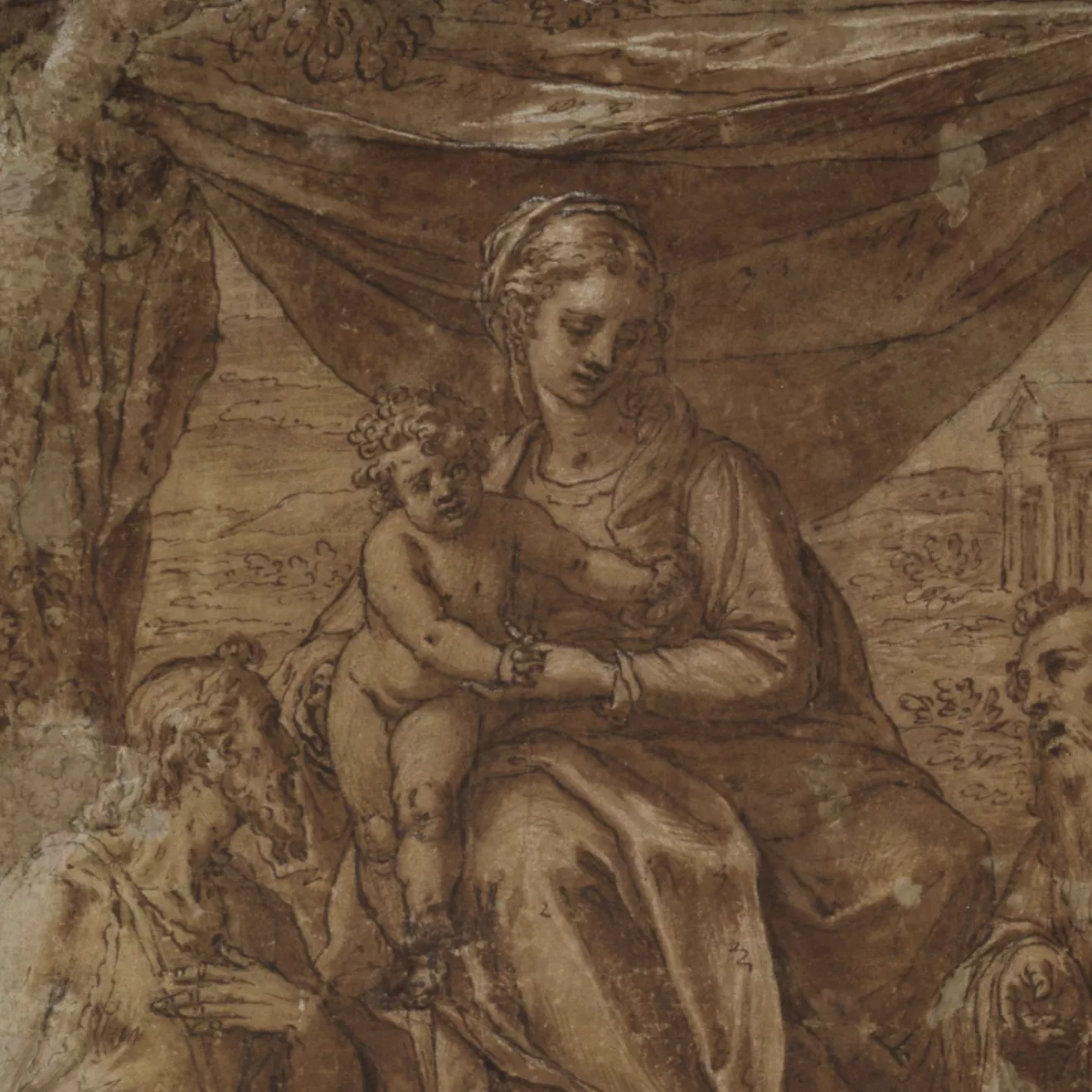
Mannerism is a European artistic movement that emerged between 1520 and 1600 as a reaction to the classical balance of the High Renaissance. It is characterized by a deliberate pursuit of formal sophistication, artifice, and visual tension, at the expense of naturalism.
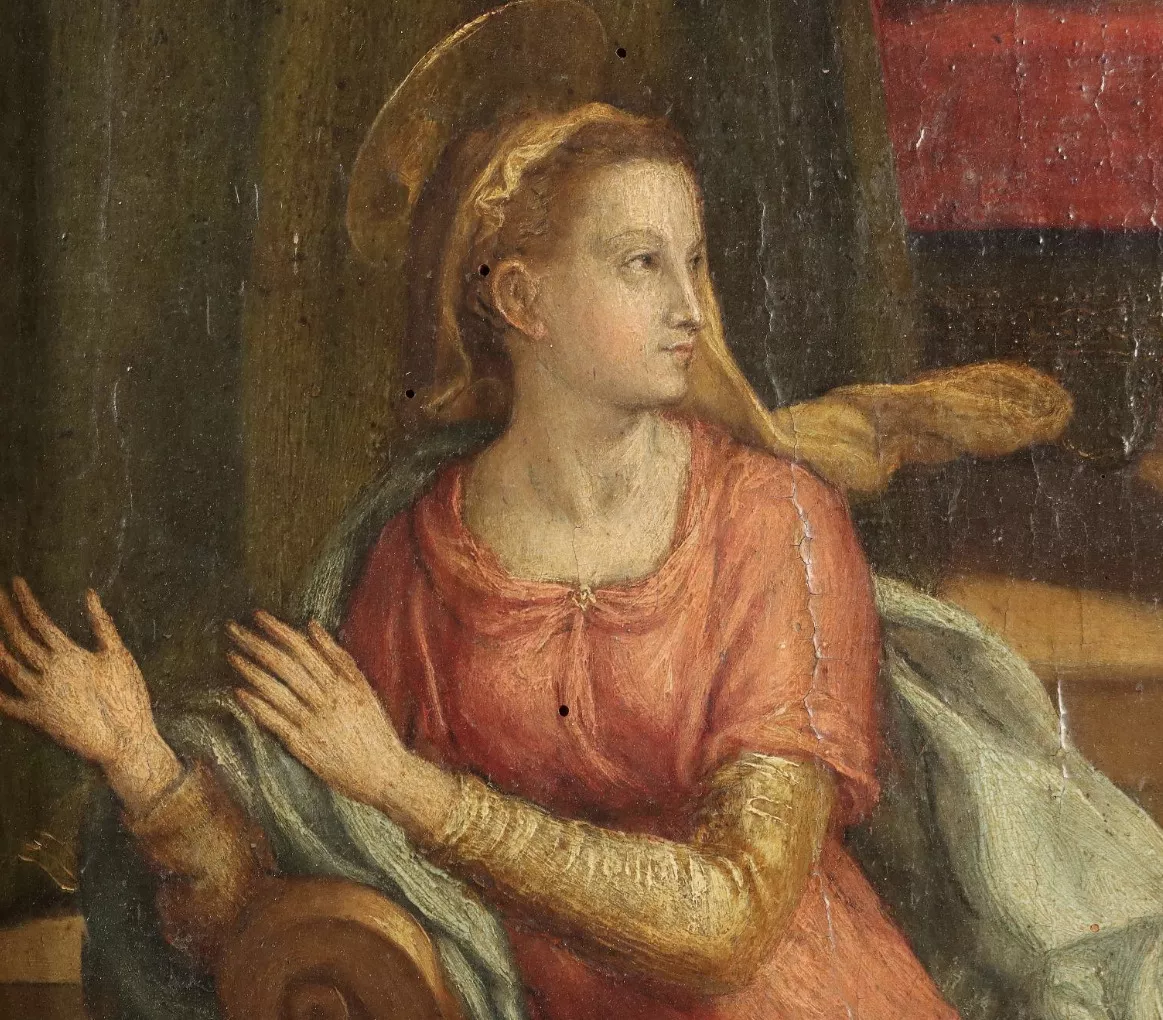
A Mannerist painting can be recognized by its pastel colors and a slight distortion of bodies and forms, which are often elongated. The contours, meanwhile, are more blurred.
The term was initially pejorative and is derived from “maniera,” a term coined by the painter Vasari to denote a style “in the manner of.” The term was rehabilitated by 20th-century art history, notably through the work of Shearman and Freedberg.
It emerged in Florence and Rome around 1520, against the backdrop of the spiritual and political crisis preceding the Sack of Rome (1527), marking a break with the ideals of proportion, harmony, and decorum inherited from Leonardo, Raphael, and Michelangelo.
Artist | Dates | Center | Main characteristic |
Pontormo | 1494–1557 | Florence | Expressiveness and Formal Instability |
Rosso Fiorentino | 1494–1540 | Florence / Fontainebleau | Founder of the Fontainebleau School |
Parmigianino | 1503–1540 | Parma / Rome | Serpentine figure, extreme elegance |
Bronzino | 1503–1572 | Florence | Court style, official portraits |
Giambologna | 1529–1608 | Florence (Flemish) | Sculpture, The Rape of the Sabine Women |
Primatice | 1504–1570 | Fontainebleau | Court Decorations and Frescoes |
Arcimboldo | 1527–1593 | Prague | Composite allegorical portraits |
El Greco | 1541–1614 | Spain (Cretan) | Late Mannerism, extreme elongations |
The serpentine figure, the movement’s signature
The concept was formalized by Lomazzo (“Trattato dell’arte pittura,” 1584): the human figure organized around a spiraling axis with multiple twists.
It embodies the Mannerist principles of movement, elongation, and formal complexity, in which the body serves as a vehicle for demonstrating virtuosismo.
Giambologna’s *The Rape of the Sabine Women* (1583) is one of the finest examples of this.
From Rome to France: The Spread of the Movement Across Europe
The primary driver of the movement’s spread was the migration of Italian artists following the Sack of Rome (1527), which disseminated the style throughout European courts. Independent centers:
• France via the Fontainebleau School (Rosso Fiorentino, Primaticcio) under Francis I;
• Antwerp and the Spanish Netherlands, a major hub for Mannerist engraving
• Prague: the court of Rudolf II, a center of Northern Mannerism
• Madrid: El Greco, late Mannerism and Hispanic mysticism
Mannerism thus became an international court style, embodying an aristocratic ideal of refinement and visual erudition. It spread independently of the artworks themselves through the graphic arts and printmaking.
Mannerist Artists and Their Auction Values
Mannerist artists constitute a niche market with high per-piece values, with demand concentrated among institutional collectors and museums. Supply is structurally scarce, with a limited number of works in private hands.
The hierarchy of auction prices correlates with the artist’s historiographical reputation, the technique used, and the work’s documented provenance.
Table of Price Ranges by Technique
Technique | Auction Price Range | Market Characteristics |
Painting on panel / canvas | €500,000 – €30 million+ | Extremely rare, most hotly contested auctions |
Bronze sculpture (signed) | €300,000 – €8 million | Comparable to cabinet paintings |
Drawing (leading masters) | €50,000 – €5 million | Most active segment, graphological analysis |
Drawing (second-tier masters) | €5,000 – €100,000 | Abundant corpus, relatively accessible |
Engraving / print | €500 – €30,000 | Entry-level market, heritage-based |
Decorative arts / miniatures | €10,000 – €500,000 | Cabinet pieces, master goldsmiths |
Paintings, sculptures, drawings: order of value
Paintings on panel or canvas represent the pinnacle of the hierarchy of techniques, characterized by maximum rarity, a monumental scale of representation, and the status of a finished work.
Signed bronze sculpture occupies a position comparable to that of painting, and even superior for cabinet-sized works (bronzetti) from documented workshops.
Drawings represent the most active and accessible segment of the Mannerist market, with a more abundant body of work and authentication facilitated by graphological analysis.
Engraving and prints constitute an entry-level market, driven more by heritage than speculation.
Factors Influencing the Value of a Mannerist Work
Valuation is based on a constellation of independent criteria, none of which can be isolated without affecting the overall assessment.
These criteria interact in a nonlinear manner: exceptional provenance can compensate for poor condition, while a rare subject matter can increase the value of a work of secondary attribution tenfold.
1. Attribution, Authenticity, and School of Origin
Attribution is the most decisive factor in determining value.
The transition of a work from “workshop” to “autograph” status can increase its value by a factor of 10 to 100. (Source: RKD – Netherlands Institute for Art History)
The authentication process is multidisciplinary:
• Connoisseurship analysis (stylistic comparison)
• Technical examination: X-ray, infrared reflectography, dendrochronology
• Documentary analysis: archives, historical inventories, correspondence
• Scientific databases (RKD, Getty Provenance Index)
The school of origin establishes a geographical hierarchy: the Florentine and Roman schools take precedence over northern or provincial schools, provided they are of equivalent formal quality.
School | Rank of value | Representative Artists |
Florentine / Roman | 1st (reference) | Pontormo, Bronzino, Salviati |
Parma | 1st bis | Parmigianino, Anselmi |
Fontainebleau School | 2nd | Rosso, Primaticcio, Niccolò dell’Abbate |
Northern (Antwerp, Prague) | 2nd – 3rd | Spranger, Van Mander, Heintz |
Iberian (Spain) | 3rd | El Greco (but an independent market) |
2. Iconography and Subject Matter
Religious subjects dominate Mannerist production in terms of quantity and form a precise iconographic hierarchy in the contemporary market.
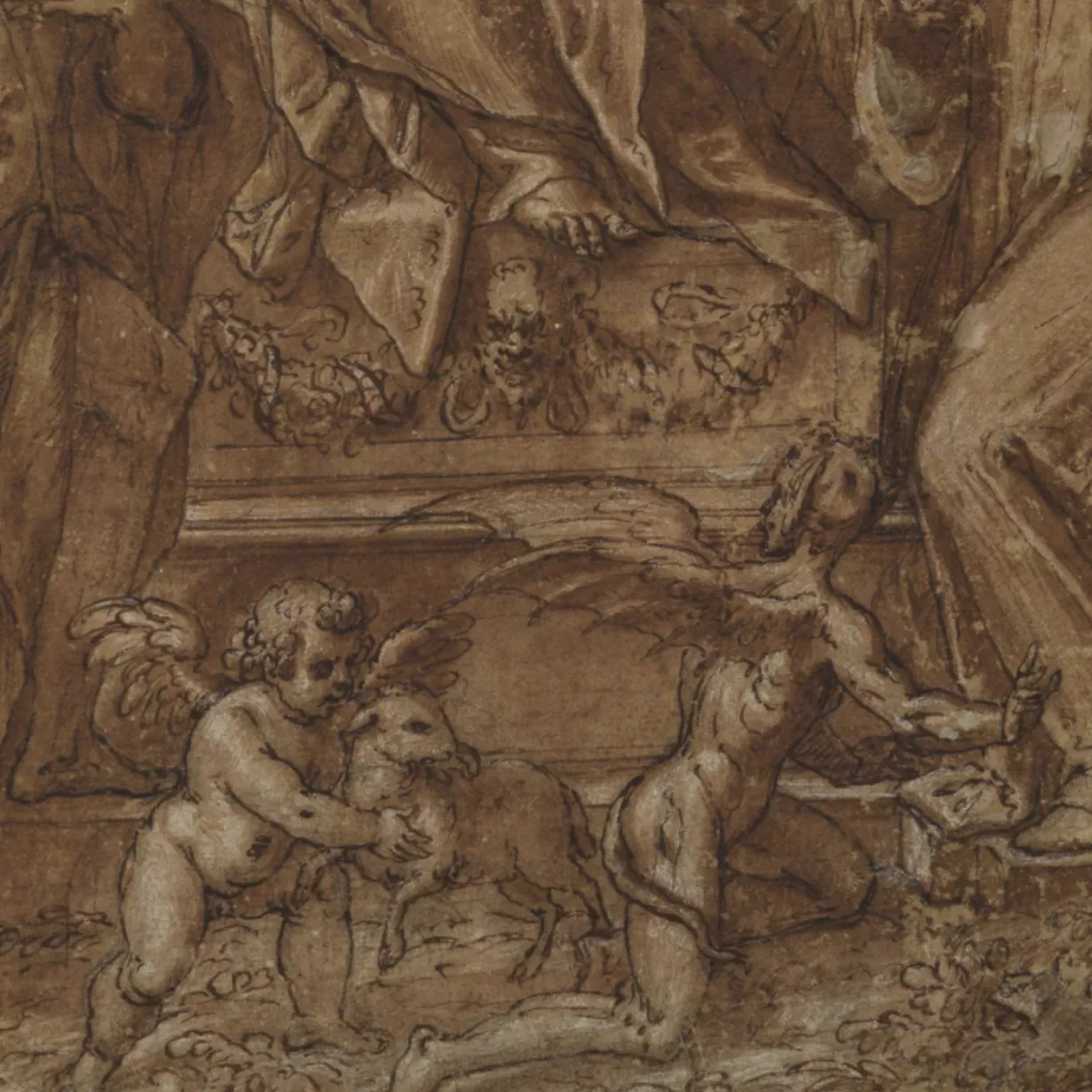
• Virgin and Child: the most liquid segment, with strong institutional and private demand
• Christological scenes (Deposition, Pietà, Christ in Glory): higher value, serpentine figure fully utilized
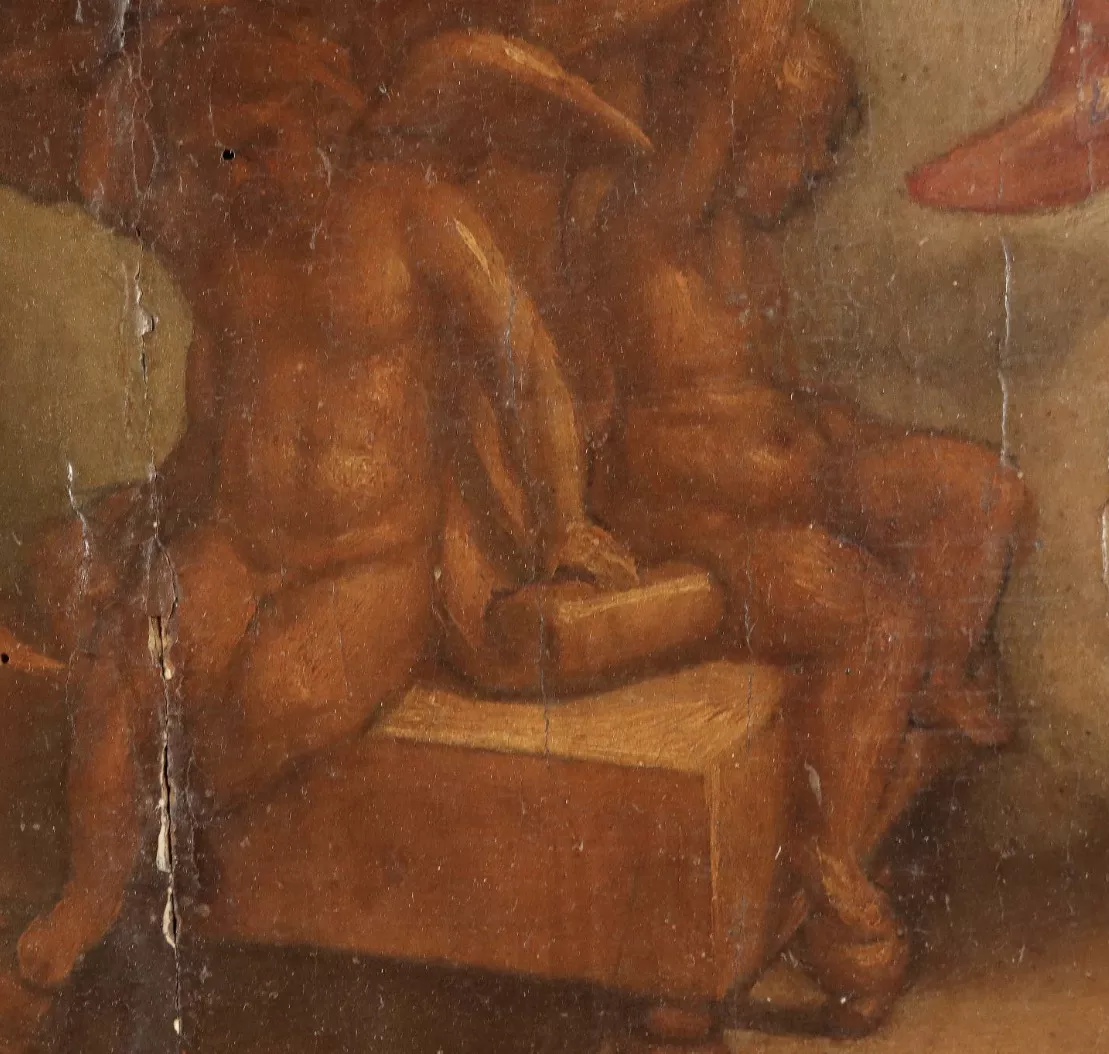
• Angelic depictions: a sought-after sub-segment, particularly fragments of dismantled altarpieces
• Mythological subjects (Diana, Venus, The Abduction): may surpass religious subjects if a princely patron is identified (Este, Medici, Farnese)
• Anonymous portraits / unidentified allegories: significant discount due to the lack of a compelling narrative
3. Condition and Provenance
Condition serves as a minimum elimination criterion: a work whose support or paint layer is irreparably damaged loses all market value, regardless of its attribution.
Condition criterion | Impact on value |
Perfect structural condition (wood, canvas, stone) | Maximum value |
Well-documented and limited restorations | Neutral to slightly positive |
Old, poorly documented reprints | Perceived risk, 10–40% discount |
Significant gaps in the paint layer | Severe discount of 40–70% |
Irreparably damaged support | Almost total loss of market value |
Provenances commanding a high premium: the Medici, Este, Borghese, and Farnese collections, as well as major 18th-century British collections. Provenance serves a dual purpose: as an implicit certificate of authenticity and as a vehicle for narrative value.
Selling a Mannerist Work: Where to Start?
Putting a Mannerist artwork up for sale requires a methodical, step-by-step approach that differs from selling contemporary or modern artworks. The scarcity of qualified experts and the complexity of authentication necessitate a certain amount of preparation time that cannot be shortened.
The Three Sales Contexts
• Estate and inheritance: legal requirements, valuation by a certified expert (Art. 764 of the CGI)
• Joint ownership of an estate: agreement among co-owners or court authorization
• Voluntary liquidation / arbitration: maximum flexibility in terms of timing and strategy
French Legal Framework for Auctions
In France, voluntary sales of personal property at public auctions are governed by Articles L 321-1 et seq. of the Commercial Code.
Since the law of July 10, 2000 (followed by the reforms of 2011 and 2022), the historic monopoly of auctioneers for voluntary sales has been abolished: any Voluntary Auction Operator (OVV) registered with the Council of Auction Houses may organize such sales, provided it has a licensed auctioneer among its members.
Why use a licensed auctioneer?
Although the auctioneer’s monopoly on voluntary sales has been abolished, every OVV must nevertheless have among its members a person authorized to conduct sales and award lots. Only the judicial aspect (foreclosure sales, compulsory sales) remains the exclusive domain of judicial auctioneers.
The advantages of using a licensed professional:
• Preliminary appraisal, photographs, and a professional catalog
• Comprehensive logistics management: transportation, insurance, and collection of proceeds
• Civil and professional liability coverage regarding authenticity
• Access to an international network of qualified buyers
• Transparency and mandatory public notice of the sale (at least one year prior to the auction)
Sources and References
The figures and legal information in this document are drawn from the following sources. These links are provided for informational purposes only.
Art Market and Economic Data
Art Basel & UBS Report 2026 (via Baratin.art)
Artprice — Annual Art Market Report (Artmarket.com)
Council of Auction Houses — Update on Auctions
Legal Framework for Auctions
Légifrance — Commercial Code, Art. L 321-1 et seq. (public auctions)
Senate — Proposed Law on the Modernization of the Art Market
Lefebvre Dalloz — Public Auctions: Regulation and Legislative Developments
Estimate in less than 24h
Discover in the same theme

Rating and value of paintings by Antoine Coypel
Antoine Coypel is a French artist who produced famous works that are highly valued at auction. 24h estimate.
Learn more >

Rating and value of drawings and paintings by Salomon de Bra...
Salomon de Bray was a painter of the Dutch Golden Age who produced numerous works that command high prices at auction.
Learn more >

Rating and value of drawings and paintings by Nicolas de Lar...
Nicolas de Largillierre is a classical and Baroque painter who produced numerous portraits that command high prices at auction.
Learn more >
Nos records d'enchères à l'hôtel Drouot

Estimated 10.000 - 15.000 €
Ebridge Ayer BURBANK(1858-1949), Young African-American boy, Oil on panel.

Estimated 20.000 - 30.000
EXCEPTIONAL LARGE OVAL DISH IN VINCENNES SOFT PASTE PORCELAIN FROM THE "BLEU CÉLESTE" SERVICE OF KING LOUIS XV AT THE CHÂTEAU DE VERSAILLES

Estimated 20.000 - 30.000
MANUFACTURE ROYALE DE SÈVRES, 18th century "L'Empereur de la Chine" - Portrait of the Emperor Qianlong, Hard porcelain bisque, 1775

Estimated 1.500 - 3.000
HERMÈS, "Kelly" 32 saddle bag in black box calf

Estimated Between €5,000 and €8,000
KRACHKOWSKY (1854-1914), Before the storm, oil on canvas

Estimated 40.000 - 80.000
Alexandre ROUBTZOFF (1884-1949), Portrait of Arbia, oil on canvas

Secure site, anonymity preserved

Auctioneer approved by the State

Free and certified estimates
Frequently asked questions
-
What is Mannerism, and when did it emerge?Mannerism is a European artistic movement that emerged between 1520 and 1600, characterized by a deliberate pursuit of formal sophistication, artifice, and visual tension. It emerged in Florence and Rome as a reaction to the classical balance of the High Renaissance, particularly in the context of the spiritual and political crisis preceding the Sack of Rome in 1527. This style is recognizable by its pastel colors, elongated forms, and blurred contours, embodying the principles of movement and formal virtuosity.
-
What impact does attribution have on the value of a Mannerist work?Attribution is the most decisive factor in determining the value of a Mannerist work. When a work is reclassified from “workshop” to “autograph,” its value can increase by a factor of 10 to 100. Authentication is based on connoisseurship, technical examinations (X-ray, infrared reflectography, dendrochronology), and in-depth documentary research. This multidisciplinary process is essential prior to any sale.
-
What is the price range for Mannerist works based on the technique used?Paintings on panel or canvas by the great Mannerist masters can exceed 30 million euros, while the general price range extends from 500,000 euros to over 30 million euros. Signed bronze sculptures range from €300,000 to €8 million, and drawings by leading masters from €50,000 to €5 million. The most accessible segment remains engravings and prints (€500 to €30,000), constituting an entry-level market that is more about building a legacy than speculation.
-
How do I have a Mannerist artwork appraised at Auctie's?Auctie's offers a free, no-obligation appraisal conducted by specialized auctioneers. The process includes an attribution analysis, a thorough technical examination, a documentary verification of provenance, and an assessment of the item's condition. You will receive a response within 48 hours, providing a reliable initial assessment before you decide to put your item up for sale.
-
Is this the right time to sell a Mannerist painting?Yes, the Mannerist art market remains dynamic and is driven by stable demand from institutional collectors and museums, with a limited supply. The global art market is showing steady growth, and Mannerism, as a specialized niche, has enjoyed increased historiographical recognition since the 20th century. The intrinsic rarity of works in private hands supports long-term appreciation in value.
