



Rating and value of works, paintings, drawings by Eugène Boudin

Key takeaways
- Boudin’s works sell for between €25 and €2.2 million, with a record set in 2022 for “La plage de Trouville” (1863) at €2,216,620.
- Oil-on-canvas paintings fetch the highest prices (€190 to €2.2 million), compared to €90 to €115,000 for drawings and watercolors and €25 to €2,200 for prints.
- A pioneer of marine painting in the 19th century, Boudin participated in the first Impressionist exhibition in 1874 and remains highly sought after by English and American collectors.
If you own a work by or after Eugène Boudin, and would like to know its value, our state-approved experts and auctioneers will offer you their appraisal services.
Our specialists will carry out a free appraisal of your work, and provide you with a precise estimate of its value on the current market.
Then, if you wish to sell your work, we will direct you to the best possible arrangement to obtain the optimum price.
Rating and value of the artist Eugène Boudin
Boudin leaves behind an impressionist oeuvre, much inspired by the sea. Now, prices for his works are exploding under auctioneers' gavels.
His paintings are highly prized, especially by English and American buyers. The price at which they sell on the art market rangesfrom €25 to €2,216,620, a very substantial range but one that speaks volumes about the value that can be attributed to Boudin's works.
In 2022, his marine painting La plage de Trouville,dating from 1863, sold for €2,216,620. His rating is high and stable.
Order of value from a simple work to the most prestigious
Technique used | Result |
|---|---|
Estamp | From €25 to €2,200 |
Drawing - watercolor | From €90 to €115,000 |
Oil on canvas | From €190 to €2,216,620 |
Estimate in less than 24h
Style and technique of artist Eugène Boudin
Eugène Boudin produces marine paintings, consisting of depictions of the sea, sailors, ships and seascapes. We can discern in his work some of the beginnings of what would become Impressionism.
He mainly produced drawings and oils on canvas.
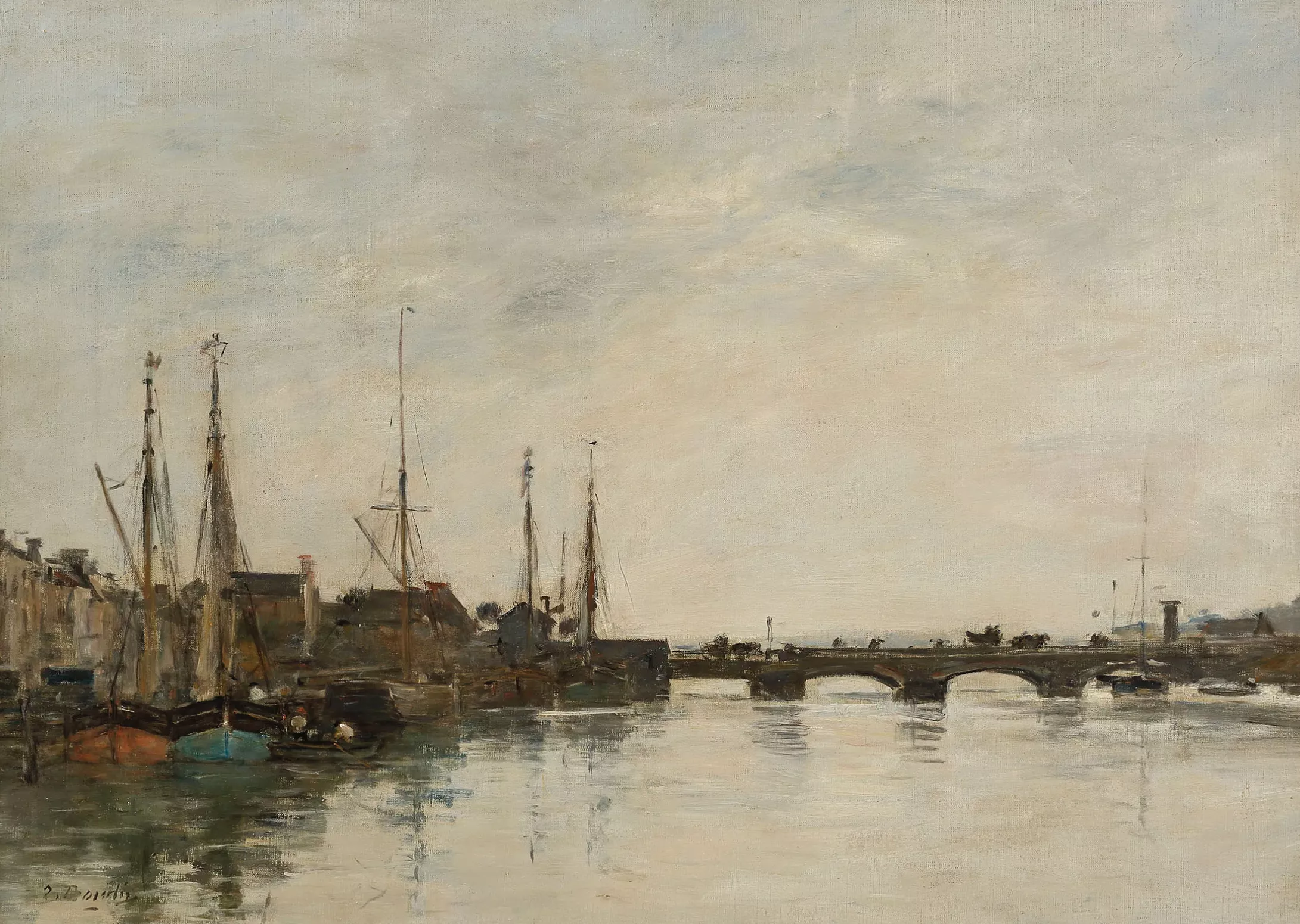
Eugène Boudin: Master of the Sea
Eugène Boudin (1824-1898), an eminent figure of 19th-century marine painting, was one of the pioneers of French art who devoted himself to depicting seascapes and the coasts of Normandy and Brittany.
Born in Honfleur, Calvados, he was immersed in the maritime world from an early age, the son of a sailor who worked on passenger ships and a chambermaid who worked aboard the same vessels.
This background imbued him with an early fascination for the ocean and its changing moods. As a young boy, he took his first steps as a mousse, before finding a job in a paper mill in Le Havre, where his artistic destiny began to take shape.
In this store, Boudin exhibited the works of various artists, and it was in this way that he became acquainted with the painters of the Barbizon school, including Eugène Isabey, who was to become a major influence.
Soon abandoning his commercial activity, he decided to devote himself entirely to his passion for painting. Thanks to a scholarship, he left for Paris, where he studied for three years under the tutelage of Isabey.
As Richard Parkes Bonington, Boudin was strongly influenced by the Flemish and Dutch masters, particularly for their mastery of landscapes and light, a fascination that would mark all his work.
Despite his frequent stays in Paris, Boudin remained deeply attached to his Norman roots. He returned regularly to Honfleur, but it was on the Breton coast, like his contemporary Mathurin Janssaud, that he found an inexhaustible source of inspiration.
He witnessed the birth of Deauville, and the rise of sea bathing, scenes he immortalized in his canvases with a unique sensitivity.
Fascinated by the play of light on water and changing skies, he borrowed certain techniques from Gustave Courbet, while developing his own artistic language.
Before the Franco-Prussian War, Boudin enjoyed a certain financial success, his works being regularly exhibited at the Salon. In 1874, he took part in the first Impressionist exhibition, a movement with which his work is often associated.
However, although influenced by this school, Boudin remained faithful to a more realistic approach, focusing on the sea and its landscapes, always imbued with poetry and naturalness.
Towards the end of his life, enriched by his successes, he acquired a villa in Deauville, a place that symbolized his love of the sea. Feeling his end approaching in 1898, while in Paris, he asked to be transported to Deauville, so that he could pass away facing this sea he had so loved and magnified throughout his career.
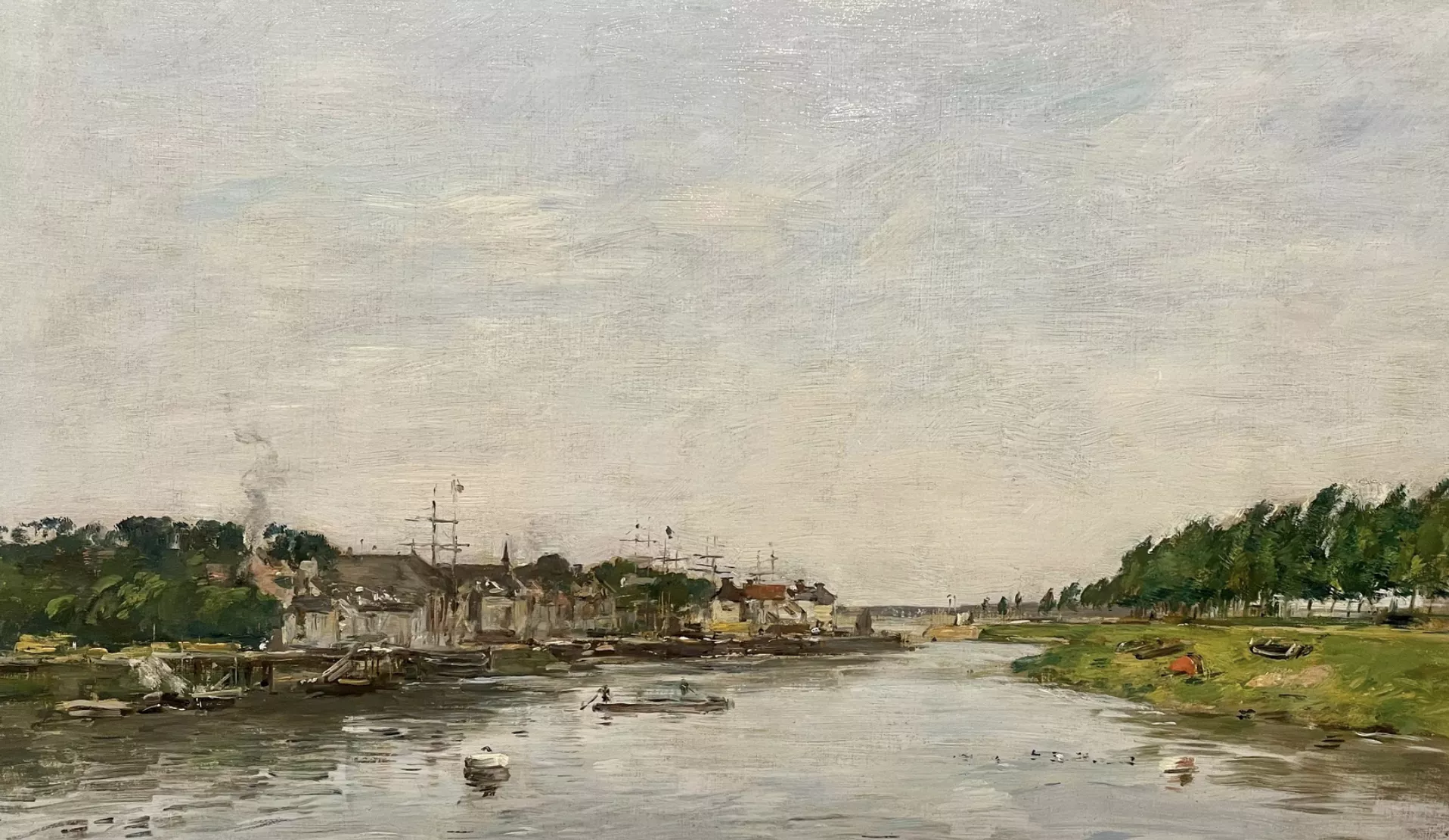
Focus on a harbor scene by Boudin (see painting above)
This painting, by Eugène Boudin, fits perfectly into the tradition of 19th-century seascapes, a genre of which he made himself one of the undisputed masters.
Here, we are faced with a harbor scene, a landscape dear to Boudin, which he explored tirelessly throughout his career. The masts of the boats rise up, delicate filigrees against a pale, vaporous sky, while the water, almost absolutely calm, faithfully reflects these slender silhouettes.
The diffused light, soft and silvery, marks the end of a day or perhaps a still misty morning. Boudin, always attentive to atmospheric variations, here captures with extraordinary sensitivity the suspended moment when sky and sea seem to melt into each other.
Far from the dramatic storms or raging waves often depicted in the seascapes of a Joseph Vernet or a Turner, Boudin prefers a more peaceful, realistic approach, where nature is depicted in its everyday tranquility.
The bridge that crosses the horizon on the right of the painting introduces a horizontal line that stabilizes the composition, while the houses, boats and landscape elements blend harmoniously into one another.
This attention to detail, without ever falling into overload, testifies to the influence of Dutch painters on Boudin, notably for their ability to translate light and clarity with such precision.
The painting recalls the transition experienced by marine painting in the 19th century. Where previous generations, such as Vernet or the academic painters, focused on scenes of storms and dramatic shipwrecks, Boudin favors serenity and meticulous observation of natural elements.
His participation in the first Impressionist exhibition in 1874 marks this evolution: he places light and atmosphere at the heart of his artistic concerns.
Here, the diffused light, the sky charged with delicate nuances, and the reflections on the water become the true subjects of the painting, far more than the buildings or boats themselves.
With this tranquil harbor, Boudin captures the essence of maritime life, not in its violence or excess, but in the discreet beauty of ordinary moments.
Eugène Boudin, between sky and sea
Eugène Boudin's imprint on his era
Eugène Boudin left an indelible imprint on 19th-century art, becoming a key figure in marine painting and a pioneer of atmospheric studies.
Thanks to his unique mastery of light and the sea, he was able to impose a new vision of nature, far removed from the dramatic representations of his predecessors, favoring a more realistic and sensitive approach.
His paintings, hailed at the time by his peers and critics alike, enjoyed dazzling success, particularly with collectors and art lovers.
Although marine painting today is no longer as popular with the general public as it once was, Boudin's work continues to appeal to connoisseurs and to find a special place in the art world.
His works, which capture coastal landscapes with remarkable acuity, are still highly sought-after on the auction market, where they regularly fetch high prices.
Private collectors play an essential role in preserving his work, enabling many canvases to survive outside museums.
However, a significant part of his production is also exhibited in prestigious institutions such as the Musée d'Orsay in Paris or the National Gallery in London, confirming his place in the pantheon of the great masters of French painting.
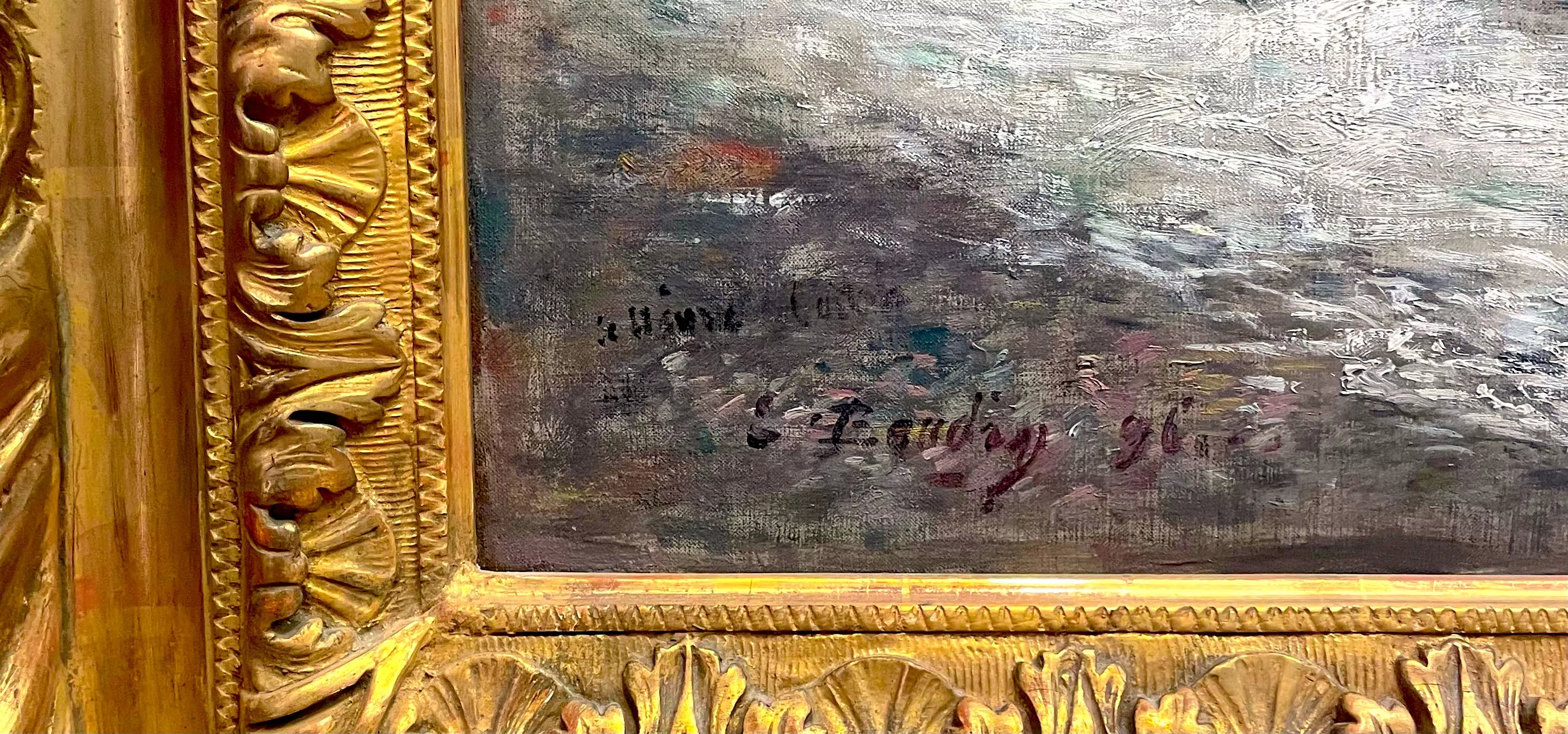
Recognizing the artist's signature
Not all of Boudin's works are signed. They may be at the bottom of the painting, but if you think you own one, it's best to have it appraised to be sure of its originality.
Knowing the value of a work
If you happen to own a work by or after Boudin, don't hesitate to request a free valuation using our form on our website.
A member of our team of experts and chartered auctioneers will contact you promptly to provide you with an estimate of the market value of your work, not forgetting to pass on ad hoc information about it.
If you wish to sell your work, you will also be accompanied by our specialists in order to benefit from alternatives for selling it at the best possible price, taking into account the inclinations of the market.
.Estimate in less than 24h
Works from the same period sold at auction

Estimated 2 000 € - 3 000 €
Delphin ENJOLRAS (1857-1945) "A Midsummer Night's Dream", Oil on canvas

Estimated 600 € - 800 €
Henri ZUBER (1844-1909), Bridge at Artemare. Oil on canvas.

Estimated 8000 - 12000 €
Raymond THIBESART (1874-1968) Apple trees in blossom Oil on canvas.

Estimated 3000-5000€
Alexandre Roubtzoff - View of Tunis (small format)
Discover in the same theme

Rating and value of works, sculptures by Louis Ernest Barria...
Louis Ernest Barrias was a 19th-century sculptor who worked mainly in bronze. His works are highly valued at auction.
Learn more >

Rating and value of paintings by Gustave Jacquet
Gustave Jacquet is a highly regarded painter of portraits and genre scenes, whose works have a certain value at auction.
Learn more >

Rating and value of paintings by Hippolyte Lazerges
Hippolyte Lazerges was a painter of religious and Orientalist subjects who produced paintings of high value.
Learn more >

Secure site, anonymity preserved

Auctioneer approved by the State

Free and certified estimates
Frequently asked questions
-
Who is Eugène Boudin, and why are his works so highly sought after?Eugène Boudin (1824–1898) was a major 19th-century painter, a pioneer of marine painting, and a key figure in the transition to Impressionism. Born in Honfleur, he specialized in depicting the coasts of Normandy and Brittany, capturing with unique sensitivity the variations in light on the water and the shifting skies. His works are highly prized by collectors, particularly in England and the United States, due to his mastery of atmosphere and his realistic yet poetic approach to the maritime landscape.
-
What is the market value of Eugène Boudin's works, and at what prices do they sell?Prices for Boudin’s works vary considerably depending on the medium and quality: prints range from €25 to €2,200, drawings and watercolors from €90 to €115,000, and oil paintings on canvas from €190 to €2,216,620. The auction record is held by the painting “La plage de Trouville” (1863), which sold for €2,216,620 in 2022. His market value is currently high and stable in the art market.
-
How can I have a work attributed to Eugène Boudin authenticated?To authenticate a work by Boudin, we recommend that you request a free, no-obligation appraisal from Auctie's. Our state-certified experts and auctioneers will examine your artwork and provide you with an accurate estimate of its market value within 48 hours. This process will allow you to verify the authenticity of your piece before making any decision to sell.
-
Is this the right time to sell a work by Boudin?Yes, now is a good time to sell a work by Boudin. Although marine painting no longer enjoys the same widespread popularity among the general public, his paintings remain highly sought after by connoisseurs and discerning collectors, particularly on the international market. His market value is stable and high, and his works regularly fetch significant prices at auction.
-
How does the appraisal and sales process work at Auctie's?The process is simple and free: you fill out an appraisal request form on our website, and an expert from our team will contact you shortly to examine your artwork and provide you with a no-obligation appraisal. If you decide to sell, we’ll then guide you through the entire process, offering you the best options to achieve the highest possible price while taking market trends into account.
