



Rating and value of works, drawings, paintings by Alphonse Osbert

Key takeaways
- Alphonse Osbert’s oil-on-canvas paintings sell for between €15,000 and €42,000 at auction, with certain works being particularly sought after by collectors.
- Drawings and watercolors range from €60 to €19,000, while prints range from €15 to €480, offering an accessible price range.
- A major Symbolist artist born in 1857, Osbert was awarded the Legion of Honor in 1934 and left a legacy of 414 paintings now housed at the Musée d’Orsay.
If you own a work by or based on the artist Alphonse Osbert and would like to know its value, our state-approved experts and auctioneers will guide you.
Our specialists will carry out a free appraisal of your work, and send you a precise estimate of its value on the current market.
Then, if you wish to sell your work, we'll direct you to the best possible arrangement to get the best price for it.
Rating and value of the artist
On the auction market, works by Alphonse Osbert are uncommon and highly prized by collectors.
The most sought-after works are oils on canvas, the price at which they sell on the auction market ranges between €15 and €42,000, a consequent delta but one that speaks volumes about the value that can be attributed to the artist's works.
As such, a painting signed by Osbert can fetch tens of thousands of euros in the auction room, as witness his painting In the evening's tranquility, fetched €42,000 in 2017.
Order of value from the most basic to the most prestigious
Technique used | Result |
|---|---|
Stamps | From €15 to €480 |
Drawings - watercolors | From €60 to €19,000 |
Paintings | From €335 to €42,000 |
Estimate in less than 24h
The artist's style and technique
Alphonse Osbert's works plunge us into a universe where poetry and symbolism coexist harmoniously, where every meticulous detail seems to have been laid down with extreme care, like a note in a visual symphony.
The refined chromatic palette he employs, dominated by bluish, ethereal hues, envelops his compositions in a soft, dreamlike aura. Osbert succeeds in creating scenes of singular harmony, where realism rubs shoulders with discreet symbolism, peppered with hidden meanings and mythological references.
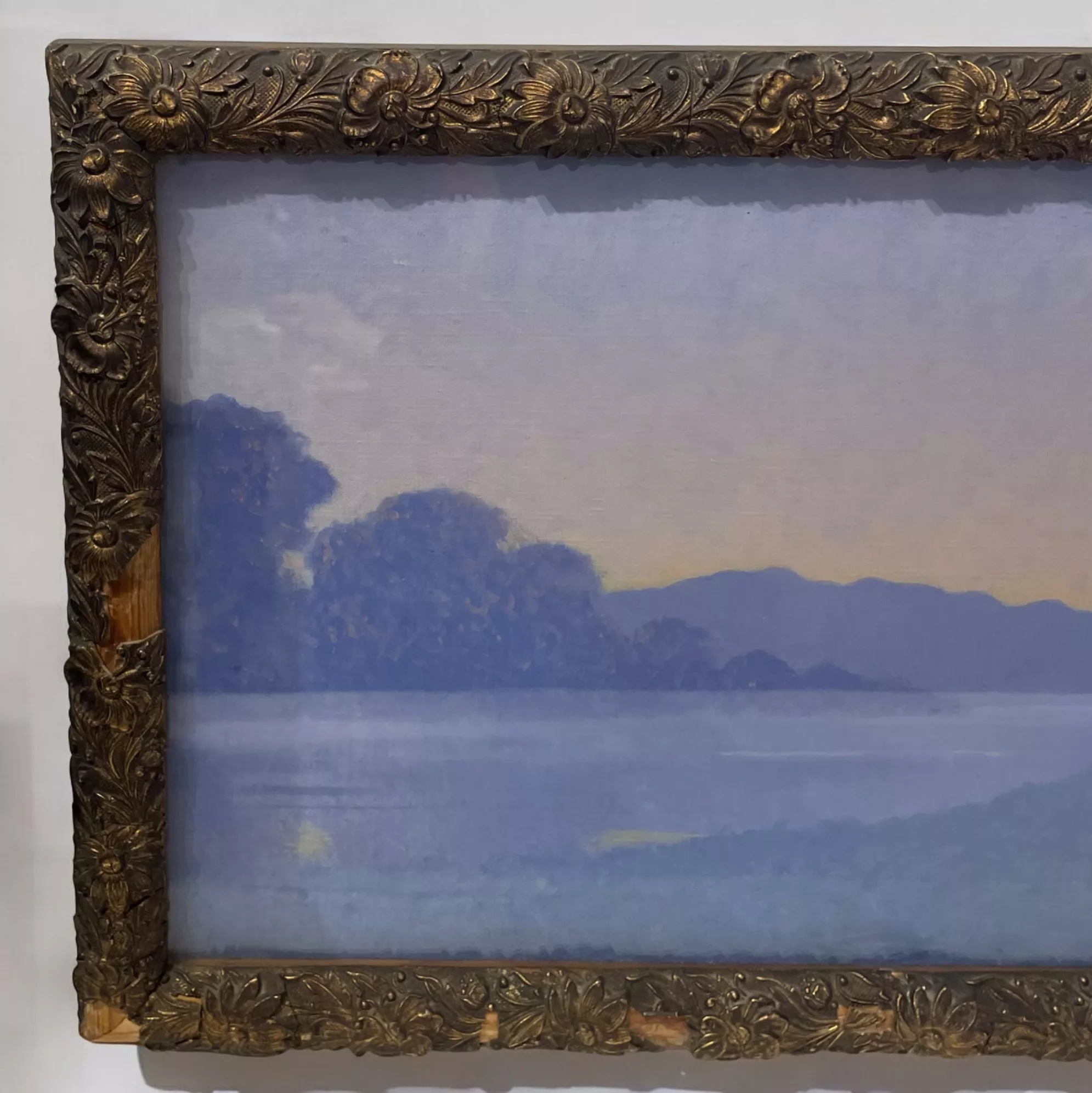
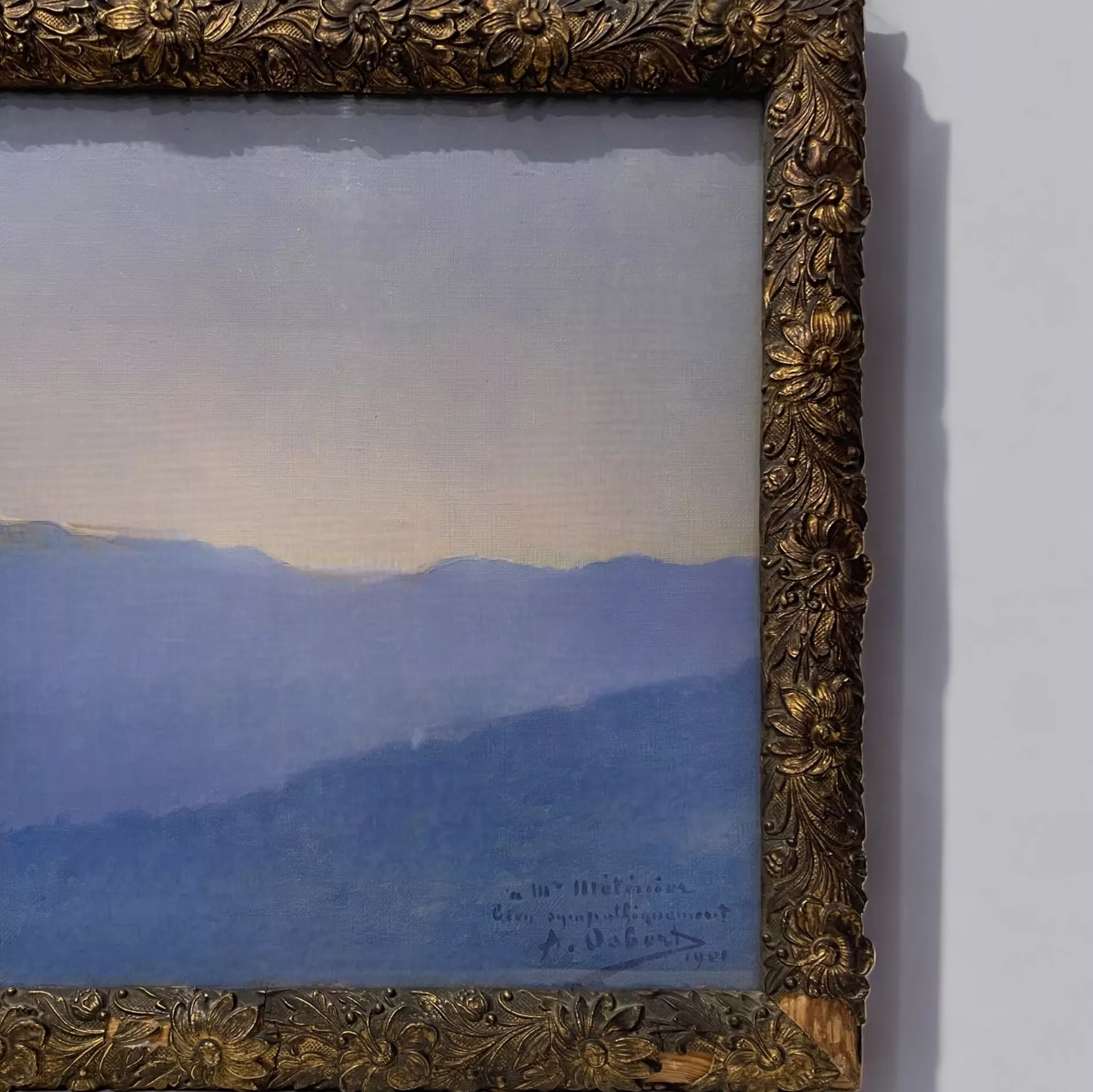
Osbert's landscapes are blasted in a twilight, giving rise to what is often referred to as "Osbert blue": a soft, almost mystical color that evokes both peace and a certain melancholy.
In this unique light, contemplative figures, frequently female, seem suspended between dream and reality, as if participating in a sacred ritual. Women, in fact, occupy an essential place in this universe, the embodiment of mystery and the unattainable ideal.
They are both muse and symbol, embodying esoteric and metaphysical themes reminiscent of the great mythologies and inviting reflection on existence.
Beneath this appearance of poetic calm lies a certain pessimism, a vision of the world tinged with nostalgia and mystery, where light plays an essential role in softening the shadows that creep in here and there.
Through his compositions, Osbert invites us to contemplate another world, a universe where nature becomes a theater of the soul, where each character, in meditation or silence, seems to be listening to a distant echo, a truth that only the initiated can fully grasp.
Stylistically, he is also close to Symbolist artists, including Odilon Redon and Alexandre Séon, but also Nabis artists such as Maurice Denis.
The career and life of Alphonse Osbert
Alphonse Osbert, born in 1857 in Paris, quickly established himself as one of the masters of Symbolism. His career began in a buoyant artistic context, where he distinguished himself with mysterious landscapes and compositions imbued with a poetic atmosphere.
Over the years, he distinguished himself at the Salon des artistes français and other exhibitions, where his captivating works won the admiration of audiences and critics alike.
His constant search for harmony is reflected in a refined technique, characterized by light brushstrokes and a subtle palette, where shades of blue, violet and pink blend to create an ethereal atmosphere.
Themes of nature and dreams dominate his work, while the figures, often female figures, evolve in enchanting settings, between light and shadow.
Osbert succeeds in capturing moments of contemplation, where the viewer is invited to plunge into an intimate reflection on time, beauty and illusion.
His personal life, though marked by challenges, reflects his commitment to art and the quest for universal truth.
Despite a certain isolation, Osbert devoted himself to his artistic practice until his death in 1939, leaving behind a legacy of works that continue to evoke melancholy and mystery, testimonies to a world where the spiritual and the sensitive intertwine, guiding each towards an exploration of the depths of the soul.
Focus on a landscape at dusk by Alphonse Osbert
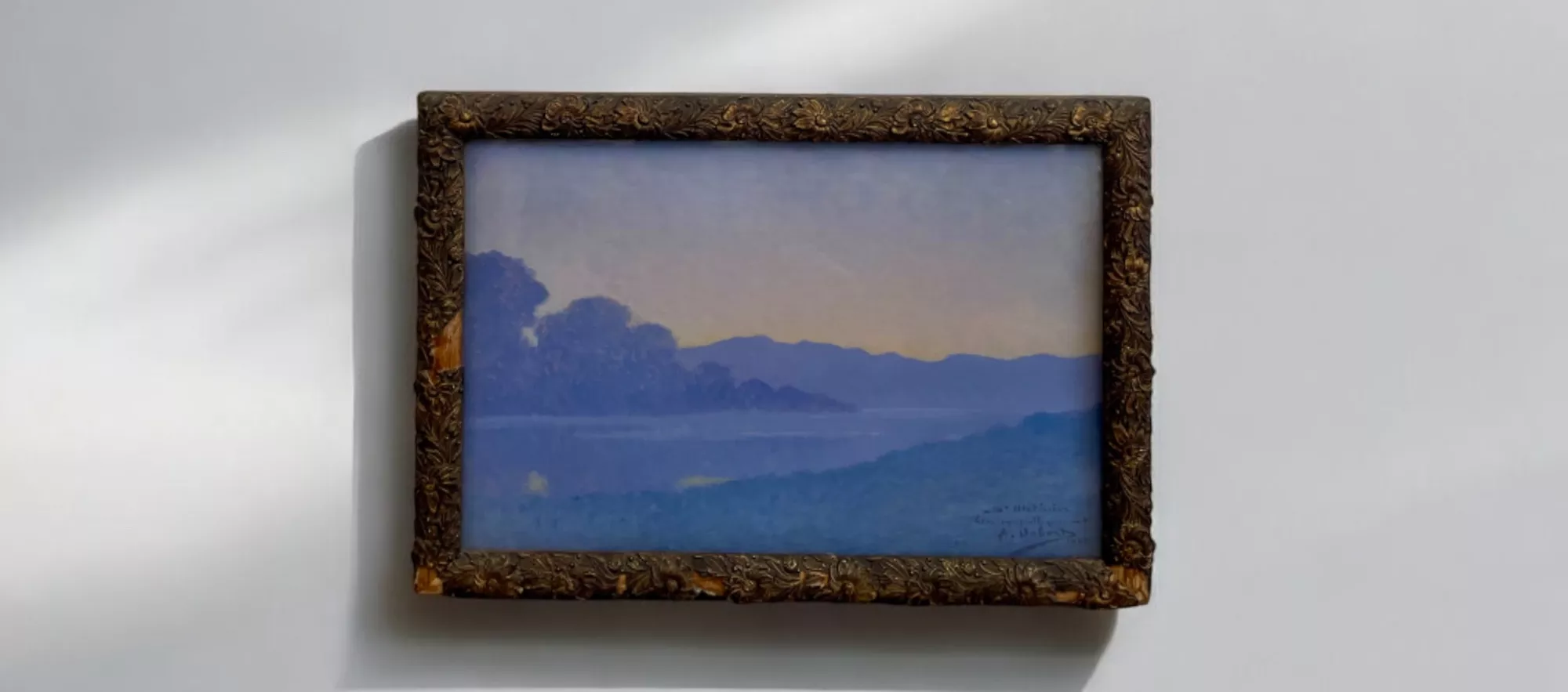
This painting by Alphonse Osbert plunges us into a world of silence and soft light, typical of his idealistic, decorative style, developed as early as the 1890s. Inspired by Pierre Puvis de Chavannes, Osbert here departs from raw reality to offer us a poetic, mystical vision of nature.
This lakeside landscape bathed in bluish, pastel tones seems suspended in time, inviting us to an inner meditation, a journey where light becomes the soul's subtle guide.
The landscape is composed of a horizon line where mountains and sky merge in a delicate, almost unreal gradation. The light, at dusk, envelops the scene in a vaporous veil, like a silent embrace, a visual tribute to the very essence of nature.
Osbert captures this fleeting light here with a mastery all his own, creating an ethereal atmosphere that transcends simple forms to become a silent song celebrating the beauty of nature and the depth of feeling it inspires.
An influential member of the Symbolist group and a recognized figure at the Salons de la Rose-Croix, Osbert seeks, in each work, to attain a spiritual truth that goes beyond mere representation. This painting, though modest in appearance, carries within it this monumental aspiration.
It becomes a space of recollection, a place where every nuance, shadow and reflection contributes to uplifting the soul. Osbert doesn't simply paint a lake or hills; he invites us to an aesthetic experience that touches on the sacred, a praise of silence and light.
This canvas, with its sober, balanced composition, recalls the monumental, introspective style that earned Osbert his place among the greatest symbolists of his time.
His mastery of color and light, inherited from the Impressionists and magnified by long-term work, lends each element of this landscape an unrivaled spiritual depth.
With this painting, Osbert continues to speak to us, to invite us into a contemplation where the visible fades away to make way for a larger reality, a universe where soul and nature meet in harmony.
The legacy of Alphonse Osbert
Alphonse Osbert was, in short, an active and influential member of the post-impressionist Nabis group, a collective of daring artists who reinvented painting through an innovative approach.
Inspired by the painterly wisdom of Pierre Puvis de Chavannes, Osbert continually redefined the boundaries of light and color.
During the 1880s, he engaged in a meticulous exploration of the "essence" of light, scrutinizing the nuances and reflections that both alter the perception of his subjects and awaken deep emotion in the viewer.
His research leads him to question chromatic interactions, while striving to capture that fleeting luminosity that plays with nature and the human soul.
Thus, in the early 1890s, Alphonse Osbert developed an idealistic, decorative style that became his hallmark, propelling him to the forefront of the artistic scene.
His art took on a monumental dimension, in which he created gargantuan compositions that transcended the everyday. Forms rise up, organize themselves, and invite immersive contemplation, like visual songs celebrating the beauty of the world.
Osbert then participated fervently in the Salons de la Rose-Croix, where his talent was quickly recognized and acclaimed, placing him among the leading Symbolist painters of his day.
His reputation, firmly established, attracted major public commissions, enabling him to express his art on an even wider scale.
Among his notable achievements, he created sumptuous decors, such as that for the great hall of the Vichy spa establishment, which became a veritable hymn to beauty and serenity.
In 1934, his outstanding work earned him the Légion d'honneur medal, a well-deserved distinction that testifies to his influence and artistic legacy.
To this day, it's easy to go to the Musée d'Orsay to honor Alphonse Osbert and admire his 414 or so preserved canvases, each one a burst of light and emotion, taking us on a journey where imagination and reality elegantly intertwine.
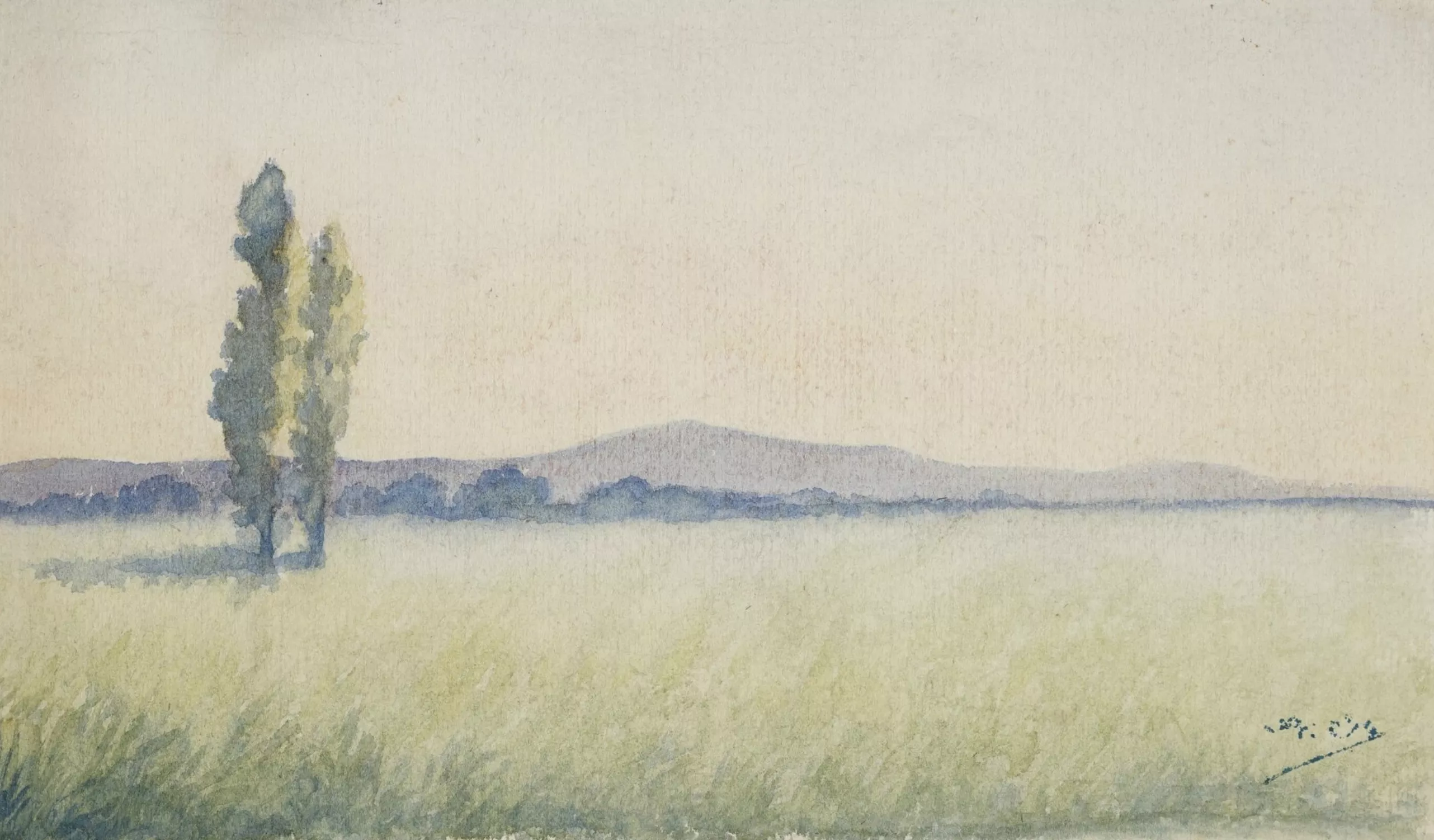
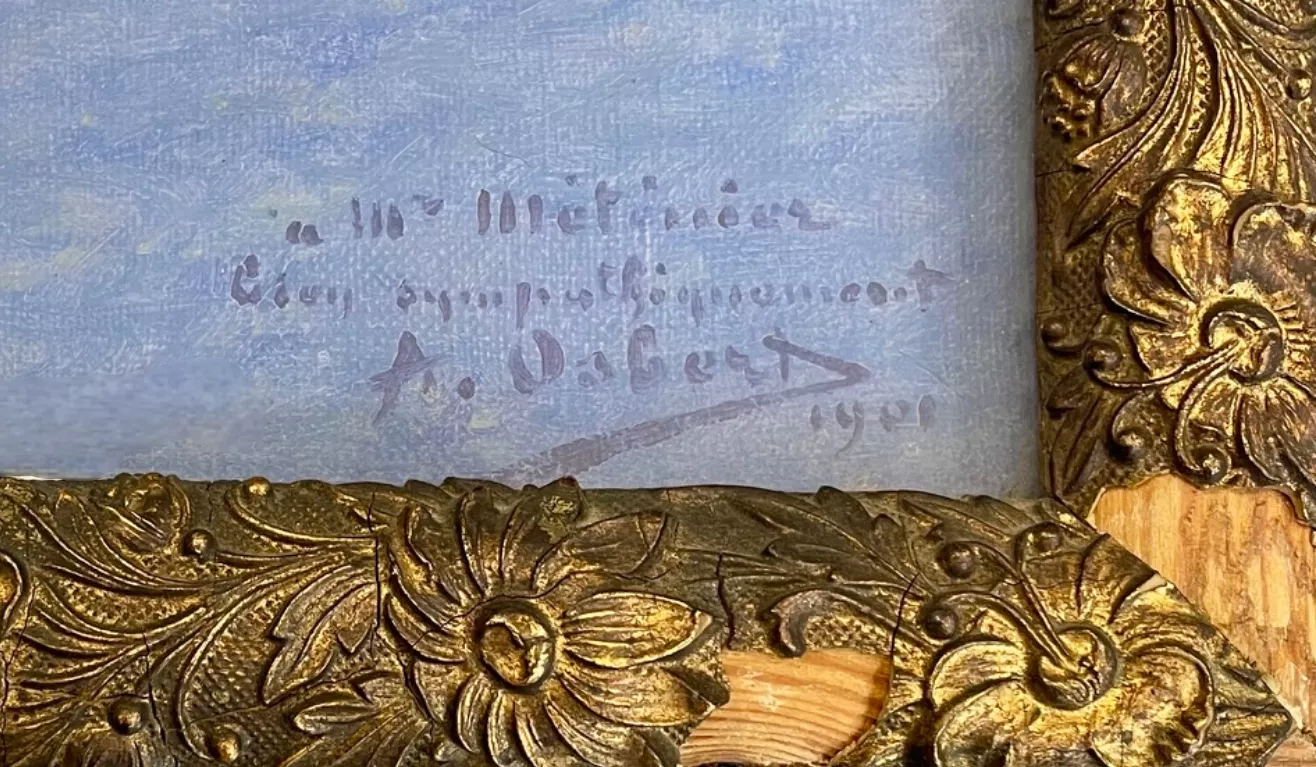
His signature
Not all Alphonse Osbert 's works are signed.
Although there are variations, here is a first example of his signature:
Expertise your property
If you happen to own a work by Alphonse Osbert, request a free appraisal without further delay via our form on our website.
A member of our team of experts and auctioneers will contact you promptly to provide you with an estimate of the value of your work, as well as ad hoc information about it.
If you are considering selling your work, you will also be accompanied by our specialists in order to benefit from alternatives for selling it at the best possible price.
.Estimate in less than 24h
Discover in the same theme

Rating and value of sculptures and bronzes by Antonin Mercié
Antonin Mercié is a 19th-century neoclassical sculptor whose works are highly prized at auction.
Learn more >

Rating and value of Paul Paulin's sculptures and bronzes
Paul Paulin is a twentieth-century Impressionist sculptor whose works are highly prized at auction.
Learn more >

Rating and value of paintings, drawings and sculptures by Er...
Ernest Meissonier was a 19th-century artist who produced many small-scale works and sculptures, which are now listed at auction.
Learn more >
Works from the same period sold at auction

Estimated 500 - 800 €
Louis BUISSERET (1888-1956) - Water carrier, Portugal, circa 1943, Oil on canvas

Estimated 10.000 - 15.000 €
Ebridge Ayer BURBANK(1858-1949), Young African-American boy, Oil on panel.

Estimated 3.000 - 5.000 €
Henri EPSTEIN (1892-1944), Place du sud de la France, Oil on canvas.

Estimated 8000 - 12000 €
Raymond THIBESART (1874-1968) Apple trees in blossom Oil on canvas.

Estimated 3.000 - 5.000
Henri Adrien TANOUX (1865-1923) The Slave Trader, oil on canvas

Secure site, anonymity preserved

Auctioneer approved by the State

Free and certified estimates
Frequently asked questions
-
Who was Alphonse Osbert, and what was his artistic background?Alphonse Osbert (1857–1939) was a leading French painter of the Symbolist movement and an influential member of the Nabis group. A well-known figure at the Salons de la Rose-Croix, he distinguished himself through his mysterious landscapes bathed in a characteristic twilight glow, developing as early as the 1890s an idealistic and decorative style inspired by Pierre Puvis de Chavannes. His monumental and spiritual body of work earned him the Legion of Honor medal in 1934.
-
What is the price range for works by Alphonse Osbert?On the auction market, the prices of Alphonse Osbert’s works vary considerably depending on the medium: prints sell for between €15 and €480, drawings and watercolors between €60 and €19,000, and paintings between €335 and €42,000. Figurative oil-on-canvas paintings are the most sought-after by collectors and can fetch tens of thousands of euros, as evidenced by the 2017 auction sale of “In the Evening’s Tranquility” for €42,000.
-
How can you authenticate a work by Alphonse Osbert?To authenticate a work by Alphonse Osbert, we recommend that you request a free appraisal from Auctie's using the form on our website. A state-certified expert or auctioneer will examine your work and provide you with an accurate estimate of its value, with no obligation on your part. Our team will respond to your request within 48 hours.
-
Is this the right time to sell a work by Alphonse Osbert?Yes, now is a good time to sell a work by Alphonse Osbert. His works remain rare on the market and highly sought after by collectors, which keeps demand steady and ensures attractive valuations. Recognition of his place among the great Symbolists of the 19th and 20th centuries ensures lasting interest in his compositions.
-
How does the appraisal process work at Auctie's, and what should I do if I want to sell?Appraisals at Auctie's are free and non-binding: simply fill out our online form, and an expert or auctioneer will contact you to examine your piece and provide you with an accurate appraisal. If you decide to sell, our team of specialists will guide you every step of the way—from the appraisal to the auction—to ensure you get the best possible price for your item.
