



Rating and value of sculptures and paintings by Alfred Boucher

Key takeaways
- Works by Alfred Boucher (1850–1934) sell for between €40 and €502,240, with marble sculptures fetching up to €233,540.
- An academic sculptor influenced by Carpeaux and Dalou, Boucher worked marble with precision and favored clean lines and restrained emotion.
- As the founder of La Ruche in Paris in 1902, his works are particularly sought after by French and English buyers, especially his busts and female figures.
If you own a work by or after the artist Alfred Boucher, and would like to know its value, our state-approved experts and auctioneers will offer you their appraisal services.
Our specialists will carry out a free appraisal of your work, and provide you with an accurate estimate of its value on the current market.
Then, should you wish to sell your work, we will direct you to the best possible arrangement to obtain the optimum price.
Rating and value of the artist Alfred Boucher
Alfred Boucher is the founder of La Ruche in Paris. His legacy consists of paintings and sculptures. At present, the prices of his works are exploding at the auctioneers' gavel.
His works are particularly prized especially by French and English buyers, and the price at which they sell on the Art market ranges from €40 to €502,240, a considerable delta but one that speaks volumes about the value that can be attributed to Boucher's works.
In 2009, a marble, Nu, sold for €233,540 while it was estimated at between €77,900 and €111,210. The artist's quotation is high and varies according to the quantity of works present on the auction market.
Order of value from a single work to the most prestigious
Technique used | Result |
|---|---|
Drawing - watercolor | From €100 to €700 |
Oil on canvas | From €50 to €11,000 |
Sculpture - volume | From €90 to €233,540 |
Estimate in less than 24h
Style and technique by artist Alfred Boucher
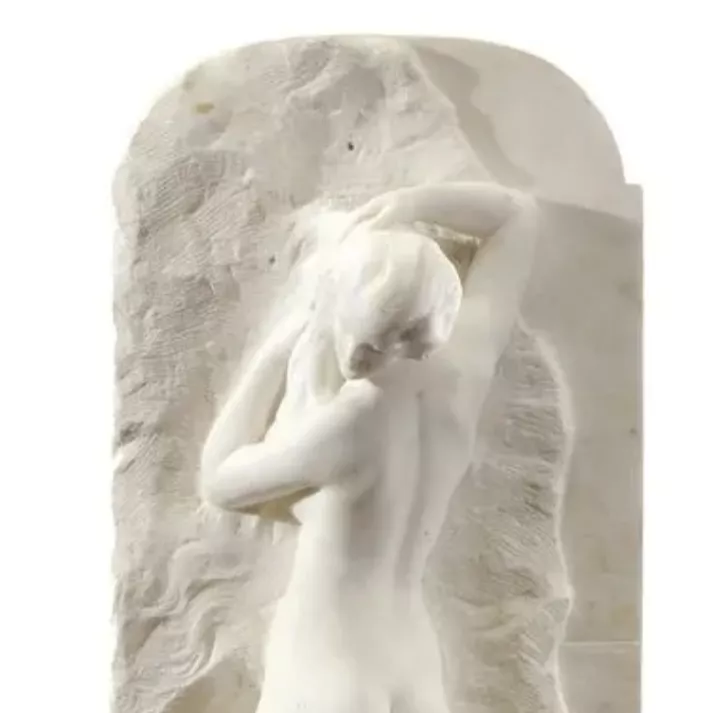
Alfred Boucher's style and technique are part of an academic tradition that, while looking to the past, paves the way for a discreet yet assertive modernity.
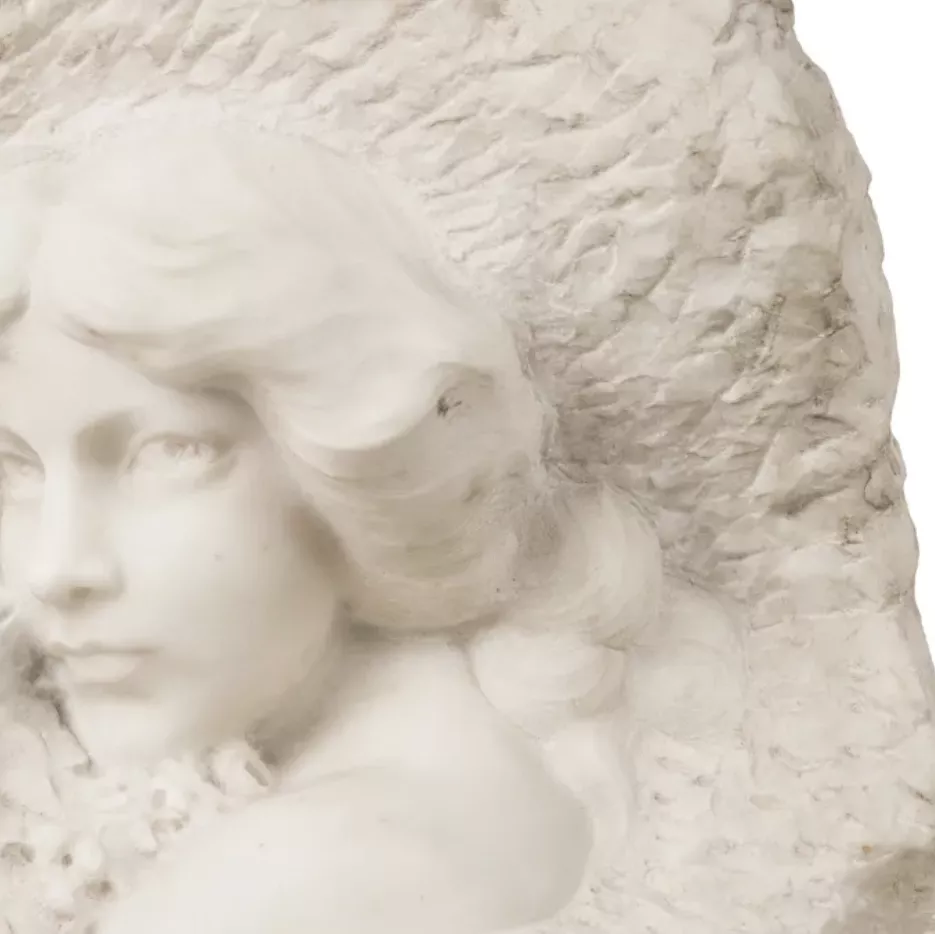
Heir to the great sculptors of the 19th century, he shows a predilection for marble, which he works with virtuoso precision.
The softness of his lines and the elegance of his forms testify to his quest for harmony, while light, subtly captured, underlines volumes and gives his works an inner life.
Influenced by Carpeaux and Dalou, Boucher appropriates their lessons without being a prisoner of them: his figures, though often academic in their composition, stand out for their stripped-down simplicity and restrained emotion, revealing a more intimate sculptural language.
Boucher's modeling, precise but never rigid, strives to convey the fragility of flesh and the fluidity of drapery. He favors natural poses, where the serenity of attitudes reflects a quest for universal beauty.
This revisited classicism, far removed from theatrical exaggerations, is based on impeccable technique and a sensibility that rejects the spectacular in favor of contemplative art.
Through his works, Boucher establishes a subtle dialogue between tradition and innovation, inscribing his practice in a calmed continuity marked by a quest for authenticity.
The life of Alfred Boucher
Born in 1850 in Bouy-sur-Orvin, a small village in the Aube region, Alfred Boucher grew up in a modest environment, his father working as a gardener.
Early on, he showed an aptitude for drawing and modeling, talents that soon attracted the attention of a local patron, who decided to finance his studies.
Thus, Boucher entered the École des Beaux-Arts in Paris, where he trained under the great masters of academic sculpture.
Rapidly, his ability to render the subtleties of faces and bodies earned him notable recognition, particularly when he won first prize at the Salon des Artistes Français in 1881.
The finesse of his works, combined with a deeply human dimension, appealed as much to his contemporaries as to public and private commissioners.
A man deeply attached to his roots, Boucher divided his career between Paris and his native Nogent-sur-Seine, where he remained a lifelong benefactor to young artists.
In 1902, he founded the Maison des Artistes, a unique venue designed to welcome emerging talent, including Camille Claudel, whom he benevolently supported in her early years.
Admired for his busts, female figures and compositions imbued with a sober classicism, he also stood out for his integrity and commitment to accessible art.
Died in 1934, Alfred Boucher remains a major figure in French sculpture, his work testifying to a perfect balance between tradition and emotion, in the service of a timeless humanity.
Focus on La jeune fille à l'Atalante, Alfred Boucher (1890)
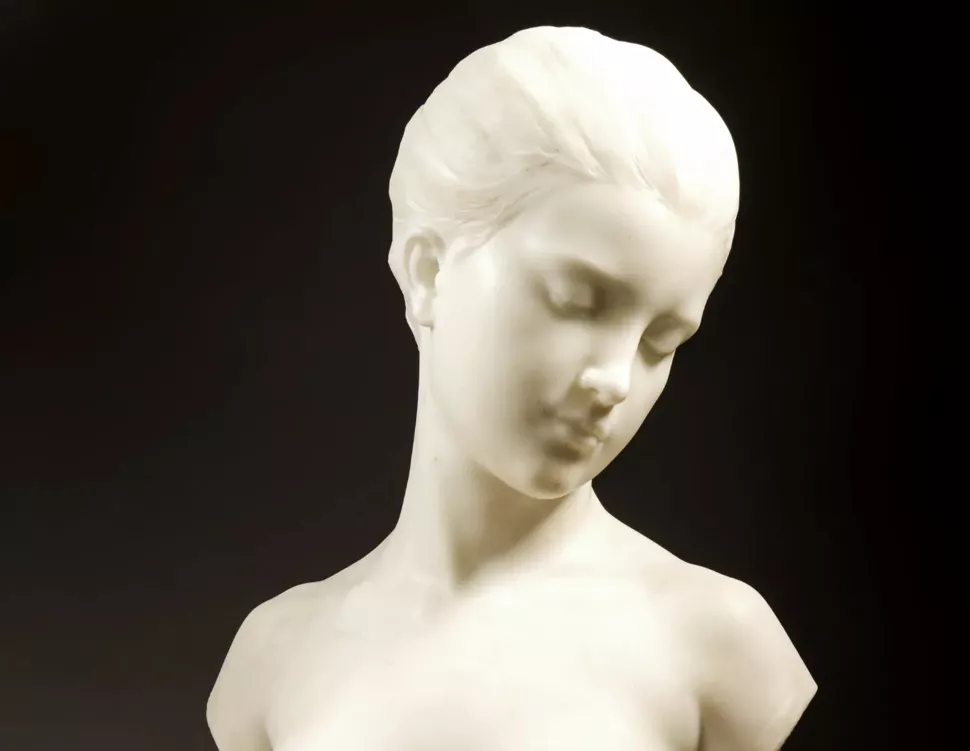
In La Jeune Fille à l'Atalante (1890), Alfred Boucher chose to embody, through sculpture, an ideal of grace and youth. His bust, at once simple and profound, testifies to his ability to capture beauty in its most absolute purity.
The young girl's face, serene and reflective, seems to escape the contingency of the moment, as if suspended between two realities: that of marble and that of life.
The features are both realistic and idealized, suggesting the soul more than the body, and translating this search for a form of eternity.
The workmanship of the material is of remarkable finesse. Every detail, from the modelling of the face to the undulations of the hair, is treated with a precision that goes beyond mere visual effect.
The artist doesn't just reproduce a face, he captures its essence, bringing this bust to life in an almost supernatural way.
Marble, a classical material par excellence, here becomes a medium that transcends its coldness to reflect the softness and sensuality of the subject.
The work then seems more than a simple representation; it becomes a meditation on youth, timelessness and the idealization of the human body.
The artist, with this work, goes beyond technique to offer a genuine aesthetic and emotional reflection, a perfect balance between form and meaning.
Alfred Boucher's imprint on his period
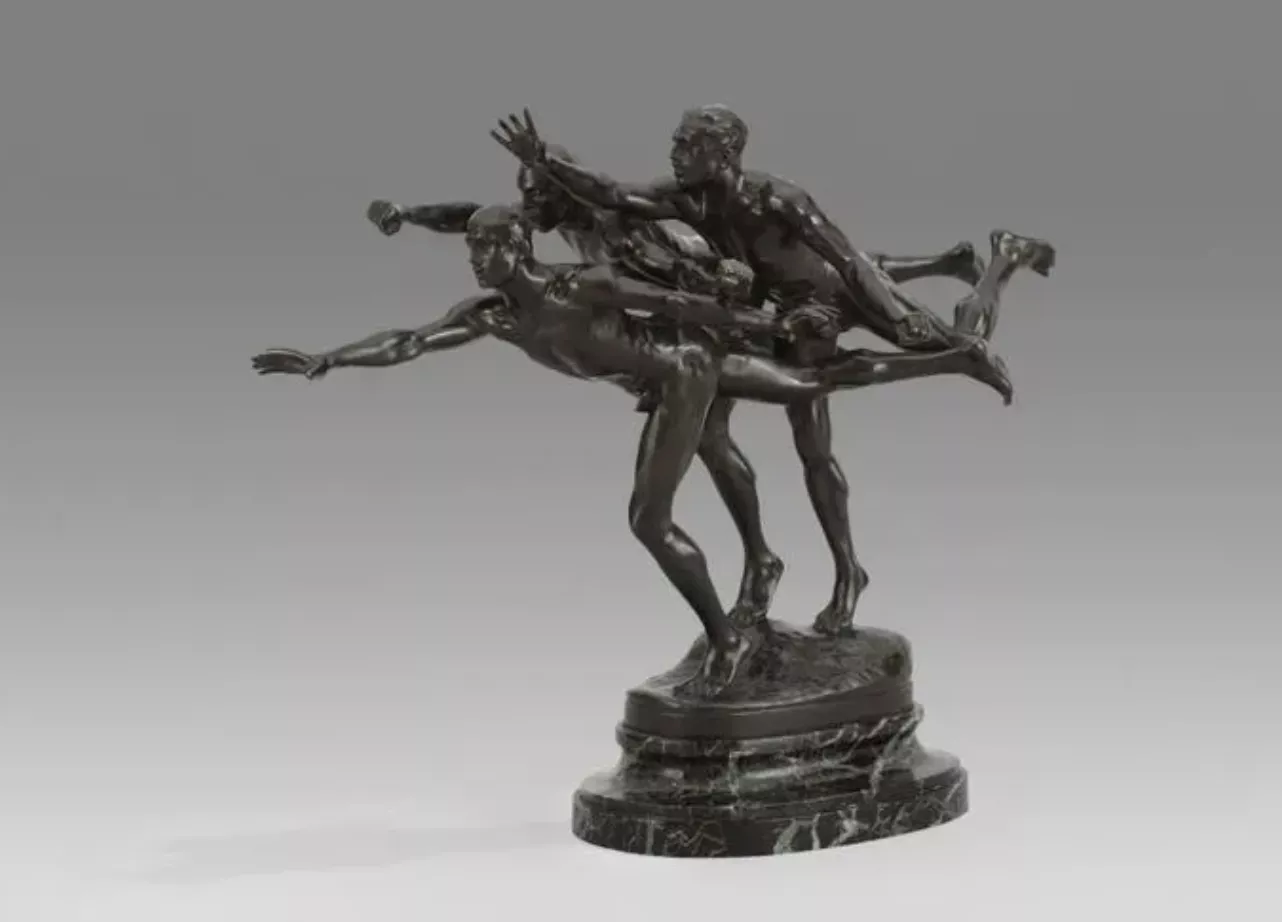
Alfred Boucher's imprint on his period is marked by a constant search for harmony and emotion in his sculptures. Through his mastery of marble and bronze, he succeeds in making the material as fluid as the forms he depicts in it.
His technically refined style is distinguished by an ability to breathe life and movement into seemingly frozen figures.
Like the great classical sculptors, he exploits matter as a vehicle for expression, while retaining a lightness of tone that contrasts with the academic rigor of his time.
His busts, his sculptures of women or children, treated with exceptional delicacy, possess that rare quality of transcending mere representation to embody the very essence of his subjects.
But beyond technical virtuosity, Boucher's imprint is also to be found in his influence on his contemporaries and the redefinition of sculptural standards.
His works embody a point of passage between the classical traditions of the 19th century and the avant-gardes that would emerge in the early 20th century.
The softness and sensuality emanating from his creations would continue to inspire subsequent generations, while marking the passage from one era to another.
The stylistic influences of Alfred Boucher
The stylistic influences of Alfred Boucher are multiple and reflect a perfect symbiosis between tradition and modernity.
Trained in contact with the great masters of his time, such as Jean-Baptiste Carpeaux and Auguste Rodin, he imbibed the principles of academic sculpture while seeking to go beyond its limits.
Ancient art, and in particular Greco-Roman sculpture, is a major reference for Boucher, who, while remaining faithful to idealized proportions, seeks to infuse his figures with a more contemporary expressiveness.
But his eye was also drawn to the new artistic trends of his time: the moving sculptures of Auguste Rodin, the fine detail of realism and the first attempts at deconstructing forms in the early 20th century.
These influences, though perceptible in his treatment of material, did not entirely define him.
In fact, what sets Boucher apart is his ability to feed off his influences while asserting a voice of his own, subtly blending modern expressivity with classical rigor.
Through the purity of his lines and the sensuality of his figures, he thus stands out as an heir to the great masters, while at the same time being one of the precursors of modern sculpture.
Despite the fact that he is less well-known than sculptors such as Rodin or Bourdelle, his value proves to be very high on the auction market. Particularly prized by French buyers, his neoclassical style combined with modern influences is very appealing to 20th-century sculpture enthusiasts.
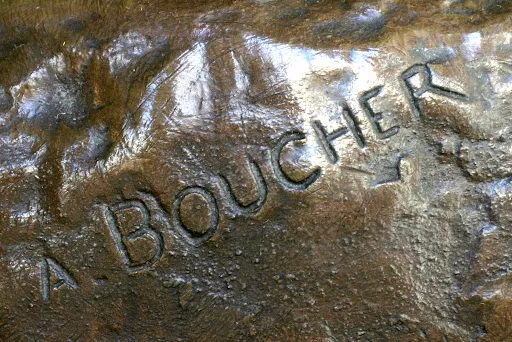
Recognizing Alfred Boucher's signature
Alfred Boucher doesn't always sign his works. If you think you own one, it's best to have your property appraised.
Knowing the value of a work
If you happen to own a work by or after Alfred Boucher, don't hesitate to request a free appraisal using our form on our website.
A member of our team of experts and certified auctioneers will contact you promptly to provide you with an estimate of the market value of your work, as well as ad hoc information about it.
If you are considering selling your work, you will also be accompanied by our specialists in order to benefit from alternatives for selling it at the best possible price, taking into account the inclinations of the market.
.Estimate in less than 24h
Discover in the same theme

Rating and value of works, paintings by Jean-Joseph Benjamin...
Benjamin-Constant is a 19th-century Orientalist painter. The author of a rich output, his works are highly valued at auction.
Learn more >

Ratings and values of paintings by Alfred Roll
Alfred Roll was a 19th-century realist painter who produced drawings and oils on canvas that are valued at auction.
Learn more >

Rating and value of drawings, pastels and watercolors by Éli...
Elie Repin is a 19th-century Russian realist painter whose drawings are highly prized at auction.
Learn more >
D'autres bronzes modernes vendus aux enchères

Estimated Between €2,000 and €4,000
Edouard Marcel SANDOZ (1881-1971) curly stingray, bronze print

Estimated Between €1,500 and €3,000
Renato CARVILLANI (1896-1986), seated woman, gilded bronze print

Estimated Between €1,500 and €3,000
César BALDACCINI dit CESAR (1921-1998), Poule Cartier, bronze print

Estimated Between €10,000 and €20,000
Baltasar LOBO (1910-1993), female nude in bronze

Estimated 5.000 - 8.000
Igor MITORAJ (1944-2014), Bust of Asclepius, Green patina bronze sculpture

Secure site, anonymity preserved

Auctioneer approved by the State

Free and certified estimates
Frequently asked questions
-
Who was Alfred Boucher, and what was his historical context?Alfred Boucher (1850–1934) was a leading 19th-century French sculptor and the founder of La Ruche in Paris. Trained at the École des Beaux-Arts and a laureate of the Salon des Artistes Français in 1881, he worked within the academic tradition while embracing a subtle modernity. Influenced by Carpeaux and Rodin, he remains a key figure in the transition from 19th-century classicism to modern sculpture, admired in particular for his busts and feminine figures imbued with sensitivity.
-
What is the price range for Alfred Boucher's works at auction?The prices of Alfred Boucher’s works vary considerably depending on the medium and size: drawings and watercolors range from €100 to €700, oil paintings on canvas from €50 to €11,000, and sculptures can reach up to €233,540. In 2009, the marble sculpture *Nu* exceeded its initial estimate, selling for €233,540. This wide range reflects the importance of rarity, size, and material (particularly marble) in determining the value of his works.
-
How can you authenticate a work by Alfred Boucher and determine its value?To authenticate and appraise a work by Alfred Boucher, we recommend that you request a free estimate using our online form. An expert or certified auctioneer from our team will contact you shortly to examine your item and provide you with an accurate assessment of its market value, with no obligation on your part. This appraisal will also allow you to receive advice on the best options for selling your item.
-
What kind of artwork is this? Is now a good time to sell a sculpture or painting by Alfred Boucher?Yes, now is a good time to sell a work by Alfred Boucher. The artist’s market value is high and rising in the auction market, particularly among French and British buyers. Prices are skyrocketing at auction, and sculptures in particular are in high demand, reflecting a renewed interest in this sculptor—who was long less well-known than Rodin, but whose reimagined classicism appeals to contemporary collectors.
-
How does Auctie's assist with the sale of a work by Alfred Boucher?Auctie's supports you every step of the way: after a free, no-obligation appraisal by our experts, we guide you toward the best possible approach to sell your artwork at the optimal price. Our licensed auctioneers manage the entire sales process, taking into account market trends and collectors’ preferences to maximize the final hammer price.
