



Rating and value of paintings by Peder Mork Monsted

Key takeaways
- Peder Mork Monsted, a Danish painter (1859–1941), specialized in naturalistic landscapes, particularly snowy scenes from Northern Europe and Italy.
- Oil-on-canvas paintings constitute the dominant segment of the market, with prices ranging from €10 to €220,000 depending on size and quality.
- In 2021, “Flusslandschaft im Spreewald” (1912) exceeded estimates by fetching €220,000, demonstrating the strength of the international market.
If you own a work by or after the artist Peder Mork Monsted, and you'd like to know its value, our state-approved experts and auctioneers will offer you their appraisal services.
Our specialists will carry out a free appraisal of your work, and provide you with an accurate estimate of its value on the current market.
Then, should you wish to sell your work, we will direct you to the best possible arrangement to obtain the optimum price.
Rating and value of the artist Peder Mork Monsted
Peder Mork Monsted is a Danish painter known for his snowy canvases. He leaves behind a unique artistic repertoire characteristic of Impressionism.
At present, the prices of his works are flying off the auctioneers' hammers. His paintings and other works are particularly prized, especially by European and American buyers, and the price at which they sell on the art market ranges from €10 to €220,000, a considerable delta but one that speaks volumes about the value that can be attributed to the works of Peder Mork Monsted.
In 2021, his composition Flusslandschaft im Spreewald, dating from 1912 sold for €220,000, while it was estimated at between €20,000 and €30,000.
Order of value from a simple work to the most prestigious
Technique used | Result |
|---|---|
Estamp - multiple | From €30 to €500 |
Drawing - watercolor | From €70 to €5,230 |
Oil on canvas | From €10 to €220,000 |
Estimate in less than 24h
Style and technique of the artist Peder Mork Monsted
Peder Mork Monsted (1859 - 1941) was a Danish painter associated with Nordic naturalism, with an advanced technical mastery inherited from the European academic tradition. His work is situated between meticulous realism and controlled impressionist sensibility, without adherence to the avant-gardes.
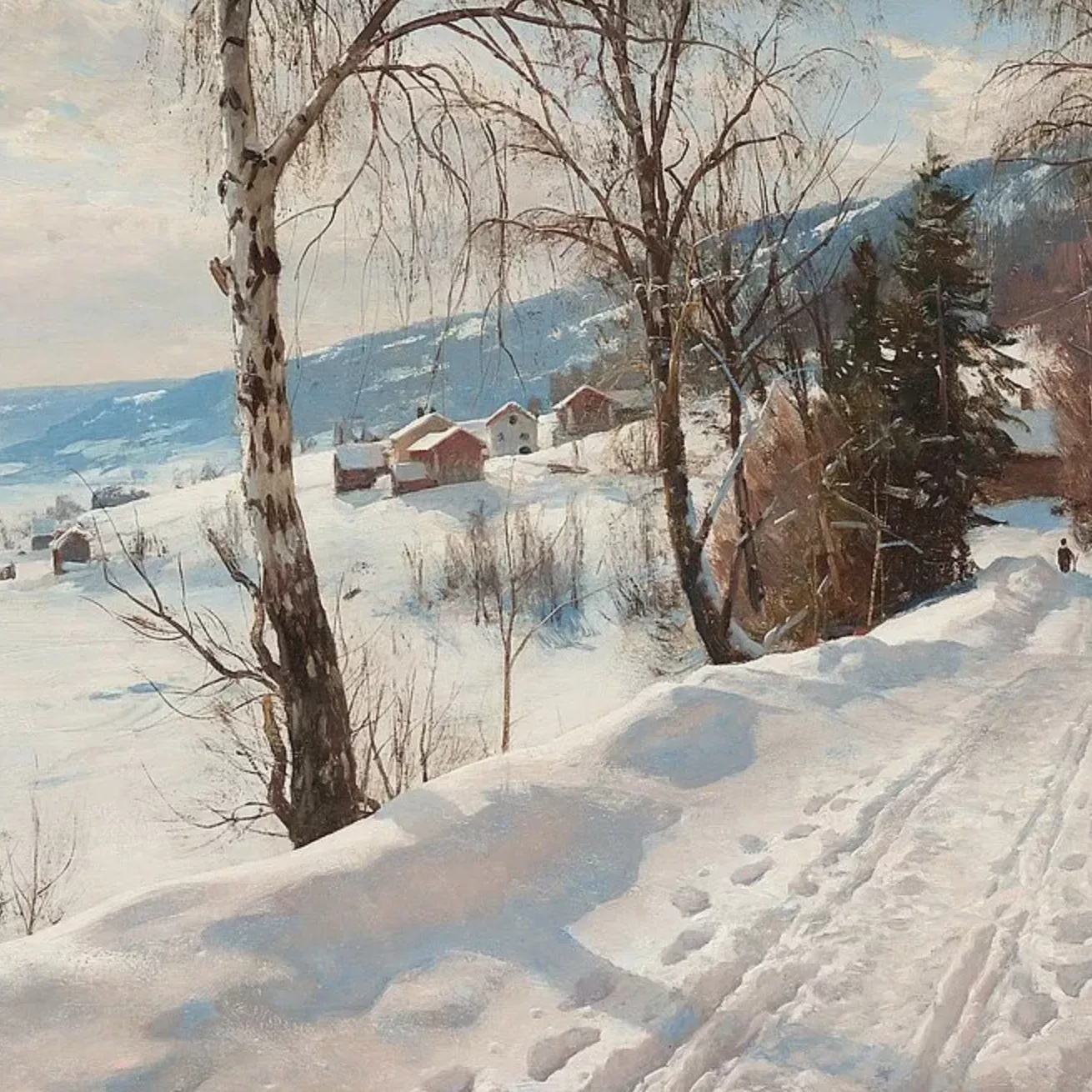
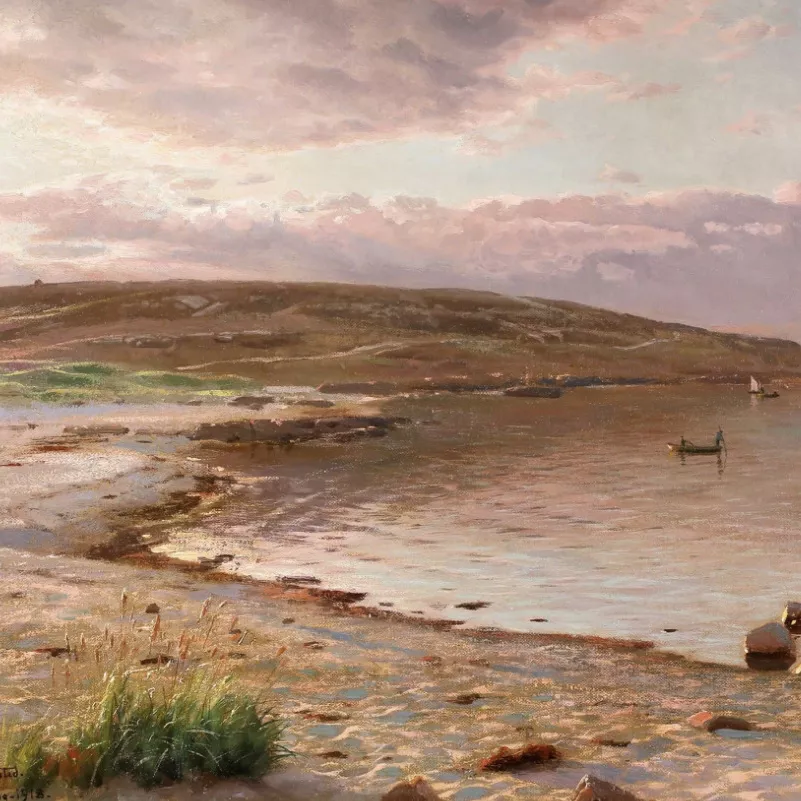
He is in constant pursuit of visual fidelity and optical verisimilitude. Landscapes are his central and almost exclusive subject. His recurring motifs are forests, undergrowth, rivers, snowy landscapes, paths, clearings and rural views of Northern Europe and Italy.
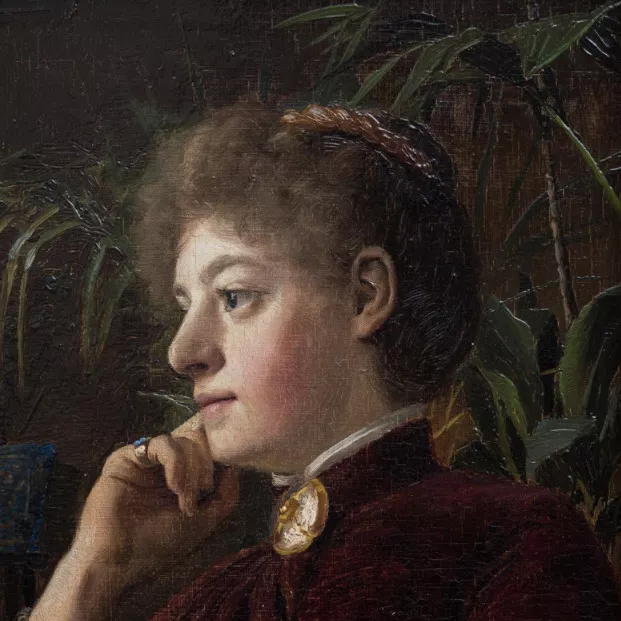
Human figures are sometimes present, always secondary and integrated into the landscape. He observes the motif directly and attentively. Nature is depicted as a living space, precise and orderly, without excessive romantic idealization.
The compositions are classically structured, with a detailed foreground, a middle ground that articulates depth and an atmospheric background. He frequently uses paths, streams or trunks as reading axes, and seeks a balance between descriptive complexity and visual clarity.
Light is the fundamental element of his pictorial language. Natural light is changeable, often filtered by foliage or reflected by snow. His palette is rich and controlled, with nuanced greens, browns and ochres, whites and cold blues for winter scenes. Colors are used to render atmospheric effects rather than for subjective expressiveness.
He works almost exclusively with oil on canvas, layering thin, transparent layers, which allows for great precision. His brushwork is almost invisible, aiming for a smooth surface and detailed rendering.
Monsted is known for his style as a major figure in Nordic naturalist landscape, and internationally recognized during his lifetime for his technical virtuosity. His work is appreciated for its quality of execution and enduring decorative value.
The life of Peder Mork Monsted
Peder Mork Monsted (1859 - 1941) was born in Grena, Denmark. He came from a Nordic cultural environment marked by the importance of landscape and the observation of nature. The Danish context was conducive to academic training and naturalism.
He studied at the Royal Danish Academy of Fine Arts in Copenhagen, and received a rigorous training based on drawing, landscape study and mastery of perspective and light. He completed his training with periods of study abroad, notably in Paris and Italy.
He began exhibiting in the 1880s, and soon specialized in naturalistic landscapes, which became the exclusive focus of his work, and made his mark with precocious technical virtuosity. His career was marked by the international distribution of his works.
He exhibited and sold in Scandinavia, Germany, France, Italy and the UK, and was highly appreciated by a bourgeois and aristocratic European clientele.
His works entered private and public collections from the end of the 19th century. He deliberately stayed away from the avant-gardes (radical impressionism, expressionism), and defended a painting style based on precision, patience and direct observation.
He reached full artistic maturity at the turn of the 20th century, and maintained a remarkable stylistic consistency over several decades. His reputation rests on consistency and technical excellence.
He continued to work until the 1930s, when he died in Copenhagen. Today, he is recognized as one of Scandinavia's great naturalist painters. His work is regularly exhibited on the international market.
Market segmentation and artist rating
Oils on canvas are the almost exclusive, structuring segment of the market. Works on panel are rare and belong to a secondary market. Drawings and sketches have a marginal presence and a mainly documentary interest.
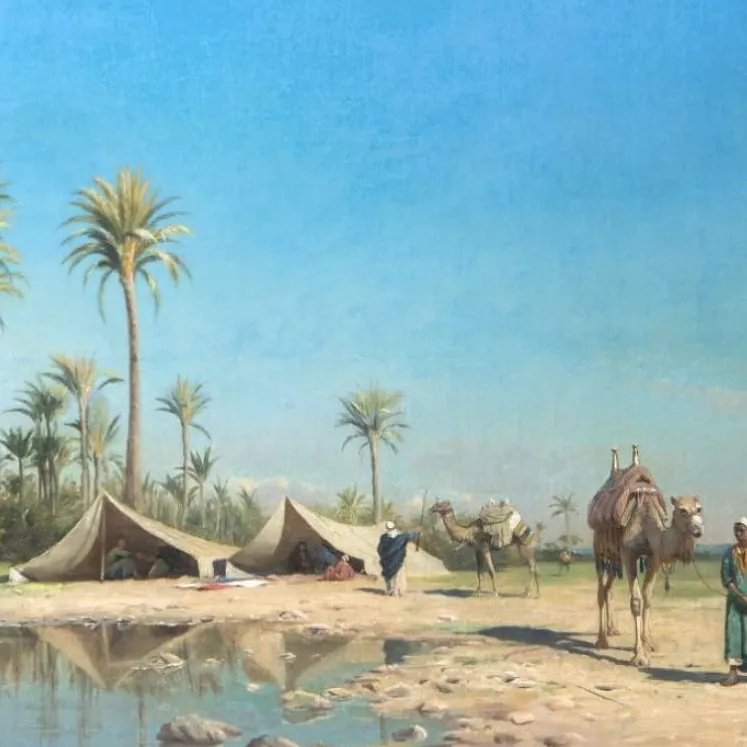
He produces naturalistic landscapes (forests, undergrowth, rivers), snowy scenes, and rural landscapes and roads. Italian landscapes form a distinct segment, appreciated for their luminosity. Nordic winter landscapes form the core of demand.
Small formats (25 - 40 cm) are an entry-level market, with good liquidity. Medium formats (40 - 80 cm) are part of a core segment, which is also the most highly valued. Large formats over 80 cm are rare and form part of a selective but very buoyant market.
The decisive valuation criteria are quality of execution (precision, fine detail), successful light effects (snow, reflections, filtered light), irreproachable state of preservation (very sensitive for this type of smooth painting), and legible signature as well as unreserved attribution.
The international market is very active in Northern Europe, Western Europe and the USA. The profile of buyers are collectors of European naturalist paintings, and high-end decorative buyers. The heritage market is strong, with a moderate investment dimension.
Monsted occupies a high segment of the European naturalist landscape market. The market is very stable and sustained, with a steady demand for ultra-naturalist winter landscapes, such as those by Guermatcheff, Répine or Korovine.
Recognizing Peder Mork Monsted's signature
Peder Mork Monsted's paintings are often signed at the bottom left of the painting. He signs with his first and last name, often in a dark tone ; sometimes with the town where he painted the picture, or the date.
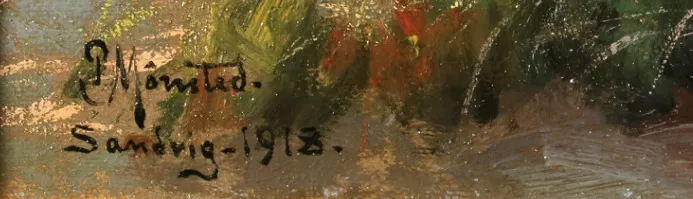
Knowing the value of a work
If you happen to own a work by or after Peder Mork Monsted, don't hesitate to request a free valuation using our form on our website.
A member of our team of experts and certified auctioneers will contact you promptly to provide you with an estimate of the market value of your work, as well as ad hoc information about it.
If you are considering selling your work, you will also be accompanied by our specialists in order to benefit from alternatives for selling it at the best possible price, taking into account market inclinations.
Estimate in less than 24h
Discover in the same theme

Rating and value of sculptures, paintings and drawings by Je...
Jean-Baptiste Carpeaux is a 19th-century painter and sculptor who produced many works that are highly valued at auction.
Learn more >

Rating and value of paintings by Alexandre Séon
Alexandre Séon is a Symbolist painter who produced paintings that are highly valued at auction. 100% free estimate!
Learn more >

Rating and value of marines paintings by Hendrik Willem Mesd...
Hendrik Willem Mesdag was a marine painter associated with the Hague School, who produced numerous paintings that fetch high prices at auction.
Learn more >
D'autres tableaux impressionnistes vendus aux enchères

Estimated 6.000 - 8.000
Mikhail Markianovich GUERMACHEFF (1867 - 1930) House under the snow, oil on canvas

Estimated 2.000 - 4.000
Jean DUFY (1888-1964) Vase of anemones, Watercolor

Estimated 600 € - 800 €
Henri ZUBER (1844-1909), Bridge at Artemare. Oil on canvas.

Secure site, anonymity preserved

Auctioneer approved by the State

Free and certified estimates
Frequently asked questions
-
Who is Peder Mork Monsted, and what is his artistic style?Peder Mork Monsted (1859–1941) was a leading Danish painter of Nordic naturalism, internationally recognized for his technical virtuosity. His work lies between meticulous realism and controlled Impressionism, characterized by landscapes of great precision, particularly snowy scenes, forests, and rivers of Northern Europe and Italy. He deliberately distanced himself from the avant-garde movements to champion a style of painting based on direct observation and academic mastery.
-
What is the price range for Peder Mork Monsted's works?The prices of Peder Mork Monsted’s paintings vary considerably depending on the size, technique, and quality: prints range from €30 to €500, drawings and watercolors from €70 to €5,230, while oil-on-canvas works—the dominant segment of the market—range from €10 to €220,000. Medium-sized works (40–80 cm) are the most highly valued segment, while small-sized works offer an accessible entry-level market with good liquidity.
-
How can you authenticate and appraise a work by Peder Mork Monsted?To authenticate a work by Peder Mork Monsted and determine its value, request a free, no-obligation appraisal from Auctie's using the form on the website. A certified expert or auctioneer will contact you within 48 hours to provide you with an accurate assessment of the market value and detailed information about your painting. This free appraisal will also help you explore the best options for selling it at the best possible price.
-
Is this a good time to sell a work by Peder Mork Monsted?Yes, now is a good time to sell a work by Peder Mork Monsted. The market is very stable and robust, with steady, international demand for this artist’s hyper-realistic winter landscapes. European and American collectors particularly appreciate his paintings, and his market value continues to rise on the international art market.
-
What factors determine the value of a painting by Peder Mork Monsted?The value of a painting by Peder Mork Monsted depends primarily on the quality of its execution (precision and finesse of detail), the effectiveness of the lighting effects (snow, reflections, filtered light), its impeccable condition (a particularly important factor for his smooth-surfaced paintings), and a certified attribution with a legible signature. The painting’s size also significantly influences its value, with medium and large formats being particularly highly valued.
