



Rating and value of paintings by Marie Guillemine Benoist

Key takeaways
- Works by Marie Guilhelmine Benoist (1768–1826), a Neoclassical painter, sell for between €100 and €300,000, depending on the technique and the prestige of the subject.
- Her oil-on-canvas painting *Portrait of Empress Marie-Louise* fetched €300,000 in 2025, far exceeding its initial estimate of €60,000 to €80,000.
- The artist’s market value is on the rise, as his portraits of women and neoclassical works are particularly sought after by French collectors.
If you own a work by Marie Guilhelmine Benoist or after, and would like to know its value, our state-approved experts and auctioneers will offer you their appraisal services.
Our specialists will work to carry out a free appraisal of your work, and will provide you with an accurate estimate of its value on the current market.
Then, if you wish to sell your work, we will direct you to the best possible arrangement to obtain the optimum price.
Rating and value of the artist Marie Guilhelmine Benoist
Marie Guilhelmine Benoist is an artist known to lovers of neoclassical canvases. Now, prices for her works are rising at the auctioneers' gavel.
Her oils on canvas are particularly prized, especially by French buyers, and the price at which they sell on the art market ranges from €100 to €300,000, a significant delta but one that speaks volumes about the value that can be attributed to the artist's works.
In 2025, his oil on canvas Portrait de l'Impératrice Marie-Louise sold for €300,000, whereas it was estimated at €60,000 to €80,000. His value is exploding, and his works, which are becoming rare on the market, promise very significant results.
Order of value from a simple work to the most prestigious
Technique used | Result |
|---|---|
Drawing - watercolor | From €100 to €1,000 |
Oil on canvas | From €7,900 to €300,000 |
Estimate in less than 24h
Style and technique by artist Marie Guilhemine Benoist
Marie Guilhelmine Benoist (1768 - 1826) was a student of Élizabeth Vigée le Brun, then Jacques Louis David. Trained by the greatest, she developed a style marked by clarity of drawing, sobriety of line and the calm monumentality of figures.
Her approach is completely in keeping with neoclassical language, valuing form, balance and the controlled idealization of reality. The figures are posed, sculptural and isolated in clear, structured compositions.
His work testifies to an extraordinary mastery of academic drawing, with sustained attention paid to anatomy, drapery and the geometric construction of poses. Her brushstrokes are smooth and barely visible, as the pictorial material is polished, transparent and in the tradition of the classical finish.
Oil is applied in thin, superimposed layers (glazes), giving flesh a subtle transparency and inner light. She favors portraits, often of women, whom she depicts with restrained grace and calm dignity, without decorative overload.
The faces she portrays are pensive, absorbed, sometimes melancholy, treated with real psychological depth. Far from the ornamental, she offers an interiorized vision of the human figure, particularly the female, often imbued with silent nobility.
She uses a narrow palette, dominated by beiges, browns, muted blues, off-whites and deep reds. Light is soft and undramatic, to gently shape the volumes.
The background is mostly neutral or highly simplified, emphasizing the figure's presence and expression. While her style remains faithful to the canons of neoclassicism, she sometimes introduces emotional or political tension into her subjects (as in her portrait of a free black woman from 1800).
In this way, she combines formal rigor and psychological finesse, which was very rare in her time, heralding a pre-romantic sensibility in certain looks or in the pose of the hands.
Her art is therefore distinguished by its balance between plastic exigency and continuous humanity.
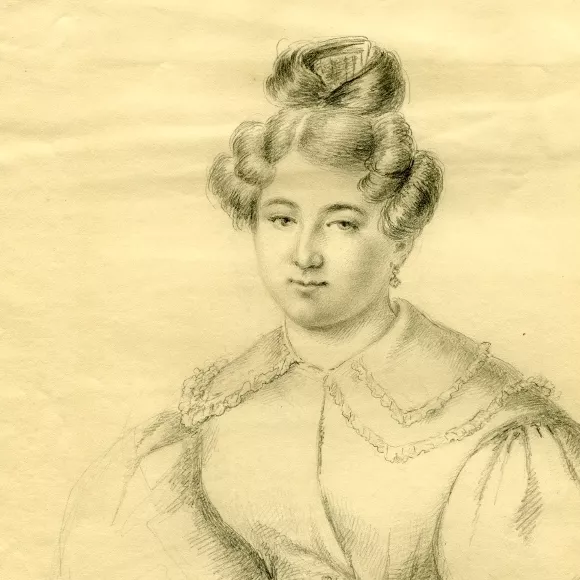
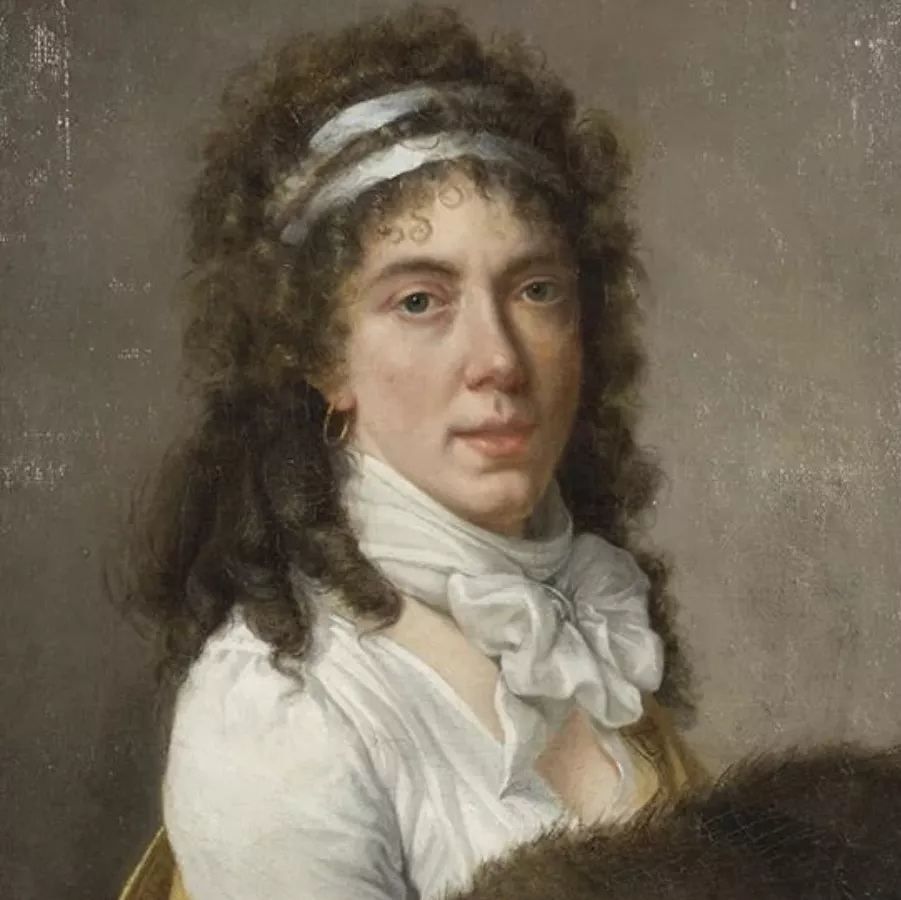
The life of Marie Guilhelmine Benoist
Marie-Guilhelmine or Marie Guillemine de Laville-Leroux was born in Paris in 1768, into a cultured family open to the arts. She first trained with Élizabeth Vigée le Brun, then entered the studio of Jacques-Louis David, where she quickly distinguished herself for the quality of her drawing.
The artist began exhibiting at the Paris Salon as early as 1791, in a period of political and institutional upheaval. She gained recognition for her refined portraits, allegorical and mythological scenes, which are executed in a rigorous neoclassical style.
Her painting combines academic mastery, psychological sensitivity and an interest in matters of sobriety.
His most famous work,Portrait d'une femme noire (1800, preserved in the Louvre), depicts a free black woman, seated front-on, and is a radical work for its time since it is often interpreted as a feminist and anti-slavery gesture, although its intention remains debated.
She thus became one of the first French women artists to depict a black woman as the main subject of a history painting, with dignity and monumentality. The work was exhibited at the Salon, in a post-abolition context (1794), but before Napoleon maintained slavery in the newly annexed colonies (1802).
Marie Guilhelmine married the high-ranking civil servant and lawyer Benoist, whose name she took, which consequently became her artist's name. From the 1800s, and especially after 1810, she reduced her artistic activity, certainly because of family and social responsibilities, and perhaps because of the political reorientation of the regime.
She stopped exhibiting publicly, but continued to paint privately, producing mainly portraits of her entourage. The artist died in Paris in 1826, relatively forgotten by the art world.
Her name fell into oblivion for almost a century, despite significant recognition during her lifetime. She would be rediscovered in the 20th century, notably through her Portrait of a Black Woman, a work that has become emblematic of contemporary reflections on the visibility of women and black people in art history.
Focus on Portrait de l'Impératrice Marie-Louise, Marie Guilhelmine Benoist
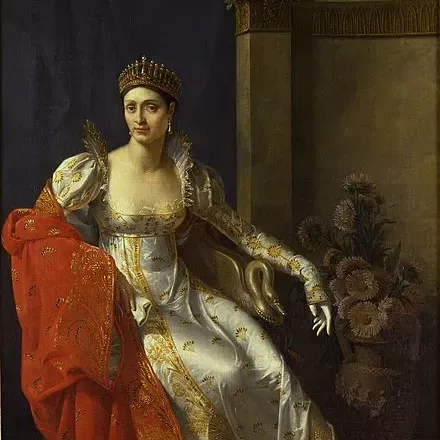
This portrait of Marie-Louise of Austria, second wife of Emperor Napoleon I, by Marie Guilhelmine Benoist, portraitist of Napoleonic high society, is currently the world auction record for the artist.
This can be explained on the one hand by the increase in the artist's rating in general, but also by the sale in which this painting was presented, devoted exclusively to the First Empire.
Presented in a monumental gilded oval frame adorned with two imperial eagles and foliate scrolls, typical of the Empire style, this oil on canvas is a commissioned work produced around 1810-1812, in the context of imperial propaganda and the cult of the dynastic image.
Marie-Louise is depicted in a three-quarter bust, frontal, in a solemn and impassive attitude, which is in keeping with the dignity of her rank. She wears a gold crown inlaid with rubies and pearls, matched with a pair of earrings and a white dress embroidered with bees, also symbols of the Empire.
Her expression is restrained, almost frozen, in the tradition of ceremonial portraiture, which privileges function over individuality.
The treatment of the face is of great finesse : the empress's complexion is pearly, the modelling of the cheekbones is subtle, with a direct yet gentle gaze. The drapery and jewelry are rendered with extreme precision, in a desire for technical demonstration and decorative veracity.
The light is soft, almost glazed, with no marked shadows, contributing to the effect of idealized presence. The frame is an integral part of the portrait, carved in gilded wood, with two imperial eagles facing each other, laurel branches and oak leaves.
It plays a strong symbolic role insofar as it glorifies the sovereign, in direct reference to the Roman Empire (through the eagles) and Napoleonic power. The device transforms the portrait into an imperial reliquary, almost a monarchical icon.
This portrait is a perfect illustration of Marie-Guilhelmine Benoist's role as the regime's official painter, capable of combining neoclassical idealism with political exigency. It bears witness to a period when portraiture became a tool for dynastic legitimization, in a vein quite far removed from the Romantic intimism to come.
The work reflects both Benoist's technical mastery and the formal constraints imposed by the genre of court portraiture, where the painter becomes a mediator of power.
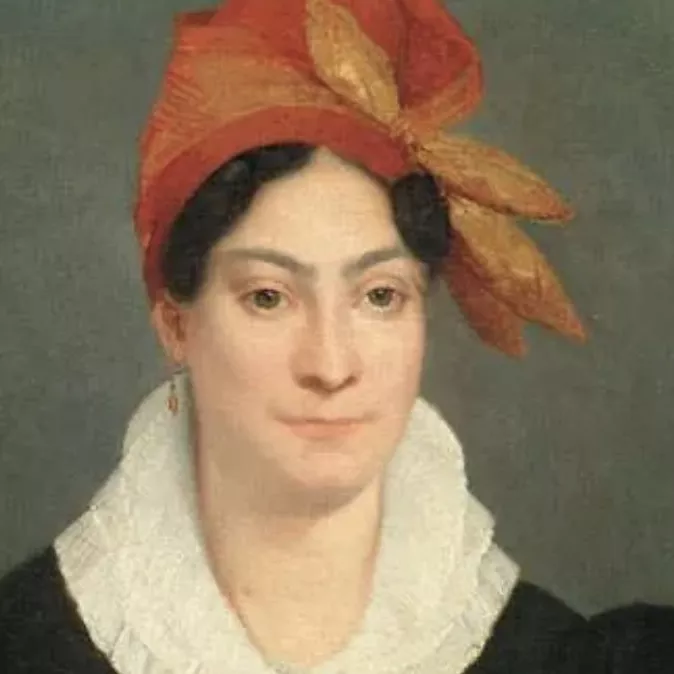
Recognizing the artist's signature
Marie Guilhelmine Benoist doesn't necessarily sign her works. Copies may exist, which is why expertise remains important.
Knowing the value of a work
If you happen to own a work by Marie Guilhelmine Benoist or after the artist, don't hesitate to request a free appraisal using our form on our website.
A member of our team of experts and certified auctioneers will contact you promptly to provide you with an estimate of the market value of your work, as well as ad hoc information about it.
If you are considering selling your work, you will also be accompanied by our specialists in order to benefit from alternatives for selling it at the best possible price, taking into account market inclinations.
Estimate in less than 24h
Discover in the same theme

Value and quotation of works, paintings by Elbridge Ayer Bur...
Burbank was a committed 19th-century American painter and portraitist. Thanks to Auctie's, the value of his works has never been so high.
Learn more >

Rating and value of works, sculptures by Jules Aimé Dalou
Jules Aimé Dalou was a realist sculptor of the 19th century, who produced a number of highly-regarded works that are valued at auction.
Learn more >

Rating and value of paintings by Giuseppe de Nittis
Giuseppe de Nittis is an Italian artist of 19th-century modernity who lives in Paris. His works are highly valued.
Learn more >
Other similar works sold at auction

Estimated 1.000 - 2.000
French school, circa 1860 Presumed portrait of Églé Ney de la Moskowa (1832-1890), Duchess of Persigny

Estimated 500 - 800
Edma MORISOT-PONTILLON (1839-1921) Spectatrice du crépuscule au bord de l'étang Oil on canvas

Estimated 3000€ - 5000€
Entourage of Pierre Révoil (Lyon 1776-1842 Paris) The...

Estimated 4000€ - 6000€
Eugène Isabey (Paris 1803-1886 Montévrain) The return of...

Estimated 1000€ - 2000€
Alexandre CALAME (1810-1864) Peasant woman in front of a house on...

Estimated 1800€ - 2500€
Attributed to Thomas Couture (Senlis 1815 - 1879...

Secure site, anonymity preserved

Auctioneer approved by the State

Free and certified estimates
Frequently asked questions
-
Who was Marie Guilhelmine Benoist, and what is her artistic style?Marie Guilhelmine Benoist (1768–1826) was a French Neoclassical painter and a student of Élisabeth Vigée le Brun and Jacques-Louis David. Her style is characterized by an exceptional mastery of academic drawing, clear lines, understated compositions, and a particular focus on the psychology of her subjects, especially in her portraits of women, which are rendered with restrained grace and emotional depth.
-
What is the price range for works by Marie Guilhelmine Benoist?Marie Guilhelmine Benoist’s works range in price from €100 for watercolor drawings to €300,000 for her most prestigious oil-on-canvas paintings. Her oil paintings generally sell for between €7,900 and €300,000, with a notable upward trend in recent years, particularly for official portraits and historical subjects.
-
How can you authenticate a work by Marie Guilhelmine Benoist?To authenticate a work attributed to Marie Guilhelmine Benoist, we recommend that you request a free, no-obligation appraisal from Auctie's. Our team of experts and state-certified auctioneers will examine your artwork and provide you with a detailed appraisal within 48 hours, confirming the attribution and estimating its market value.
-
Is this the right time to sell a work by Marie Guilhelmine Benoist?Yes, this is an excellent time to sell a work by Marie Guilhelmine Benoist. Her market value is on the rise, particularly for her oil-on-canvas paintings and prestigious portraits. The rediscovery of the artist in the 20th century and the growing interest in female Neoclassical artists are driving sustained demand, particularly among French buyers.
-
How does the process of selling a work of art at Auctie's work?At Auctie's, we support sellers every step of the way, from the free appraisal to the auction. After our certified experts have provided a detailed appraisal of your artwork, we offer you the best options for selling it at the highest possible price, taking into account current market conditions and buyer preferences.
