



Rating and value of drawings and paintings by Gustave Caillebotte

Key takeaways
- Works by Gustave Caillebotte sell for between €600 and €40,166,500, with a record set in 2021 for "Young Man at His Window."
- Major paintings from the 1870s and 1880s dominate the market, selling for between 5 and 25 million euros, while drawings range from 30,000 to 400,000 euros.
- The 2025 exhibition at the Musée d’Orsay and the critical reappraisal of Caillebotte are supporting a sustained upward trend in his market value.
Paintings and drawings by Gustave Caillebotte trade up to €40,166,500 on the auction market. An appraisal enables us to accurately determine the price of your work by Gustave Caillebotte on the current market and to optimize, if necessary, the sale of a work.
If you own a work by Gustave Caillebotte and would like to know its value, our state-approved auctioneers carry out a free appraisal based on authenticity, quotation and recent market results.
Rating and value of the artist Gustave Caillebotte
Gustave Caillebotte is an artist who emerged from Impressionism. His legacy consists mainly of paintings. At present, the prices of his paintings are exploding under the auctioneers' gavel.
His portraits are particularly prized above all by English and American buyers, and the price at which they sell on the art market ranges from €600 to €40,166,500, a considerable delta but one that speaks volumes about the value that can be attributed to Caillebotte's paintings.
In 2021, a painting entitled Jeune homme à sa fenêtre (116 x 81 cm), dating from 1876, sold for €40,166,500.
Order of value ranging from a simple work to the most prestigious
Technique used | Result |
|---|---|
Estamp - multiple | From €8,000 to €10,000 |
Drawing - watercolor | From €17,000 to €760,570 |
Oil on canvas | From €600 to €40,166,500 |
Estimate in less than 24h
Situate the artist
Period
Caillebotte's career spans the second half of the 19th century (1848 - 1894), a period marked by Haussmann's urban transformations and the rise of a visual culture linked to industrial modernity.
This was a time of consolidation and dissemination of Impressionism, in which Caillebotte played an active part from the 1870s, as a painter but also as a patron and exhibition organizer.
Currents
Caillebotte participated in the group's exhibitions, with an interest in scenes of modern life, urban leisure and atmospheric effects, maintaining a smoother facture than Monet or Renoir.
He was also close to modern realism, with a focus on descriptive precision, rigorous perspective and the depiction of the bourgeois classes in their everyday environment.
The artist was also influenced by photography and innovative framing, with oblique compositions, plunging or counter-plunging viewpoints, spatial cut-outs that heralded certain visual research of the end of the century.
.
The life of Gustave Caillebotte
Cultural context
Caillebotte was born in Paris in 1848 into an affluent bourgeois milieu, which enabled him to benefit from a solid artistic training and relative financial independence. He studied law and then painting under Léon Bonnat.
His work is part of the Impressionist movement, while retaining a strong realistic dimension, characterized by a rigorous construction of space and an interest in the effects of perspective and framing.
Entourage
Caillebotte maintained close relations with Claude Monet, whose interest in landscapes and light variations he shared, but also with Renoir and Degas, two major figures of Impressionism.
He is also close to Pissarro and Sisley, participating in a collective dynamic based on pictorial experimentation and the organization of independent exhibitions. He also acquired many works by his contemporaries, which he bequeathed to the State.

Artist's techniques
Gustave Caillebotte's style
The artist occupies a singular position within Impressionism, characterized by a synthesis between descriptive realism and modern perceptive experimentation. He shows a predilection for contemporary urban views.
He makes frequent use of plunging or off-center perspectives, inspired by photographic framing and Japanese aesthetics. His palette is often cold and restrained, contributing to an analytical atmosphere.
Focus on a key work
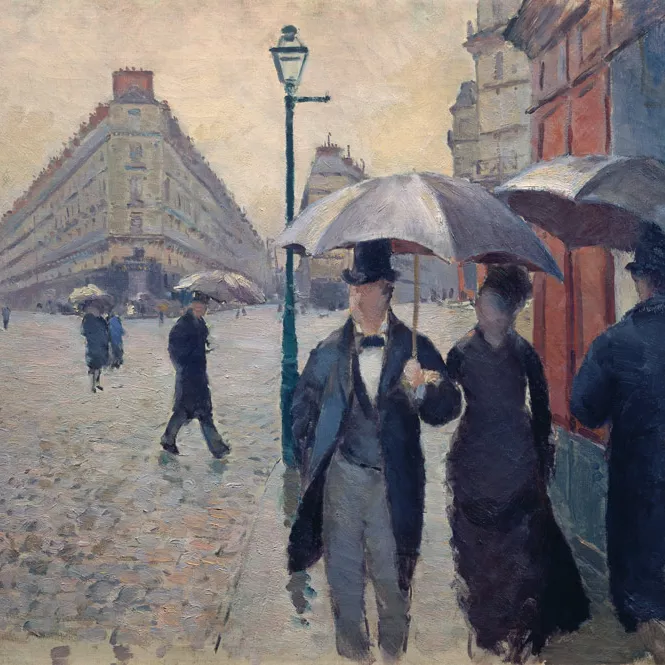
Rue de Paris, temps de pluie (1877)
This composition is based on a rigorously constructed perspective, articulated around a Haussmann crossroads that structures the pictorial space. The framing is asymmetrical and the figures truncated at the margins, evoking a photographic snapshot and a mobile vision of the viewer.
He makes a meticulous treatment of wet surfaces and reflections, showing an almost scientific observation of luminous phenomena. The figures are elegant yet anonymous.
As in many other compositions, the geometric construction is implicit (vanishing lines, architectural verticals) which reinforces visual stability despite the complexity of the scene.
FAQ - How to value a work by Caillebotte ?
1) What stylistic criteria specific to Caillebotte are decisive ?
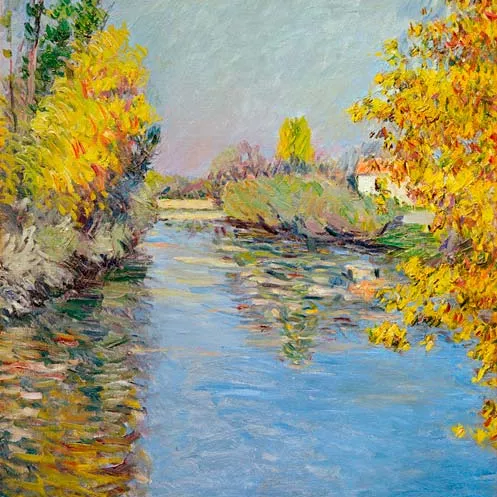
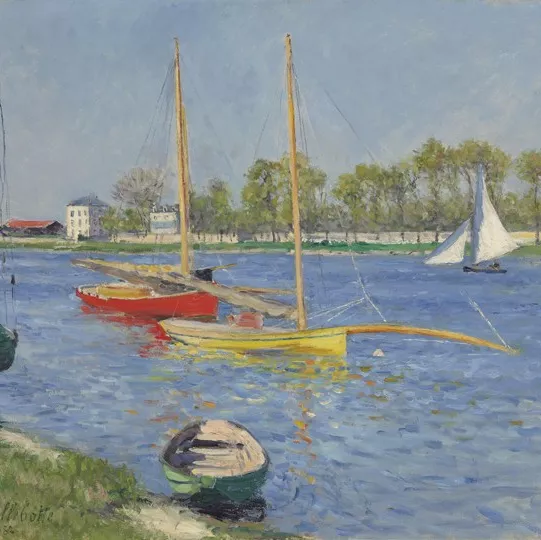
The analysis should focus on the work's place within his Impressionist corpus, particularly the Parisian urban views with their bold perspectives, the scenes of modern life and the compositions linked to the nautical universe.
2) What importance does the period of creation have in the estimation ?
Dating makes it possible to distinguish the great compositions of the 1870s - 1880s, which are associated with Impressionist exhibitions, from later works devoted to landscapes and river themes, whose reception on the market may differ.
3) How does the market influence the estimate ?
The estimate is based on an analysis of the results of comparable public sales, taking into account the rarity of major works in private hands, the growing interest in the figure of Caillebotte in the history of Impressionism, but also the distinction between emblematic works and study works.
Market segmentation and figures
Prices of works
Caillebotte was long perceived as a secondary figure in Impressionism, but for several decades he has been experiencing a critical rereading that supports a structural increase in his valuation.
Paintings are the clearly dominant segment, with auctions generally between 5 and 25 million euros for major compositions, with some emblematic works exceeding 40 million euros.
Drawings and studies form part of a more restricted market, with prices most often fluctuating between €30,000 and €400,000, depending on quality and subject.
Valuation factors
Works from the 1870s concentrate most of the demand, with later or experimental productions remaining valued but at lower levels.
Recent international museum exhibitions (including Orsay in 2025), the critical reappraisal of his role in the history of Impressionism and increased collector interest in the singular figures of the Impressionist group are contributing to a sustained upward trend.
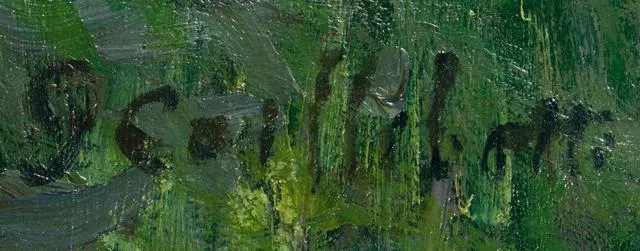
Recognizing Gustave Caillebotte's signature
The artist does not always sign his works. If you think you own one, it's best to have it appraised. The signature may differ depending on the type of work, but paintings are often signed. There are also copies, which is why appraisal is important.
Have your work by Gustave Caillebotte
If you own a work by Gustave Caillebotte, an estimate enables you to assess its value on the current market.
Using our online form, our experts and certified auctioneers will carry out a free appraisal and provide you with a reliable estimate of your work's market value.
If you're considering selling it, we'll work with you to ensure that you get the best value.
.Estimate in less than 24h
Discover in the same theme

Rating and value of works, paintings by Jules Breton
Jules Breton was a 19th-century naturalist and realist painter who produced many valuable and successful works at auction.
Learn more >

Rating and value of works, paintings by Léon Lhermitte
Léon Lhermitte was a 19th-century naturalist painter who produced drawings and oil paintings that are highly prized at auction.
Learn more >

Rating and value of paintings, drawings and engravings by Je...
Jean-François Millet is a twentieth-century naturalist painter quoted on the art market, who has produced works of great value.
Learn more >
Nos records d'enchères à l'hôtel Drouot

Estimated 10.000 - 15.000 €
Ebridge Ayer BURBANK(1858-1949), Young African-American boy, Oil on panel.

Estimated 20.000 - 30.000
EXCEPTIONAL LARGE OVAL DISH IN VINCENNES SOFT PASTE PORCELAIN FROM THE "BLEU CÉLESTE" SERVICE OF KING LOUIS XV AT THE CHÂTEAU DE VERSAILLES

Estimated 20.000 - 30.000
MANUFACTURE ROYALE DE SÈVRES, 18th century "L'Empereur de la Chine" - Portrait of the Emperor Qianlong, Hard porcelain bisque, 1775

Estimated 1.500 - 3.000
HERMÈS, "Kelly" 32 saddle bag in black box calf

Estimated Between €5,000 and €8,000
KRACHKOWSKY (1854-1914), Before the storm, oil on canvas

Estimated 40.000 - 80.000
Alexandre ROUBTZOFF (1884-1949), Portrait of Arbia, oil on canvas

Secure site, anonymity preserved

Auctioneer approved by the State

Free and certified estimates
Frequently asked questions
-
Who is Gustave Caillebotte, and what is his artistic context?Gustave Caillebotte (1848–1894) was a French Impressionist painter who studied law before turning to painting. Active during the second half of the 19th century, he was known for his unique blend of descriptive realism and Impressionism, with a particular fondness for Parisian cityscapes and bold perspectives inspired by photography. A patron of the arts and exhibition organizer, he maintained close relationships with Monet, Renoir, and Degas.
-
What is the price range for Caillebotte's paintings and drawings?Caillebotte's paintings sell for between €600 and €40,166,500, depending on their significance. Major works from the 1870s and 1880s generally sell for between 5 and 25 million euros, while drawings and watercolors range from 30,000 to 400,000 euros. Multiple prints range from €8,000 to €10,000.
-
How can you authenticate a work by Gustave Caillebotte?An appraisal is essential for authenticating a work by Caillebotte, as the artist did not always sign his works and copies exist. Auctie's offers a free, no-obligation appraisal conducted by certified auctioneers and experts, who analyze the work’s authenticity, style, technique, and provenance.
-
Is this the right time to sell a Caillebotte painting?Yes, the market for Caillebotte is experiencing a sustained upward trend. Long regarded as a minor figure in Impressionism, the artist is now benefiting from a favorable critical reappraisal, international museum exhibitions, and growing interest from collectors. These factors are contributing to a structural rise in his market value.
-
How does the appraisal process work at Auctie's, and how do I sell a piece of art?The appraisal is free, with no obligation, and is conducted by a certified expert who will provide you with a reliable valuation within 48 hours. If you’re considering selling, Auctie’s will guide you through the process—from the appraisal to the auction—as an auction house, ensuring you get the best possible price for your artwork.
